
Social Communication Disorder Explained
Updated May 2026
Understand Social Communication Disorder (SCD) and its impact on pragmatic language. Discover how it differs from Autism in our comprehensive expert guide.
Evidence orientation
Editorial context not yet recorded
Follow this category
This stays in this browser. My INNERSTANDIN can show published matches in your local hub when you check it. It does not send email, push, or alert notifications.
Local learning review
A private browser aid for revisiting ideas. It is not an alert or a health recommendation.
Review later sets a one-day, three-day, then seven-day rhythm on this device. Choose it only when you want to revisit this article.
Communication is the bedrock of human interaction. It is the invisible thread that binds our social structures, allows for the exchange of complex ideas, and facilitates the forming of deep emotional bonds. However, for individuals with Social Communication Disorder (SCD), this thread is often frayed or difficult to grasp.
In the United Kingdom, as our understanding of neurodiversity evolves, SCD has emerged as a distinct and significant diagnosis. Often overshadowed by Autism Spectrum Disorder (ASD) or Attention Deficit Hyperactivity Disorder (ADHD), SCD—or Social (Pragmatic) Communication Disorder as it is formally known in the DSM-5—requires its own spotlight. This article provides an authoritative exploration of SCD within the UK context, examining its symptoms, the diagnostic pathway, its relationship with other neurodevelopmental conditions, and the strategies for support.
1. Defining Social Communication Disorder
At its core, Social Communication Disorder is a primary deficit in the "pragmatic" use of language. While a person with SCD may possess a vast vocabulary and perfect grammar, they struggle with the social application of language. They understand what words mean in a literal sense, but they struggle with what words do in a social context.
The Pragmatic Pillar
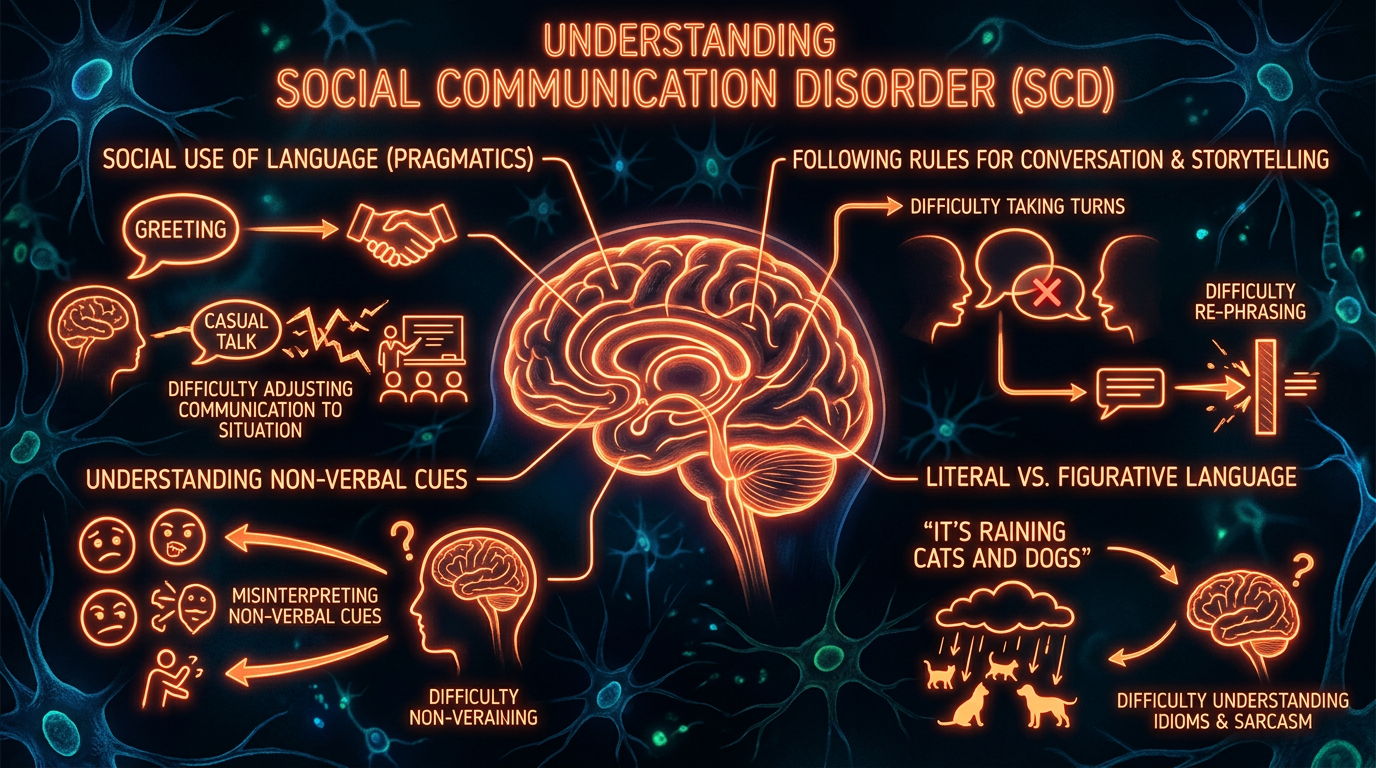
Pragmatics refers to the social rules of language that we often learn intuitively. These include:
- Using language for different purposes: Greeting, informing, demanding, or promising.
- Changing language according to the listener or situation: Speaking differently to a baby than to a boss, or providing background information to a stranger that a friend wouldn't need.
- Following conversational rules: Taking turns in conversation, staying on topic, rephrasing when misunderstood, and using verbal and non-verbal signals (like eye contact and gestures).
For an individual with SCD, these rules are not intuitive; they are like a complex foreign language where the grammar is known, but the cultural nuances are missing.
2. Historical Context and the DSM-5 Shift
To understand SCD, we must look at how diagnostic criteria have changed. Before 2013, many individuals now diagnosed with SCD might have been labelled with "Asperger’s Syndrome" or "Pervasive Developmental Disorder Not Otherwise Specified" (PDD-NOS).
When the American Psychiatric Association updated the Diagnostic and Statistical Manual of Mental Disorders (DSM-5), it consolidated several diagnoses into Autism Spectrum Disorder. However, clinicians recognised a group of individuals who exhibited the social communication challenges of autism but did not display the restricted, repetitive patterns of behaviour or sensory sensitivities required for an ASD diagnosis. Thus, Social (Pragmatic) Communication Disorder was established as a standalone category.
In the UK, the NHS and private practitioners also look toward the ICD-11 (International Classification of Diseases), which similarly recognises "Pragmatic Language Disorder."
3. Core Symptoms and Clinical Presentation
SCD usually manifests in early childhood, though it may not be fully recognised until social demands exceed the individual’s limited capacities (often during the transition to secondary school).
Challenges in Social Interaction
- Literal Interpretation: A hallmark of SCD is difficulty with non-literal language. Sarcasm, idioms ("it’s raining cats and dogs"), and metaphors are often taken at face value, leading to confusion or social embarrassment.
- Difficulty with Inference: They struggle to "read between the lines." If a friend says, "It’s getting a bit late, isn't it?" an individual with SCD might simply agree rather than inferring that the friend wants to go home.
- Inappropriate Responses: They may give responses that are contextually irrelevant or fail to respond to social cues altogether.
Conversational Mechanics
- Monologues: An individual may talk at length about a topic of interest without noticing the listener has lost interest or wants to speak.
- Abrupt Transitions: They may change the subject suddenly without providing a conversational bridge.
- Lack of Repair: When a conversation breaks down or a misunderstanding occurs, the individual may not know how to clarify their meaning or ask for clarification.
Non-Verbal Communication
While the primary deficit is linguistic, non-verbal cues are often affected. This includes:
- Difficulty modulating volume or pitch (prosody).
- Limited or "wooden" facial expressions.
- Struggles with maintaining appropriate eye contact or understanding personal space.
4. The UK Diagnostic Pathway
Navigating the diagnostic process in the UK can be complex, involving the NHS, local authorities, and sometimes private specialists.
The Role of the GP and Health Visitor
In the UK, the journey usually begins with a GP or a Health Visitor (for younger children). If a parent or teacher notices that a child is struggling to make friends or seems "off-beat" in conversations, a referral is made to a specialist.
The Multi-Disciplinary Team (MDT)
A diagnosis of SCD cannot be made in isolation. It requires a multi-disciplinary approach, typically involving:
- Speech and Language Therapists (SLTs): The lead professionals in assessing pragmatic language.
- Paediatricians or Child Psychiatrists: To rule out other medical or neurological conditions.
- Educational Psychologists: To assess how these challenges impact learning and school life.
Assessment Tools
Assessments often involve standardised testing, such as the Clinical Evaluation of Language Fundamentals (CELF) or the Children’s Communication Checklist (CCC-2). Observation in a social setting (like a classroom or playground) is also vital.
The "Postcode Lottery"
It is important to acknowledge that waiting times for neurodevelopmental assessments in the UK can be lengthy. Many families wait 18–24 months for an NHS assessment, leading some to seek private diagnoses. In the UK, a private diagnosis is valid, provided it is conducted by a qualified multi-disciplinary team and adheres to NICE (National Institute for Health and Care Excellence) guidelines.
5. SCD, Autism, and ADHD: The Overlap
One of the most frequent questions from parents and educators is: “How is this different from Autism?”
SCD vs. Autism Spectrum Disorder (ASD)
The defining difference lies in the presence or absence of restricted/repetitive behaviours.
- Autism: Includes social communication deficits plus repetitive movements, rigid routines, highly fixed interests, or sensory sensitivities.
- SCD: Includes social communication deficits without the repetitive behaviours or sensory issues.
If a person meets the criteria for Autism, the Autism diagnosis "trumps" SCD. SCD is only diagnosed when Autism has been ruled out.
SCD and ADHD
There is a significant overlap between ADHD and social communication difficulties. A child with ADHD may interrupt, fail to listen, or miss social cues because of impulsivity or inattention. However, the underlying cause is different.
- In ADHD, the individual often knows the social rule but fails to apply it in the moment due to executive dysfunction.
- In SCD, the individual lacks the underlying understanding of the social rule itself.
It is common for these conditions to be comorbid. A child may have ADHD and SCD simultaneously, requiring a dual-track support plan.
6. Impact on Education: The UK School Context
For a child with SCD, the British school environment is a minefield of "hidden rules."
The Playground vs. The Classroom
A student with SCD might excel in structured classroom settings where the "rules" of engagement are clear: sit down, be quiet, raise your hand. However, the unstructured environment of the playground is where the disorder becomes most apparent. Without the ability to navigate the nuances of group play, negotiation, and "banter," these children often find themselves isolated or the target of bullying.
Special Educational Needs (SEN) Support
In the UK, children with SCD are entitled to support under the SEND Code of Practice.
- SEN Support: The school provides extra help, often involving a Speech and Language Therapist or a Teaching Assistant (TA).
- Education, Health and Care Plan (EHCP): For children with more significant needs, an EHCP is a legal document that outlines the support the local authority must provide. Because SCD affects "communication and interaction," it qualifies as one of the four primary areas of need.
The Role of the SENCO
The Special Educational Needs Co-ordinator (SENCO) is the primary contact for parents. They are responsible for ensuring that "reasonable adjustments" are made under the Equality Act 2010. This might include:
- Visual timetables.
- Social stories to prepare for transitions.
- A "quiet zone" during break times.
7. Support Strategies and Interventions
While there is no "cure" for SCD—nor should there be, given the neurodiversity perspective—there are numerous strategies to help individuals navigate a neurotypical world more effectively.
Speech and Language Therapy (SALT)
SALT is the gold standard for SCD support. Therapy focuses on:
- Social Skills Training (SST): Role-playing social scenarios, such as how to join a group or how to disagree politely.
- Video Modelling: Watching videos of social interactions to identify non-verbal cues and "theory of mind" (understanding what others are thinking).
- Pragmatic Language Groups: Facilitated groups where peers practice conversation in a safe, controlled environment.
Social Stories and Comic Strip Conversations
Developed by Carol Gray, Social Stories help individuals understand the "why" and "how" of social situations through simple, descriptive text and images. Comic Strip Conversations use stick figures and thought bubbles to help the individual "see" what people might be thinking or feeling during an interaction.
Visual Aids and Scaffolding
Using visual supports can reduce the cognitive load of processing spoken language. This can include "Talk Tokens" for turn-taking or visual checklists for "How to Start a Conversation."
The "Double Empathy" Problem
In recent years, the UK neurodiversity movement has championed the "Double Empathy" theory. It suggests that communication breakdowns aren't just the fault of the neurodivergent person; they occur because neurotypical and neurodivergent people have different ways of experiencing the world. Support should involve teaching neurotypical peers to be more direct and literal, rather than placing the entire burden of change on the person with SCD.
8. SCD in Adolescence and Adulthood
As children with SCD enter their teenage years, the social landscape shifts. Conversations become more nuanced, involving sarcasm, dating, and complex social hierarchies.
Mental Health Implications
Adolescents with SCD are at a higher risk for:
- Social Anxiety: Fearing they will say the "wrong thing" leads to withdrawal.
- Depression: Feeling chronically misunderstood or lonely.
- Masking: Attempting to hide their difficulties by mimicking others. Masking is incredibly exhausting and is a leading cause of burnout in neurodivergent adults.
Transition to Higher Education and Employment
The UK’s Equality Act 2010 protects adults with SCD in the workplace. However, the recruitment process—specifically interviews—is often a major barrier. Interviews are essentially high-stakes tests of social pragmatics.
- Adjustments: Employers can offer "work trials" instead of traditional interviews or provide interview questions in advance.
- Clear Communication: In the workplace, SCD individuals benefit from written instructions rather than verbal ones and clear, unambiguous feedback.
9. Living with SCD: The Adult Perspective
Many adults in the UK are only now receiving diagnoses of SCD, often after their own children are diagnosed with neurodevelopmental conditions.
Self-Advocacy
For an adult, understanding the SCD profile can be a moment of profound "lightbulb" clarity. It explains a lifetime of "feeling like an alien" or "missing the memo." Self-advocacy involves:
- Learning to say, "I struggle with sarcasm; please tell me directly what you need."
- Identifying environments that are socially overwhelming and allowing for "downtime."
- Seeking out neurodivergent-friendly social groups where literal communication is the norm.
Relationships and Intimacy
Pragmatic language is the lifeblood of romantic relationships. Partners of those with SCD may feel their loved one is "blunt" or "unemotional." Couples therapy with a therapist who understands neurodiversity can help bridge the gap, teaching both partners how to communicate their needs explicitly.
10. The Role of Technology and the Future
We are entering an era where technology offers new avenues for support.
- AI and LLMs: Large Language Models (like the one writing this article) can be used by individuals with SCD to "practice" conversations or to "translate" an ambiguous email into literal terms.
- Wearable Tech: Some researchers are exploring wearables that can provide real-time feedback on vocal tone or social cues, though this remains a point of ethical debate within the neurodiversity community.
Moving Toward Acceptance
The UK is slowly shifting from a "medical model" (which sees SCD as a deficit to be fixed) to a "social model" (which sees it as a difference to be accommodated). The goal of intervention is not to make the individual "normal," but to give them the tools to navigate the world without losing their identity.
11. Advice for Parents and Carers in the UK
If you suspect your child has Social Communication Disorder, the following steps are recommended:
- Keep a Diary: Note specific examples of where communication breaks down. Does the child take things literally? Do they struggle with turn-taking?
- Speak to the Teacher: Ask if these behaviours are mirrored in school.
- Request a SALT Assessment: You can often self-refer to NHS Speech and Language services, though a GP referral is usually faster.
- Connect with Charities: Organisations like I CAN (the children’s communication charity), Afasic, and the National Autistic Society provide invaluable resources and support networks for UK families.
- Focus on Strengths: Individuals with SCD are often incredibly honest, detail-oriented, and possess a unique perspective on the world. Celebrate their literal thinking—it often leads to great clarity and integrity.
Conclusion
Social Communication Disorder is more than just "being shy" or "socially awkward." It is a specific neurodevelopmental challenge that affects the very way a person processes the social world. In the UK, while the diagnostic pathway can be arduous, the increasing recognition of SCD within the education and healthcare systems is a positive step forward.
By fostering an environment of "explicit communication"—where we say what we mean and mean what we say—we don't just help those with SCD; we make communication clearer and more accessible for everyone. Understanding SCD is about recognising that while we may speak different social languages, the desire to connect remains universal.
For the individual with SCD, the world is a puzzle of unwritten rules. Our job as a society, as educators, and as family members is to help provide the key to those rules, ensuring that no one is left out of the conversation.
Key Terms Reference (UK Context):
- Pragmatics: The social use of language.
- SALT / SLT: Speech and Language Therapy / Therapist.
- SEND: Special Educational Needs and Disabilities.
- EHCP: Education, Health and Care Plan (Legal support document).
- SENCO: Special Educational Needs Co-ordinator (School-based lead).
- NICE: National Institute for Health and Care Excellence (Sets clinical standards).
- ICD-11: International Classification of Diseases (WHO manual used in the UK).
- Equality Act 2010: UK law protecting against disability discrimination.
This article is provided for informational and educational purposes only. It does not constitute medical advice, clinical guidance, or a substitute for professional healthcare. Information reflects cited research at time of publication. Always consult a qualified healthcare professional before acting on any health information.
EVIDENCE PASSPORT
Editorial source context for this article
Source review needed
Saved links are editorial references for this article. They may support specific claims rather than every sentence. Open and assess each source in context. This passport does not independently verify them.
Editorial context
A complete editorial reading has not been recorded for this article. Source links remain available for you to open and assess directly.
Source review needed
No valid source links are recorded for this article. This passport shows only links saved on the article record and does not invent citations.
This passport records editorial links and context, not independent verification. Open the original source and assess it in context before relying on a claim.
Medical Disclaimer
The information in this article is for educational purposes only and does not constitute medical advice, diagnosis, or treatment. Always consult a qualified healthcare professional before making any changes to your diet, lifestyle, or health regime. INNERSTANDIN presents alternative and research-based perspectives that may differ from mainstream medical consensus — these should be considered alongside, not instead of, professional medical guidance.
Read Full DisclaimerContinue the thread
Keep this question moving.
Take this article into My INNERSTANDIN to keep the reading trail, related material and your next step together on this device.
Explore this in the Body Map
See where this hits your biology. Interactive anatomy, threats, and protective protocols.
Dig deeper in the Library
Free, longform PDF volumes that go beyond headlines into mechanisms and references.