
The Bromine Exchange: Why Iodine Deficiency is an Engineered UK Crisis
Updated May 2026
The UK is one of the most iodine-deficient nations, exacerbated by high environmental bromine levels in furniture and bread. We explain the halide displacement theory and its catastrophic impact on thyroid hormone synthesis.
Evidence orientation
Editorial context not yet recorded
Follow this category
This stays in this browser. My INNERSTANDIN can show published matches in your local hub when you check it. It does not send email, push, or alert notifications.
Local learning review
A private browser aid for revisiting ideas. It is not an alert or a health recommendation.
Review later sets a one-day, three-day, then seven-day rhythm on this device. Choose it only when you want to revisit this article.
Overview
For decades, the United Kingdom has been sleepwalking into a public health catastrophe. While the mainstream medical establishment fixates on macronutrient ratios and caloric deficits, a more insidious biochemical hijacking is taking place within the endocrine systems of the British population. We are currently witnessing the results of a systemic, and arguably engineered, iodine deficiency—a crisis exacerbated by the pervasive saturation of bromine in our immediate environment.
Iodine is not merely a "trace mineral" required for basic metabolic function; it is the master architect of vertebrate evolution. Every single cell in the human body possesses a requirement for iodine, yet the UK remains one of the few developed nations without a mandatory salt iodisation programme. This policy vacuum has left the population vulnerable to the Halide Displacement Theory, a biochemical phenomenon where toxic halides—specifically bromine, fluorine, and chlorine—displace iodine from its essential receptors.
The result is "The Bromine Exchange." As our environmental exposure to brominated flame retardants (BFRs) in furniture and textiles has surged—thanks to some of the most stringent and arguably lobby-driven fire safety laws in the world—our biological stores of iodine have plummeted. This article serves as a technical exposé on the mechanisms of this displacement, the failure of UK public health policy, and the biological roadmap for reclaiming thyroid sovereignty.
Fact: The UK is now ranked among the top ten iodine-deficient nations globally, alongside several developing countries, according to data from the World Health Organisation (WHO).
##
The Biology — How It Works
To understand the Bromine Exchange, one must first grasp the intricate machinery of the thyroid gland and the Sodium-Iodide Symporter (NIS). The thyroid is a butterfly-shaped endocrine organ that acts as the body's metabolic thermostat. Its primary function is the synthesis of thyroid hormones: Thyroxine (T4) and Triiodothyronine (T3).
The numbers "3" and "4" in these hormones refer specifically to the number of iodine atoms attached to the tyrosine backbone. Without iodine, these hormones cannot exist. The process begins with the "trapping" of inorganic iodide from the bloodstream. This is achieved via the NIS, a transmembrane protein located on the basolateral membrane of thyroid follicular cells.
The HPT Axis and Feedback Loops
The synthesis of these hormones is governed by the Hypothalamus-Pituitary-Thyroid (HPT) axis. When circulating levels of T4 and T3 drop, the hypothalamus releases Thyrotropin-Releasing Hormone (TRH), which signals the anterior pituitary to secrete Thyroid-Stimulating Hormone (TSH). TSH then stimulates the NIS to pull more iodine into the thyroid.
However, the NIS is not exclusively selective for iodine. It is designed to transport monovalent anions of a specific size and charge. This is the "Achilles' heel" of human endocrinology.
The Role of Organification
Once inside the follicular cell, iodide must undergo organification. The enzyme Thyroid Peroxidase (TPO) oxidises iodide to iodine and attaches it to a protein called thyroglobulin. This creates monoiodotyrosine (MIT) and diiodotyrosine (DIT). The coupling of these molecules forms T4 (DIT + DIT) or T3 (MIT + DIT). If the system is flooded with competing halides, this assembly line grinds to a halt, producing "hormone-like" molecules that lack biological activity but still occupy receptor sites.
##
Mechanisms at the Cellular Level
The Halide Displacement Theory is based on the periodic table of elements. Iodine, bromine, fluorine, and chlorine all belong to Group 17: The Halogens. Elements within the same group share similar chemical properties and valence electron configurations.
Competitive Inhibition
In chemistry, elements with a smaller atomic radius and higher electronegativity can often displace those lower down in the same group. While iodine is the most biologically essential, it is also the largest and least electronegative of the common halogens.
- Fluorine (Atomic Weight 18.9)
- Chlorine (Atomic Weight 35.4)
- Bromine (Atomic Weight 79.9)
- Iodine (Atomic Weight 126.9)
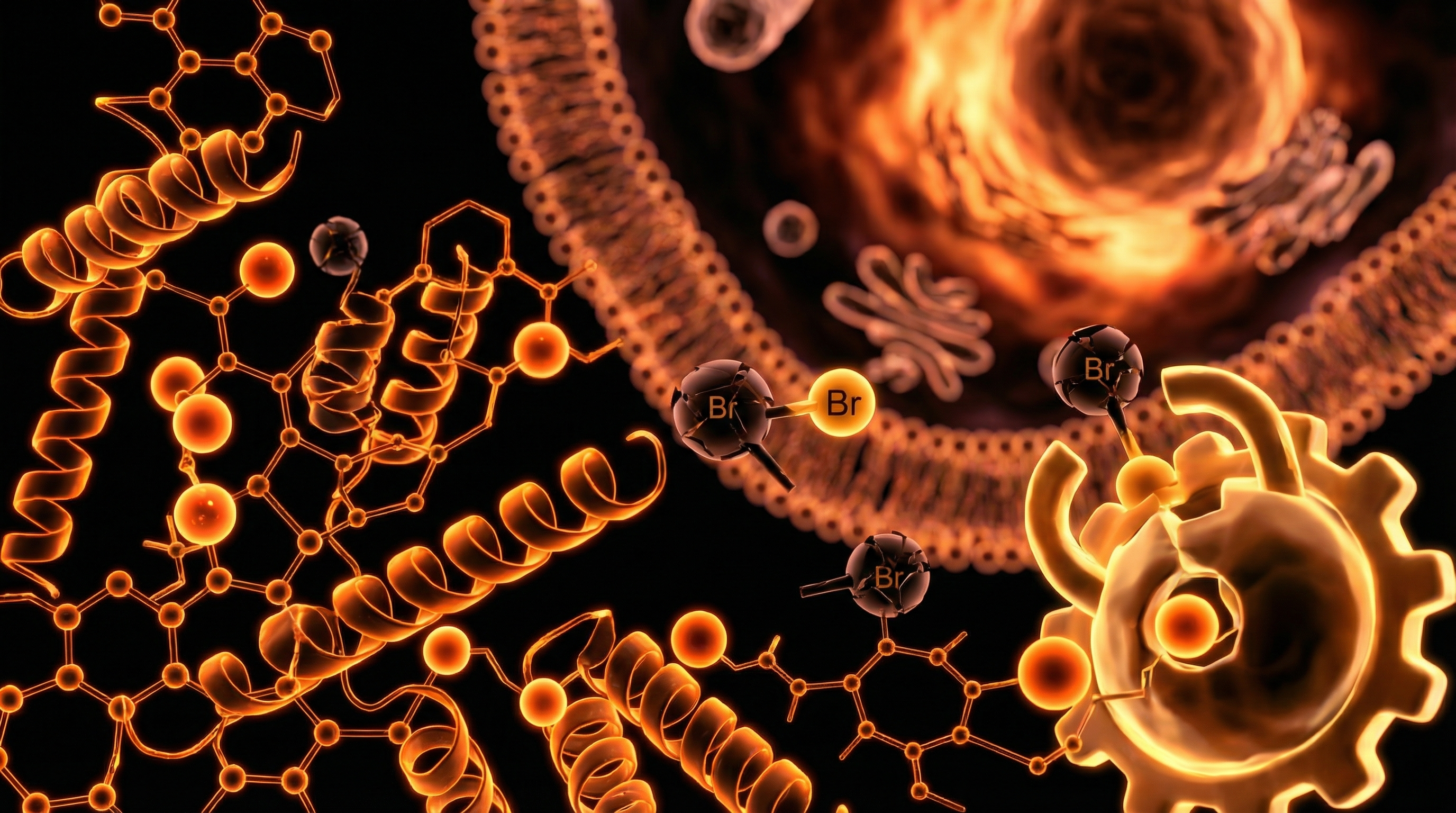
Bromine, being smaller and more reactive than iodine, can effectively "mimic" iodine at the NIS. When the body is saturated with bromine, the NIS becomes congested with bromine atoms. This is known as competitive inhibition. The thyroid "thinks" it is uptaking iodine, but it is actually sequestering a toxic halide that it cannot use for hormone synthesis.
The NIS Gatekeeper Failure
The NIS is found not only in the thyroid but also in the salivary glands, the gastric mucosa, the lactating mammary glands, and the choroid plexus of the brain. This means that bromine displacement doesn't just cause "low thyroid"—it causes systemic iodine starvation. In the breast tissue, the absence of iodine leads to the formation of fibrocystic structures, as iodine is required to maintain the architectural integrity of the ductal epithelium.
Mitochondrial Interference
Furthermore, iodine is crucial for mitochondrial function. It acts as an antioxidant within the mitochondria, protecting the delicate electron transport chain from oxidative stress. Bromine, conversely, induces lipid peroxidation and depletes cellular glutathione. When bromine replaces iodine in the mitochondrial membrane, the cell’s ability to produce Adenosine Triphosphate (ATP) is compromised, leading to the profound, "unexplained" fatigue characteristic of the modern UK workforce.
Statistic: Research indicates that bromine can reduce the iodine uptake of the thyroid by up to 33%, even when iodine intake is considered "adequate" by RDA standards.
##
Environmental Threats and Biological Disruptors
The "Engineering" of the UK’s iodine crisis is most visible in our unique environmental landscape. While many nations have moved away from brominated compounds, the UK has doubled down through specific regulatory frameworks.
The Furniture and Furnishings (Fire Safety) Regulations 1988
The UK has the highest usage of Brominated Flame Retardants (BFRs) in the world for domestic furniture. Polybrominated diphenyl ethers (PBDEs) are applied to sofas, carpets, curtains, and mattresses. These chemicals are not chemically bound to the fabric; they "off-gas" into the air and accumulate in household dust.
As we breathe or ingest this dust, bromine enters the bloodstream. Studies have shown that UK citizens have significantly higher levels of PBDEs in their breast milk and blood serum compared to their European counterparts. This creates a state of chronic, low-level bromine poisoning that effectively locks iodine out of the body.
The Bread Connection: Potassium Bromate
Historically, iodine was used as a "dough conditioner" in the baking industry (as potassium iodate). In a move that defies biological logic, the industry shifted toward potassium bromate. While the UK and EU have technically banned potassium bromate in flour, bromine is still extensively used in the form of brominated vegetable oils (BVO) in certain soft drinks and as a "processing aid" in various imported foodstuffs. Furthermore, the legacy of methyl bromide as a soil fumigant means that many non-organic crops still carry a bromine load.
Water Fluoridation and Chlorination
The UK’s tap water is a "halide soup." With many regions undergoing mandatory water fluoridation and the universal use of chlorine for disinfection, the British public is constantly ingesting two other iodine-displacing halogens. Fluoride is particularly aggressive; it is the most electronegative element in existence and has a documented affinity for the thyroid and pineal glands.
Pesticides and Plastics
Many modern pesticides are "organobromines." These are used in large-scale agriculture and end up in the food chain. Additionally, certain plastics and consumer electronics use bromine as a stabiliser. We are, quite literally, living in a "Bromine Age."
##
The Cascade: From Exposure to Disease
When the Bromine Exchange takes hold, the physiological consequences ripple through every organ system. This is not a single disease, but a "syndrome of deficiency and toxicity."
Hypothyroidism and "Type 2" Hypothyroidism
Standard TSH testing often fails to catch this crisis. A patient may have "normal" TSH levels, but their cells are suffering from peripheral thyroid hormone resistance. Because bromine has altered the shape or function of the thyroid receptors on the cell nucleus, the T4 and T3 (even if present) cannot "dock" correctly. This leads to:
- Persistent weight gain and inability to lose fat.
- Brain fog and cognitive decline (the "Iodine-Deficient Brain").
- Depression and anxiety (T3 is a potent modulator of serotonin and norepinephrine).
- Cold intolerance and low basal body temperature.
The Reproductive Crisis
Iodine is a "desensitiser" of estrogen receptors. In its absence, the body becomes hypersensitive to estrogen (Estrogen Dominance). This is a primary driver behind the UK’s soaring rates of Endometriosis, PCOS (Polycystic Ovary Syndrome), and Fibrocystic Breast Disease.
In men, iodine deficiency in the prostate gland—which also contains a high concentration of NIS—is linked to Benign Prostatic Hyperplasia (BPH) and prostate cancer. The Bromine Exchange effectively removes the "braking system" for reproductive tissue growth.
The Developmental Toll
The most tragic aspect of the UK iodine crisis is its impact on the next generation. Iodine is essential for the myelination of the central nervous system in the foetus. Low maternal iodine (caused by bromine displacement) is directly correlated with a reduction in the child’s IQ.
Critical Fact: A study by the University of Surrey and Bristol University found that over 60% of UK schoolgirls were iodine deficient, warning that this could result in a "diminished cognitive potential" for the nation’s future children.
##
What the Mainstream Narrative Omits
The question must be asked: Why is this not headline news? Why are UK doctors not routinely testing for iodine or bromine toxicity? The answer lies in the Wolff-Chaikoff Effect and a century of medical "iodophobia."
The Wolff-Chaikoff Myth
In 1948, researchers Wolff and Chaikoff published a paper claiming that increasing iodine intake would shut down the thyroid gland. This "effect" was based on a flawed study of rats and has never been replicated in humans under normal conditions. Yet, it became the foundation of modern RDA (Recommended Dietary Allowance) levels.
The current UK RDA for iodine is roughly 150 micrograms (mcg). This is the bare minimum required to prevent a goitre (a visible swelling of the thyroid). It is nowhere near the amount required for whole-body iodine sufficiency or for the "flushing" of toxic bromine.
The Japanese Paradox
Mainstream nutritionists often warn that "too much iodine is dangerous." However, the Japanese population, which consumes an average of 3,000 to 13,000 mcg (3-13mg) of iodine daily via seaweed, has some of the lowest rates of thyroid disease, breast cancer, and prostate cancer in the world. They also have among the highest average IQs. The UK narrative ignores this data because it contradicts the low-dose RDA model that allows the Bromine Exchange to continue unchecked.
The Failure of TSH Testing
The UK's reliance on TSH (Thyroid Stimulating Hormone) as the "gold standard" for thyroid health is a systemic failure. TSH is a pituitary hormone, not a thyroid hormone. It does not measure:
- Intracellular T3 levels.
- Bromine-to-Iodine ratios.
- Thyroid peroxidase antibodies (TPOAb).
- Reverse T3 (a "brake" hormone that increases during stress and toxicity).
By the time TSH is elevated, the patient has already been in a state of cellular iodine starvation for years.
##
The UK Context
The UK is uniquely positioned as a "Perfect Storm" for iodine deficiency. Several factors make the British context more severe than that of the US or mainland Europe.
1. The Absence of Salt Iodisation
In the early 20th century, many countries (such as Switzerland and the USA) noticed a "Goitre Belt" and mandated the addition of iodine to table salt. The UK did not. Instead, the UK relied on an "accidental" source of iodine: Dairy.
In the 1930s, UK farmers began using iodine-based disinfectants for cow udders and adding iodine to cattle feed. This made milk a primary source of iodine for the British public. However, this "system" is now failing because:
- The rise of "plant-based" milk alternatives (almond, oat, soy) which are often not fortified with iodine.
- Changes in farming practices that reduce iodine use.
- The trend toward "organic" milk, which has been shown in studies to contain significantly less iodine than conventional milk.
2. The UK Fire Safety "Trap"
As mentioned, the UK's 1988 Fire Safety Regulations are some of the strictest in the world. While intended to save lives from fires, they have created a chronic toxicity problem. Because the UK is an island with a legacy of textile manufacturing, the lobbying power of chemical flame retardant manufacturers has been historically strong. This has resulted in a domestic environment saturated with bromine that is virtually impossible to avoid without deliberate intervention.
3. Geography and the "Goitre Belt"
Large swathes of the UK—including the Peak District, the Cotswolds, and North Wales—are "iodine-poor" regions where the soil has been leached of minerals over millennia. Historically, "Derbyshire Neck" was a common term for goitre. Despite this known geographical deficiency, there is still no national fortification strategy beyond the haphazard dairy model.
##
Protective Measures and Recovery Protocols
Reversing the Bromine Exchange requires more than just "eating more seaweed." It requires a strategic, bio-chemical "unseating" of bromine and the restoration of the iodine-to-halide balance.
1. Functional Testing
Standard NHS blood tests are insufficient. To truly assess the Bromine Exchange, one should consider:
- Urinary Iodine Loading Test: A 24-hour urine collection after a loading dose of iodine. If the body retains most of the iodine, it indicates a deep tissue deficiency.
- Bromine/Fluoride/Chlorine Clearance: Measuring the excretion of toxic halides in the urine.
- Basal Body Temperature: A low waking temperature (below 36.5°C) is often a more accurate indicator of thyroid function than a TSH test.
2. The Protocol: Lugol’s Iodine
The gold standard for iodine supplementation is Lugol's Solution, which contains both molecular iodine and potassium iodide. This is crucial because different tissues prefer different forms. The thyroid prefers iodide, while the breast and prostate tissue prefer iodine.
Note: Supplementation must be done under the guidance of a functional medicine practitioner, as the "detox" can be intense.
3. The Salt Flush and Bromine Detox
As iodine begins to displace bromine, the bromine is released into the bloodstream. This can cause "bromide acne," headaches, irritability, and metallic taste—often mistaken for an "allergic reaction" to iodine.
- The Salt Flush: Consuming a half-teaspoon of high-quality sea salt (unrefined) in water can help the kidneys flush the released bromine more efficiently. The chloride in the salt competes with the bromine for reabsorption in the renal tubules.
4. Essential Co-factors
Iodine cannot work in a vacuum. To prevent the "oxidation" of the thyroid gland, specific co-factors are required:
- Selenium: Essential for the conversion of T4 to T3 and for the production of glutathione peroxidase, which protects the thyroid from the hydrogen peroxide produced during iodine organification.
- Magnesium: Required for the ATP-driven NIS pump.
- Vitamin C: Supports the NIS and helps repair damaged symporters.
- Vitamin B2 (Riboflavin) and B3 (Niacin): Necessary for the "redox" reactions that power thyroid hormone synthesis.
5. Environmental Mitigation
- Filtration: Use a high-quality water filter that specifically removes fluoride and chlorine (e.g., Reverse Osmosis or specialized gravity filters).
- Dust Control: Use a HEPA-filter vacuum and wet-dusting techniques to remove brominated flame retardant particles from the home.
- Organic Produce: Switch to organic grains and vegetables to avoid brominated pesticides.
- Textile Choices: When possible, choose natural fibres (wool, cotton, linen) that have not been treated with brominated chemicals.
##
Summary: Key Takeaways
The UK iodine crisis is not a mystery; it is a predictable outcome of chemical saturation and nutritional negligence. By understanding the Bromine Exchange, we can move beyond the "one-size-fits-all" model of thyroid health.
- The Displacement: Bromine, fluorine, and chlorine are "hijacking" our thyroid receptors via the Sodium-Iodine Symporter (NIS).
- The UK Factor: High BFR usage and lack of salt iodisation make the UK a global outlier in iodine deficiency.
- Systemic Impact: Iodine deficiency is a major driver of the UK’s epidemics of obesity, "brain fog," and reproductive cancers.
- The Solution: We must move beyond the goitre-prevention RDA (150mcg) and towards therapeutic levels that allow for the detoxification of environmental bromine.
- Holistic Recovery: Success requires a combination of Lugol’s iodine, co-factors like selenium, and "salt loading" to safely flush toxic halides from the system.
The "Bromine Exchange" is a silent thief of British vitality. Reclaiming our health requires us to look past the mainstream narrative and restore the elemental balance that our biology demands. Iodine is not just a nutrient; it is the chemical key to human intelligence and metabolic integrity. It is time we took it back.
This article is provided for informational and educational purposes only. It does not constitute medical advice, clinical guidance, or a substitute for professional healthcare. Information reflects cited research at time of publication. Always consult a qualified healthcare professional before acting on any health information.
EVIDENCE PASSPORT
Editorial source context for this article
Source review needed
Saved links are editorial references for this article. They may support specific claims rather than every sentence. Open and assess each source in context. This passport does not independently verify them.
Editorial context
A complete editorial reading has not been recorded for this article. Source links remain available for you to open and assess directly.
Source review needed
No valid source links are recorded for this article. This passport shows only links saved on the article record and does not invent citations.
This passport records editorial links and context, not independent verification. Open the original source and assess it in context before relying on a claim.
Medical Disclaimer
The information in this article is for educational purposes only and does not constitute medical advice, diagnosis, or treatment. Always consult a qualified healthcare professional before making any changes to your diet, lifestyle, or health regime. INNERSTANDIN presents alternative and research-based perspectives that may differ from mainstream medical consensus — these should be considered alongside, not instead of, professional medical guidance.
Read Full DisclaimerContinue the thread
Keep this question moving.
Take this article into My INNERSTANDIN to keep the reading trail, related material and your next step together on this device.
Explore this in the Body Map
See where this hits your biology. Interactive anatomy, threats, and protective protocols.
Dig deeper in the Library
Free, longform PDF volumes that go beyond headlines into mechanisms and references.