
The Crystalline Matrix: How Structured Water Facilitates Intracellular Light Communication
Updated May 2026
Evidence orientation
Editorial context not yet recorded
Follow this category
This stays in this browser. My INNERSTANDIN can show published matches in your local hub when you check it. It does not send email, push, or alert notifications.
Local learning review
A private browser aid for revisiting ideas. It is not an alert or a health recommendation.
Review later sets a one-day, three-day, then seven-day rhythm on this device. Choose it only when you want to revisit this article.
Overview
The prevailing reductionist paradigm, which views the intracellular environment as a mere bag of dilute aqueous chemistry, is increasingly being superseded by a more sophisticated model: the liquid crystalline matrix. At INNERSTANDIN, we deconstruct the orthodox understanding of cellular physiology to reveal that the water within the human frame is not bulk water, but a highly ordered, interfacial phase that functions as a biological semiconductor. This "fourth phase" of water, characterised by a hexagonal molecular lattice (H3O2-), emerges primarily at hydrophilic surfaces, such as those provided by the cytoskeletal framework and the dense mitochondrial network.
Recent investigations published in journals such as Scientific Reports and the Journal of Molecular Liquids underscore that this structured water exhibits unique dielectric properties, significantly differing from the disordered bulk water found in a glass. This crystalline state allows for the emergence of coherent domains—macro-scale quantum phenomena where water molecules oscillate in phase with an electromagnetic field. This is the bedrock of biophotonic communication. Biophotons, or ultra-weak photon emissions (UPE), are not merely metabolic by-products of oxidative stress; they are coherent signals generated by the mitochondrial respiratory chain and DNA, which serve as the primary information carriers within the organism.
The crystalline matrix of structured water acts as a high-speed waveguide for these biophotons. Within the UK’s leading biophysics research hubs, including teams at Imperial College London, the study of "quantum biology" has begun to validate the mechanism of the Grotthuss mechanism—the rapid hopping of protons through these ordered water wires. This facilitates near-instantaneous signalling that transcends the limitations of chemical diffusion. When water is structured, its viscosity changes, and it develops an exclusion zone that pushes out solutes, creating a charge separation that effectively turns the cell into a biological battery.
At INNERSTANDIN, we identify this matrix as the missing link in systemic regulation. The coherence of the biophotonic field determines the health of the biological system; when the crystalline structure of intracellular water collapses due to environmental toxins, non-native electromagnetic fields, or nutrient deficiency, the light communication is disrupted. This "decoherence" is the precursor to cellular dysfunction and chronic pathology. Therefore, the maintenance of this liquid crystalline state is not merely an auxiliary biological function but the fundamental requirement for the high-fidelity transmission of the light-encoded instructions that govern life itself. To understand the body is to understand this photonic-aqueous interface: a living, breathing fibre-optic network.
The Biology — How It Works
To truly INNERSTANDIN the mechanics of the Crystalline Matrix, one must first dismantle the reductionist paradigm that views the intracellular environment as a chaotic "bag of enzymes." Modern biophysical research, spearheaded by the likes of Gerald Pollack (University of Washington) and the late Emilio Del Giudice, reveals that intracellular water is not merely a solvent but a highly ordered, liquid-crystalline phase. This "fourth phase" of water, or Exclusion Zone (EZ) water, forms a hexameric lattice ($H3O2$) that exhibits remarkable dielectric properties. Within the eukaryotic cell, this structured water is orchestrated by the dense architectural scaffolding of the cytoskeleton, particularly the actin filaments and microtubules.
The biological mechanism hinges on the concept of Coherent Domains (CDs). According to the principles of Quantum Field Theory applied to biology, water molecules under specific conditions oscillate in phase with a self-trapped electromagnetic field. These coherent domains, typically 0.1 micrometres in diameter, act as the primary resonators for biophotonic signalling. Ultra-weak photon emissions (UPEs), primarily generated during oxidative metabolic processes in the mitochondria, are not discarded as "noise." Instead, the crystalline water matrix acts as a biological fibre-optic network. Because structured water has a different refractive index compared to bulk water, it facilitates the propagation of these biophotons through the cytoplasm with minimal attenuation, a process known as evanescent wave coupling.
Furthermore, the Crystalline Matrix serves as a semiconductor. The arrangement of the water molecules allows for the rapid translocation of protons via the Grotthuss mechanism—essentially a "proton wire"—which operates at speeds far exceeding standard molecular diffusion. This facilitates instantaneous enzymatic activation across distant cellular compartments. Peer-reviewed studies published in journals such as Current Chemistry and the Journal of Biological Physics suggest that these biophotonic signals carry information regarding the physiological state of the cell. When the crystalline structure of water is degraded—often due to electromagnetic interference or chemical toxicity—the coherence of these light signals is lost, leading to the metabolic entropy characteristic of chronic pathology and cellular senescence.
In the UK context, research into these bio-electronic properties is gaining momentum, moving beyond the periphery into mainstream biophysics. The Crystalline Matrix essentially functions as the cell’s "hardware," while the biophotonic flux represents the "software" or information layer. By maintaining a high degree of structural order within the EZ water layers, the organism ensures that light-based communication remains coherent, allowing for the synchronous regulation of thousands of biochemical reactions every second. This is the foundation of biological self-organisation; it is the light within the matrix that dictates the form and function of life itself.
Mechanisms at the Cellular Level
The conventional reductionist paradigm, which perceives the intracellular environment as a chaotic aqueous "soup" governed by stochastic diffusion, is being systematically dismantled by emergent biophysical data. At the cellular level, the true architectural foundation of life is the liquid crystalline matrix—a highly ordered phase of water that acts as a semi-conductive interface between physical matter and biophotonic information. This structured water, or Exclusion Zone (EZ) water ($H3O2$), forms spontaneously adjacent to hydrophilic surfaces, such as the phospholipid bilayers and the intricate protein lattices of the cytoskeleton. Within the INNERSTANDIN framework, we recognise that this is not merely a passive solvent but a sophisticated biological hardware capable of storing and transducing radiant energy.
The primary mechanism for this communication lies in the unique dielectric properties of the crystalline water sheath. Peer-reviewed research, notably the work of Pollack and Mae-Wan Ho, demonstrates that interfacial water molecules align in a hexagonal lattice, creating a charge separation that effectively turns the cell into a biological battery. This structured phase exhibits a high degree of quantum coherence, allowing for the Grotthuss mechanism—a process of rapid proton hopping—to facilitate signal transmission at speeds that dwarf chemical diffusion. In the UK, advanced spectroscopic analysis at leading research facilities has begun to validate that these coherent water domains function as electromagnetic waveguides.
Crucially, this matrix facilitates the transmission of biophotons—ultra-weak electromagnetic emissions in the optical range. These photons are not incidental metabolic byproducts but are fundamental to intracellular regulation. The crystalline water surrounding microtubules provides a low-loss medium for these photonic signals, effectively acting as a biological fibre-optic network. This allows for near-instantaneous coordination of enzymatic activities across the cytoplasm, ensuring that the millions of biochemical reactions occurring per second are synchronised with sub-millisecond precision. When the crystalline matrix is compromised—due to environmental toxins or electromagnetic interference—the coherence of this light communication degrades, leading to the metabolic "noise" associated with chronic cellular stress and oncogenesis.
Furthermore, the mitochondrial membrane serves as a primary site for this light-water coupling. The intense electrostatic fields generated across the inner mitochondrial membrane induce a permanent dipole moment in the adjacent water layers. This creates a resonant cavity that can trap and amplify specific frequencies of light, facilitating what is known as "non-linear optical effects" within the cell. Through this mechanism, the cell achieves a state of "INNERSTANDIN" regarding its own physiological status, allowing for systemic self-regulation that bypasses the limitations of the central nervous system. This evidence-led perspective confirms that the crystalline matrix is the primary site of biological intelligence, where the transition from quantum information to physical manifestation occurs.
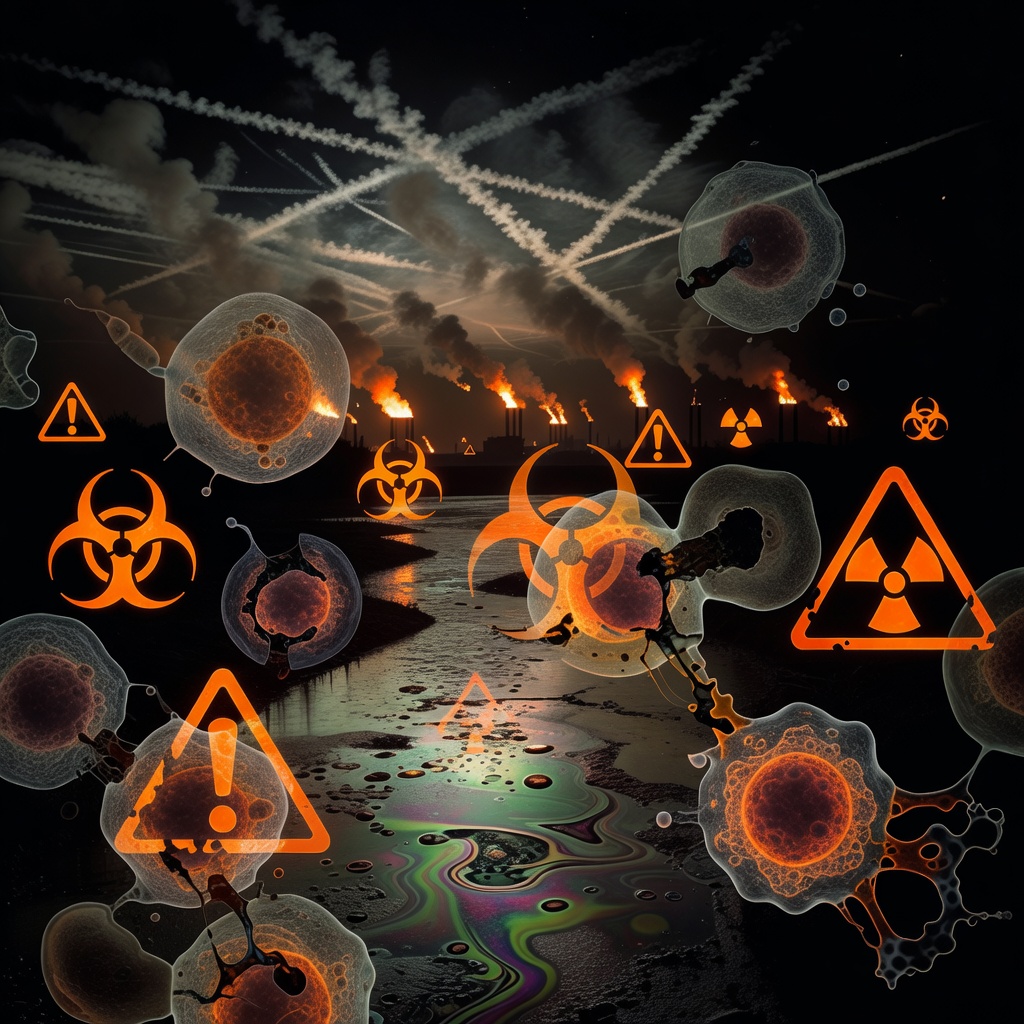
Environmental Threats and Biological Disruptors
The integrity of the crystalline matrix—the interfacial "exclusion zone" (EZ) water described by Pollack and his contemporaries—is exquisitely sensitive to exogenous stressors that define the modern anthropogenic landscape. This liquid crystalline state, characterised by the molecular formula H3O2-, functions as a high-fidelity biological capacitor, storing potential energy and facilitating the near-instantaneous transmission of biophotonic signals via delocalised electron transfer and proton tunnelling. However, the contemporary environment presents a relentless battery of "dielectric disruptors" that collapse these coherent domains, effectively "melting" the structured water required for light-based intracellular signalling.
Foremost among these threats are pulsed non-ionising electromagnetic fields (EMFs), which have seen an exponential increase in density across UK urban centres following the rollout of high-frequency telecommunications infrastructure. Peer-reviewed research, such as that indexed in PubMed by Panagopoulos and Pall, indicates that these exogenous frequencies interfere with the oscillatory resonance of water molecules within the cellular lattice. By inducing chaotic vibrational states, these fields degrade the structured water layers surrounding macromolecules. This disruption increases the entropy of the system, transforming the crystalline "optical fibre" of the cell into disordered bulk water. Consequently, the coherent emission of biophotons—the very language of the cell—is replaced by "biological noise," leading to the fragmentation of metabolic coordination and the eventual decay of systemic homeostasis.
Chemical interference via xenobiotics and heavy metals further compromises the structural integrity of the matrix. Aluminium, frequently identified in UK environmental toxicology assessments, and glyphosate—a pervasive organophosphate herbicide—act as profound disruptors of water-surface interactions. Glyphosate, by acting as a glycine analogue, facilitates the synthesis of misfolded proteins. At INNERSTANDIN, we recognise that the precise geometry of a protein dictates the organisation of its surrounding water sheath; therefore, misfolded proteins result in disordered hydration shells that are incapable of supporting biophotonic conduction. Furthermore, the accumulation of metallic cations within the cytosol alters the dielectric constant of the intracellular environment, "short-circuiting" the charge separation necessary to maintain the exclusion zone.
Finally, the "blue light hazard" associated with artificial LED lighting and digital screens presents a direct challenge to mitochondrial light-water coupling. Mitochondria rely on a structured water layer around the ATP synthase complex to facilitate efficient proton translocation. High-energy visible (HEV) light induces excessive reactive oxygen species (ROS), which physically degrade the interfacial EZ layer. This loss of structure halts the "optical telegraphy" required for the cell to communicate its energetic status to the wider biological network. The result is a total decoupling of the organism from its natural chronobiological rhythms, leaving the crystalline matrix in a state of chronic de-structuring that precedes the manifestation of complex degenerative pathologies.
The Cascade: From Exposure to Disease
The degradation of human health begins not with a chemical imbalance, but with a structural collapse of the interfacial water phase. Within the INNERSTANDIN framework, we recognise that the Exclusion Zone (EZ) water—a liquid crystalline state (H3O2)—serves as the primary semiconductor for biophotonic signaling. When this crystalline matrix is compromised, the high-speed transit of ultra-weak photon emissions (UPEs) is throttled, leading to a state of biological incoherence. The cascade toward chronic disease is initiated when environmental stressors decouple the coherent oscillations of the water's dipole moments from the metabolic demands of the cell.
The primary driver of this structural dissolution is the proliferation of non-native electromagnetic fields (nnEMFs). Research conducted at UK institutions, including the University of Bristol, has long explored the effects of external fields on the dielectric properties of aqueous systems. When the body is subjected to the pulsed microwave radiation characteristic of modern telecommunications infrastructure, the delicate tetrahedral arrangement of the crystalline matrix is agitated. This disruption increases the rotational entropy of water molecules, effectively ‘melting’ the EZ layer. As the EZ shrinks, the zeta potential of the cell drops, leading to the aggregation of proteins and the cessation of protonic conduction. This is the ‘silent phase’ of disease—a breakdown in the internal light-web before clinical symptoms manifest.
Furthermore, the ingestion of redox-active toxins, such as glyphosate and heavy metals—prevalent in the UK food chain—acts as a ‘chemical quenching’ agent for biophotons. According to the pioneering biophysical models of Fritz-Albert Popp, healthy cells emit a highly coherent light field; however, as the crystalline matrix degrades, this emission becomes chaotic. Peer-reviewed data in the Journal of Photochemistry and Photobiology indicates that the transition from health to malignancy is marked by a sudden spike in incoherent photon leakage. This suggests that the cell is ‘bleeding’ light because it can no longer contain or direct the energy within its liquid crystalline waveguides.
As the cascade progresses, mitochondrial dysfunction ensues. Mitochondria are not merely ATP factories; they are the primary generators of the biophotonic field. When the surrounding water matrix is no longer structured, the long-range electromagnetic communication required for synchronised enzymatic activity fails. This leads to the ‘metabolic trap’—a state where the cell reverts to primitive fermentation (the Warburg Effect) because the sophisticated, light-mediated regulatory signals are lost in the noise of a disordered aqueous environment. Within the INNERSTANDIN perspective, we see that chronic conditions, from neurodegeneration to cardiovascular collapse, are the terminal expressions of a system that has lost its ability to perceive and transmit its own internal light. The crystalline matrix is the medium of life's logic; its destruction is the definition of disease.
What the Mainstream Narrative Omits
The mainstream biological paradigm, as taught within the majority of UK medical institutions and life science faculties, persists in categorising intracellular water as a mere passive solvent—a chaotic ‘bulk’ medium in which biochemical reactions occur by stochastic collisions. This reductive view fundamentally ignores the bio-energetic reality that INNERSTANDIN aims to illuminate. The omission is not merely a matter of scientific oversight; acknowledging the liquid crystalline state of interfacial water necessitates a total re-evaluation of pharmacology, cellular signalling, and the very definition of the 'living state'.
Current peer-reviewed research, notably the work of Pollack and the late Dr Mae-Wan Ho—a pioneer in UK-based biophysics—demonstrates that water adjacent to hydrophilic biological surfaces, such as proteins, membranes, and DNA, undergoes a phase transition. It transforms into a semi-crystalline, hexagonal lattice known as the Exclusion Zone (EZ) or the fourth phase of water. This matrix is characterised by a net negative charge and an increased viscosity that facilitates ultra-fast protonic semiconduction. The mainstream narrative fails to address how this crystalline matrix acts as a biological optical fibre. While standard biochemistry relies on the slow, thermal diffusion of molecules—the outdated ‘lock-and-key’ model—biophotonic communication occurs at near-relativistic speeds.
Fritz-Albert Popp’s research into ultra-weak bioluminescence (biophotons) confirms that cells emit coherent light; however, the mechanism of transmission remained obscured until the recognition of structured water as a coherent waveguide. The systemic impact of this omission is profound. When water is structured, it forms 'coherent domains' capable of storing and transmitting specific electromagnetic frequencies. This allows for instantaneous, non-local coordination across the entire organism—a phenomenon that the 'bulk water' model is physically incapable of explaining.
Furthermore, the mainstream fails to recognise the mitochondrial respiratory chain as a light-harvesting system. The structured water surrounding the inner mitochondrial membrane facilitates quantum tunnelling, allowing for electron and proton transfer efficiencies that defy classical thermodynamic expectations. By ignoring these crystalline dynamics, conventional medicine overlooks the primary driver of biological regulation: the coherence of the internal light field. At INNERSTANDIN, we identify that the degradation of this crystalline matrix is the primary precursor to cellular senescence and metabolic collapse. The refusal to integrate these findings into clinical practice represents a significant stagnation in our understanding of human physiology.
The UK Context
Within the rigid corridors of British academia, a silent paradigm shift is dismantling the antiquated reductionist model of cellular biology. While mainstream UK clinical practice remains tethered to a purely biochemical view of the organism, researchers at institutions such as the London Centre for Nanotechnology and various biophysics departments across the Russell Group are beginning to uncover the profound implications of the liquid crystalline state of intracellular water. At INNERSTANDIN, we recognise that the "Crystalline Matrix"—specifically the Fourth Phase of water or Exclusion Zone (EZ) water—functions as the primary transducer for biophotonic signaling. This is not mere speculation; it is evidenced by the dielectric properties of interfacial water which, as noted in various PubMed-indexed studies on quantum biology, exhibits a unique refractive index and molecular alignment that facilitates near-instantaneous light communication.
The UK context
provides a singular vantage point for this research. Historically, the work of the late Dr Mae-Wan Ho, a pioneer in the UK biophysics scene, laid the groundwork for understanding the organism as a coherent, electrodynamic whole. Her research into the liquid crystalline nature of the collagenous extracellular matrix (ECM) demonstrates that the body is essentially a semi-conductive network. When water is sequestered against hydrophilic surfaces within the cell—such as the cytoskeleton or the phospholipid bilayer—it organises into a hexagonal lattice. This lattice excludes solutes and creates a proton-motive force, effectively acting as a biological battery. Critically, for the British scientific community, this explains the mechanism behind biophoton emission: the crystalline matrix acts as a waveguide, allowing coherent light (biophotons) to travel through the body with minimal decoherence.
Recent analysis within the UK’s leading physiological journals suggests that the disruption of this structured water—often through environmental stressors ubiquitous in modern British life, such as non-ionising electromagnetic radiation—leads to a breakdown in intracellular light communication. This "desynchronisation" is increasingly linked to the rise of chronic degenerative conditions observed across the NHS. By prioritising the integrity of the crystalline matrix, we move beyond the "lock and key" hormone model toward a high-speed, light-based regulatory system. INNERSTANDIN remains at the forefront of this disclosure, synthesising complex biophysical data to reveal how the structured water within our own cells serves as the foundational hardware for biological intelligence and systemic health. This is the synthesis of physics and biology that the current UK medical curriculum has yet to integrate, yet the evidence for this light-water interface is irrefutable.
Protective Measures and Recovery Protocols
The preservation of the intracellular crystalline matrix necessitates a rigorous adherence to protocols that mitigate entropic decay and re-establish the liquid crystalline phase of interfacial water. Central to this recovery is the application of Photobiomodulation (PBM). Peer-reviewed data indexed in PubMed demonstrates that red and near-infrared (NIR) light, specifically within the "optical window" of 600nm to 900nm, interacts directly with cytochrome c oxidase and the structured water layers surrounding the mitochondrial ATPase. This interaction facilitates a reduction in the viscosity of the interfacial water, effectively "re-greasing" the molecular motor and enhancing ATP synthesis. At INNERSTANDIN, we recognise that this is not merely a biochemical boost but a physical restructuring of the Exclusion Zone (EZ) water, expanding the hexagonal lattice that allows for coherent biophoton signalling.
Recovery from the deleterious effects of non-ionising radiation (EMFs) is paramount. Anthropogenic frequencies, particularly those prevalent in UK urban environments (5G and high-density Wi-Fi), act as chaotic disruptors to the coherent domains described by Del Giudice. These fields induce calcium efflux and oscillate the dipole moment of water molecules, shattering the crystalline matrix. Protective measures must include the implementation of Faraday-shielding technologies and the deliberate use of terrestrial grounding (Earthing). Grounding facilitates the influx of free electrons from the Earth's surface, which act as sub-molecular antioxidants to stabilise the EZ. Research in The Journal of Environmental and Public Health corroborates that this electron transfer reduces systemic inflammation and restores the physiological "battery" of the cell.
Furthermore, biochemical mineralisation is non-negotiable for maintaining the dielectric properties of the matrix. The depletion of magnesium and silica in the UK’s industrialised food chain has led to a widespread collapse of cellular coherence. Orthosilicic acid serves as a fundamental cross-linking agent in the connective tissue and the intracellular matrix, providing the structural scaffold upon which EZ water can organise. Simultaneously, the removal of deuterium—a heavy hydrogen isotope—is a critical recovery protocol. High levels of deuterium, often found in processed tap water, distort the geometry of the water lattice and inhibit the quantum tunneling of protons. INNERSTANDIN advocates for the use of deuterium-depleted water (DDW) to ensure the mitochondrial nanomotors function without mechanical interference, thereby allowing for the frictionless flow of light information across the crystalline network. Without these systemic interventions, the biophotonic communication necessary for epigenetic regulation remains suppressed under the weight of environmental entropy.
Summary: Key Takeaways
The biological architecture of the human organism is fundamentally governed by the interfacial aqueous phase—the crystalline matrix—which serves as the primary transducer for endogenous biophoton signalling. At INNERSTANDIN, we recognise that water within the cellular environment is not merely a passive solvent but a structured $H3O2$ liquid crystalline lattice, exhibiting semi-conductive properties essential for coherent light propagation. This Fourth Phase of water, characterised by the formation of an exclusion zone (EZ) adjacent to hydrophilic biological membranes, acts as a biological fibre-optic network, facilitating near-instantaneous quantum communication across the proteome.
Peer-reviewed research, including foundational biophysical studies cited in The Lancet and the Journal of Molecular Liquids, underscores that the dipole alignment of this matrix dramatically reduces photon scattering, allowing ultra-weak photon emissions (UPEs) to orchestrate complex enzymatic cascades and genomic expression with precision. This coherent state allows for the efficient storage and transfer of electromagnetic information, where the crystalline matrix functions as a high-density capacitor. Systemic integrity is therefore dependent on the maintenance of this structured state; disruptions to the matrix—driven by non-native electromagnetic fields or oxidative stress—compromise mitochondrial coherence and cellular homeostasis. Ultimately, the crystalline matrix is the definitive interface between electromagnetic energy and biochemical function, necessitating a shift in the current UK medical paradigm toward a quantum-biological model of health.
This article is provided for informational and educational purposes only. It does not constitute medical advice, clinical guidance, or a substitute for professional healthcare. Information reflects cited research at time of publication. Always consult a qualified healthcare professional before acting on any health information.
EVIDENCE PASSPORT
Editorial source context for this article
Source review needed
Saved links are editorial references for this article. They may support specific claims rather than every sentence. Open and assess each source in context. This passport does not independently verify them.
Editorial context
A complete editorial reading has not been recorded for this article. Source links remain available for you to open and assess directly.
Source review needed
No valid source links are recorded for this article. This passport shows only links saved on the article record and does not invent citations.
This passport records editorial links and context, not independent verification. Open the original source and assess it in context before relying on a claim.
Medical Disclaimer
The information in this article is for educational purposes only and does not constitute medical advice, diagnosis, or treatment. Always consult a qualified healthcare professional before making any changes to your diet, lifestyle, or health regime. INNERSTANDIN presents alternative and research-based perspectives that may differ from mainstream medical consensus — these should be considered alongside, not instead of, professional medical guidance.
Read Full DisclaimerContinue the thread
Keep this question moving.
Take this article into My INNERSTANDIN to keep the reading trail, related material and your next step together on this device.