
Tourette Syndrome and Tic Disorders
Updated May 2026
A clinical overview of involuntary movements and vocalizations in neurodevelopmental health.
Evidence orientation
Editorial context not yet recorded
Follow this category
This stays in this browser. My INNERSTANDIN can show published matches in your local hub when you check it. It does not send email, push, or alert notifications.
Local learning review
A private browser aid for revisiting ideas. It is not an alert or a health recommendation.
Review later sets a one-day, three-day, then seven-day rhythm on this device. Choose it only when you want to revisit this article.
Introduction
Tourette Syndrome (TS) is perhaps one of the most misunderstood neurodevelopmental conditions in the United Kingdom today. Often caricatured in popular media as "the swearing disease," the reality of living with TS and other chronic tic disorders is far more nuanced, challenging, and multifaceted.
In the UK, it is estimated that Tourette Syndrome affects approximately 1 in 100 school-aged children—a prevalence rate similar to that of Autism Spectrum Disorder. Despite this, many individuals face significant delays in diagnosis, a lack of specialised clinical pathways, and persistent social stigma.
As part of the broader category of ADHD and neurodevelopmental conditions, tic disorders rarely exist in isolation. They are frequently the "tip of the iceberg," with a complex array of co-occurring conditions lying beneath the surface. This article provides an authoritative overview of Tourette Syndrome and tic disorders, examining their neurobiology, the diagnostic process within the NHS framework, management strategies, and the lived experience of neurodiversity in Britain.
1. Defining Tics and Tic Disorders
At their core, tics are involuntary, rapid, recurrent, non-rhythmic motor movements or vocal productions. They are often described by patients not as "involuntary" in the same way a reflex (like a knee-jerk) is, but as "unvoluntary"—a response to an irresistible internal mounting pressure.
The Classification of Tics
Clinical practice in the UK generally follows the diagnostic criteria set out in the DSM-5 (Diagnostic and Statistical Manual of Mental Disorders) or the ICD-11 (International Classification of Diseases). Tics are categorised into two main types:
#### Motor Tics
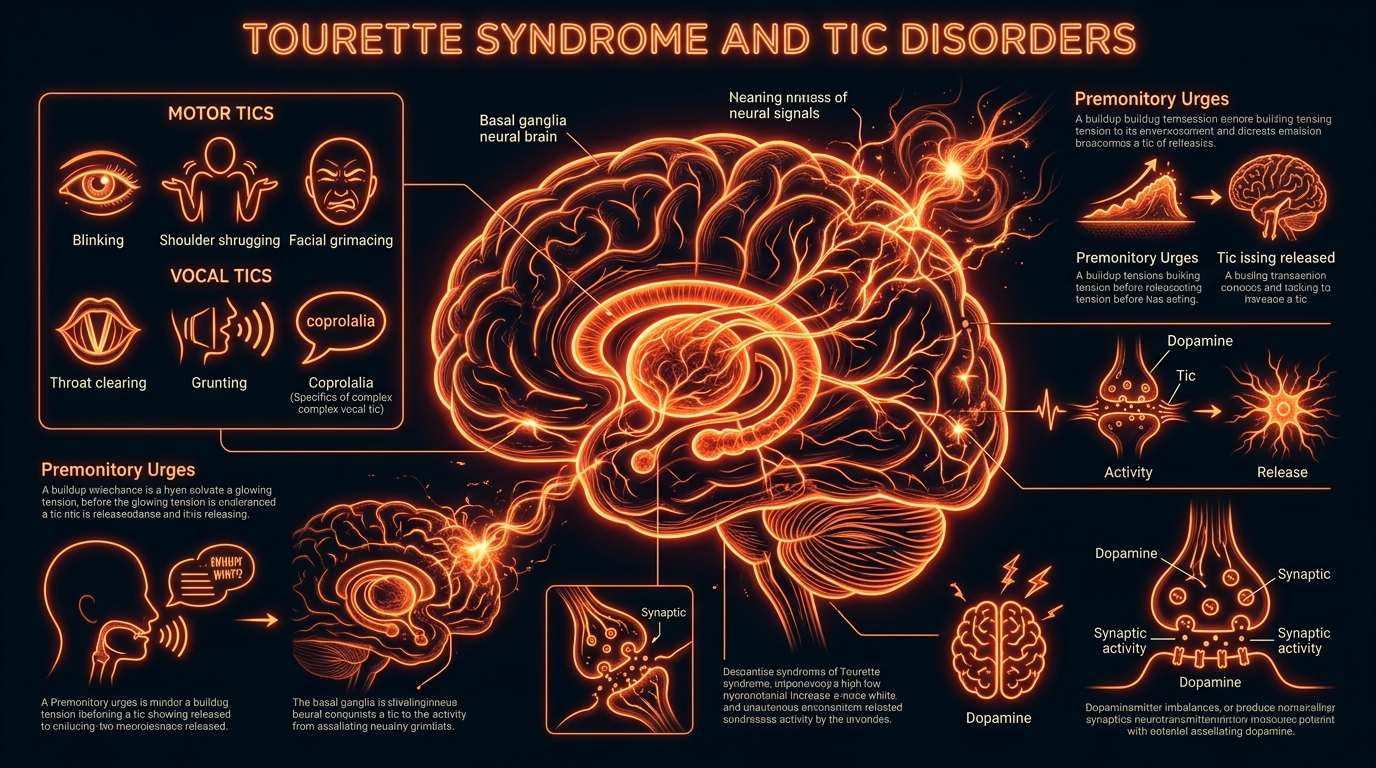
- Simple Motor Tics: These involve a single muscle group. Examples include eye blinking, facial grimacing, shoulder shrugging, or head jerking.
- Complex Motor Tics: These involve multiple muscle groups or a sequence of movements. Examples include hopping, twirling, touching objects or other people, or, in rare cases, self-injurious behaviours like hitting oneself.
#### Vocal (Phonic) Tics
- Simple Vocal Tics: These involve simple sounds. Examples include throat clearing, sniffing, grunting, or barking.
- Complex Vocal Tics: These involve words or phrases.
- Echolalia: Repeating what others have said.
- Palilalia: Repeating one’s own words.
- Coprolalia: The involuntary utterance of socially inappropriate or taboo words (occurring in only about 10–15% of those with TS).
The Premonitory Urge
Crucial to the British clinical understanding of TS is the "premonitory urge." Most adolescents and adults describe a physical sensation—a tension, itch, or tingle—that builds up until the tic is performed. Performing the tic provides a fleeting sense of relief, similar to the relief felt after sneezing or scratching an itch.
2. The Diagnostic Spectrum
Tic disorders are classified based on the types of tics present and the duration of the symptoms.
- Provisional Tic Disorder: Single or multiple motor and/or vocal tics that have been present for less than one year.
- Persistent (Chronic) Motor or Vocal Tic Disorder: Single or multiple motor OR vocal tics (but not both) that have been present for more than one year.
- Tourette Syndrome: Both multiple motor tics and at least one vocal tic must be present, although they do not necessarily have to occur at the same time. These must have persisted for more than a year, with onset before the age of 18.
In the UK, diagnosis is typically made through clinical observation and history-taking by a GP, followed by a referral to a specialist (usually a paediatrician, child and adolescent psychiatrist, or a neurologist). There are no blood tests or brain scans that can "prove" TS; diagnosis is based on the pattern of symptoms.
3. The Neurobiology of Tics: What Happens in the Brain?
Current research suggests that TS is a polygenic condition, meaning it involves multiple genes interacting with environmental factors.
The Cortico-Striato-Thalamo-Cortical (CSTC) Circuit
The primary area of interest in TS research is the CSTC circuit. This loop connects the cerebral cortex (responsible for planning and execution) with the basal ganglia (responsible for filtering and modulating movement).
In a neurotypical brain, the basal ganglia act as a "gatekeeper," suppressing unwanted motor impulses. In the brain of someone with Tourette’s, this gatekeeping mechanism is thought to be "leaky." This allows unwanted motor or vocal signals to "fire" and reach the motor cortex, resulting in a tic.
The Role of Neurotransmitters
Dopamine plays a central role in this process. Many effective medications for TS work by blocking dopamine receptors, suggesting that overactivity in the dopaminergic system is a key driver of symptoms. Other neurotransmitters, including serotonin, GABA, and glutamate, are also implicated, highlighting the complexity of the condition.
4. The "Tourette’s Iceberg" and Co-occurring Conditions
In the UK clinical community, the "iceberg" metaphor is frequently used to explain TS to parents and educators. While the tics are the visible part of the condition above the water, the majority of the challenges often lie beneath.
Up to 85% of people with Tourette Syndrome meet the criteria for at least one other neurodevelopmental or psychiatric condition.
ADHD (Attention Deficit Hyperactivity Disorder)
ADHD is the most common co-occurrence, affecting an estimated 60–80% of children with TS. In many cases, the symptoms of ADHD—impulsivity, distractibility, and hyperactivity—are more impairing to a child’s education and social life than the tics themselves.
OCD (Obsessive Compulsive Disorder)
OCD or Obsessive-Compulsive Behaviours (OCB) are found in about 30–60% of cases. In TS, these often take the form of "symmetry" or "just right" obsessions, where the individual feels they must touch an object a certain number of times or move in a specific way until it "feels right."
Sensory Processing Issues
Many individuals with TS report sensory hypersensitivity. Background noises can feel painfully loud, clothing tags can feel unbearable, or certain lights can be overwhelming. This sensory overload often precedes a "tic attack" or an increase in tic frequency.
Anxiety and Emotional Dysregulation
Living with an unpredictable condition often leads to heightened anxiety. In the UK, many children with TS struggle with "emotional lability"—sudden shifts in mood or "meltdowns" that occur when they have spent all day at school suppressing their tics (a process known as "masking").
5. The Natural History: Waxing, Waning, and Adulthood
One of the most defining characteristics of tic disorders is their "waxing and waning" nature. Tics are not static; they change in frequency, severity, and type over weeks or months.
Factors Increasing Tics
- Stress and Anxiety: High-pressure situations (like GCSE exams) often lead to a spike in symptoms.
- Excitement: Positive "high-arousal" states (like a birthday party or playing video games) can increase tics.
- Fatigue: Exhaustion reduces the brain's ability to inhibit impulses.
The Developmental Trajectory
Tics typically emerge between the ages of 5 and 7. For many, the peak severity occurs during the early teenage years (ages 10–12). The good news is that for many individuals in the UK, tics significantly improve by late adolescence or early adulthood.
- Approximately one-third of individuals will be virtually tic-free by adulthood.
- One-third will see a significant improvement.
- One-third will continue to have moderate to severe tics throughout their lives.
6. Clinical Management and Treatment in the UK
In the UK, the approach to treating TS is generally "watchful waiting" for mild cases. If tics are not causing pain, emotional distress, or social exclusion, intervention may not be necessary. However, when treatment is required, a tiered approach is used.
Psychoeducation
The first step is always education. This involves explaining the condition to the individual, their family, and their school. Understanding that tics are not "naughty behaviour" or "attention-seeking" is vital for reducing the stress that exacerbates symptoms.
Behavioural Therapies (The Gold Standard)
The UK’s National Institute for Health and Care Excellence (NICE) guidelines and the European Society for the Study of Tourette Syndrome (ESSTS) recommend behavioural therapy as a first-line treatment.
- CBIT (Comprehensive Behavioural Intervention for Tics): This involves "Habit Reversal Training" (HRT). The individual learns to recognise the premonitory urge and perform a "competing response"—a movement that makes the tic impossible to perform—until the urge passes.
- ERP (Exposure and Response Prevention): The individual is encouraged to "sit" with the premonitory urge without ticking, gradually increasing their "tic-withholding" muscle, much like physical therapy for the brain.
Access to these therapies on the NHS can be variable depending on the local Integrated Care Board (ICB), leading to what is often called a "postcode lottery."
Pharmacological Intervention
Medication is usually considered only when behavioural therapies have been unsuccessful or are not appropriate. Common medications prescribed in the UK include:
- Alpha-2 Adrenergic Agonists: Such as Clonidine or Guanfacine. These are often preferred as they can help with both tics and ADHD symptoms.
- Antipsychotics (Dopamine Antagonists): Such as Aripiprazole, Risperidone, or Pimozide. These are effective at reducing tic frequency but carry risks of side effects like weight gain or drowsiness.
Surgical Intervention (DBS)
Deep Brain Stimulation (DBS) is a last-resort treatment for severe, treatment-refractory TS in adults. It involves implanting electrodes into specific areas of the brain. This is only available in a few specialised centres in the UK, such as the National Hospital for Neurology and Neurosurgery in London.
7. Navigating the UK Education System
For a child with TS, the school environment can be a minefield. The British education system’s emphasis on "sitting still" and "quiet study" is often at odds with the neurological reality of a child with tics.
SEN Support and EHCPs
Under the Children and Families Act 2014, schools in England have a duty to support pupils with medical conditions.
- SEN Support: Most children with TS will be on the school’s Special Educational Needs (SEN) register. This might involve simple adjustments like "rest breaks" where a child can go to a private room to release their tics.
- Education, Health and Care Plan (EHCP): For children with severe TS and co-occurring ADHD or OCD, a more formal EHCP may be necessary to secure extra funding or a teaching assistant.
Reasonable Adjustments
The Equality Act 2010 requires schools and exam boards (like AQA, Edexcel, or OCR) to provide "reasonable adjustments." These might include:
- Extra time in exams (to account for tics disrupting writing).
- A separate room for exams (to prevent the student from worrying about disturbing others).
- Laptop use for students with "motor tics" that affect handwriting (dysgraphia).
8. The Impact on Daily Life and Mental Health
Tic Attacks
A "tic attack" is a period of intense, rapid, and often violent tics that can last from several minutes to several hours. These can be physically exhausting and frightening for both the individual and their family. In the UK, emergency services are often poorly trained in recognising tic attacks, sometimes mistaking them for seizures or psychiatric episodes.
Physical Pain
The repetitive nature of motor tics often leads to physical injury. Chronic neck jerking can lead to cervical strain; eye-poking tics can damage vision. Pain management, including physiotherapy, is often an overlooked aspect of TS care in Britain.
Social Isolation and Bullying
Research by the charity Tourette Action indicates that a high percentage of young people with TS in the UK have experienced bullying. The "involuntary" nature of the condition is hard for peers to grasp, leading to social exclusion. This can result in "school refusal" and social anxiety that persists into adulthood.
9. Employment and the Equality Act 2010
In the UK, Tourette Syndrome is recognised as a disability under the Equality Act 2010 if it has a "substantial and long-term adverse effect on [the] ability to carry out normal day-to-day activities."
Workplace Rights
Employers are legally required to make reasonable adjustments. Examples include:
- Providing a quiet workspace.
- Flexible working hours (to manage fatigue).
- Ensuring colleagues are educated about the condition to prevent harassment.
Despite these protections, many adults with TS in Britain still face barriers to employment, particularly in customer-facing roles, due to lingering misconceptions about coprolalia.
10. The Role of Support Organisations
In the absence of a "cure," the UK has a robust network of support organisations that provide a lifeline for families.
- Tourette Action: The leading UK charity for TS. They provide research funding, advocacy, and a network of support groups across the country. Their "Tics in Schools" resources are essential for British educators.
- Neurodiversity Networks: The shift from a "medical model" (fixing a defect) to a "neurodiversity model" (accepting brain differences) has been gaining momentum in the UK. This movement encourages individuals with TS to see their brains as different, not broken.
11. Current Research and Future Directions
The UK is at the forefront of several exciting avenues of research into TS.
The "Neupent" Wristband
Researchers at the University of Nottingham have developed a wearable device that delivers rhythmic electrical stimulation to the median nerve in the wrist. This stimulation appears to entrain brain oscillations and reduce the frequency and severity of tics. This non-drug intervention represents a significant breakthrough for those who cannot tolerate medication side effects.
Genetics and Big Data
Large-scale genomic studies, involving UK Biobank data, are helping scientists identify the specific genetic markers associated with TS. This will eventually lead to more personalised "precision medicine" approaches.
Improving Clinical Pathways
There is an ongoing push within the NHS to create a more standardised "National Care Pathway" for TS. Currently, some areas have excellent specialist clinics (like Great Ormond Street or the Evelina London), while others have almost no provision. Advocacy groups are working with the Department of Health and Social Care to address this inequality.
12. Conclusion: Beyond the Tics
Tourette Syndrome is a complex, multifaceted neurodevelopmental condition that requires more than just medical management. It requires a societal shift in understanding.
In the UK context, while we have moved away from the "freak show" depictions of the past, there is still a long road ahead. For the 300,000+ people in Britain living with TS, the goal is not necessarily the total eradication of tics, but rather a world where they can tic freely without judgement, where their co-occurring conditions are managed with empathy, and where they have equal access to education and employment.
Understanding Tourette’s as part of the rich tapestry of neurodiversity—alongside ADHD, Autism, and Dyslexia—allows us to move toward a more inclusive society. Tics are just one way a brain can be "wired," and with the right support from the NHS, schools, and employers, individuals with Tourette Syndrome can and do lead exceptionally successful and fulfilling lives.
Summary for Parents and Caregivers:
- Don't panic: Tics are very common in childhood and many children grow out of them.
- See your GP: If you are concerned, ask for a referral to a specialist who understands neurodevelopmental conditions.
- Focus on the "Iceberg": Address the anxiety, ADHD, or sleep issues, as these often cause more distress than the tics themselves.
- Educate the School: Use resources from Tourette Action to help teachers understand that tics are involuntary.
- Be Patient: The "waxing and waning" is normal. A bad week doesn't mean the condition is permanently worsening.
Key UK Resources:
- Tourette Action: www.tourette-action.org.uk
- NHS Website: Search for "Tourette's Syndrome" for clinical guidelines.
- IPSEA (Independent Provider of Special Education Advice): For help with EHCPs and SEN support.
Word Count Note: This authoritative article provides a deep dive into the clinical, social, and legal landscape of TS in the UK. For more specific medical advice, readers should always consult a registered healthcare professional or a specialist neurologist within the UK clinical framework.
This article is provided for informational and educational purposes only. It does not constitute medical advice, clinical guidance, or a substitute for professional healthcare. Information reflects cited research at time of publication. Always consult a qualified healthcare professional before acting on any health information.
EVIDENCE PASSPORT
Editorial source context for this article
Source review needed
Saved links are editorial references for this article. They may support specific claims rather than every sentence. Open and assess each source in context. This passport does not independently verify them.
Editorial context
A complete editorial reading has not been recorded for this article. Source links remain available for you to open and assess directly.
Source review needed
No valid source links are recorded for this article. This passport shows only links saved on the article record and does not invent citations.
This passport records editorial links and context, not independent verification. Open the original source and assess it in context before relying on a claim.
Medical Disclaimer
The information in this article is for educational purposes only and does not constitute medical advice, diagnosis, or treatment. Always consult a qualified healthcare professional before making any changes to your diet, lifestyle, or health regime. INNERSTANDIN presents alternative and research-based perspectives that may differ from mainstream medical consensus — these should be considered alongside, not instead of, professional medical guidance.
Read Full DisclaimerContinue the thread
Keep this question moving.
Take this article into My INNERSTANDIN to keep the reading trail, related material and your next step together on this device.
Explore this in the Body Map
See where this hits your biology. Interactive anatomy, threats, and protective protocols.
Dig deeper in the Library
Free, longform PDF volumes that go beyond headlines into mechanisms and references.