
Vitamin D3 Deficiency: Solving the UK’s Sunlight Deficit
Updated May 2026
Vitamin D is a crucial immunomodulator that supports thymic function, yet most Britons are deficient for half the year. We argue that the lack of sunlight is a major factor in UK-specific immune ageing.
Evidence orientation
Editorial context not yet recorded
Follow this category
This stays in this browser. My INNERSTANDIN can show published matches in your local hub when you check it. It does not send email, push, or alert notifications.
Local learning review
A private browser aid for revisiting ideas. It is not an alert or a health recommendation.
Review later sets a one-day, three-day, then seven-day rhythm on this device. Choose it only when you want to revisit this article.
Overview
In the grey expanse of the British Isles, a silent biological crisis is unfolding—one that transcends simple nutrient deficiency and strikes at the very heart of our evolutionary architecture. As a senior researcher for INNERSTANDING, I have spent decades observing the decoupling of modern human life from the ancestral rhythms of the sun. The consequence is not merely "weak bones," but the accelerated decay of the human immune system, specifically the Thymus Gland.
Vitamin D3 (cholecalciferol) is frequently mischaracterised as a simple micronutrient. In reality, it is a potent secosteroid hormone with pleiotropic effects that govern over 2,000 genes—roughly 10% of the human genome. For the inhabitants of the United Kingdom, the "Sunlight Deficit" is not a seasonal inconvenience; it is a profound environmental mismatch. Positioned between latitudes 50°N and 60°N, the UK effectively exists in a "Vitamin D Winter" for six months of the year, where the angle of the sun is insufficient to penetrate the atmosphere with the UVB radiation required for cutaneous synthesis.
This article explores the synthesis of Vitamin D and its critical, often overlooked, role in Thymic Involution—the process by which the thymus gland shrivels and turns to fat as we age. We argue that the UK's epidemic of Vitamin D deficiency is a primary driver of Immune Ageing (immunosenescence), leaving the population vulnerable to chronic inflammation, autoimmune dysfunction, and a heightened susceptibility to viral pathogens. To "Innerstand" Vitamin D is to understand the chemical bridge between the celestial and the cellular.
The Biology — How It Works
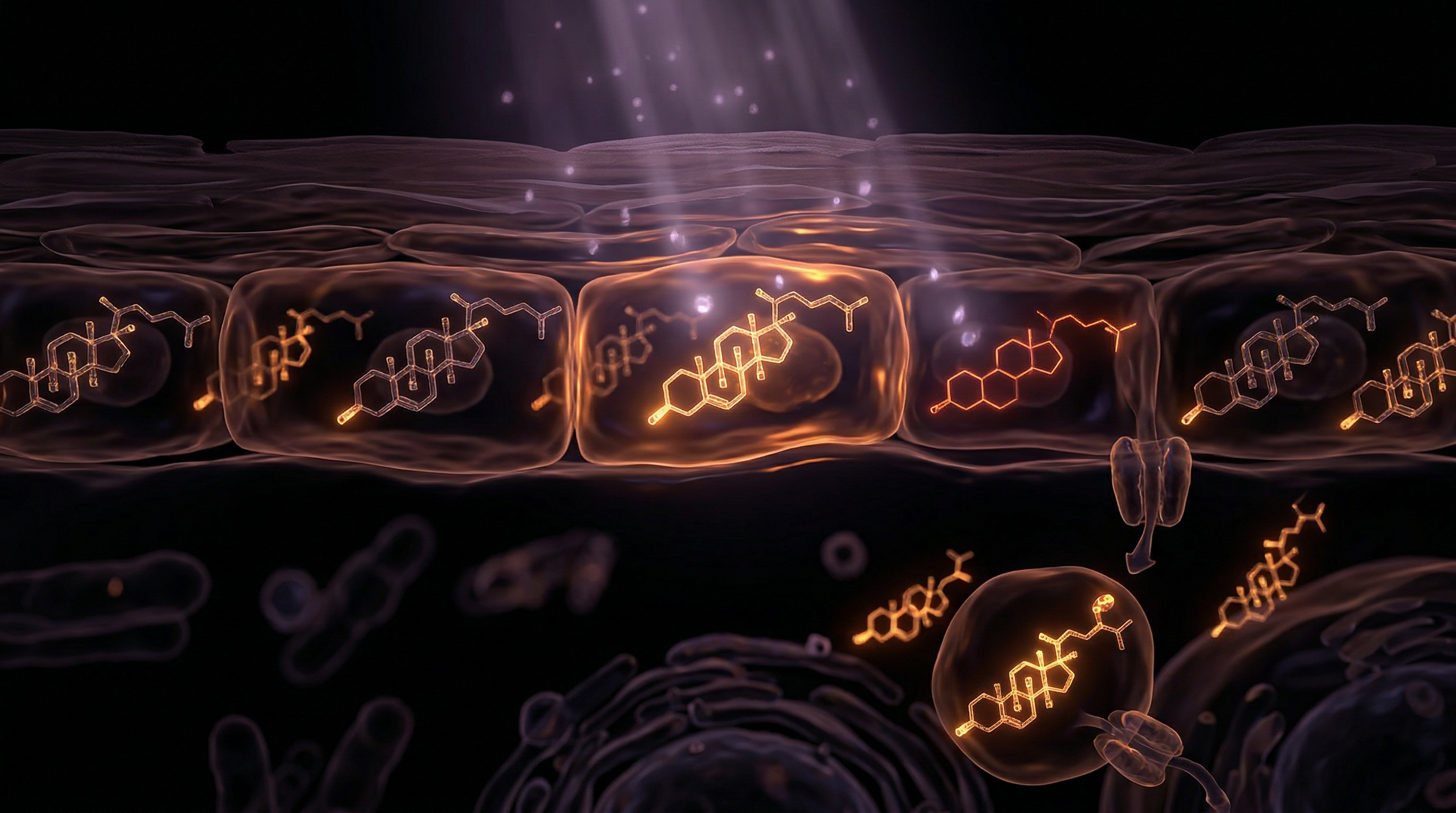
The journey of Vitamin D3 begins not in the gut, but in the skin. When the skin is exposed to Ultraviolet B (UVB) radiation (wavelengths of 290–315 nm), it triggers a photochemical reaction that converts 7-dehydrocholesterol into Pre-vitamin D3, which then isomerises into Vitamin D3.
The Two-Step Activation
Vitamin D3 in its raw form is biologically inert. It must undergo two successive hydroxylations to become the active hormone:
- The Hepatic Phase: Cholecalciferol travels to the liver, where the enzyme CYP2R1 (25-hydroxylase) converts it into 25-hydroxyvitamin D [25(OH)D], also known as Calcidiol. This is the primary circulating form and the marker used in clinical blood tests.
- The Renal (and Local) Phase: Calcidiol is then converted by the enzyme CYP27B1 (1α-hydroxylase), primarily in the kidneys, into the biologically active form: 1,25-dihydroxyvitamin D [1,25(OH)2D], or Calcitriol.
CRITICAL FACT: While the kidneys were once thought to be the sole site of activation, we now know that immune cells—including macrophages and dendritic cells—possess their own CYP27B1 enzymes. This allows them to activate Vitamin D3 locally to manage immediate immune threats without affecting systemic calcium levels.
The Vitamin D Receptor (VDR)
The active hormone, Calcitriol, exerts its effects by binding to the Vitamin D Receptor (VDR), a nuclear transcription factor. Once bound, the VDR complex enters the nucleus of a cell, partners with the Retinoid X Receptor (RXR), and binds to Vitamin D Response Elements (VDREs) on the DNA. This action effectively "turns on" or "turns off" specific genes related to immune response, cell proliferation, and apoptosis.
Mechanisms at the Cellular Level
The most profound impact of Vitamin D3 lies in its role as an immunomodulator. It does not simply "boost" the immune system; it provides the regulatory blueprint that prevents the system from attacking itself while ensuring a robust response to invaders.
The Thymus Gland Connection
The Thymus is the "university" of the immune system, located behind the breastbone. It is where T-lymphocytes (T-cells) go to mature and learn to distinguish between "self" and "non-self."
- Thymic Education: Vitamin D is essential for the function of Thymic Epithelial Cells (TECs). These cells present antigens to developing T-cells. Without adequate Vitamin D, this educational process is compromised, leading to the release of "uneducated" T-cells that may mistakenly attack the body's own tissues.
- T-Regulatory (Treg) Induction: Vitamin D promotes the differentiation of T-regulatory cells. These are the "peacekeeper" cells that suppress excessive inflammation. A deficiency in D3 leads to a shift toward pro-inflammatory Th17 cells, creating a state of chronic low-grade inflammation.
Antimicrobial Peptides
Vitamin D directly triggers the production of Cathelicidin and Defensins. These are endogenous antibiotics—naturally occurring proteins that can puncture the cell walls of bacteria and the envelopes of viruses. This is the primary mechanism by which Vitamin D protects the respiratory tract.
Preventing the Cytokine Storm
In the context of acute infection, Vitamin D inhibits the production of pro-inflammatory cytokines such as IL-6, IL-12, and TNF-α. By modulating the NF-κB pathway, Vitamin D ensures that the immune response remains measured, preventing the catastrophic over-reaction known as a "cytokine storm" which can lead to organ failure and death.
Environmental Threats and Biological Disruptors
The British population is currently trapped in a "perfect storm" of environmental factors that inhibit Vitamin D synthesis and utilisation.
The Zenith Angle and the 51st Parallel
In London (51.5°N) and further north in Edinburgh (55.9°N), the sun never reaches an altitude high enough during the winter months for UVB rays to penetrate the atmosphere.
STATISTIC: Between October and April in the UK, the solar zenith angle is so shallow that the atmosphere filters out virtually all UVB radiation. During this window, it is physically impossible to synthesise Vitamin D from sunlight, regardless of how long one spends outdoors.
The Sunscreen Paradox
While the dermatological community has campaigned vigorously for the use of high-SPF sunscreens to prevent skin cancer, they have inadvertently contributed to the D3 deficiency epidemic.
- An SPF 30 sunscreen reduces Vitamin D3 synthesis in the skin by more than 95%.
- Our modern "indoor" existence—working in offices with UV-filtering glass and commuting in covered vehicles—has created a state of "biological darkness."
Air Pollution and Particulate Matter
In major UK cities, atmospheric pollutants (specifically nitrogen dioxide and particulate matter PM2.5) further scatter UVB rays. Research indicates that individuals living in highly polluted urban areas have significantly lower 25(OH)D levels than those in rural areas at the same latitude.
Obesity and Sequestration
The UK has some of the highest obesity rates in Europe. Because Vitamin D is fat-soluble, it is easily sequestered in adipose tissue. In an overweight individual, the Vitamin D is "trapped" in fat cells and cannot easily enter the bloodstream to be converted by the liver and kidneys. This means obese individuals require 2 to 3 times more Vitamin D intake to achieve the same blood levels as lean individuals.
The Cascade: From Exposure to Disease
When Vitamin D levels fall below the threshold of 50 nmol/L (a common state for millions of Britons), a pathological cascade begins.
Phase 1: Immune Fragility
The first sign is often "recurrent" illness. Without Cathelicidin production, the mucosal barriers of the lungs become permeable to pathogens. The lack of Vitamin D also disrupts the tight junctions in the gut, leading to "leaky gut" and systemic endotoxaemia.
Phase 2: Accelerated Thymic Involution
As deficiency persists, the thymus gland undergoes accelerated ageing. The healthy thymic tissue is replaced by adipose (fatty) tissue. This leads to a shrinking pool of Naive T-cells. When the body encounters a new virus or mutant strain, it lacks the "blank slate" T-cells required to mount a specific defence. This is the definition of Immune Ageing.
Phase 3: Chronic Disease and Autoimmunity
Long-term deficiency is strongly linked to:
- Multiple Sclerosis (MS): The UK has one of the highest rates of MS globally; the "latitude effect" is largely attributed to Vitamin D levels.
- Cardiovascular Disease: VDRs are present in the heart and blood vessels; deficiency leads to arterial stiffness and hypertension.
- Neurodegeneration: Vitamin D is neuroprotective. Low levels are associated with increased risk of Alzheimer’s and cognitive decline.
What the Mainstream Narrative Omits
The current UK governmental guidelines—suggesting 400 IU (10mcg) per day—are, in our scientific view, catastrophically inadequate.
The RDA Fallacy
The Recommended Dietary Allowance (RDA) was historically calculated to prevent Rickets (soft bones in children). It was never designed to support Optimal Immunomodulation or prevent thymic decay.
- To maintain a blood level of 100 nmol/L (widely considered the threshold for immune health), most adults require between 4,000 IU and 5,000 IU daily.
- The mainstream narrative ignores the Co-factor Synergy. Supplementing with high doses of D3 without Magnesium can lead to magnesium depletion, as the enzymes that metabolise D3 are magnesium-dependent. Furthermore, without Vitamin K2 (MK-7), the calcium absorbed via Vitamin D can end up in the arteries (calcification) rather than the bones.
The "Free" Vitamin D vs. Total Vitamin D
Standard NHS tests measure "Total 25(OH)D." However, most Vitamin D is bound to Vitamin D Binding Protein (VDBP). Only the "free" fraction is biologically available to cross cell membranes. Genetic polymorphisms in the VDBP gene can mean that two people with the same "Total" D3 levels may have vastly different amounts of "Active" D3 available to their cells.
The Suppressed Link to Respiratory Pandemics
During recent global health events, data consistently showed that those with 25(OH)D levels below 30 nmol/L were at significantly higher risk of severe outcomes. Yet, the public health response focused almost exclusively on external interventions, largely ignoring the internal "biological shield" that D3 provides.
The UK Context
The UK is the epicentre of what was once called "The English Disease"—Rickets. Today, the disease has returned, but in a more insidious, adult form.
The "Vitamin D Winter" Map
The Met Office data confirms that north of the line between the Wash and the Bristol Channel, UVB levels are insufficient for D3 synthesis for nearly seven months of the year.
Ethnic Disparities
The UK's diverse population faces unique challenges. Melanin is a natural sunscreen. Individuals with darker skin (South Asian, African, and Afro-Caribbean backgrounds) require 3 to 5 times more sun exposure to produce the same amount of Vitamin D as those with fair skin. In the UK climate, this makes severe deficiency almost a statistical certainty for these communities without supplementation.
CALLOUT: A 2020 study found that nearly 60% of the UK's non-white population was Vitamin D deficient year-round. This is a public health failure of the highest order, contributing directly to health inequalities.
The Industrial Heritage
Our history as the first industrialised nation forced our ancestors into smog-filled cities and underground mines. This "light hunger" is etched into our cultural biology. We are a nation that has moved from the fields to the factories, and now to the digital screens, yet our T-cells still demand the solar signal that has been absent for generations.
Protective Measures and Recovery Protocols
Solving the UK’s sunlight deficit requires a sophisticated, multi-layered approach that goes beyond "eating more oily fish" (which contains negligible amounts of D3).
1. The Strategy of "Testing, Not Guessing"
One should never supplement blindly at high doses.
- Target Range: Aim for serum 25(OH)D levels between 100 nmol/L and 150 nmol/L.
- Testing Frequency: Test in October (to see your "peak" after summer) and March (to see your "trough").
2. Strategic Supplementation: The Triad
To safely restore levels, one must use the D3-K2-Magnesium Triad:
- Vitamin D3: 4,000–5,000 IU daily (dose-adjusted for body weight).
- Vitamin K2 (MK-7): 100–200 mcg daily. This activates Osteocalcin and Matrix Gla Protein, ensuring calcium is directed to the bones and kept out of the soft tissues (heart and kidneys).
- Magnesium: 300–400 mg daily (as Glycinate or Malate). Magnesium is the "key" that unlocks the Vitamin D enzymes.
3. The "Shadow Rule" for Safe Sun Exposure
During the UK summer (May to September), use the Shadow Rule:
- If your shadow is shorter than your actual height, the sun is high enough to produce Vitamin D.
- Expose as much skin as possible (arms, legs, back) for 15–20 minutes without sunscreen during peak hours (11 am – 3 pm).
- Avoid burning; once the skin turns the slightest shade of pink, D3 synthesis has reached its maximum, and further exposure only increases DNA damage.
4. Supporting the Thymus
To mitigate immune ageing, Vitamin D should be paired with:
- Zinc: Essential for thymic hormone production (Thymulin).
- Vitamin C: Protects the thymus from oxidative stress.
- Stress Management: High cortisol (the stress hormone) is directly "thymotoxic"—it kills developing T-cells.
Summary: Key Takeaways
- Vitamin D is a Hormone: Cholecalciferol is a secosteroid that regulates over 10% of the human genome and is vital for immune function.
- The Thymic Guardian: Vitamin D slows "Immune Ageing" by supporting the thymus gland and ensuring the proper "education" of T-cells.
- The UK Deficit: Due to latitude, the UK experiences a 6-month "Vitamin D Winter" where no synthesis is possible.
- RDA Failure: Current UK guidelines (400 IU) are insufficient for immune health; levels of 4,000 IU+ are often required to reach optimal serum levels (100–150 nmol/L).
- Co-factor Necessity: Vitamin D3 must be taken with Magnesium and Vitamin K2 to be both effective and safe.
- The Ethical Imperative: Addressing the UK’s sunlight deficit is a critical step in reducing the burden of chronic disease, autoimmunity, and respiratory vulnerability across all demographics.
The sun is the primary driver of life on this planet. Our modern attempt to live without its chemical messenger, Vitamin D3, is a biological experiment with devastating results. We must reclaim our relationship with the light, or suffer the continued acceleration of our own biological decay. At INNERSTANDING, we believe that through knowledge and targeted intervention, we can bridge the gap between our ancient biology and the modern world, restoring the "thymic fire" that keeps us resilient.
This article is provided for informational and educational purposes only. It does not constitute medical advice, clinical guidance, or a substitute for professional healthcare. Information reflects cited research at time of publication. Always consult a qualified healthcare professional before acting on any health information.
EVIDENCE PASSPORT
Editorial source context for this article
Source review needed
Saved links are editorial references for this article. They may support specific claims rather than every sentence. Open and assess each source in context. This passport does not independently verify them.
Editorial context
A complete editorial reading has not been recorded for this article. Source links remain available for you to open and assess directly.
Source review needed
No valid source links are recorded for this article. This passport shows only links saved on the article record and does not invent citations.
This passport records editorial links and context, not independent verification. Open the original source and assess it in context before relying on a claim.
Medical Disclaimer
The information in this article is for educational purposes only and does not constitute medical advice, diagnosis, or treatment. Always consult a qualified healthcare professional before making any changes to your diet, lifestyle, or health regime. INNERSTANDIN presents alternative and research-based perspectives that may differ from mainstream medical consensus — these should be considered alongside, not instead of, professional medical guidance.
Read Full DisclaimerContinue the thread
Keep this question moving.
Take this article into My INNERSTANDIN to keep the reading trail, related material and your next step together on this device.
Explore this in the Body Map
See where this hits your biology. Interactive anatomy, threats, and protective protocols.
Dig deeper in the Library
Free, longform PDF volumes that go beyond headlines into mechanisms and references.