
Xenoestrogens in the Pantry: The Plastic-Heat Interface
Published April 2026
Exposing the myth of 'BPA-free' plastics and investigating how thermal degradation leads to the migration of endocrine-disrupting xenoestrogens into our food.
Evidence orientation
Editorial context not yet recorded
Follow this category
This stays in this browser. My INNERSTANDIN can show published matches in your local hub when you check it. It does not send email, push, or alert notifications.
Local learning review
A private browser aid for revisiting ideas. It is not an alert or a health recommendation.
Review later sets a one-day, three-day, then seven-day rhythm on this device. Choose it only when you want to revisit this article.
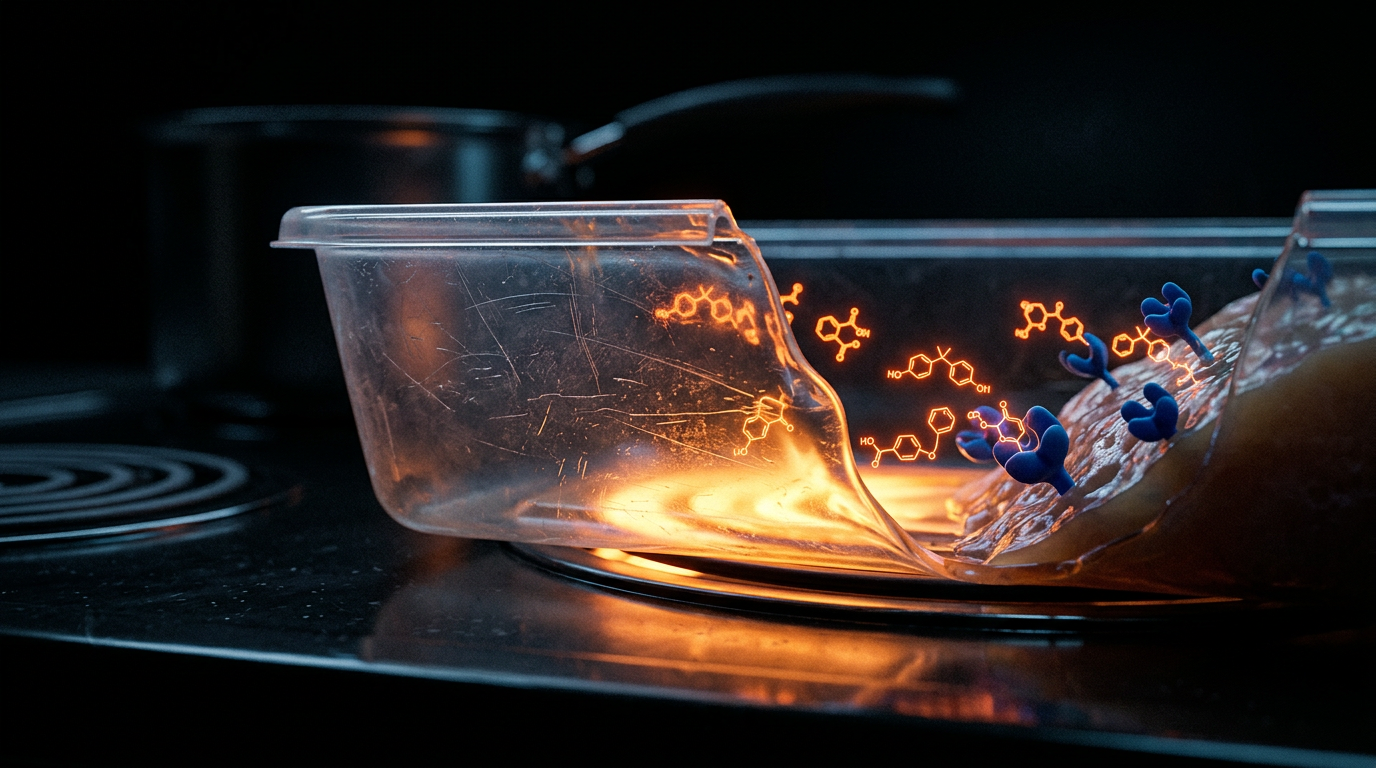
The modern kitchen is saturated with polymers, from storage containers to spatulas. While the dangers of Bisphenol A (BPA) have finally reached mainstream awareness, the 'BPA-free' label has become a masterclass in corporate gaslighting. In most cases, BPA has simply been replaced by Bisphenol S (BPS) or Bisphenol F (BPF), which evidence suggests may be even more endocrine-disruptive and more resistant to degradation. The fundamental issue is the phenomenon of plasticiser migration, where chemical additives—not chemically bound to the polymer chain—leach into food, a process that is exponentially accelerated by heat and fat. For the INNERSTANDING reader, this is not just an environmental issue; it is a direct assault on the oestrogen receptor and the epigenetic signalling of future generations. --- Polymer Degradation and Phthalate Migration --- Beyond bisphenols, phthalates—used to make plastics flexible—represent a significant category of xenoestrogens.
These compounds are lipid-soluble, meaning they have a high affinity for fatty foods like cheese, oils, and meats stored in plastic. When plastic containers are microwaved or even washed in a high-temperature dishwasher, the polymer structure undergoes micro-fracturing, increasing the surface area for leaching. These chemicals are 'hormone mimics'; they possess a molecular structure that can bind to oestrogen receptors (ER-alpha and ER-beta) with high affinity. This leads to a state of 'oestrogen dominance' which, in the UK, is increasingly linked to metabolic syndrome, reproductive issues, and certain hormone-sensitive cancers. --- Epigenetic Signalling and the Oestrogen Receptor --- The biological impact of xenoestrogens is not merely a matter of hormonal imbalance; it is a matter of gene expression. These chemicals can influence DNA methylation and histone modification, meaning that the toxins you ingest today could potentially influence the health of your children and grandchildren.
This is the 'transgenerational' effect of kitchen plastics. Mainstream toxicology often operates on the 'dose makes the poison' principle, but endocrine disruptors defy this logic. They often exhibit non-monotonic dose-response curves, meaning that incredibly small, parts-per-billion concentrations can have more significant biological effects than larger doses by mimicking natural hormonal pulses. --- Navigating the Post-Plastic Kitchen --- Eradicating plastic from the kitchen requires more than just replacing Tupperware. It involves an investigative audit of every point of contact: the plastic lining in canned goods, the nylon spatulas used in hot pans, and the phthalate-laden seals on glass jars. Transitioning to glass, stainless steel, and silicone (which is more stable than plastic, though not entirely inert) is a necessary step.
The goal is to create a 'low-xenoestrogen' micro-environment that allows the body's endocrine system to recalibrate and function without constant interference from synthetic mimics.
This article is provided for informational and educational purposes only. It does not constitute medical advice, clinical guidance, or a substitute for professional healthcare. Information reflects cited research at time of publication. Always consult a qualified healthcare professional before acting on any health information.
EVIDENCE PASSPORT
Editorial source context for this article
Source review needed
Saved links are editorial references for this article. They may support specific claims rather than every sentence. Open and assess each source in context. This passport does not independently verify them.
Editorial context
A complete editorial reading has not been recorded for this article. Source links remain available for you to open and assess directly.
Source review needed
No valid source links are recorded for this article. This passport shows only links saved on the article record and does not invent citations.
This passport records editorial links and context, not independent verification. Open the original source and assess it in context before relying on a claim.
Medical Disclaimer
The information in this article is for educational purposes only and does not constitute medical advice, diagnosis, or treatment. Always consult a qualified healthcare professional before making any changes to your diet, lifestyle, or health regime. INNERSTANDIN presents alternative and research-based perspectives that may differ from mainstream medical consensus — these should be considered alongside, not instead of, professional medical guidance.
Read Full DisclaimerContinue the thread
Keep this question moving.
Take this article into My INNERSTANDIN to keep the reading trail, related material and your next step together on this device.
Explore this in the Body Map
See where this hits your biology. Interactive anatomy, threats, and protective protocols.
Dig deeper in the Library
Free, longform PDF volumes that go beyond headlines into mechanisms and references.