
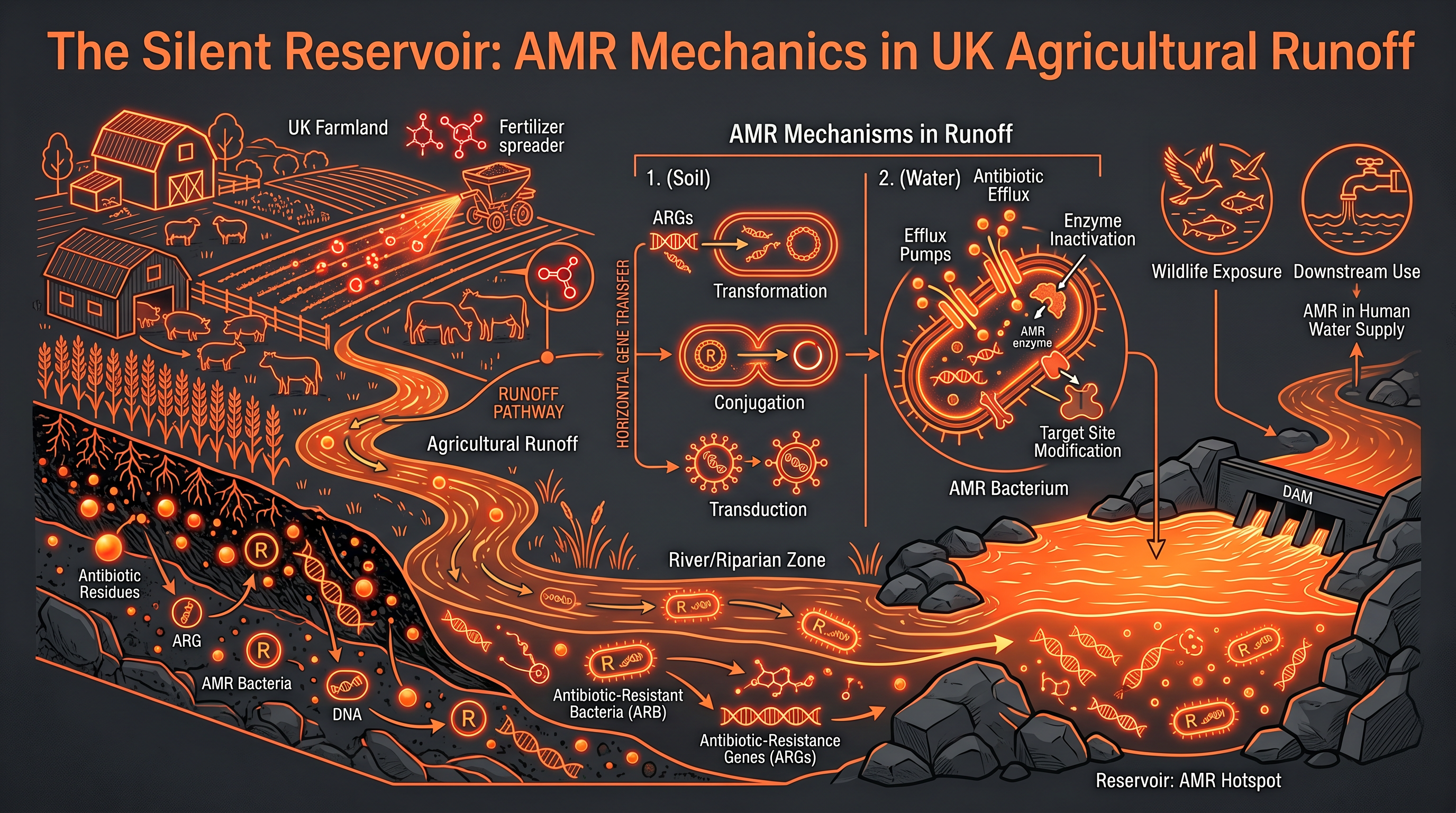
The Silent Reservoir: AMR Mechanics in UK Agricultural Runoff
Overview
The agricultural environment within the United Kingdom is far more than a simple site of food production; it represents a vast, multi-dimensional reaction vessel where biological agents, pharmaceutical residues, and environmental stressors collide. Agricultural runoff—the water that flows off farmland during the UK’s frequent heavy rainfall—acts as a primary conduit for the transport of Antimicrobial Resistance (AMR). This phenomenon is not merely the presence of resistant bacteria but the movement of a complex genetic 'resistome' that threatens to undermine modern medicine.
UK intensive farming practices, particularly in the dairy and poultry sectors, involve the management of massive volumes of slurry and manure. When these are applied to land as fertilizer, they carry not only nutrients but also a legacy of veterinary interventions. The silent reservoir refers to the soil and water systems that harbor these resistant determinants, away from the clinical gaze, yet remain intimately connected to the human food chain and public health infrastructure. To address the challenge of AMR, we must first dissect the mechanics of how resistance is cultivated, maintained, and disseminated through the British countryside.
The Biology
At the heart of the AMR crisis is the inherent plasticity of the bacterial genome. Unlike more complex organisms that rely primarily on vertical inheritance (passing traits from parent to offspring), bacteria excel at Horizontal Gene Transfer (HGT). This allows for the rapid acquisition of survival traits across different species and even different genera. In the context of agricultural runoff, this means that a harmless soil bacterium can acquire resistance from a pathogen shed by livestock, essentially becoming a 'carrier' that can later pass that resistance back to a human pathogen.
The environmental resistome acts as a precursor to clinical resistance, providing a genetic library from which human pathogens can recruit survival traits.
This biological adaptability is driven by selective pressure. When sub-lethal concentrations of antibiotics enter the soil or water through animal waste, they do not kill the bacteria outright. Instead, they create an environment where only those individuals with resistant mutations or acquired resistance genes can thrive. Over time, this shifts the entire microbial population of the soil toward a resistant state. This is not a slow evolutionary crawl; in the microbial world, this adaptation occurs with remarkable speed, often within hours of exposure to a chemical stressor.
Mechanisms at the Cellular Level
To understand how resistance survives the journey from a farm to a riverbed, we must look at the Mobile Genetic Elements (MGEs) that facilitate gene movement. These are the specialized tools of bacterial evolution. Among the most critical are plasmids, circular pieces of DNA that exist independently of the main bacterial chromosome. Plasmids often carry 'cassettes' of multiple resistance genes, meaning a single transfer event can render a bacterium resistant to several different classes of antibiotics simultaneously.
Plasmids and Conjugation
Conjugation is often described as bacterial 'mating.' It involves the physical connection of two cells via a pilus, through which a copy of a plasmid is transferred. In the nutrient-rich environment of agricultural slurry, bacterial density is high, making conjugation an incredibly efficient mechanism for spreading resistance. This is the primary driver of the rapid dissemination of extended-spectrum beta-lactamase (ESBL) genes, which are a major concern in UK healthcare settings.
Integrons and Transposons
Integrons are site-specific recombination systems that can capture and express gene cassettes. They act like a molecular 'plug-and-play' system, allowing bacteria to stack resistance genes one after another. Similarly, transposons (or 'jumping genes') can move themselves from a plasmid to the main chromosome or vice versa. These mechanisms ensure that once a resistance gene enters a microbial community, it is very difficult to remove; it simply moves into a more stable part of the genetic architecture.
Environmental Threats
The threat of AMR in runoff is amplified by the presence of co-selectors. It is a common misconception that only antibiotics drive antibiotic resistance. In reality, heavy metals such as copper and zinc, which are frequently used as growth promoters in pig and poultry feed, can select for antibiotic resistance. This occurs because the genes for metal resistance and antibiotic resistance are often located on the same MGE.
The Role of Biocides and Detergents
Beyond metals, the use of biocides and disinfectants in farm hygiene also contributes to the problem. These chemicals can trigger the upregulation of efflux pumps—proteins that bacteria use to pump out toxic substances. Crucially, these pumps are often non-specific, meaning they can pump out antibiotics just as easily as they pump out detergents. This 'cross-resistance' means that even if antibiotic use is strictly controlled, other chemical inputs can still maintain a highly resistant microbial population in the soil and water.
The Soil Microbiome as a Bio-Reactor
The soil itself is not just a filter; it is a bio-reactor. The rhizosphere (the area around plant roots) is a hotspot for microbial activity. Here, the high concentration of nutrients and the presence of root exudates stimulate high rates of bacterial metabolism and, consequently, high rates of gene exchange. When runoff carries these stimulated bacteria into local waterways, the resistance genes are already well-integrated into the population.
The Cascade
The movement of AMR determinants through the environment is best described as a cascade. It begins with the application of manure or the deposition of waste by grazing animals. From here, the mechanics of the UK’s water cycle take over. During a storm event, the sheer volume of water overcomes the soil’s infiltration capacity, leading to surface runoff. This runoff carries suspended solids, including fecal matter and soil particles, which are heavily colonized by resistant bacteria.
- —Stage 1: Terrestrial Deposition. Antibiotics and resistant bacteria enter the soil via slurry.
- —Stage 2: Hydrological Transport. Rainfall washes these agents into field drains and small streams.
- —Stage 3: Aquatic Biofilms. Once in the water system, bacteria settle into biofilms—slimy layers on the beds of rivers and inside drainage pipes. Biofilms are notoriously resistant to environmental stress and provide a stable environment for further gene exchange.
- —Stage 4: Human Exposure. These rivers may be used for irrigation, recreational activities, or as a source for drinking water, completing the loop back to the human population.
Research Evidence
Recent studies across the UK have highlighted the severity of this cascade. Research conducted on the River Thames and the River Wye has shown a significant correlation between the proximity of intensive livestock units and the prevalence of multi-drug resistant (MDR) E. coli in the water. Metagenomic sequencing of river sediments has revealed the presence of 'clinical' resistance genes—those usually found in hospitals—thriving in rural river systems.
Research indicates that the concentration of sulfonamide resistance genes in UK river sediments can be up to 100 times higher downstream of agricultural discharge points compared to upstream controls.
Furthermore, longitudinal studies have shown that these resistance traits persist in the environment long after the initial antibiotic exposure has ceased. This suggests that once the 'silent reservoir' is filled, it does not empty easily. The persistence of vancomycin-resistant enterococci (VRE) in UK farm soils years after the ban on certain growth promoters serves as a stark warning of the long-term biological 'memory' of the environment.
The UK Context
The UK faces a unique set of challenges in managing agricultural AMR. Our landscape is characterized by high-density livestock farming located in areas of high annual rainfall, such as the West Country and Wales. This creates a high risk of 'slurry surplus,' where more waste is produced than can be safely absorbed by the land. Additionally, the UK's aging infrastructure, including Victorian-era combined sewer overflows (CSOs), often fails during heavy rain, leading to a mix of agricultural and human waste entering our waterways simultaneously.
Regulatory Landscape
Post-Brexit, the UK is navigating its own regulatory path. While the UK 5-year action plan for antimicrobial resistance sets ambitious targets for reducing antibiotic use in animals, the regulation of 'environmental' AMR is still in its infancy. There is a growing push for the Environment Agency (EA) to include AMR monitoring as part of its standard water quality assessments, recognizing that traditional metrics like nitrate levels do not capture the full scope of biological risk.
The River Wye Crisis
The River Wye has become a focal point for this discussion. The massive expansion of poultry units in the catchment area has led to a significant increase in phosphate levels, but it has also introduced a massive microbial load into the river system. Local monitoring efforts have identified a troubling rise in resistant markers, highlighting the need for a more integrated approach to river health that considers both chemical and biological pollutants.
Protective Measures
Mitigating the flow of AMR into the environment requires a multi-pronged strategy that addresses the problem at the source, the transport, and the destination. We cannot rely on a single 'silver bullet' solution; rather, we need a 'One Health' approach that recognizes the interconnectedness of animal, human, and environmental health.
- —Source Control: Improving animal health through better housing and nutrition reduces the need for antibiotics in the first place. Vaccination programs are also a critical tool in reducing the pharmaceutical burden on the land.
- —Slurry Management: Moving away from raw slurry application toward anaerobic digestion can help. While AD does not eliminate all resistance genes, the heat and biological processes involved can significantly reduce the bacterial load.
- —Vegetative Buffer Strips: Planting wide strips of native vegetation between fields and watercourses can act as a natural filter. These strips slow down runoff, allowing sediment to settle and giving soil microbes time to break down pharmaceutical residues.
- —Constructed Wetlands: These engineered systems use the natural filtering power of reeds and aquatic plants to treat runoff before it enters the main river system. They have been shown to be highly effective at removing both chemical contaminants and resistant bacteria.
Key Takeaways
- —AMR is an environmental pollutant. It should be treated with the same regulatory rigor as chemical pesticides or industrial waste.
- —Horizontal Gene Transfer is the primary engine. The movement of plasmids and integrons allows resistance to jump species and survive in the 'silent reservoir' of the soil.
- —Co-selection is a major factor. Heavy metals and biocides used on farms can maintain antibiotic resistance even when antibiotic use is low.
- —The UK's climate increases risk. High rainfall and high livestock density make the UK particularly vulnerable to AMR transport via runoff.
- —A 'One Health' strategy is essential. Protecting human health requires protecting the integrity of our agricultural soils and waterways.
Understanding the mechanics of AMR in agricultural runoff is the first step toward securing our future. By treating our soil and water as vital components of our public health infrastructure, we can begin to close the door on the silent reservoir and ensure that our life-saving medicines remain effective for generations to come.