
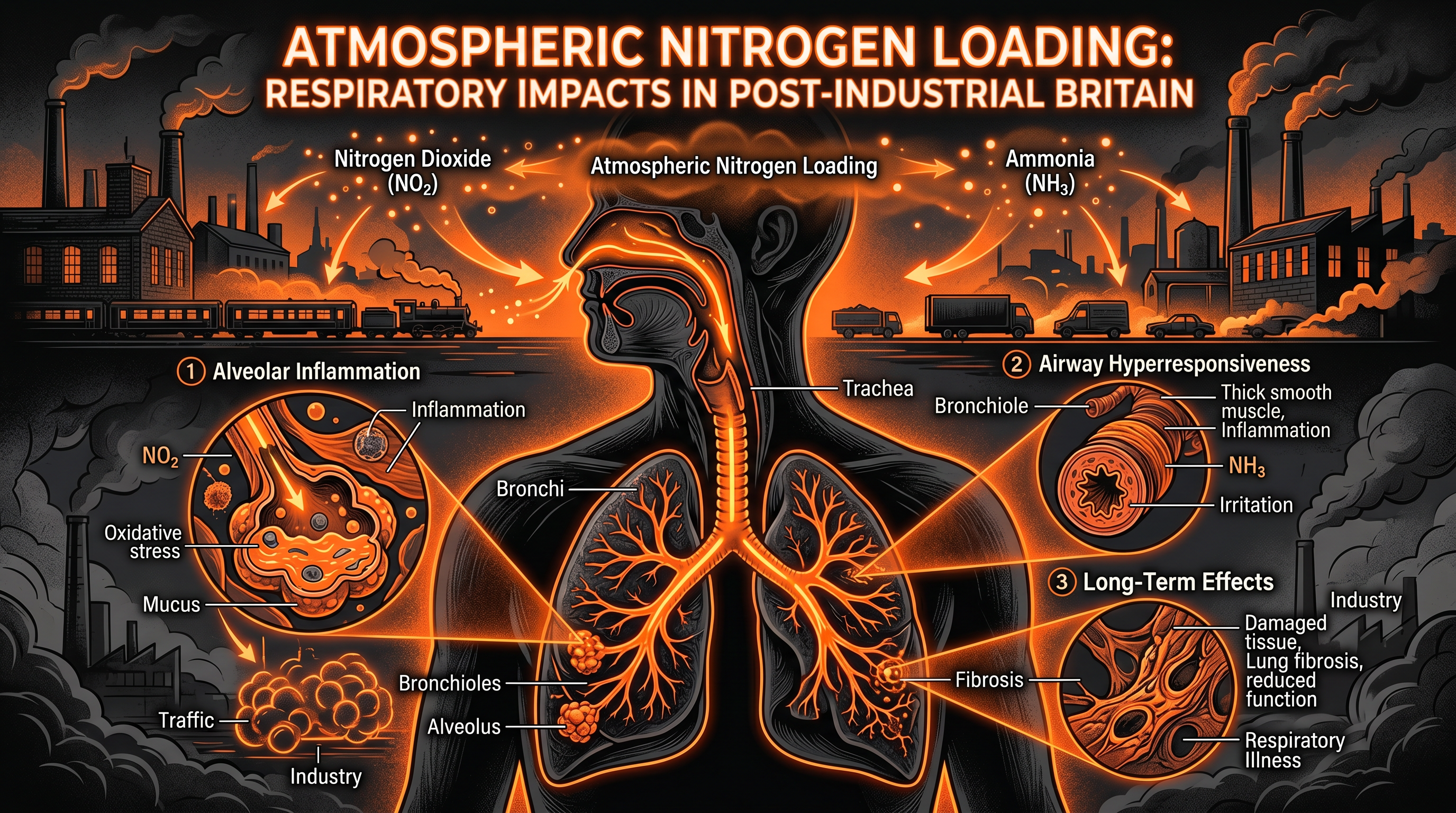
Atmospheric Nitrogen Loading: Respiratory Impacts in Post-Industrial Britain
Overview
Atmospheric nitrogen loading represents the contemporary face of Britain's long-standing struggle with air quality. While the 'Great Smogs' of the mid-20th century were defined by coal-derived sulfur dioxide, the modern post-industrial era is characterised by complex nitrogenous species. This briefing explores the biological consequences of nitrogen dioxide (NO2) and its synergy with fine particulate matter within the UK's unique geographic and industrial context.
The transition from heavy manufacturing to a service-based economy has not eliminated atmospheric loading but has instead shifted its chemical composition. Current loading is primarily driven by high-temperature combustion in transport and remaining industrial nodes, creating 'linear corridors' of high pollution. These corridors coincide with some of the UK's most densely populated regions, leading to chronic community exposure.
Biological intelligence now suggests that nitrogen loading is not merely an external irritant but a fundamental disruptor of human epigenetics. The interaction between reactive nitrogen species (RNS) and the respiratory epithelium initiates a cascade of cellular events. This briefing details how these interactions lead to long-term health degradation in post-industrial cohorts.
The shift from visible industrial smoke to invisible nitrogenous loading represents a transition from acute respiratory distress to chronic, epigenetic-driven pathology.
The Post-Industrial Legacy
Britain's industrial heartlands, particularly in the North of England and the Midlands, retain a topographical and infrastructural vulnerability to pollution. Narrow valleys and urban canyons trap nitrogenous gases, preventing the dispersal seen in more open landscapes. This 'trapping' effect ensures that local populations are subjected to concentrations that frequently exceed current World Health Organization guidelines.
The Biology
The primary interface between the atmosphere and the human body is the bronchial epithelium. This delicate layer of cells is tasked with the dual role of gas exchange and immunological defence. Nitrogen loading introduces exogenous stressors that compromise the integrity of the apical junctional complexes which hold these cells together.
When NO2 is inhaled, it dissolves into the thin layer of epithelial lining fluid (ELF) that coats the respiratory tract. Within this fluid, nitrogen oxides react with water to form nitrous and nitric acids, alongside various free radicals. This chemical reaction instantly lowers the local pH and initiates a process known as lipid peroxidation.
Lipid peroxidation targets the pulmonary surfactant, a complex mixture of phospholipids and proteins that prevents alveolar collapse. Damage to these surfactants increases the surface tension within the lungs, making breathing more mechanically demanding. This biological stressor is particularly potent in individuals with pre-existing conditions such as asthma or chronic obstructive pulmonary disease (COPD).
- —Epithelial barrier disruption occurs within minutes of high-level exposure.
- —Mucociliary clearance is inhibited, leading to a build-up of pathogens and pollutants.
- —Type II pneumocytes are forced into a state of hyper-repair, which can lead to fibrotic changes.
The lung is not a passive filter but a dynamic biological sensor that responds to nitrogen loading through immediate structural and chemical shifts.
Mechanisms at the Cellular Level
At the sub-cellular level, the impact of nitrogen loading is mediated through the production of reactive oxygen species (ROS). These molecules serve as the primary triggers for the inflammatory cascade within the lung tissue. When the production of ROS outweighs the body's natural antioxidant capacity, a state of oxidative stress ensues.
This oxidative stress activates the NF-ΙB transcription factor, which is the 'master switch' for the body's inflammatory response. Once activated, this factor moves into the cell nucleus and triggers the production of pro-inflammatory cytokines such as IL-6 and TNF-α. This creates a persistent state of 'low-grade' inflammation that never fully resolves.
Furthermore, nitrogen species can directly modify cellular proteins through a process called nitration. The addition of a nitro group to tyrosine residues on proteins can alter their structure and function. This is particularly damaging when it affects enzymes involved in cellular energy production, such as those in the mitochondria.
The Role of Particulate Matter Synergy
Nitrogen loading rarely occurs in isolation; it is almost always accompanied by PM2.5 (fine particulate matter). These particles act as 'trojan horses,' carrying adsorbed nitrogen species deep into the alveolar regions where gas exchange occurs. The synergy between these two pollutants creates a more aggressive oxidative environment than either could produce alone.
- —Synergistic loading enhances the permeability of the alveolar-capillary membrane.
- —Chronic activation of the NLRP3 inflammasome leads to programmed cell death (pyroptosis).
- —Mitochondrial dysfunction in respiratory cells reduces the energy available for cellular repair.
Environmental Threats
The environmental threat in the UK is uniquely concentrated in 'urban canyons' and along major trans-pennine routes. Regions such as the M62 corridor and the West Midlands industrial belt exhibit atmospheric profiles where nitrogen loading remains stubbornly high. These areas are often subject to temperature inversions, which trap nitrogen dioxide at ground level.
Secondary organic aerosols (SOAs) represent another significant environmental threat linked to nitrogen. Nitrogen oxides react with volatile organic compounds (VOCs) in the presence of sunlight to form these complex aerosols. In Britain's damp climate, these SOAs can persist longer and penetrate deeper into the domestic environment.
Furthermore, the 'urban heat island' effect in cities like London and Manchester accelerates the chemical reactions that produce ground-level ozone from nitrogen oxides. This creates a secondary layer of biological threat, as ozone is a potent respiratory irritant. The combined effect is a 'toxic cocktail' that defines the modern British urban environment.
Environmental nitrogen loading in the UK is a product of historical infrastructure meeting modern combustion chemistry.
The Cascade (Exposure to Disease)
The progression from initial nitrogen exposure to chronic respiratory disease is a multi-stage cascade. It begins with acute airway hyper-responsiveness, often dismissed as a minor cough or 'seasonal' irritation. Over time, this acute response transitions into chronic remodeling of the airway walls.
One of the most significant discoveries in recent years is the role of epigenetic modifications in this cascade. Nitrogen loading has been shown to alter DNA methylation patterns in genes responsible for lung development and immune regulation. These changes act as a biological 'memory' of pollution exposure.
In post-industrial cohorts, these epigenetic markers are often passed down, or at least established early in childhood. This leads to a phenomenon known as 'accelerated lung ageing,' where a 40-year-old's respiratory function may resemble that of a 60-year-old. The cascade ends in chronic conditions like COPD, which are highly prevalent in former industrial heartlands.
- —Stage 1: Acute oxidative stress and surfactant damage.
- —Stage 2: Chronic cytokine release and immune cell recruitment.
- —Stage 3: Fibroblast activation and airway wall thickening.
- —Stage 4: Permanent epigenetic silencing of protective genes.
Research Evidence
Recent data from the UK Biobank has provided definitive evidence linking NO2 loading to lung function decline. A study of over 300,000 individuals found a linear relationship between nitrogen exposure and reduced FEV1 (Forced Expiratory Volume). This effect was observed even at concentrations below current legal limits.
Longitudinal studies in cities like Leicester and Sheffield have focused on the epigenetic 'clocks' of residents in high-loading zones. Research indicates that children growing up in these corridors have significantly higher levels of methylation in the TET genes. These genes are crucial for maintaining the flexibility of the immune system.
Furthermore, the ESCAPE study (European Study of Cohorts for Air Pollution Effects) highlighted the UK as a region of particular concern. The data showed that for every 10 μg/m³ increase in NO2, there was a measurable increase in the incidence of lung cancer. This held true even for non-smokers, pointing directly to atmospheric loading as the primary driver.
- —The UK Biobank confirms a strong correlation between NO2 and COPD prevalence.
- —Epigenetic studies show 'signature' methylation patterns in urban cohorts.
- —Research indicates that nitrogen loading contributes to roughly 40,000 premature deaths annually in the UK.
The UK Context
The UK's specific history with 'dieselisation' has created a unique nitrogen loading profile. In the early 2000s, tax incentives encouraged a massive shift toward diesel vehicles to reduce CO2 emissions. However, this policy overlooked the significantly higher output of nitrogen oxides (NOx) from diesel engines.
This legacy is now being addressed through the implementation of Clean Air Zones (CAZ) in cities such as Birmingham, Bath, and Bristol. These zones aim to reduce loading by charging older, higher-emission vehicles. While successful in some areas, the displacement of traffic to the peripheries of these zones creates new 'pollution hotspots' in suburban industrial areas.
Additionally, the UK's ageing housing stock plays a role in nitrogen exposure. Many post-industrial homes are located near major arterial roads and lack modern air filtration systems. This means that atmospheric nitrogen loading is not just an outdoor threat but an indoor reality for millions of British citizens.
The 'dieselisation' legacy remains one of the most significant public health missteps in modern UK history, directly contributing to current nitrogen loading levels.
Protective Measures
Addressing nitrogen loading requires a combination of macro-level policy and micro-level biological protection. On a structural level, the transition to Electric Vehicles (EVs) and the expansion of active travel infrastructure are essential. However, these changes will take decades to fully mitigate the existing atmospheric loading.
Public health interventions now include 'nature-based solutions,' such as the planting of urban forests. Specific tree species, such as birch and pine, are particularly effective at capturing nitrogenous gases and particulates. These green barriers are being integrated into the design of new school playgrounds and residential developments in high-risk zones.
On a biological level, research into 'nutri-epigenetics' suggests that certain antioxidants may help mitigate nitrogen-induced damage. Compounds such as sulforaphane, found in cruciferous vegetables, can activate the Nrf2 pathway. This pathway boosts the body's endogenous production of protective enzymes like glutathione, providing a cellular shield against oxidative stress.
- —HEPA filtration in schools and homes near industrial corridors can reduce indoor loading.
- —Urban planning must prioritise 'ventilation paths' to prevent gas trapping.
- —Clinical monitoring of epigenetic biomarkers may soon allow for targeted interventions in at-risk populations.
Key Takeaways
Atmospheric nitrogen loading is a primary driver of respiratory health inequality in post-industrial Britain. The synergy between nitrogen dioxide and particulate matter creates a potent biological stressor that targets the epithelial barrier and triggers chronic inflammation. This process is reinforced by epigenetic modifications that can persist for a lifetime.
The UK's unique transport history and geographic 'hotspots' make this a particularly British challenge. Understanding the deep mechanistic details of how nitrogenous species interact with human cells is vital for developing effective public health strategies. Moving forward, the focus must shift from merely measuring gas concentrations to assessing the total biological burden on the population.
- —Nitrogen loading is an invisible but persistent biological threat in the UK.
- —Epigenetic modifications provide a mechanism for long-term health decline.
- —Post-industrial corridors are at the highest risk due to infrastructure and topography.
- —Mitigation requires both environmental policy and cellular-level protection.
The future of UK respiratory health depends on our ability to decarbonise our atmosphere and desensitise our biology to nitrogenous loading.