
Microplastic Bio-Accumulation: The Internal UK Landscape
Overview
The United Kingdom faces a burgeoning environmental crisis that has moved from the oceans into the very air we breathe. Microplastics, once considered a primarily marine contaminant, are now recognised as a pervasive atmospheric pollutant in UK urban centres. These microscopic synthetic polymers originate from tyre wear, textile shedding, and industrial degradation. Current evidence suggests that the 'internal landscape' of the British public is increasingly colonised by these persistent materials.
Recent monitoring in cities like London and Manchester has revealed some of the highest recorded levels of atmospheric microplastic deposition globally. These particles do not merely settle on surfaces; they remain suspended in the breathing zone of the populace. As these fragments decrease in size, their biological reactivity increases, posing a direct challenge to the integrity of human physiological barriers. This briefing examines the transition of plastics from the environment into the deepest recesses of the human body.
The Shift to Atmospheric Concern
For decades, the focus of microplastic research remained tethered to the 'Blue Planet' narrative of oceanic pollution. However, the UK's high population density and reliance on road transport have shifted the priority toward inhalation as a primary exposure route. Airborne microplastics (AMPs) bypass the digestive system's first-pass metabolism, allowing direct access to the respiratory mucosa. This pathway is particularly critical in the 'street canyons' of British metropolitan areas.
- —Tyre wear particles (TWPs) account for a significant portion of the urban aerosol mass.
- —Synthetic fibres from indoor environments contribute to the cumulative inhalation burden.
- —Fragmented road markings and industrial coatings serve as secondary sources of AMPs.
The atmospheric pathway represents a direct, non-consensual entry point for synthetic polymers into the human systemic circulation.
The Biology
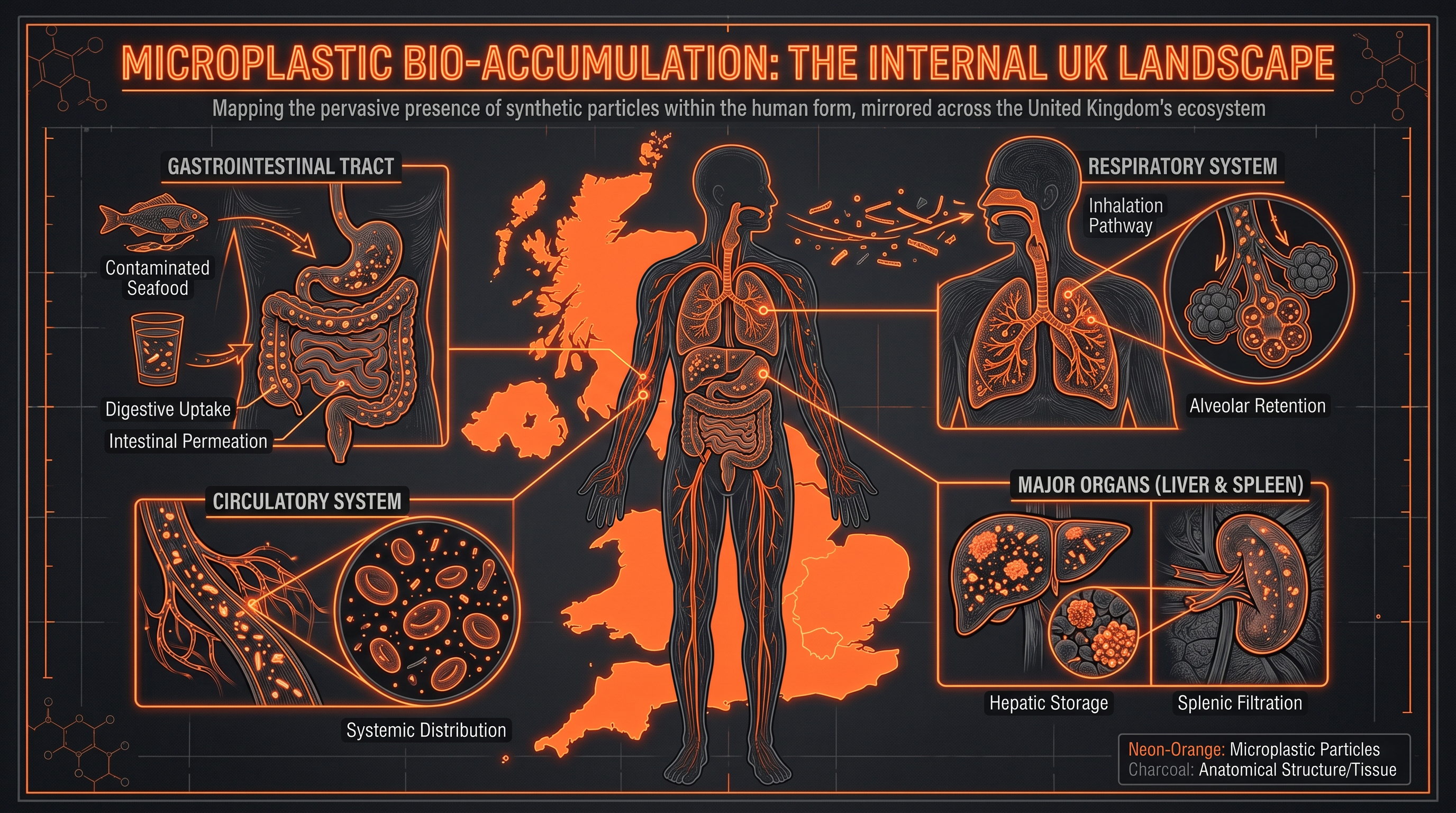
The primary biological interface between the UK atmosphere and the human body is the respiratory system. Unlike the gastrointestinal tract, the lungs lack the robust acidic barriers and thick mucous shielding found in the stomach. When microplastics are inhaled, they traverse the trachea and bronchi, eventually reaching the alveoli. This is the critical site of gas exchange, where the barrier between air and blood is thinnest.
Particles smaller than 2.5 micrometres, often referred to as PM2.5, can penetrate the deep lung tissue where they lodge within the alveolar sacs. At this junction, the alveolar-capillary barrier—comprised of a single layer of epithelial cells and a thin basement membrane—is the only thing preventing systemic entry. Synthetic polymers exhibit a unique persistence, resisting the phagocytic action of alveolar macrophages. This resistance leads to chronic presence within the pulmonary architecture.
Pulmonary Translocation
Once a microplastic particle is deposited on the alveolar surface, it interacts with the pulmonary surfactant. This interaction can alter the surface tension of the lung, potentially impacting respiratory efficiency. More critically, the particles can trigger a process of translocation, moving from the air spaces into the interstitial tissue. From here, they gain access to the lymphatic system and the micro-vasculature of the lungs.
- —Alveolar macrophages attempt to engulf particles but often fail due to the plastic's chemical inertness.
- —Frustrated phagocytosis leads to the release of pro-inflammatory cytokines.
- —Increased permeability of the epithelial barrier facilitates the passage of smaller nanoplastics.
Mechanisms at the Cellular Level
The translocation of microplastics into the circulatory system is governed by complex cellular mechanics. One of the primary modes of entry is endocytosis, where the cell membrane wraps around the plastic particle to pull it inside. Once inside the cell, these particles can disrupt organelle function, particularly the mitochondria and lysosomes. This cellular 'invasion' is often stealthy, as the plastics are coated in a protein corona.
This protein corona is a layer of biomolecules that adsorb onto the surface of the plastic immediately upon contact with bodily fluids. It effectively 'disguises' the plastic, allowing it to bypass the immune system's initial detection mechanisms. The composition of this corona dictates the particle's eventual destination within the body. In the UK context, the specific chemical additives found in British-manufactured tyres and textiles influence this protein binding.
Paracellular and Transcellular Transport
In addition to being swallowed by cells, microplastics can move between cells through paracellular transport. This occurs when the 'tight junctions' that hold cells together are weakened by local inflammation or oxidative stress. Once these junctions are compromised, plastics can leak directly into the bloodstream. This 'leaky barrier' syndrome is a significant concern for those living in highly polluted UK corridors.
- —Nanoplastics (less than 100nm) can even penetrate the nuclear envelope, potentially interacting with DNA.
- —Plastic-induced oxidative stress generates reactive oxygen species (ROS) that damage cell membranes.
- —The 'Trojan Horse' effect allows plastics to carry heavy metals and polycyclic aromatic hydrocarbons (PAHs) into the cell.
The cellular uptake of microplastics is not merely a physical intrusion but a biochemical disruption of the cell's internal environment.
Environmental Threats
The UK’s urban landscape presents a unique set of environmental threats that exacerbate microplastic bio-accumulation. The high density of road networks in regions like the South East and the West Midlands results in massive volumes of tyre wear particles. These particles are often complex composites of synthetic rubber, carbon black, and heavy metals. Their aerodynamic properties allow them to remain airborne for extended periods.
Indoor environments in the UK also play a pivotal role in the exposure landscape. Modern British homes are often heavily carpeted and furnished with synthetic textiles like polyester and nylon. These environments have been found to contain significantly higher concentrations of microplastic fibres than outdoor air. Given that the average UK citizen spends over 90% of their time indoors, the 'domestic dust' pathway is a major contributor to the internal plastic load.
The Urban Street Canyon Effect
In many historic UK cities, narrow streets and tall buildings create 'street canyons' that trap pollutants. This effect prevents the dispersion of microplastics generated at the ground level by traffic. Pedestrians and cyclists in these areas are exposed to concentrated 'clouds' of synthetic debris. The lack of adequate green screening in many British urban centres further worsens the retention of these particles.
- —Rainfall in the UK often 'washes' microplastics out of the air, but this 'wet deposition' can concentrate them on walkways.
- —Construction sites across growing UK hubs are major sources of fragmented polystyrene and PVC dust.
- —Agricultural plastics used in the UK hinterlands can become airborne during dry periods and migrate to urban centres.
The Cascade: Exposure to Disease
The translocation of microplastics from the lungs to the blood triggers a systemic cascade of biological events. Once in the circulatory system, microplastics can interact with red blood cells and platelets. There is growing concern that these particles may promote 'micro-clotting' or contribute to the development of atherosclerosis. The presence of foreign synthetic bodies in the blood keeps the innate immune system in a state of chronic low-grade activation.
Beyond the blood, the endocrine system is particularly vulnerable to the chemical leachates associated with microplastics. Additives such as bisphenols (BPA) and phthalates are known endocrine-disrupting chemicals (EDCs). As microplastics accumulate in organs like the liver, kidneys, and even the brain, they slowly release these toxins. This can disrupt the delicate hormonal balance required for metabolic and reproductive health.
Chronic Inflammatory Pathogenesis
The persistent presence of microplastics leads to what clinicians call 'sterile inflammation.' This is an immune response that occurs in the absence of pathogens. Over time, this state of constant inflammation can lead to tissue scarring (fibrosis) and the development of chronic obstructive pulmonary disease (COPD) or cardiovascular issues. In the UK, the rising incidence of these conditions in non-smokers is prompting closer scrutiny of environmental microplastics.
- —Neurotoxicity is a concern as nanoplastics have been shown to cross the blood-brain barrier in animal models.
- —Maternal-foetal transfer has been confirmed, with microplastics detected in human placentas.
- —Metabolic disruption may contribute to the UK's rising rates of obesity and Type 2 diabetes.
The journey of a microplastic particle does not end in the blood; it marks the beginning of a life-long chemical and physical interaction with the host's biology.
Research Evidence
Groundbreaking research conducted within the UK has been instrumental in defining the scope of this issue. In 2022, scientists at the Hull York Medical School and the University of Hull detected microplastics in live human lung tissue for the first time. The study identified twelve different types of plastic, with polypropylene and PET being the most common. This provided definitive proof that inhalation leads to deep-tissue deposition.
Furthermore, research involving UK cohorts has highlighted the presence of microplastics in human blood. These studies utilised sophisticated techniques like Pyrolysis-Gas Chromatography-Mass Spectrometry (Py-GC-MS) to quantify plastic levels. The evidence suggests that for many in the UK, synthetic polymers are a standard component of their internal biochemistry. This data is currently being used to model the long-term health trajectories of the British population.
Key UK Studies and Findings
- —The King’s College London air quality group has mapped the deposition of microplastics across the capital.
- —Research into the 'plastisphere'—the microbial community living on plastic—has shown that AMPs in the UK can carry pathogens.
- —Longitudinal studies are now assessing the correlation between high microplastic exposure and autoimmune markers.
The UK Context
The UK's regulatory and geographical context provides a specific backdrop for the microplastic issue. Since leaving the European Union, the UK has operated under UK REACH, its own chemical regulatory framework. There is ongoing debate regarding how strictly the UK will regulate microplastic additives compared to its neighbours. The high reliance on gas boilers and the specific 'damp' climate of the British Isles also influence how microplastics behave in the domestic environment.
Geographically, the 'Blue Belt' and coastal UK towns face a dual threat. They are exposed to both atmospheric microplastics from urban drift and 'sea spray' aerosols containing microplastics from the ocean. This creates a unique exposure profile for coastal residents. Additionally, the UK's ageing infrastructure often contributes to microplastic release from old coatings and pipes.
Policy and Public Health Response
The NHS is beginning to recognise environmental pollutants beyond traditional gases like NO2. There is a growing movement to integrate 'environmental history' into patient assessments, particularly for respiratory and endocrine clinics. However, policy changes regarding tyre composition and textile standards are still in their infancy. The UK Government's '25 Year Environment Plan' mentions microplastics, but many experts argue the focus remains too heavily on litter rather than invisible aerosols.
- —London’s Ultra Low Emission Zone (ULEZ) focuses on exhaust, but does not yet address non-exhaust microplastics.
- —The UK's textile industry is under pressure to adopt mandatory microfibre filters in washing machines.
- —Public awareness in the UK is high, but practical 'bio-security' measures for the home are not yet standardised.
Protective Measures
While the elimination of microplastics from the UK environment is a long-term goal, individual and structural protective measures can be implemented now. At a structural level, the installation of HEPA (High-Efficiency Particulate Air) filtration in public buildings and schools can significantly reduce the inhalation burden. Urban planning that prioritises 'green buffers' between roads and pedestrian zones can also help filter out larger tyre wear particles.
Individually, UK residents can reduce their exposure by addressing the 'domestic' source of plastics. This includes choosing natural fibres like wool or cotton over synthetic fleece and ensuring adequate ventilation to prevent dust accumulation. The use of high-quality vacuum cleaners with sealed HEPA systems is also recommended. While these measures do not eliminate the risk, they reduce the cumulative 'plastic load' the body must manage.
Mitigation Strategies
- —Air Purification: Using medical-grade purifiers in bedrooms to reduce the nocturnal inhalation of fibres.
- —Dietary Antioxidants: Increasing intake of antioxidants to help the body combat plastic-induced oxidative stress.
- —Policy Advocacy: Supporting UK-based initiatives that call for 'closed-loop' tyre manufacturing and synthetic textile regulation.
Protection against microplastic bio-accumulation requires a dual approach: personal vigilance and systemic regulatory reform.
Key Takeaways
- —Atmospheric Microplastics are a primary route of entry into the human body in the UK, bypassing traditional barriers through inhalation.
- —The Alveolar-Capillary Barrier is the critical junction where microplastics transition from the environment into the circulatory system.
- —Translocation is facilitated by cellular endocytosis and the formation of a protein corona that masks the plastic from the immune system.
- —Tyre Wear and indoor synthetic fibres are the leading sources of microplastic exposure for the British public.
- —Chronic Inflammation and endocrine disruption are the primary long-term health risks associated with internal plastic accumulation.
- —UK Research has definitively proven the presence of microplastics in human lungs and blood, moving the issue from theory to clinical reality.
- —Regulatory Gaps remain in the UK, particularly regarding non-exhaust emissions and indoor air quality standards.
- —Protective Measures such as HEPA filtration and a shift to natural textiles can reduce the individual bio-accumulation rate.
- —Urgent Action is required to bridge the gap between environmental monitoring and public health policy in the United Kingdom.