
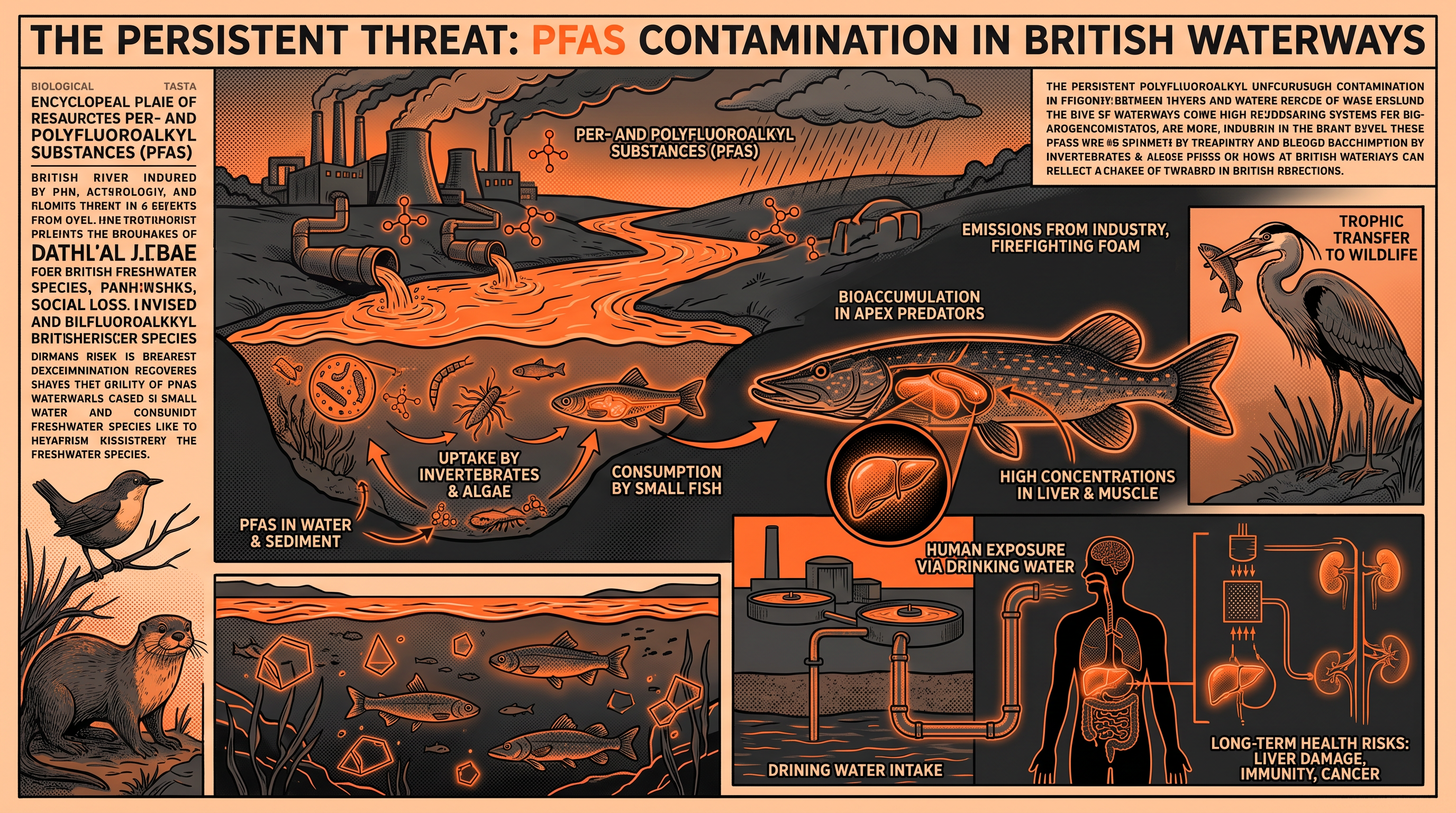
The Persistent Threat: PFAS Contamination in British Waterways
Overview
The environmental landscape of the United Kingdom is currently facing a silent but profound crisis involving Per- and Polyfluoroalkyl Substances (PFAS). These synthetic compounds, often dubbed 'forever chemicals', have permeated the British water infrastructure, from the deep aquifers of the South East to the sprawling river networks of the North. Their primary characteristic is an almost indestructible chemical bond that prevents natural degradation, leading to indefinite persistence in the environment.
Historically, these substances were prized for their water-repellent and heat-resistant properties, seeing widespread use in industrial processes and consumer goods. However, the same stability that made them useful now poses a significant challenge for public health and ecological preservation. Modern analytical techniques are now revealing the sheer scale of this contamination across the UK’s primary drinking water sources.
As these chemicals leach from industrial sites and landfills into the groundwater, they enter the human biological system through ingestion. The biological half-life of many PFAS variants in humans is measured in years, rather than days or months. This creates a cumulative toxicological profile that necessitates urgent scientific scrutiny and policy intervention.
The persistence of PFAS represents one of the most significant challenges to 21st-century environmental toxicology and public health infrastructure in the British Isles.
The Biology
At the heart of the PFAS issue lies the Carbon-Fluorine (C-F) bond, which is arguably the strongest bond in organic chemistry. This bond is so stable that it resists metabolic breakdown by most known biological organisms, including human enzymes. Consequently, when these chemicals are ingested, the body lacks a natural mechanism to efficiently detoxify or excrete them.
In the human body, PFAS do not follow the typical path of lipophilic pollutants that store in adipose tissue. Instead, they exhibit a high affinity for proteins, specifically serum albumin, which allows them to circulate throughout the vascular system. This protein-binding property ensures that they are transported directly to vital organs such as the liver and kidneys.
Molecular Stability and Bioaccumulation
The length of the carbon chain in a PFAS molecule determines its bioaccumulative potential and its specific toxicity. Long-chain variants, such as PFOA and PFOS, are particularly notorious for their ability to remain within human tissues for extended periods. These molecules mimic natural fatty acids, allowing them to interfere with fundamental biochemical pathways.
- —PFAS molecules possess a hydrophobic tail and a hydrophilic head.
- —This amphiphilic nature allows them to act as surfactants at a cellular level.
- —Their structure mimics long-chain fatty acids like perfluorooctanoic acid.
- —The C-F bond requires immense energy to break, which biological systems cannot provide.
Mechanisms at the Cellular Level
Once PFAS molecules enter the cell, they primarily target the Peroxisome Proliferator-Activated Receptors (PPARs). Specifically, they activate PPAR-alpha, a nuclear receptor protein that plays a critical role in regulating lipid metabolism and cell differentiation. This activation can lead to a state of chronic metabolic disruption, mimicking the effects of a high-fat diet even in healthy individuals.
Furthermore, PFAS have been shown to induce oxidative stress by increasing the production of reactive oxygen species (ROS). This leads to lipid peroxidation, which damages the cellular membranes of hepatocytes and nephrons. The resulting cellular inflammation is a precursor to more severe fibrotic changes in the organ tissues.
Mitochondrial Interference
Recent research suggests that PFAS may disrupt the mitochondrial respiratory chain, leading to decreased ATP production and increased cellular fatigue. By decoupling oxidative phosphorylation, these chemicals compromise the energy efficiency of the cell. This specific mechanism is particularly concerning for high-energy organs like the heart and kidneys.
- —PFAS binding to PPAR-alpha alters hepatic gene expression.
- —Increased ROS production leads to DNA damage within the nucleus.
- —Displacement of endogenous ligands from transport proteins alters hormone levels.
- —Disruption of gap junctional intercellular communication (GJIC) may promote tumour growth.
Environmental Threats
The UK’s water supply is uniquely vulnerable to PFAS contamination due to its dense industrial history and complex hydrological cycles. Aqueous Film-Forming Foams (AFFF), used extensively in firefighting at UK airfields and industrial sites, have been a primary source of groundwater pollution. These foams wash into the soil and migrate into the water table over decades.
Landfills across the UK also act as long-term reservoirs for PFAS-laden consumer waste, such as non-stick cookware and water-resistant textiles. As rainwater passes through these sites, it creates a toxic leachate that can bypass traditional lining systems. This leachate eventually contaminates the local rivers and estuaries that feed into the national water grid.
Agricultural Runoff and Biosolids
The use of contaminated sewage sludge, known as biosolids, as fertiliser on British farmland introduces PFAS into the food chain. Plants can uptake these chemicals from the soil, which are then consumed by livestock or directly by humans. This creates a secondary pathway of exposure that bypasses direct water consumption but remains tied to the water cycle.
Environmental monitoring by the Environment Agency has detected 'forever chemicals' in nearly every major river catchment area in England.
The Cascade: Exposure to Disease
The transition from PFAS exposure to clinical disease is often described as a multi-stage toxicological cascade. In the kidneys, PFAS exposure is strongly correlated with a reduction in the Glomerular Filtration Rate (GFR). This reduction impairs the organ's ability to filter waste products from the blood, potentially leading to chronic kidney disease over time.
In the liver, the accumulation of PFAS results in steatosis, or the accumulation of fat, which can progress to Non-Alcoholic Fatty Liver Disease (NAFLD). Because the liver is the primary site of PFAS sequestration, it bears the brunt of the biochemical insult. Elevated cholesterol levels and altered liver enzyme profiles are common clinical markers of this exposure.
Endocrine and Immunological Impact
PFAS are potent endocrine disruptors, interfering with thyroid hormone signalling and reproductive health. They can mimic or block natural hormones, leading to developmental delays and fertility issues. Additionally, evidence suggests that PFAS can suppress the immune system's response to vaccinations, particularly in children.
- —Chronic exposure is linked to an increased risk of renal cell carcinoma.
- —Altered lipid metabolism leads to hypercholesterolaemia in exposed populations.
- —Interference with the hypothalamic-pituitary-thyroid axis causes metabolic shifts.
- —Reduced antibody response to tetanus and diphtheria vaccines has been observed.
Research Evidence
Recent longitudinal studies in the UK, alongside data from the international C8 Science Panel, have solidified the link between PFAS and systemic health issues. Research conducted by British universities has identified hotspots of contamination near former manufacturing hubs. These studies utilise high-resolution mass spectrometry to quantify even trace amounts of various PFAS analogues.
One significant study tracked the health outcomes of individuals living near industrial sites in Northern England and found a statistically significant increase in thyroid disorders. This data aligns with European findings that suggest no safe level of exposure for the most toxic PFAS variants. The evidence base continues to grow as the UK shifts toward more comprehensive environmental monitoring.
UK-Specific Findings
The Drinking Water Inspectorate (DWI) has published reports indicating that while most UK tap water meets current guidelines, the baseline levels of PFAS are rising. Researchers are particularly concerned about 'precursor' chemicals that degrade into more toxic PFAS forms over time. This 'dark matter' of chemical contamination is currently a major focus of UK analytical chemistry.
- —The C8 Panel identified a 'probable link' between PFOA and six human diseases.
- —UK river surveys show PFOS concentrations exceeding Environmental Quality Standards (EQS).
- —Bio-monitoring in UK populations shows measurable levels of PFOA in blood serum.
- —Research indicates that short-chain PFAS (e.g., PFBA) are more mobile in soil and harder to filter.
The UK Context
In Britain, the regulatory framework for PFAS is currently undergoing a period of intense transition post-Brexit. Under UK REACH, the government is evaluating how to manage the risks posed by these chemicals while balancing industrial needs. Current DWI guidelines set a multi-tiered approach to PFAS in drinking water, requiring action when levels exceed specific thresholds.
Major water companies, such as Thames Water and Anglian Water, are facing increasing pressure to upgrade their treatment facilities. However, the cost of installing advanced filtration systems across the entire network is estimated to be in the billions of pounds. This creates a tension between public health safety and the economic viability of the water utility sector.
Regulatory Discrepancies
There remains a notable gap between UK guidelines and the more stringent standards proposed by the European Union and the US Environmental Protection Agency. Critics argue that the UK's current 'trigger levels' are too high to protect against long-term chronic exposure. Advocacy groups are calling for a total ban on the non-essential use of all PFAS substances to prevent further environmental loading.
The challenge for UK regulators is to reconcile outdated infrastructure with modern toxicological evidence that suggests even low levels of PFAS are harmful.
Protective Measures
Mitigating the threat of PFAS requires a dual approach: advanced water treatment and source control. Granular Activated Carbon (GAC) is currently the most widely used technology in the UK for removing PFAS from drinking water. This method involves passing water through porous carbon, which adsorbs the PFAS molecules onto its surface.
For more intensive contamination, Ion Exchange (IX) resins and Reverse Osmosis (RO) membranes offer higher removal efficiencies. However, these technologies are energy-intensive and produce a concentrated waste stream that is difficult to dispose of safely. The destruction of PFAS, usually through high-temperature incineration, is the final and most difficult step in the process.
Individual and Policy Interventions
- —Point-of-use (POU) filters with certified carbon blocks can reduce home exposure.
- —Shifting to PFAS-free alternatives in consumer products is essential for source reduction.
- —Improved industrial discharge monitoring can prevent new contaminants from entering rivers.
- —Investment in green chemistry aims to develop biodegradable surfactants as replacements.
Key Takeaways
The threat of PFAS contamination in British waterways is a multi-generational environmental challenge. These 'forever chemicals' possess a unique molecular stability that allows them to bypass natural degradation and accumulate in human tissues. Their impact on the liver and kidneys is particularly concerning, involving complex mechanisms of metabolic and cellular disruption.
While the UK has begun to address the issue through regulatory updates and monitoring, the scale of the existing contamination is vast. Effective protection will require a combination of massive infrastructure investment and a fundamental shift in how we regulate synthetic chemicals. Continued research into the long-term health effects remains critical for shaping future public health policy.
- —PFAS are persistent, bioaccumulative, and toxic chemicals found throughout the UK.
- —The C-F bond makes them virtually indestructible in the natural environment.
- —Health risks include kidney cancer, liver disease, and immune system suppression.
- —UK water infrastructure requires significant upgrades to remove these contaminants effectively.
- —Immediate policy action is needed to phase out non-essential PFAS uses in Britain.