
Vector-Borne Shifts: The Emergence of Novel Pathogens in the UK
Overview
The United Kingdom is currently navigating a profound and irreversible transformation in its epidemiological landscape. Historically, the British Isles have been protected by a temperate maritime climate that acted as a biological buffer, limiting the establishment of various infectious diseases common in tropical and sub-tropical regions. However, as global climate patterns trend towards milder, shorter winters and increasingly intense, humid summers, these traditional barriers are eroding at an unprecedented rate. This briefing provides a definitive analysis of the mechanics driving this shift, specifically examining the vectors—primarily ticks and mosquitoes—that serve as the primary conduits for novel pathogens entering the UK. We are witnessing a bioclimatic transition where the UK is shifting from a 'low-risk' safety zone to an environment capable of sustaining complex and persistent zoonotic cycles.
The core driver of this change is the thermal acceleration of biological processes within vector organisms. As environmental temperatures rise, the physiological constraints that once prevented certain pathogens from completing their life cycles in Britain are being lifted. This is not a future projection but a current reality; we are seeing the emergence of pathogens such as Tick-borne Encephalitis Virus (TBEV) and the potential for West Nile Virus (WNV) to become endemic. The implications for public health, veterinary surveillance, and national biosecurity are significant, necessitating a rigorous re-evaluation of our environmental monitoring frameworks and clinical readiness.
The UK's bioclimatic profile is transitioning from a temperate safety zone to an environment capable of sustaining complex zoonotic cycles, where the metabolic threshold for pathogen transmission is being met with increasing frequency.
The Biology
To understand the emergence of novel pathogens, one must first understand the fundamental biology of the vectors. Ticks and mosquitoes are ectotherms, meaning their internal body temperature and metabolic rates are governed entirely by the ambient environment. This physiological dependency makes them hyper-sensitive to even marginal increases in average temperatures. For the Ixodes ricinus tick, which is the primary vector for Lyme Borreliosis and now TBEV in the UK, temperature dictates every facet of its existence, from questing behavior to the speed of its developmental transitions.
The Ixodes ricinus Life Cycle
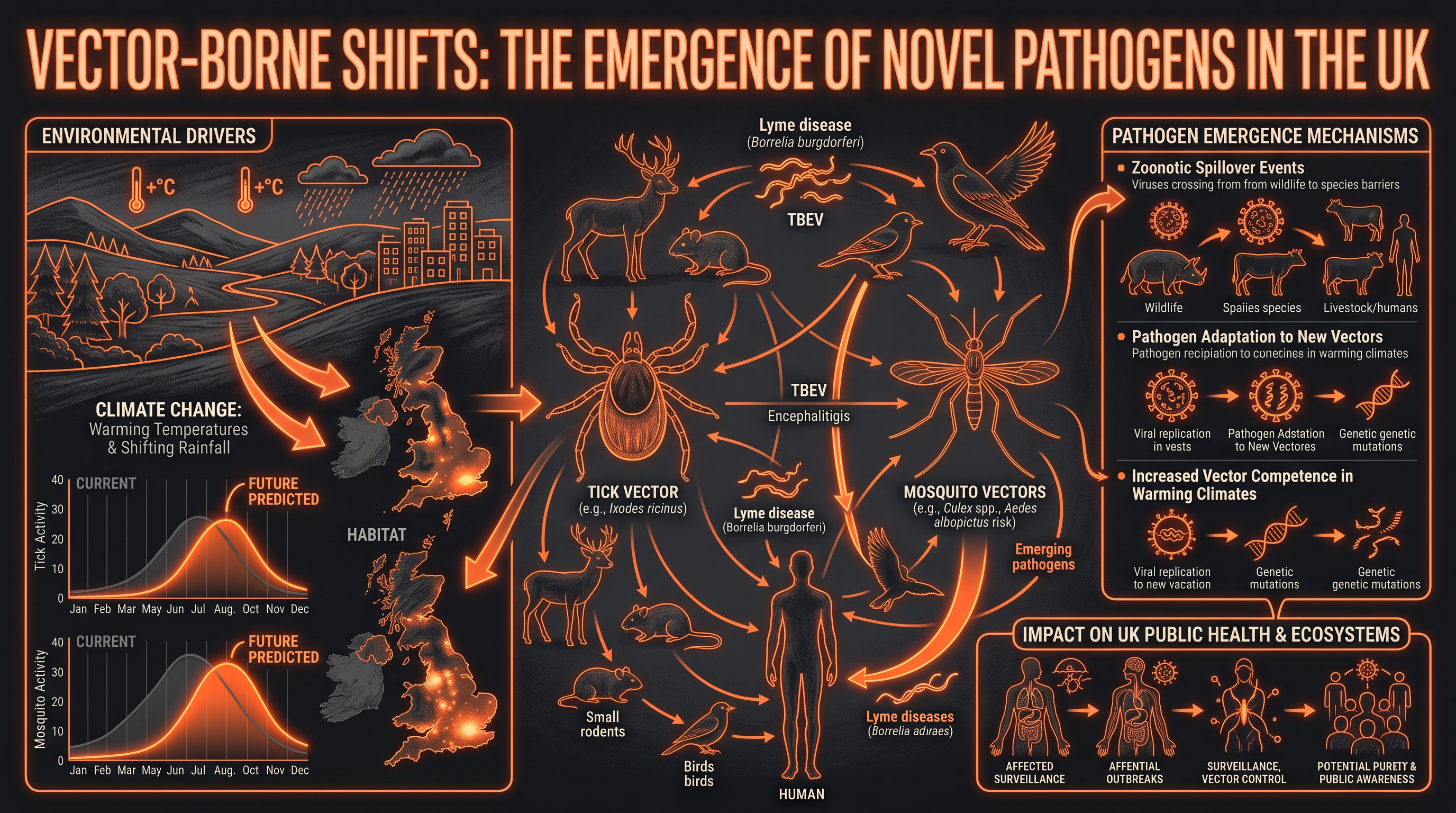
The life cycle of *Ixodes ricinus* involves three distinct stages: larva, nymph, and adult. In traditional UK climates, this cycle could take up to three or four years to complete. However, warmer conditions are significantly shortening this duration. A higher thermal sum—the cumulative heat required for development—allows the tick to move through its life stages more rapidly. This acceleration leads to a higher density of nymphs, which are the stage most likely to transmit disease to humans due to their small size and aggressive feeding habits. Furthermore, milder winters reduce winter mortality rates, allowing a larger percentage of the population to survive into the following spring.
Mosquito Phenology and Population Dynamics
Mosquito biology is similarly reactive to thermal shifts. The Culex pipiens complex, ubiquitous across the UK, is experiencing a fundamental change in its phenology—the timing of biological events. Warmer spring temperatures trigger an earlier emergence from diapause, the state of physiological dormancy used to survive winter. This early start, combined with accelerated larval development in warmer standing water, allows for additional generations to be produced within a single calendar year. The result is an exponential increase in the potential vector population density by late summer, coinciding with the peak period for human outdoor activity and bird migration.
Mechanisms at the Cellular Level
The most critical mechanism at the cellular level regarding vector-borne disease is the Extrinsic Incubation Period (EIP). The EIP is defined as the time interval between a vector ingesting a pathogen during a blood meal and that vector becoming capable of transmitting the pathogen to a new host. For a virus to be transmitted, it must first infect the mosquito’s midgut, replicate, escape into the hemocoel, and finally reach the salivary glands. This entire process is highly temperature-dependent.
Viral Replication and Enzymatic Kinetics
At higher temperatures, the enzymatic processes required for viral replication—such as the action of RNA-dependent RNA polymerase—occur with greater velocity. This significantly shortens the EIP. For example, a virus that might take 20 days to reach the salivary glands at 18°C might take only 8 to 10 days at 25°C. In a UK context, this shortening of the EIP is the difference between a mosquito dying of natural causes before it becomes infectious and that same mosquito surviving long enough to transmit a pathogen like Usutu Virus or West Nile Virus to multiple hosts.
Alterations in Vector Competence
Beyond the speed of replication, temperature influences vector competence—the intrinsic ability of a vector to transmit a specific pathogen. At the cellular level, heat stress can alter the permeability of physiological barriers within the vector. The midgut infection barrier and the salivary gland barrier can become more 'leaky' under high thermal stress, allowing pathogens to bypass the vector's innate immune defenses. Additionally, research suggests that higher temperatures can suppress certain pathways of the mosquito's immune system, such as RNA interference (RNAi), which is the primary defense mechanism against viral infections. This leads to a higher viral load per bite, increasing the probability of successful transmission to the human host.
Environmental Threats
The shifting epidemiological landscape is not solely a product of temperature; it is driven by a complex interplay of environmental factors, including precipitation patterns, land-use changes, and urban development. The UK is experiencing more frequent 'extreme' weather events, such as heavy localized rainfall followed by heatwaves. These conditions create the perfect 'incubator' for mosquitoes by providing ample stagnant water for breeding alongside the heat necessary for rapid development.
Urban Heat Islands and Microclimates
Urbanization plays a significant role in creating microclimates that favor vector survival. The Urban Heat Island (UHI) effect ensures that cities like London, Birmingham, and Manchester remain several degrees warmer than their rural surroundings, especially at night. This prevents mosquitoes from experiencing the 'cool-down' periods that would otherwise slow pathogen replication. Furthermore, urban infrastructure—such as drainage systems, water storage butts, and ornamental ponds—provides consistent breeding sites that are less susceptible to the drying effects of drought, maintaining vector populations even during dry spells.
Habitat Fragmentation and Biodiversity Loss
Changes in land management and habitat fragmentation are also altering the distribution of host species. As woodlands are fragmented, we see an increase in edge habitats, which are preferred by both *Ixodes ricinus* and its primary hosts, such as roe deer and wood mice. The loss of predator species can lead to an overabundance of these hosts, creating a massive reservoir for pathogens like *Borrelia burgdorferi*. This ecological imbalance ensures that the 'infection pressure' in the environment remains high, increasing the risk for humans entering these spaces.
The Cascade
The emergence of novel pathogens follows a trophic cascade where a change at one level of the ecosystem triggers a series of downstream effects. The primary cascade in the UK context involves the movement of migratory birds and the subsequent 'spillover' of pathogens into local vector populations. Migratory birds act as long-distance transport mechanisms for viruses like West Nile and Usutu. When these birds arrive in the UK during the spring, they are greeted by an increasingly active and dense population of local mosquitoes.
The Amplification Cycle
Once a virus is introduced by a migratory bird, it enters an amplification cycle. Local mosquitoes feed on the infected birds, become infectious themselves (facilitated by the shortened EIP mentioned earlier), and then spread the virus to other local birds. As the viral prevalence in the bird population reaches a critical threshold, 'spillover' occurs. This is when mosquitoes that have fed on infected birds then bite 'bridge hosts'—humans or livestock—who are not part of the natural cycle but are susceptible to the disease.
The 'spillover' event is the culmination of a perfectly timed ecological sequence: the arrival of the pathogen, the presence of a competent and active vector, and a thermal environment that allows the pathogen to replicate faster than the vector's natural life cycle concludes.
Research Evidence
Recent empirical data from across the UK confirms that these theoretical risks are manifesting in reality. The most significant recent discovery is the detection of Tick-borne Encephalitis Virus (TBEV) in several locations, including the New Forest, Thetford Forest, and parts of Hampshire and Dorset. Prior to 2019, TBEV was not considered present in the UK. Its discovery signifies that the UK environment is now capable of supporting the full transmission cycle of this serious neurological pathogen.
Genomic Surveillance and Sentinel Studies
Ongoing research by the UK Health Security Agency (UKHSA) and academic institutions has utilized genomic sequencing to track the origins of these pathogens. The TBEV strains found in the UK are closely related to those in mainland Europe, suggesting multiple introductions via migratory birds or the movement of livestock and pets. Furthermore, sentinel studies involving the testing of culled deer have shown a widening geographic range of TBEV antibodies, indicating that the virus is not confined to a single 'hotspot' but is actively spreading across the southern and eastern counties of England.
Invasive Species Monitoring
There is also significant research focus on Aedes albopictus (the Asian Tiger Mosquito), a highly invasive species and a competent vector for Dengue, Zika, and Chikungunya. While not yet established as a breeding population in the UK, larvae and adults have been detected at transport hubs and motorway service stations in Kent and other southern counties. Research suggests that by 2040, large swathes of Southern England will have a bioclimatic profile suitable for the permanent establishment of *Aedes albopictus*, dramatically shifting the UK's public health risk profile.
The UK Context
The UK's specific geography and socio-economic patterns create unique vulnerabilities. The dense population centers of the South-East are in close proximity to major wetlands and estuarine environments, such as the North Kent Marshes and the Somerset Levels. These areas are major stopovers for migratory birds and support massive populations of *Culex* mosquitoes. The intersection of high human density and high vector density creates a significant risk for large-scale outbreaks.
Vulnerability of the South-East
The South-East of England is currently the 'front line' of these vector-borne shifts. It experiences the highest average temperatures in the UK and serves as the primary entry point for goods and people from continental Europe. The combination of the London Heat Island, the proximity to the English Channel, and the abundance of peri-urban green spaces makes this region particularly susceptible to the establishment of both invasive vectors and the pathogens they carry.
Agricultural and Livestock Impacts
It is not only human health at risk; the UK's agricultural sector faces significant threats. Pathogens such as Schmallenberg Virus (SBV) and Bluetongue Virus (BTV), transmitted by biting midges (*Culicoides*), have already caused significant economic losses in the UK livestock industry. These viruses, which cause congenital deformities and deaths in sheep and cattle, are highly sensitive to temperature. Warmer autumns are extending the midge activity season, allowing these viruses to circulate for longer and increase the likelihood of 'overwintering' within the UK, leading to recurrent seasonal outbreaks.
Protective Measures
Addressing the threat of emerging vector-borne pathogens requires a multi-faceted approach involving surveillance, environmental management, and public education. We must move from a reactive posture to a proactive one, utilizing advanced technology to predict and mitigate risks before they result in widespread clinical cases.
Advanced Surveillance and Early Warning
- —Vector Mapping: Utilizing LiDAR and satellite imagery to map high-risk habitats for ticks and mosquitoes, allowing for targeted public health warnings.
- —Molecular Surveillance: Increasing the frequency of pathogen screening in collected vectors and sentinel host populations (e.g., deer, birds) to detect the arrival of novel viruses early.
- —Citizen Science: Encouraging the public to report sightings of invasive species like the Asian Tiger Mosquito through mobile apps to assist in rapid response and eradication efforts.
Environmental and Personal Intervention
On an individual and community level, physical protection remains the most effective defense. This includes the use of DEET-based repellents, wearing light-colored, long-sleeved clothing in high-risk areas, and ensuring that garden environments do not provide unnecessary breeding sites for mosquitoes. At the landscape level, 'Integrated Pest Management' (IPM) strategies are being developed to manage water bodies and woodland edges in ways that reduce vector density without causing broader ecological damage. This involves maintaining biodiversity to ensure natural predators (such as bats, dragonflies, and birds) can help regulate vector populations.
Key Takeaways
The emergence of novel pathogens in the UK is a definitive signal of a changing biological reality. The traditional barriers of climate and geography are no longer sufficient to protect the population from vector-borne threats that were once considered 'tropical'. Understanding the fundamental biological and cellular mechanisms driving this shift is essential for developing effective countermeasures.
- —Thermal Sums: Rising average temperatures are accelerating the life cycles of ticks and mosquitoes, leading to higher population densities and longer transmission seasons.
- —EIP Shortening: Higher temperatures significantly reduce the Extrinsic Incubation Period, making vectors infectious much faster and increasing the probability of spillover events.
- —Invasive Competence: New vectors like *Aedes albopictus* are on the verge of establishment, while existing species are becoming more competent carriers of viruses like TBEV and WNV.
- —One Health Approach: Managing this threat requires a 'One Health' perspective that integrates human, animal, and environmental health data to create a comprehensive biosecurity framework.
The UK must invest in sustained, long-term surveillance and public health infrastructure to adapt to this new epidemiological era. Failure to acknowledge the link between our changing environment and the biology of these vectors will leave us vulnerable to the next wave of emerging infectious diseases.