
VOL. 12
The Sensory Systems
Eyes, Ears, Nose, Tongue & Skin Receptors
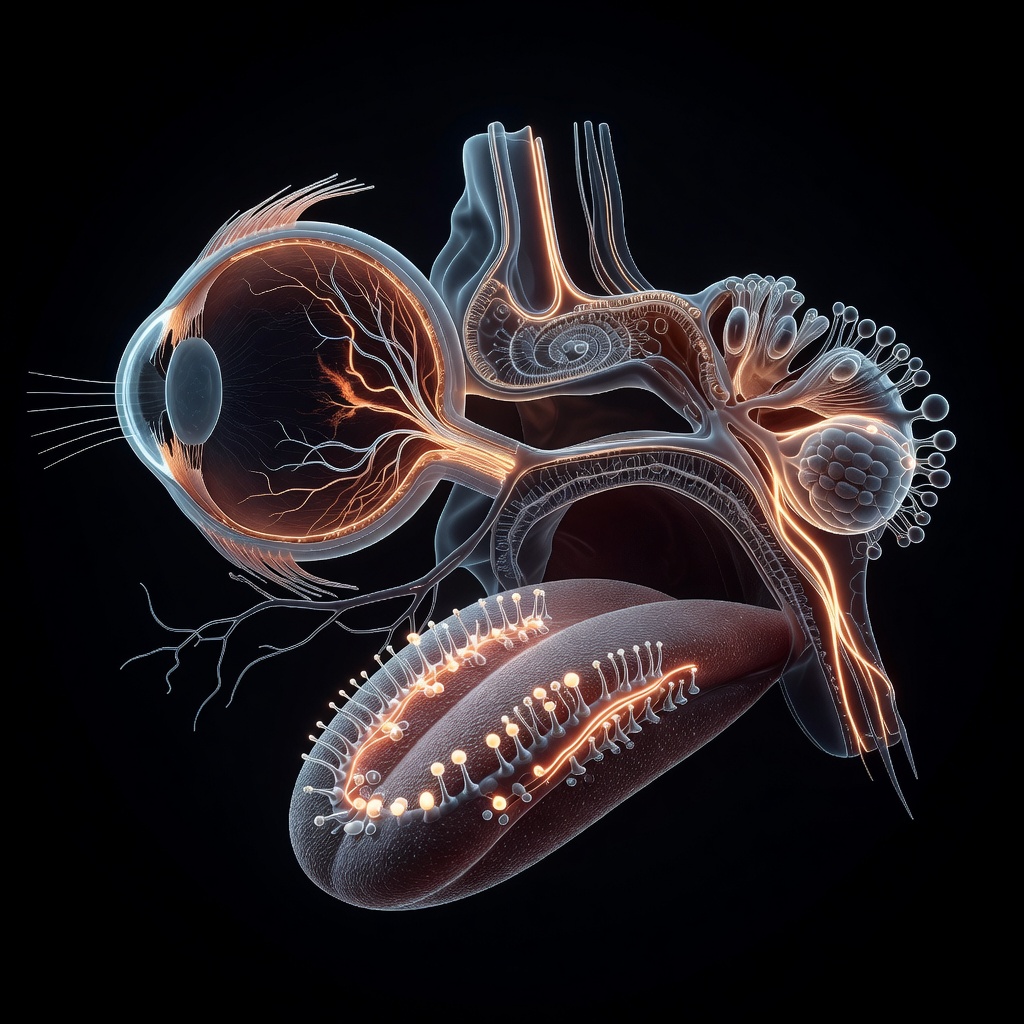
The complete structural anatomy of all five sensory organs — the layered architecture of the eye, the inner and middle ear, olfactory epithelium, taste buds and the tongue, and all classes of cutaneous mechanoreceptors and thermoreceptors.
CONTENTS
— WHAT'S INSIDE THIS VOLUME
Eye External & Internal
Retina & Photoreceptors
Visual Pathway Anatomy
Outer & Middle Ear
Cochlea & Vestibular System
Olfactory Epithelium & Bulb
Taste Buds & The Tongue
Cutaneous Sensory Receptors
REFERENCE PLATES INCLUDED
This volume features 4 high-fidelity anatomical plates for visual reference.
FULL VOLUME CONTENT
INTRODUCTION
The Sensory Systems
Right now, you are trapped. Your brain sits in total darkness, floating in a bath of salty fluid inside a thick bone vault. It has never seen a sunset, heard a whisper, or felt the brush of silk. It relies entirely on a tiny team of highly specialised scouts to tell it what is happening "out there".
These scouts—your eyes, ears, nose, tongue, and skin—are not just parts of you. They are the only bridge between the void of your skull and the beautiful chaos of the world. Most people treat their senses like passive windows they simply look through. They aren't.
They are active, aggressive filters that translate physical vibrations, chemical clouds, and rogue photons into a language your grey matter can actually speak. You probably think your eyes do the seeing. They don't. Your eyes are essentially high-definition satellite dishes made of living, transparent jelly.
They capture light and turn it into electricity. Think about that for a second. Every colour you have ever seen—the deep red of a rose or the neon buzz of a city street—is actually a stream of electrical pulses screaming along a nerve cable at hundreds of miles per hour. Your ears do the same with air.
When a drum hits, it pushes air molecules into your head, where three tiny bones—the smallest in your entire frame—clank together like a perfectly timed Rube Goldberg machine. This mechanical kinetic energy becomes a signal. You are a biological transformer, constantly turning the physics of the universe into the poetry of your experience. In the chapters ahead, we are going to pull back the curtain on this incredible, hidden infrastructure.
You will see how your tongue is tiled with chemical sensors called papillae—tiny bumps that look like miniature onions under a microscope. You will discover why your nose is the only part of your brain that actually touches the outside world through the cribriform plate, a bone that looks like a literal kitchen sieve. We will map the "homunculus"—that weird, distorted map inside your head where your lips and hands take up more space than your entire back because they are packed with more receptors. We will look at the skin, not as a wrapper, but as a massive, electrified grid of pressure pads and temperature gauges that keeps you from being a blind passenger in your own body.
How did you get this way? It started before you even looked like a human. When you were just a tiny disc of cells in your mother’s womb, your nervous system began as a simple fold called the neural tube. Your eyes didn't grow separately and then plug in.
They literally pushed out from your developing brain like two budding flowers, reaching for the surface of your face. Your ears began as little pits on the side of your neck, migrating upwards as your jaw took shape from ancient gill-like structures. This is developmental choreography at its most complex. Your body was building high-tech cameras and microphones out of simple protein and water while you were still the size of a kidney bean.
We haven't always known this. For centuries, the smartest people on Earth were convinced we were the ones doing the projecting. The ancient Greeks thought your eyes shot out invisible "fire" or beams that bounced off objects and came back to you. They called it extramission, and they were dead wrong.
It took a thousand years to realise that you are actually a passive recipient of the light the sun provides. Even the great Leonardo da Vinci struggled to map the intricate tunnels of the inner ear, where your sense of balance lives in three fluid-filled loops that act like a carpenter’s spirit level. This guide isn't about "the" senses in an abstract way. It is about your hardware.
It is about the way your cranial nerves—the twelve pairs of high-speed data cables that exit your brain—weave through the holes in your skull to give you the world. You aren't just observing life; you are literally wired into it. Every texture you touch, every note you hear, and every scent you inhale is a feat of structural engineering that would make a NASA technician weep with envy. It is time you met the equipment that makes you, you.
ALSO IN THIS SERIES
VIEW FULL SERIES

DOWNLOAD THIS VOLUME
This volume is compiled from peer-reviewed anatomy literature into a precision longform PDF. Generate once — it's then saved permanently in the INNERSTANDING library for instant re-download by all users.
PDF format · No wait time · Standardized Print Resolution