
VOL. 10
The Urinary System
Kidneys, Ureters, Bladder & Urethra
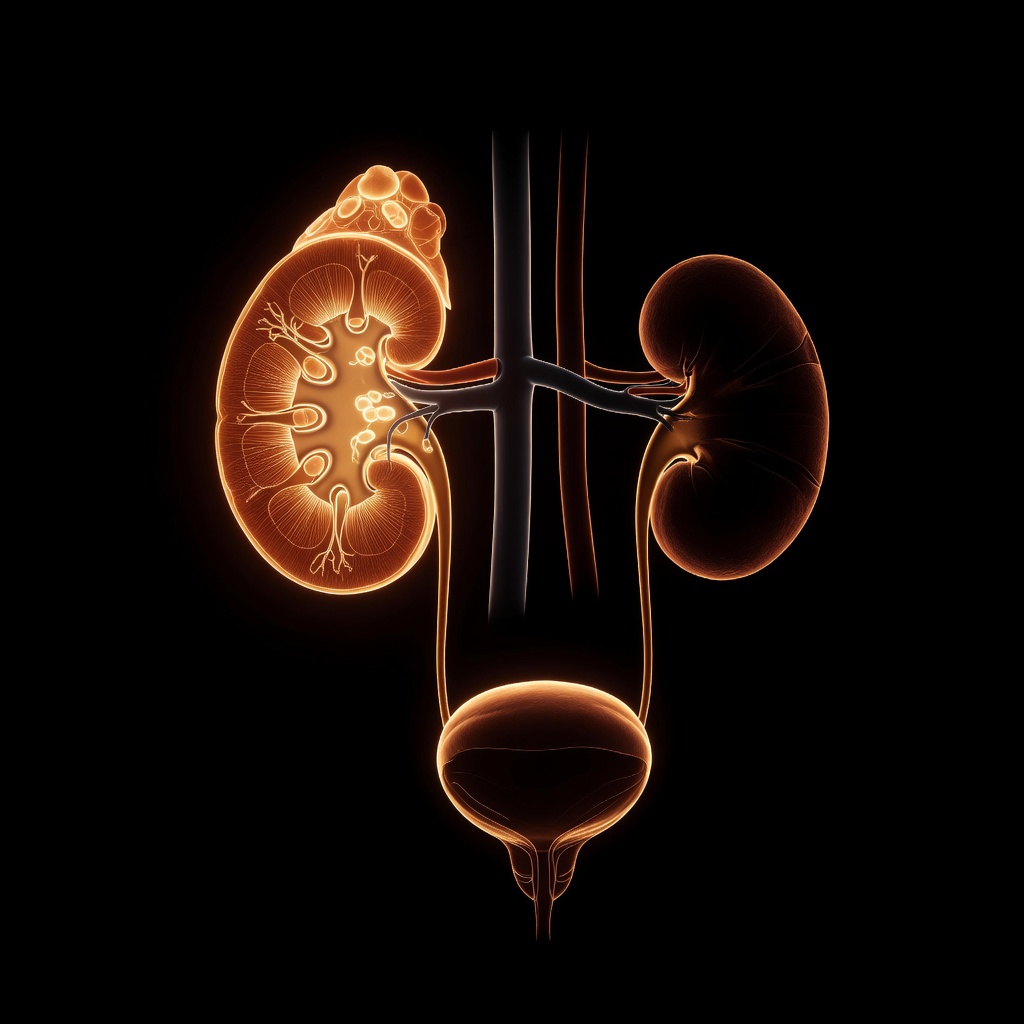
A detailed anatomical study of the kidneys — cortex, medulla, nephron architecture, glomerular ultrastructure, the collecting system — with the ureters, bladder musculature, and urethral anatomy in both sexes.
CONTENTS
— WHAT'S INSIDE THIS VOLUME
Kidney: External Anatomy & Position
Cortex & Medulla
The Nephron in Detail
The Glomerulus
Collecting System & Calyces
Renal Blood Supply
The Ureters
Bladder & Urethra Anatomy
REFERENCE PLATES INCLUDED
This volume features 4 high-fidelity anatomical plates for visual reference.
FULL VOLUME CONTENT
INTRODUCTION
The Urinary System
Imagine your body is a high-stakes, twenty-four-hour chemistry lab where the recipe for your blood must be kept perfect to the very last millimetre. You’ve likely been told your urinary system is just a glorified waste disposal unit. You’ve been told wrong. It is actually a world-class filtration plant and pressure-management hub that controls the very essence of your internal environment.
Your kidneys don’t just sit there; they are your master chemists, working without a single break from the moment your heart first beats. Every single minute, they process about twenty per cent of all the blood your heart pumps out. That is a staggering workload for two organs no bigger than a computer mouse. They sit tucked away behind your intestines, nestled against your back muscles and shielded by your lower ribs.
They aren't just 'filtering'—they are curating. They decide exactly what stays in your bloodstream and what gets the boot, down to the last molecule of salt and the final drop of water. In the chapters ahead, we are going to dive into the architecture of these two powerhouses. We’ll look at the renal cortex—the outer layer—and the renal medulla, the inner core where the real work happens.
You’ll see how your renal artery, a massive pipe coming straight off your aorta, slams blood into your kidneys under immense pressure. This pressure is the engine. Without it, the whole system stalls. We’ll follow the path of your urine as it drips into the renal pelvis and down the ureters.
These are not just passive garden hoses; they are sophisticated muscular tubes that use waves of contraction to squeeze fluid toward your bladder. This movement is called peristalsis, and it’s so powerful it can push liquid against gravity even if you’re standing on your head. Then we reach the bladder, a masterpiece of elastic engineering. It is lined with 'transitional' epithelium—cells that can stretch and flatten like a crowd of people making room on a packed dance floor.
It’s wrapped in the detrusor muscle, a powerful web of fibres that stays relaxed as you fill up and then squeezes with incredible force when it’s time to go. Finally, we’ll look at the urethra, the exit ramp that keeps the whole system watertight until you decide otherwise. This whole setup has a bizarre, almost unbelievable origin story. Before you were even born, your body auditioned three different versions of your kidneys.
First, a set called the pronephros appeared in your neck. It’s a primitive echo from our distant, fish-like ancestors, and it vanished almost as soon as it arrived. Then came the mesonephros, which functioned for a few weeks in your midsection. Only then did your final, permanent kidneys—the metanephros—begin to grow right down in your pelvis.
As your spine lengthened, your kidneys actually 'climbed' up your torso to reach their final home in your lower back. Sometimes, they get caught on a stray blood vessel or fuse together into a single 'horseshoe' kidney. It is a common structural quirk that most people never realise they have until they get a scan for something else. For centuries, our understanding of this was laughable.
The Roman physician Galen, whose word was law for over a thousand years, genuinely thought urine was manufactured inside the bladder. It wasn't until the 1660s that Marcello Malpighi used the first microscopes to reveal the truth. He discovered the glomeruli—tiny, knotted bunches of capillaries that act like high-pressure sieves. He realised your kidney isn't a solid block of tissue, but a complex mesh of millions of microscopic units called nephrons.
You have about a million of these in each kidney, and they are the frontline soldiers of your survival. They manage your blood pressure, your hydration, and your chemical balance with a precision no human-made machine can match. By the time we have finished this journey, you’ll never look at a glass of water the same way again. You’ll see yourself as a dynamic, self-regulating marvel, an architectural triumph that manages the tides of your internal sea every single second of your life.

DOWNLOAD THIS VOLUME
This volume is compiled from peer-reviewed anatomy literature into a precision longform PDF. Generate once — it's then saved permanently in the INNERSTANDING library for instant re-download by all users.
PDF format · No wait time · Standardized Print Resolution