
Accelerating Cures: AI-Powered Drug Discovery for Orphan Diseases
Updated May 2026
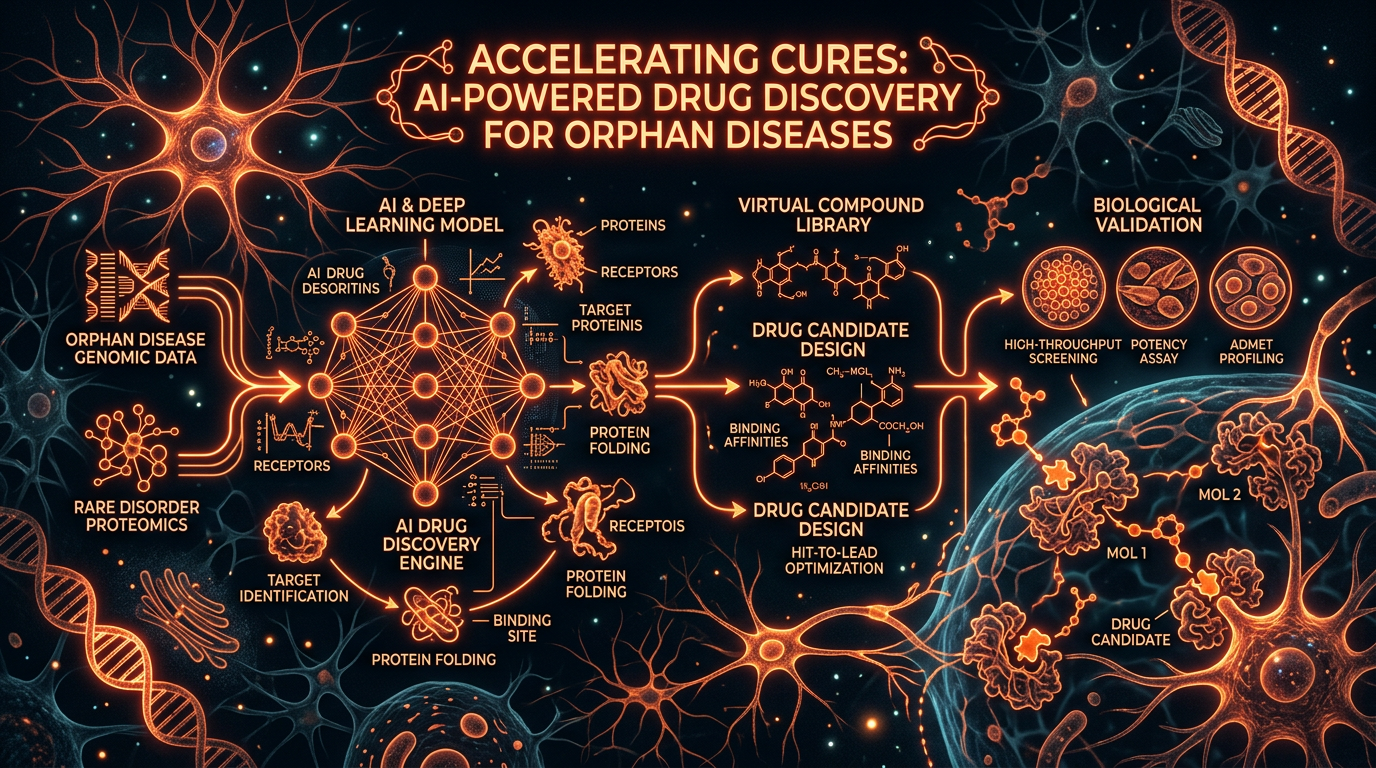
An analysis of how generative models and protein folding simulations are drastically reducing the timeline for developing treatments for rare conditions.
Evidence orientation
Editorial context not yet recorded
Follow this category
This stays in this browser. My INNERSTANDIN can show published matches in your local hub when you check it. It does not send email, push, or alert notifications.
Local learning review
A private browser aid for revisiting ideas. It is not an alert or a health recommendation.
Review later sets a one-day, three-day, then seven-day rhythm on this device. Choose it only when you want to revisit this article.
The Silent Crisis: Defining the Orphan Disease Landscape
In the shadows of global healthcare, where the "blockbuster" drug model dictates the flow of capital, lies a silent crisis affecting millions. Orphan diseases—defined in the United Kingdom as conditions affecting fewer than 5 in 10,000 people—are collectively anything but rare. While each individual diagnosis may be isolated, the cumulative impact is a staggering public health challenge that the traditional pharmaceutical industry has, for decades, found "unprofitable" to solve.
The traditional drug discovery pipeline is a precarious "Valley of Death." It typically requires 12 to 15 years and upwards of £2 billion to bring a single molecule to market. For rare diseases, where patient cohorts are small and clinical trial recruitment is arduous, this model collapses. We are witnessing a systemic failure where biological complexity meets economic inertia.
However, a paradigm shift is emerging. The convergence of Artificial Intelligence (AI), deep genomic sequencing, and high-performance computing is dismantling the barriers to entry for orphan drug development. By leveraging generative models and predictive analytics, we are no longer searching for needles in haystacks; we are building magnets.
According to Rare Disease UK, 1 in 17 people in the United Kingdom will be affected by a rare disease at some point in their lives. This equates to approximately 3.5 million people, yet only 5% of these conditions have an approved treatment.
Biological Mechanisms: The Architecture of Rarity
To understand why orphan diseases have remained intractable, one must look at the underlying biological mechanisms. Most rare diseases (approximately 80%) are genetic in origin, often stemming from monogenic mutations—a single "typo" in the 3 billion base pairs of the human genome.
The Proteomic Folding Problem
The primary mechanism of many orphan diseases involves protein misfolding. When a genetic mutation occurs, the resulting protein may fail to achieve its functional three-dimensional shape. In conditions like Cystic Fibrosis or Huntington’s Disease, these misfolded proteins either lose their function or become toxic aggregates.
AI, specifically through architectures like DeepMind’s AlphaFold, has revolutionised our "innerstanding" of this mechanism. By predicting the 3D structure of nearly every protein known to science, AI allows researchers to identify "druggable" pockets on proteins that were previously considered "undruggable."
Pathogenic Latency and Phenotypic Complexity
Rare diseases often involve complex metabolic pathways where a single enzyme deficiency causes a cascade of systemic failures. The biological "noise" makes it difficult to isolate the primary driver of the disease. AI excels here by utilising Graph Neural Networks (GNNs) to map the "interactome"—the vast web of molecular interactions within a cell. This allows for the identification of secondary targets that can compensate for a primary genetic defect.
The AI Revolution: De-risking Discovery
The application of AI in drug discovery for orphan diseases is not merely an incremental improvement; it is a total reimagining of the scientific method.
Generative Chemistry and Latent Space
Traditionally, medicinal chemists would tweak existing molecules to find improvements. AI uses "Generative Adversarial Networks" (GANs) to navigate "chemical space"—a theoretical realm containing $10^{60}$ potential drug-like molecules.
- De Novo Design: AI can "dream" up entirely new molecular structures tailored to fit a specific genetic mutation’s binding site.
- Virtual Screening: High-throughput virtual screening allows researchers to test millions of compounds in silico (within a computer simulation) in days, a process that would take years in a physical lab.
Repurposing: The Fastest Path to Cure
For many orphan patients, time is the rarest commodity. AI algorithms excel at "drug repurposing"—identifying existing, off-patent medications that may have an unforeseen efficacy against a rare condition. By analysing vast datasets of electronic health records and biochemical assays, AI can uncover "off-target" effects that can be exploited for rare disease therapy, bypassing the lengthy Phase I safety trials.
In the UK, the "Accelerated Access Collaborative" has noted that AI-driven repurposing could reduce the time to patient access for rare disease treatments by as much as 40%.
Environmental Disruptors: The Epigenetic Catalyst
A truly "truth-exposing" scientific inquiry cannot ignore the role of the environment. While the genetic blueprint provides the template, the environmental "exposome" dictates whether that blueprint leads to health or pathology. For orphan diseases, environmental disruptors often act as catalysts that trigger or exacerbate underlying genetic vulnerabilities.
The Impact of Synthetic Toxicity
We inhabit an increasingly "processed" biosphere. Chemical agents that were non-existent a century ago now permeate our biological systems:
- Glyphosate and Gut Dysbiosis: Common herbicides have been shown to disrupt the shikimate pathway in gut bacteria, leading to a deficiency in essential amino acids. For patients with rare metabolic disorders, this environmental stressor can be the difference between a managed condition and a fatal crisis.
- Endocrine Disruptors: Phthalates and Bisphenols (BPA) interfere with hormonal signalling. In rare endocrine-related orphan diseases, these ubiquitous plastics act as "molecular mimics," blocking the very receptors that targeted drugs are trying to reach.
- Electromagnetic Interference (EMI): Emerging research suggests that chronic exposure to high-frequency non-ionising radiation may influence voltage-gated calcium channels, potentially exacerbating rare neurological and cardiac channelopathies.
Epigenetic Overlays
Orphan diseases are often subject to "epigenetic silencing," where the environment causes chemical tags (methyl groups) to turn off beneficial genes. AI models are now being trained to factor in these environmental variables, allowing for "Precision Medicine" that accounts for a patient’s postcode, diet, and toxic load.
The INNERSTANDING Recovery Protocol: An Integrative Framework
True recovery for those with rare diseases requires more than a "magic bullet" pill. It demands a holistic integration of cutting-edge AI therapeutics and environmental mitigation. The following protocol represents a high-authority approach to managing and potentially reversing the symptoms of orphan conditions.
1. Genomic and Proteomic Mapping
The first step is a transition from generic diagnosis to molecular profiling.
- Utilise Whole Genome Sequencing (WGS) to identify the specific variant.
- Employ AI-driven proteomic analysis to determine if the issue is protein deficiency, misfolding, or toxic gain-of-function.
2. Targeted AI-Derived Pharmacotherapy
Once the mechanism is identified, the focus shifts to sourcing or developing a ligand. This may involve:
- Small molecule chaperones to assist in protein folding.
- Antisense Oligonucleotides (ASOs) to "silence" the faulty gene.
- AI-identified repurposed drugs to stabilise metabolic pathways.
3. Radical Environmental Detoxification
To allow AI-driven therapies to work, the "biological terrain" must be cleared of disruptors.
- Water Purity: Implementation of multi-stage reverse osmosis filtration to remove fluoride, heavy metals, and microplastics.
- Nutritional Optimisation: Shifting to an organic, biodynamic diet to eliminate glyphosate exposure and restore the microbiome.
- EMF Mitigation: Creating "low-tech" sleeping environments to facilitate cellular repair and mitochondrial function.
4. Mitochondrial Support and Bioenergetics
Many orphan diseases are, at their core, energy failures. The mitochondria are the primary targets of environmental toxins.
- Photobiomodulation: Using specific wavelengths of red and near-infrared light to stimulate Cytochrome c Oxidase and ATP production.
- Redox Signalling: Supplementing with molecular hydrogen or targeted antioxidants to neutralise the oxidative stress common in rare genetic pathologies.
The Systemic Truth: Breaking the Monopoly
The greatest hurdle to curing orphan diseases is not biological, nor is it technological; it is structural. The current patent-centric model of drug discovery disincentivises the "cure" in favour of the "treatment." When a disease affects only a few hundred people, the "market" is deemed too small for the traditional pharmaceutical behemoths.
AI provides a path toward the democratisation of discovery. Open-source AI models and decentralised clinical trials (using blockchain for data integrity) allow smaller laboratories and even patient advocacy groups to conduct world-class research. We are moving toward a future where "Bio-DAOs" (Decentralised Autonomous Organisations) can fund and develop cures for their own specific conditions, bypassing the gatekeepers of Big Pharma.
Data from the UK Biobank indicates that over 500,000 participants have contributed genetic data, creating one of the most powerful datasets for AI to mine for orphan disease correlations—data that must remain in the public commons to ensure equitable access to future cures.
Conclusion: The Horizon of Personalised Hope
The marriage of AI and rare disease research represents the pinnacle of modern scientific endeavour. By leveraging the "innerstanding" of molecular geometry and the vast computational power of machine learning, we are finally addressing the "unprofitable" suffering of the few.
However, the technology is only as effective as the philosophy behind it. If we use AI to create expensive, proprietary molecules while ignoring the environmental toxins that exacerbate these conditions, we are merely treating the branches of the problem while the roots remain diseased.
The future of health lies in a synthesis: using AI to decode the infinite complexity of our genetics, while returning to an environmental simplicity that respects our biological heritage. For those with orphan diseases, the "Valley of Death" is finally being bridged by a lattice of silicon and light.
"References & Further Reading:"
- The Lancet: Rare diseases: a global priority.
- Nature Biotechnology: AI in Drug Discovery.
- The UK Rare Diseases Framework (Department of Health and Social Care).
- DeepMind: AlphaFold Protein Structure Database.
This article is provided for informational and educational purposes only. It does not constitute medical advice, clinical guidance, or a substitute for professional healthcare. Information reflects cited research at time of publication. Always consult a qualified healthcare professional before acting on any health information.
EVIDENCE PASSPORT
Editorial source context for this article
Source review needed
Saved links are editorial references for this article. They may support specific claims rather than every sentence. Open and assess each source in context. This passport does not independently verify them.
Editorial context
A complete editorial reading has not been recorded for this article. Source links remain available for you to open and assess directly.
Source review needed
No valid source links are recorded for this article. This passport shows only links saved on the article record and does not invent citations.
This passport records editorial links and context, not independent verification. Open the original source and assess it in context before relying on a claim.
Medical Disclaimer
The information in this article is for educational purposes only and does not constitute medical advice, diagnosis, or treatment. Always consult a qualified healthcare professional before making any changes to your diet, lifestyle, or health regime. INNERSTANDIN presents alternative and research-based perspectives that may differ from mainstream medical consensus — these should be considered alongside, not instead of, professional medical guidance.
Read Full DisclaimerContinue the thread
Keep this question moving.
Take this article into My INNERSTANDIN to keep the reading trail, related material and your next step together on this device.