
Circadian Disruption: Metabolic Syndrome’s Silent Driver
Updated May 2026
The NHS focuses on calorie counting while ignoring the biological impact of blue light and shift work on insulin sensitivity. This piece explores the hormonal regulation of the master clock.
Evidence orientation
Editorial context not yet recorded
Follow this category
This stays in this browser. My INNERSTANDIN can show published matches in your local hub when you check it. It does not send email, push, or alert notifications.
Local learning review
A private browser aid for revisiting ideas. It is not an alert or a health recommendation.
Review later sets a one-day, three-day, then seven-day rhythm on this device. Choose it only when you want to revisit this article.
Overview
For decades, the United Kingdom’s National Health Service (NHS) and the broader medical establishment have approached the burgeoning crisis of Metabolic Syndrome through a narrow, reductionist lens. The prevailing dogma—primarily focused on "Calories In, Calories Out" (CICO)—suggests that obesity, Type 2 Diabetes (T2DM), and cardiovascular dysfunction are merely the result of gluttony and sloth. This perspective is not only outdated but biologically illiterate.
As a senior researcher at INNERSTANDING, my investigation into the molecular foundations of health reveals a far more insidious culprit: the systematic destruction of the human circadian rhythm. We are living in a period of unprecedented biological "mismatch." Our ancient, light-sensitive genomes are being bombarded by 24-hour artificial light environments, erratic eating patterns, and the relentless demands of a shift-work economy.
Callout: Research suggests that even a single night of total sleep deprivation can induce a state of acute insulin resistance comparable to that of a person with Type 2 Diabetes.
The "Silent Driver" of metabolic decay is the desynchronisation between our internal biological clocks and the external environment. When the master clock in the brain loses its connection with the peripheral clocks in our organs, metabolic chaos ensues. This article exposes the mechanistic pathways of this disruption and critiques the mainstream medical failure to address the photobiology of human metabolism.
The Biology — How It Works
To understand metabolic syndrome, one must first understand the Suprachiasmatic Nucleus (SCN). Located within the hypothalamus, the SCN acts as the "Master Clock," coordinating a complex symphony of physiological processes. This 20,000-neuron structure does not operate in a vacuum; it relies on external cues known as Zeitgebers (Time-givers) to synchronise the body’s internal state with the 24-hour solar cycle.
The Role of Photoreception
The primary zeitgeber is light. However, the SCN does not "see" light in the way our visual cortex does. Instead, it receives signals from a specialised class of cells in the retina called Intrinsically Photosensitive Retinal Ganglion Cells (ipRGCs). These cells contain a photopigment called melanopsin, which is exquisitely sensitive to short-wavelength blue light (approximately 460–480nm).
When blue light from the morning sun hits the retina, the ipRGCs signal the SCN to:
- Suppress the production of melatonin (the hormone of darkness and repair).
- Stimulate the release of cortisol (the hormone of alertness and fuel mobilisation).
- Upregulate core body temperature.
The Master and Peripheral Clocks
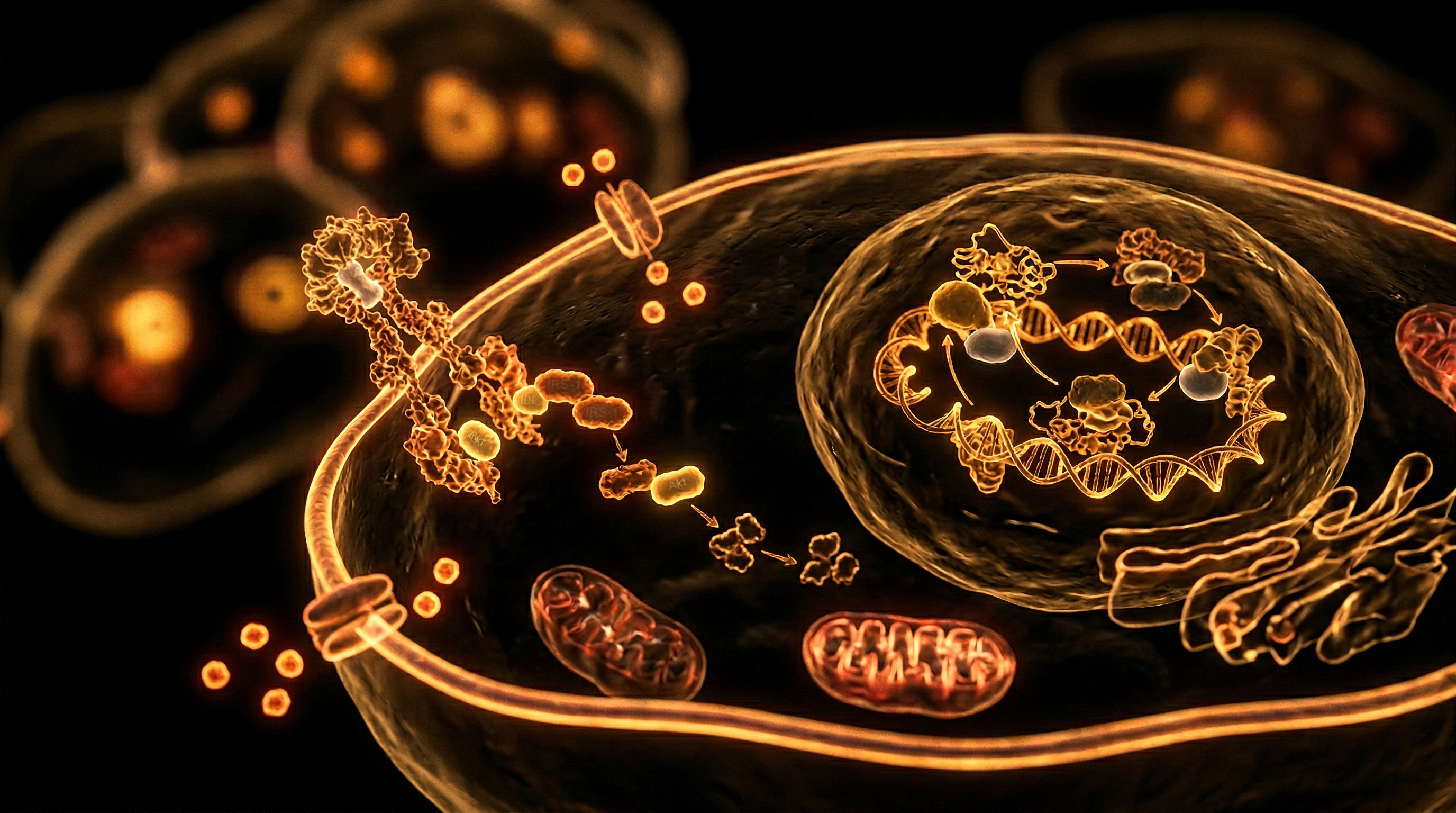
While the SCN is the conductor, every cell in the human body contains its own "peripheral clock." These clocks are governed by an autoregulatory transcriptional-translational feedback loop (TTFL) involving core clock genes such as CLOCK, BMAL1, PER, and CRY.
Ideally, these peripheral clocks—located in the liver, pancreas, adipose tissue, and skeletal muscle—work in perfect harmony with the SCN. The liver prepares for glucose metabolism during the day, while the pancreas prepares for insulin secretion. At night, these processes should downregulate to allow for cellular repair and autophagy. Circadian disruption occurs when these clocks drift apart—a state known as internal desynchrony.
Mechanisms at the Cellular Level
At the cellular level, the circadian rhythm dictates the "metabolic window" of the cell. When this rhythm is fractured, the molecular machinery responsible for energy processing begins to fail.
BMAL1 and Insulin Sensitivity
The gene BMAL1 is a master regulator of metabolic function. Studies on "knockout" models have shown that when BMAL1 is silenced, the organism develops immediate and severe hyperglycaemia and hyperinsulinaemia.
- In the Pancreas: The circadian clock regulates the rhythmic secretion of insulin. Beta-cells are programmed to be most responsive to glucose during daylight hours.
- In the Liver: The clock controls gluconeogenesis (the production of glucose). In a disrupted state, the liver continues to pump glucose into the bloodstream at night, even when the body is fasting, leading to elevated morning blood sugar.
- In Adipose Tissue: Circadian genes regulate the secretion of adiponectin and leptin, the hormones responsible for fat burning and satiety.
Mitochondrial Dysfunction
The mitochondria—the powerhouses of the cell—are also under strict circadian control. Mitochondrial fusion and fission (the processes by which mitochondria repair themselves and multiply) follow a rhythmic pattern. Circadian disruption leads to the accumulation of "leaky" mitochondria that produce excessive Reactive Oxygen Species (ROS). This oxidative stress damages the insulin receptors on the cell surface, leading to Insulin Resistance.
Callout: Blue light exposure after sunset suppresses melatonin production by up to 85%, directly inhibiting the "clean-up" phase of mitochondrial metabolism.
Environmental Threats and Biological Disruptors
Modernity is an assault on the circadian system. The primary threats are not just "bad food," but the "bad light" and "bad timing" that define 21st-century life.
Artificial Light at Night (ALAN)
The invention of the LED and the smartphone has created a "permanent noon" for the human brain. High-intensity blue light exposure in the evening signals the SCN that it is still daytime. This prevents the pineal gland from secreting melatonin. Without melatonin, the body remains in an anabolic (growth) state when it should be in a catabolic (repair) state.
The Shift-Work Epidemic
Shift work is perhaps the most extreme form of circadian disruption. By forcing the body to remain active when the SCN is signalling sleep, shift workers experience a profound "metabolic divorce." Their liver believes it is midnight (storing fat), while their brain believes it is midday (demanding glucose).
- Increased risk of T2DM by 60% in long-term shift workers.
- Higher levels of systemic inflammation (CRP).
- Chronic elevation of ghrelin (the hunger hormone).
Chrono-nutrition and Eating Windows
It is not merely what we eat, but when we eat. The NHS "Eatwell Guide" focuses on food groups but ignores the Postprandial Response as a function of time. Human insulin sensitivity peaks in the morning and declines significantly after 6:00 PM. Consuming a high-carbohydrate meal at 10:00 PM results in a glucose spike nearly double the size of the same meal consumed at 8:00 AM. This is "Time-Shifted Hyperglycaemia."
The Cascade: From Exposure to Disease
How does a bright screen at 11:00 PM lead to a diagnosis of Metabolic Syndrome three years later? The cascade is predictable and devastating.
- Phase Delay: Evening blue light delays the circadian phase. You stay up later, but must wake up early for work.
- Sleep Fragmentation: Chronic "social jetlag" leads to poor sleep quality.
- Hormonal Imbalance: Low melatonin leads to high nocturnal cortisol. Cortisol stimulates the liver to release glucose.
- Hyperinsulinaemia: The pancreas must secrete more insulin to combat the cortisol-induced glucose spike.
- Leptin Resistance: The brain stops "hearing" the signal that it is full. Cravings for ultra-processed, energy-dense foods increase.
- Ectopic Fat Storage: Because the cells are insulin-resistant, glucose is converted into fatty acids and stored in the liver (NAFLD) and around the visceral organs.
- Metabolic Syndrome: The trifecta of high blood pressure, high blood sugar, and abdominal obesity is confirmed.
Callout: People who sleep less than 6 hours per night have a 45% increased risk of developing obesity, regardless of their total caloric intake.
What the Mainstream Narrative Omits
The mainstream medical narrative, championed by the NHS and major health charities, is characterised by a "Metabolic Blind Spot." They treat the body as a steam engine—a closed system where only fuel in and energy out matter.
The Calorie Delusion
By focusing exclusively on calories, the NHS ignores the endocrine effect of light. A calorie consumed under a 5000K LED light at night does not have the same metabolic fate as a calorie consumed under natural sunlight. The former is far more likely to be stored as adipose tissue because the body’s "metabolic gates" are closed.
The Pharmaceutical Bias
The standard of care for metabolic dysfunction in the UK is pharmaceutical intervention: Metformin for blood sugar, Statins for cholesterol, and ACE inhibitors for blood pressure. While these drugs manage symptoms, they do nothing to realign the patient's circadian rhythm. In fact, many common medications actually interfere with sleep architecture, further exacerbating the root cause.
The Neglect of Infrared Light
Mainstream science rarely discusses the role of Near-Infrared (NIR) light, which makes up over 50% of natural sunlight. NIR light penetrates deep into tissues and stimulates Cytochrome C Oxidase in the mitochondria, boosting ATP production and reducing oxidative stress. By staying indoors under artificial blue light (which lacks the protective NIR spectrum), we are depriving our cells of the very signal required for metabolic resilience.
The UK Context
The UK faces a unique set of challenges regarding circadian health. Our high latitude means that for six months of the year, natural light levels are insufficient to properly "reset" the SCN for many indoor workers.
The "Grey Office" Syndrome
The average UK office worker spends 90% of their time indoors under fluorescent or LED lighting. These environments provide roughly 100–500 Lux of light. In contrast, even a cloudy day in London provides 10,000 Lux, and direct sunlight provides 100,000 Lux. We are living in a state of "biological darkness" during the day and "biological light" at night.
NHS Misdiagnosis Patterns
The NHS frequently misdiagnoses "Circadian Dysregulation" as "Clinical Depression" or "Chronic Fatigue Syndrome." Patients are prescribed SSRIs—which can cause weight gain and further disrupt REM sleep—when their primary issue is a lack of morning sunlight and excessive evening blue light. Furthermore, the NHS’s reliance on the HbA1c test as a primary diagnostic tool for diabetes is reactive. It detects damage that has already occurred over three months, rather than the acute circadian misalignments that precede the disease by years.
The Shift Work Crisis in the NHS
Ironically, the NHS is one of the largest employers of shift workers in the world. The very system designed to heal is forcing its staff into a metabolic "death spiral." Nurses and junior doctors working back-to-back night shifts are at an astronomical risk of developing the very metabolic conditions they are treating in their patients.
Protective Measures and Recovery Protocols
If we are to solve the metabolic crisis, we must move beyond the "eat less, move more" mantra and embrace Circadian Hygiene. This is not about biohacking; it is about returning to biological "first principles."
1. Morning Light Saturation
The most critical step in resetting the master clock is viewing natural sunlight within 30 minutes of waking.
- Duration: 10–30 minutes.
- Mechanism: This triggers the Cortisol Awakening Response (CAR) and sets a timer for melatonin production 14-16 hours later.
- Note: Light through a window is 5–10 times less effective than being outside due to the filtering of specific wavelengths.
2. The "Virtual Sunset"
To protect the metabolic window in the evening, one must eliminate blue light exposure after dusk.
- Use Blue-Blocking Glasses: Specifically those that filter 100% of light below 550nm (orange/red lenses).
- Environmental Lighting: Replace LED "Cool White" bulbs with warm-toned, low-wattage incandescent or red bulbs in the evening.
- Device Discipline: Utilise software like Iris or f.lux, but recognise that these do not block the "flicker" or the intensity of the light entirely.
3. Time-Restricted Feeding (TRF)
Aligning food intake with the solar cycle is the most potent "peripheral clock" reset.
- The 10-Hour Window: Limit all calorie consumption to a 10-hour window (e.g., 8:00 AM to 6:00 PM).
- Front-Loading Calories: Eat the largest meal in the morning or early afternoon when insulin sensitivity is at its peak.
- The "Three-Hour Rule": Stop eating at least three hours before bed to ensure the liver and pancreas can enter "repair mode" before sleep.
4. Thermal Signalling
The circadian rhythm is also tied to temperature.
- Evening Cooling: A drop in core body temperature is a signal for sleep. A warm bath 90 minutes before bed can facilitate this by causing vasodilation, which subsequently lowers core temperature.
- Morning Heating: Exercise or cold exposure in the morning can help "spike" the rhythm, increasing alertness and metabolic rate.
5. Supplemental Mitigation (The "Safety Net")
While light hygiene is primary, certain interventions can help those trapped in shift work:
- Magnesium Bisglycinate: Supports the nervous system and glucose metabolism.
- Melatonin (Low Dose): 0.3mg to 1mg (pharmacological doses like 5mg-10mg are often counterproductive) can help "pull" the clock forward for shift workers, though its legality in the UK requires a prescription.
Summary: Key Takeaways
The modern epidemic of metabolic syndrome is not merely a crisis of overconsumption; it is a crisis of biological timing. By ignoring the photobiological foundations of human health, the NHS and the mainstream medical establishment are treating the symptoms of a broken clock while the gears continue to grind themselves to dust.
- The Master Clock (SCN) in the brain governs every metabolic process, from insulin secretion to fat storage.
- Blue Light at night is a metabolic toxin that suppresses melatonin and induces acute insulin resistance.
- Shift Work and "Social Jetlag" create an internal desynchrony that makes weight loss nearly impossible, regardless of caloric intake.
- The NHS Narrative is failing because it treats the body as a machine that ignores the 24-hour solar cycle.
- Circadian Hygiene—morning sun, evening darkness, and time-restricted feeding—is the only sustainable path to metabolic recovery.
We must stop counting calories and start counting "Lux." We must stop looking at the plate and start looking at the sky. Only by re-synchronising our internal biology with the natural world can we hope to reverse the tide of metabolic decay and reclaim our fundamental human vitality.
The "Silent Driver" has been identified. The question is whether the medical establishment has the courage to change course.
Author: Senior Biological Researcher, INNERSTANDING Date: October 2023 Subject: Circadian Biology & Metabolic Health
This article is provided for informational and educational purposes only. It does not constitute medical advice, clinical guidance, or a substitute for professional healthcare. Information reflects cited research at time of publication. Always consult a qualified healthcare professional before acting on any health information.
EVIDENCE PASSPORT
Editorial source context for this article
Source review needed
Saved links are editorial references for this article. They may support specific claims rather than every sentence. Open and assess each source in context. This passport does not independently verify them.
Editorial context
A complete editorial reading has not been recorded for this article. Source links remain available for you to open and assess directly.
Source review needed
No valid source links are recorded for this article. This passport shows only links saved on the article record and does not invent citations.
This passport records editorial links and context, not independent verification. Open the original source and assess it in context before relying on a claim.
Medical Disclaimer
The information in this article is for educational purposes only and does not constitute medical advice, diagnosis, or treatment. Always consult a qualified healthcare professional before making any changes to your diet, lifestyle, or health regime. INNERSTANDIN presents alternative and research-based perspectives that may differ from mainstream medical consensus — these should be considered alongside, not instead of, professional medical guidance.
Read Full DisclaimerContinue the thread
Keep this question moving.
Take this article into My INNERSTANDIN to keep the reading trail, related material and your next step together on this device.
Explore this in the Body Map
See where this hits your biology. Interactive anatomy, threats, and protective protocols.