
Circadian Disruption: How Artificial Light Intensifies Pain Sensitivity
Updated May 2026
The body's internal clock regulates the production of anti-inflammatory hormones and melatonin. Modern blue light exposure disrupts these rhythms, leading to a biological state of heightened pain sensitivity.
Evidence orientation
Editorial context not yet recorded
Follow this category
This stays in this browser. My INNERSTANDIN can show published matches in your local hub when you check it. It does not send email, push, or alert notifications.
Local learning review
A private browser aid for revisiting ideas. It is not an alert or a health recommendation.
Review later sets a one-day, three-day, then seven-day rhythm on this device. Choose it only when you want to revisit this article.
Overview
For nearly four billion years, life on Earth evolved under a singular, rhythmic conductor: the sun. This celestial metronome dictated the metabolic, hormonal, and behavioural patterns of every living organism, from the simplest prokaryotes to the complex machinery of the human nervous system. We are, at our biological core, solar-powered and rhythmically driven beings. However, in the brief evolutionary blink of a century—and more acutely within the last twenty years—modernity has enacted a violent rupture of this ancient contract. The advent of Artificial Light at Night (ALAN) and the ubiquitous dominance of blue-wavelength emitting diodes (LEDs) have plunged the human species into a state of "The Great Desynchronisation."
This article explores a critical, yet frequently ignored, consequence of this disruption: the intensification of chronic pain. Whilst the medical establishment often views pain through a purely structural or localized lens—attributing it to disc herniations, nerve damage, or inflammation—the burgeoning field of circadian biology reveals a deeper truth. Pain is not a static signal; it is a rhythmic process. When we disrupt our internal clocks through inappropriate light exposure, we do not merely lose sleep; we dismantle the body’s endogenous analgesic systems. We are entering an era of "Circadian Hyperalgesia," where the very environment we inhabit is lowering our threshold for physical suffering.
UK FACT: In the United Kingdom, chronic pain affects an estimated 28 million adults—roughly 43% of the population. Simultaneously, the UK has seen a 25% increase in the installation of high-intensity blue-rich LED streetlights over the last decade, coinciding with a precipitous rise in reported sleep disorders and systemic inflammatory conditions.
The relationship between light and pain is mediated by the "master clock" in the brain and peripheral clocks in every single cell of our bodies. When these clocks are "out of gear" due to nocturnal blue light exposure, the body fails to produce the necessary anti-inflammatory markers and neuro-protective hormones required to quench the fires of nociception (the perception of pain). This is not a peripheral issue; it is a fundamental pillar of biological health that, when ignored, renders conventional pain management strategies largely ineffective.
##
The Biology — How It Works
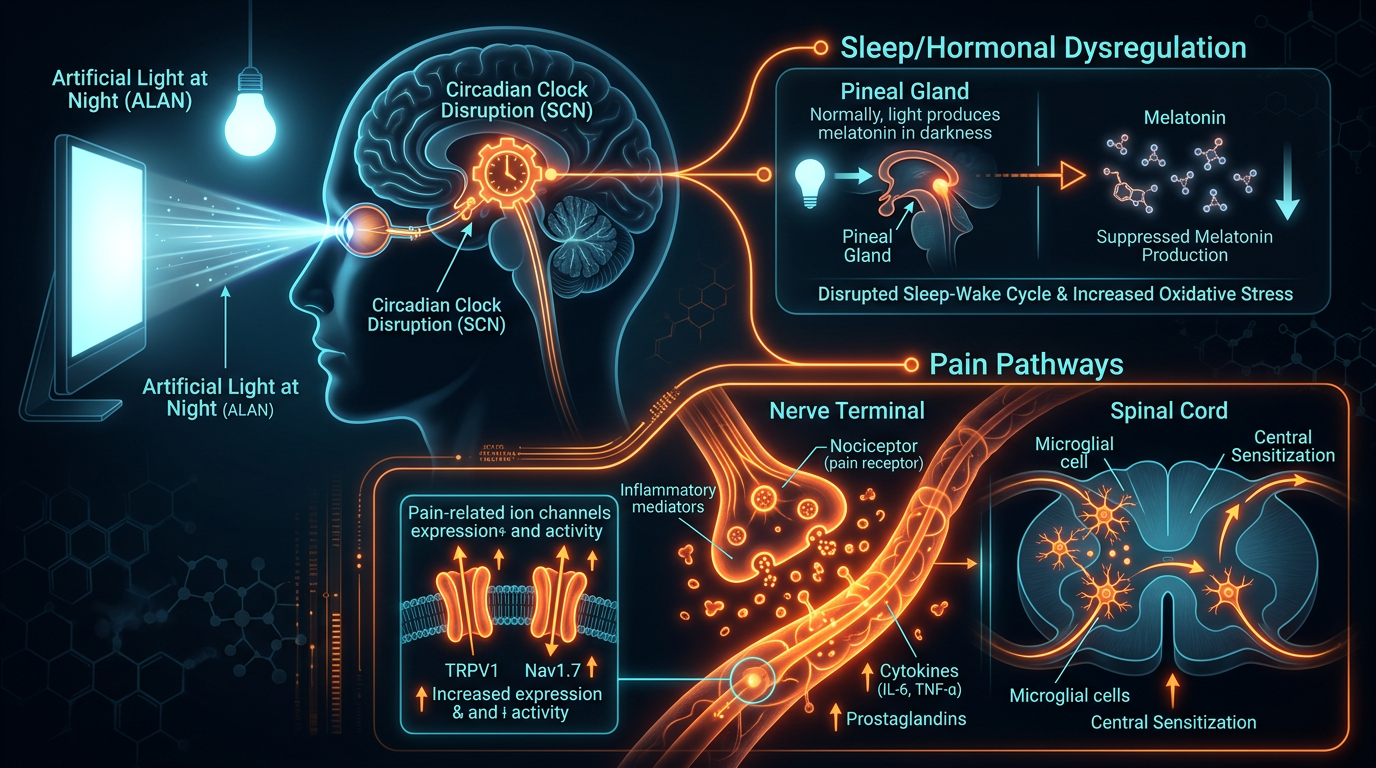
To understand why a smartphone screen can make your back hurt or your fibromyalgia flare, one must understand the Suprachiasmatic Nucleus (SCN). Nestled within the hypothalamus, the SCN is a tiny region of the brain that serves as the conductor of the biological orchestra. It receives direct input from the eyes—not from the rods and cones we use for vision, but from a specialised set of cells called Intrinsically Photosensitive Retinal Ganglion Cells (ipRGCs). These cells contain a photopigment called melanopsin, which is exquisitely sensitive to the short-wavelength "blue" light (roughly 450–480 nanometres) that characterizes both the midday sun and the modern LED screen.
The Melatonin-Analgesia Axis
The primary output of the circadian system regarding pain is the regulation of melatonin. Often mistakenly dismissed as merely a "sleep hormone," melatonin is, in reality, one of the most potent endogenous antioxidants and anti-inflammatory agents known to science. Secreted by the pineal gland in response to darkness, melatonin serves as a systemic "repair signal."
Crucially, melatonin has a direct inhibitory effect on pain pathways. It interacts with both MT1 and MT2 receptors in the dorsal horn of the spinal cord and the periaqueductal grey (PAG) area of the brain—regions responsible for modulating pain signals. When melatonin levels are high, our "pain gates" are relatively closed. When melatonin is suppressed—which occurs almost instantaneously upon exposure to blue light at night—these gates swing open.
Cortisol and the Diurnal Rhythm of Inflammation
Conversely, the SCN regulates the secretion of cortisol via the HPA (Hypothalamic-Pituitary-Adrenal) axis. Under healthy conditions, cortisol follows a strict rhythm: peaking in the early morning to provide energy and suppress inflammation, and tapering off in the evening. Circadian disruption causes a "flattening" of this cortisol curve. When cortisol remains chronically elevated at night or fails to peak in the morning, the body loses its primary hormonal mechanism for controlling systemic inflammation. The result is a body that exists in a state of "pro-inflammatory readiness," where even minor stimuli are interpreted by the brain as significant pain.
##
Mechanisms at the Cellular Level
The link between light and pain descends deep into the molecular machinery of our cells. Every cell in the human body contains "clock genes"—specifically BMAL1, CLOCK, PER, and CRY. These genes operate in a transcription-translation feedback loop that takes approximately 24 hours to complete. When light hits the retina at the wrong time, it triggers a cascade that desynchronises these cellular clocks from the master clock in the SCN.
Mitochondrial Dysfunction and Oxidative Stress
Mitochondria, the powerhouses of our cells, are heavily regulated by circadian rhythms. They possess their own internal timing mechanisms that dictate when they produce ATP (energy) and when they focus on repair. Circadian disruption leads to an accumulation of Reactive Oxygen Species (ROS) within the mitochondria. In the context of pain, this is catastrophic.
Oxidative stress in the peripheral nerves and the spinal cord leads to "sensitization." The nerve fibres responsible for transmitting pain (C-fibres and A-delta fibres) become hyper-excitable. This state, known as peripheral sensitization, means that the nerves fire more easily and more frequently. At the cellular level, the lack of "dark-cycle repair" caused by blue light exposure prevents the neutralization of these oxidative by-products, effectively "rusting" the nervous system from the inside out.
The Role of Microglia
Perhaps the most alarming cellular mechanism involves the microglia—the immune cells of the Central Nervous System (CNS). We once thought microglia were merely "glue" holding neurons together, but we now know they are the primary architects of chronic pain. Microglia have their own internal circadian clocks. Under normal conditions, they undergo a "resting" or "anti-inflammatory" phase during the night, during which they clear metabolic waste from the brain (a process known as glymphatic clearance).
When the circadian rhythm is disrupted by artificial light, microglia shift into an "activated" or M1 pro-inflammatory state. In this state, they release a deluge of pro-inflammatory cytokines, such as Interleukin-1 beta (IL-1β) and Tumour Necrosis Factor-alpha (TNF-α). These chemicals directly irritate the surrounding neurons, leading to central sensitization. This is the biological substrate of "allodynia"—a condition where even a light touch or the movement of clothing against the skin is perceived as painful.
SCIENTIFIC NOTE: Research has demonstrated that the deletion of the BMAL1 clock gene in myeloid cells (which include microglia) results in a dramatic increase in mechanical and thermal pain sensitivity, proving that circadian integrity is a prerequisite for pain stability.
##
Environmental Threats and Biological Disruptors
The modern environment is a minefield for the circadian system. We have replaced the dynamic, full-spectrum light of the sun with static, narrow-spectrum artificial light that bears no resemblance to the environment in which our genome was forged.
The LED Revolution and the "Blue Peak"
The transition from incandescent bulbs to LEDs is one of the most significant environmental changes in human history. Incandescent bulbs, much like fire, emit a broad spectrum of light rich in the "healing" red and near-infrared wavelengths. LEDs, however, are typically constructed using a blue-light emitting chip coated with a yellow phosphor. This creates a massive "Blue Peak" at the exact frequency (450nm) that maximalises the suppression of melatonin.
Even if an LED appears "warm" or "soft white" to the eye, it often still possesses a significant blue spike that signals "midday" to the SCN. This creates a state of Biological Darkness—where the eyes see light, but the brain is deprived of the signals it needs to initiate repair.
Flicker and the Nervous System
Beyond spectrum, many modern lights and screens utilize Pulse Width Modulation (PWM) to control brightness. This creates a rapid, often imperceptible flicker. Whilst we may not "see" the flicker, the brain and the autonomic nervous system perceive it. This constant "micro-stressor" keeps the nervous system in a state of sympathetic (fight-or-flight) dominance. Chronic sympathetic activation is a known driver of muscle tension, restricted blood flow, and the amplification of pain signals in the spinal cord.
The Digital Sunset (or Lack Thereof)
The use of smartphones, tablets, and laptops in the evening hours represents the "perfect storm" of circadian disruption. These devices are held close to the face, delivering a high intensity of blue light directly into the ipRGCs. Furthermore, the content on these devices—often dopamine-driven social media or stressful news—adds a psychological layer of arousal that further suppresses the "rest and digest" parasympathetic system, making the transition to an analgesic sleep state nearly impossible.
##
The Cascade: From Exposure to Disease
The progression from a disrupted circadian rhythm to a chronic pain disorder is rarely instantaneous. It is a slow, erosive process—a cascade of physiological failures that eventually manifest as a clinical diagnosis.
- Phase Shift and Sleep Fragmentation: Initial exposure to blue light at night shifts the circadian phase later. The individual finds it harder to fall asleep and, once asleep, the architecture of that sleep is fragmented. Rapid Eye Movement (REM) and Deep Sleep (Slow Wave Sleep) are reduced.
- The Glymphatic Failure: During deep sleep, the brain’s waste-clearance system (the glymphatic system) becomes 10 times more active. Circadian disruption halts this process. Metabolic waste, including beta-amyloid and pro-inflammatory proteins, builds up in the CNS.
- Low-Grade Systemic Inflammation: As the master clock loses its grip on the peripheral clocks, the immune system loses its temporal discipline. It begins to leak inflammatory markers into the bloodstream at all hours. This is often termed "inflammaging."
- Neural Plasticity and Pain Memory: The constant barrage of pro-inflammatory cytokines and the lack of melatonin-driven repair induce changes in the brain’s architecture. The "pain map" in the somatosensory cortex expands. The brain becomes "better" at feeling pain.
- The Chronic Pain State: Eventually, the threshold for pain is so lowered that the individual experiences daily, non-specific pain. Conditions like Fibromyalgia, Chronic Fatigue Syndrome (ME/CFS), and Chronic Low Back Pain become entrenched. At this stage, treating the "site" of the pain (the back, the joints) is useless because the problem is a systemic failure of the circadian-regulated nervous system.
##
What the Mainstream Narrative Omits
The mainstream medical and pharmaceutical industry has a vested interest in ignoring the circadian-pain link. There is no "patentable" profit in advising a patient to view the sunrise or to wear amber-tinted glasses.
The Pharmacological Bias
Most pain management protocols focus on masking symptoms with opioids, NSAIDs (like Ibuprofen), or gabapentinoids. Whilst these may provide temporary relief, they do nothing to address the underlying circadian desynchronisation. In fact, many of these drugs further disrupt sleep and circadian rhythms. Opioids, for instance, are known to fragment sleep and suppress melatonin production, creating a vicious cycle of dependency and increasing pain sensitivity (opioid-induced hyperalgesia).
The "Visible Light" Fallacy
Standard ophthalmology and public health advice often suggest that if a light isn't bright enough to damage the retina, it is "safe." This ignores the non-visual effects of light. The ipRGCs are sensitive to very low levels of blue light—levels far below what is required for "vision." Even the light from a streetlamp leaking through a curtain, or the standby light on a television, is enough to signal the SCN to halt melatonin production and increase pain-sensitizing cortisol.
The Neglect of Peripheral Clocks
The mainstream narrative almost exclusively focuses on the brain. However, we now know that nociceptors (pain-sensing neurons) in the skin and joints have their own internal clocks. These clocks regulate the expression of ion channels (like Nav1.8 and Nav1.7) that determine how "electrically excitable" a nerve is. When these peripheral clocks are desynchronised from the master clock—due to erratic eating patterns or late-night light—they can become "locked" in an excited state, firing pain signals even in the absence of an injury.
##
The UK Context
The United Kingdom faces a unique set of challenges regarding circadian health and pain management. Our northern latitude means that during the winter months, the "circadian signal" from the sun is naturally weak. This makes the impact of artificial light even more devastating, as there is no strong "daytime" signal to counteract the "nighttime" disruption.
UK STATISTIC: A study conducted in 2022 found that the average UK resident spends 92% of their time indoors. This "indoor lifestyle" results in a phenomenon known as "Biological Grayness," where people are under-exposed to sunlight during the day and over-exposed to artificial light at night.
The NHS Crisis and Pain Management
The NHS is currently spending billions of pounds annually on chronic pain management and the consequences of sleep deprivation. However, very few NHS pain clinics incorporate "Circadian Hygiene" into their treatment plans. Patients are often offered "Cognitive Behavioural Therapy for Insomnia" (CBT-I), which, while useful, often fails to address the biological reality of light toxicity.
Furthermore, the UK’s aggressive rollout of 4000K (cool white) LED streetlights has transformed our urban environments into "circadian dead zones." These lights, while energy-efficient, emit massive amounts of blue light that penetrate bedrooms and disrupt the sleep-wake cycles of entire communities. This is a public health crisis that is being ignored in favour of energy-savings targets.
##
Protective Measures and Recovery Protocols
If the modern world is designed to disrupt our rhythms and intensify our pain, we must take radical, conscious steps to reclaim our biological heritage. Recovery is not about "sleeping more"; it is about re-anchoring the circadian system.
1. The Morning Anchor: "First Light"
The most important step in regulating pain sensitivity is to "reset" the SCN every single morning. This requires exposure to natural, outdoor light within 30 minutes of waking.
- Action: Spend 10–20 minutes outside without sunglasses. Even on a cloudy day in London or Manchester, the lux (light intensity) outside is significantly higher than indoors. This "anchors" the clock, ensuring that melatonin production begins at the correct time 12–14 hours later.
2. The Digital Sunset and Amber Protection
As the sun goes down, the "Blue Peak" must be eliminated.
- Action: Implement a "Digital Sunset" two hours before bed. If screens must be used, they should be covered by a heavy-duty blue light filter (like Iris or f.lux) set to the "Red" or "Candlelight" setting.
- Action: Wear high-quality, laboratory-grade amber or red-tinted "blue-blocker" glasses in the evening. These glasses should block 100% of light below 500nm. This allows the pineal gland to "see" darkness even while you are in a lit room, initiating the release of analgesic melatonin.
3. Environmental Overhaul
Your bedroom must become a "Circadian Sanctuary."
- Action: Use blackout curtains to eliminate all external light (streetlights, cars).
- Action: Remove all electronic devices from the bedroom. Even a small "charging light" can interfere with the depth of sleep and the repair of the nervous system.
- Action: Switch bedside lamps to red-light bulbs (which do not suppress melatonin) or use beeswax candles.
4. Therapeutic Red and Near-Infrared Light (PBM)
Whilst blue light is the "poison," red and near-infrared light are the "antidotes." Red light (660nm) and near-infrared (850nm) penetrate deep into the tissues, where they interact with an enzyme in the mitochondria called Cytochrome C Oxidase.
- Action: Consider Photobiomodulation (PBM) therapy. This stimulates ATP production, reduces oxidative stress, and has been shown in clinical trials to reduce the pain associated with conditions like osteoarthritis and fibromyalgia. It effectively provides the "repair signal" that the body is missing due to circadian disruption.
5. Time-Restricted Feeding (TRF)
The digestive system has its own circadian clock. Eating late at night sends a "daytime" signal to the liver and gut, even if the eyes are in the dark. This "metabolic desynchronisation" is a major driver of systemic inflammation.
- Action: Aim for a 10-hour eating window (e.g., 8 am to 6 pm). Ensure that your last meal is at least 3 hours before sleep. This allows the body to focus on neural repair and glymphatic clearance during the night, rather than digestion.
##
Summary: Key Takeaways
The connection between light and pain is not a fringe theory; it is an emerging frontier of 21st-century medicine. We must move beyond the "mechanical" view of the human body and embrace the "rhythmic" view.
- Pain is Circadian: The intensity of pain, the state of inflammation, and the ability of the brain to "quench" pain signals are all governed by the 24-hour clock.
- Blue Light is a Pro-Inflammatory Stimulus: Exposure to artificial blue light at night is not just a sleep-killer; it is a direct trigger for microglial activation and central sensitization.
- Melatonin is the Body's Natural Aspirin: By suppressing melatonin, we are stripping away our primary endogenous defence against chronic pain.
- Environmental Hygiene is Medical Treatment: For a chronic pain patient, changing a lightbulb or wearing amber glasses is as much a "medical intervention" as taking a pill—and often more effective in the long term.
- The UK Faces a Crisis: With northern latitudes and widespread LED streetlighting, the British public is at an elevated risk of "Circadian Hyperalgesia."
We are living in a world that is biologically "too bright" at night and "too dark" during the day. This inversion of the natural order has created a silent epidemic of heightened pain sensitivity. Reclaiming our circadian health is not merely about "wellness"; it is about the fundamental right to live a life free from the unnecessary amplification of physical suffering. The light we choose to surround ourselves with is, quite literally, the light that dictates our pain.
This article is provided for informational and educational purposes only. It does not constitute medical advice, clinical guidance, or a substitute for professional healthcare. Information reflects cited research at time of publication. Always consult a qualified healthcare professional before acting on any health information.
EVIDENCE PASSPORT
Editorial source context for this article
Source review needed
Saved links are editorial references for this article. They may support specific claims rather than every sentence. Open and assess each source in context. This passport does not independently verify them.
Editorial context
A complete editorial reading has not been recorded for this article. Source links remain available for you to open and assess directly.
Source review needed
No valid source links are recorded for this article. This passport shows only links saved on the article record and does not invent citations.
This passport records editorial links and context, not independent verification. Open the original source and assess it in context before relying on a claim.
Medical Disclaimer
The information in this article is for educational purposes only and does not constitute medical advice, diagnosis, or treatment. Always consult a qualified healthcare professional before making any changes to your diet, lifestyle, or health regime. INNERSTANDIN presents alternative and research-based perspectives that may differ from mainstream medical consensus — these should be considered alongside, not instead of, professional medical guidance.
Read Full DisclaimerContinue the thread
Keep this question moving.
Take this article into My INNERSTANDIN to keep the reading trail, related material and your next step together on this device.