
Cortisol Dysregulation: How Chronic Stress Erodes Pain Resilience
Updated May 2026
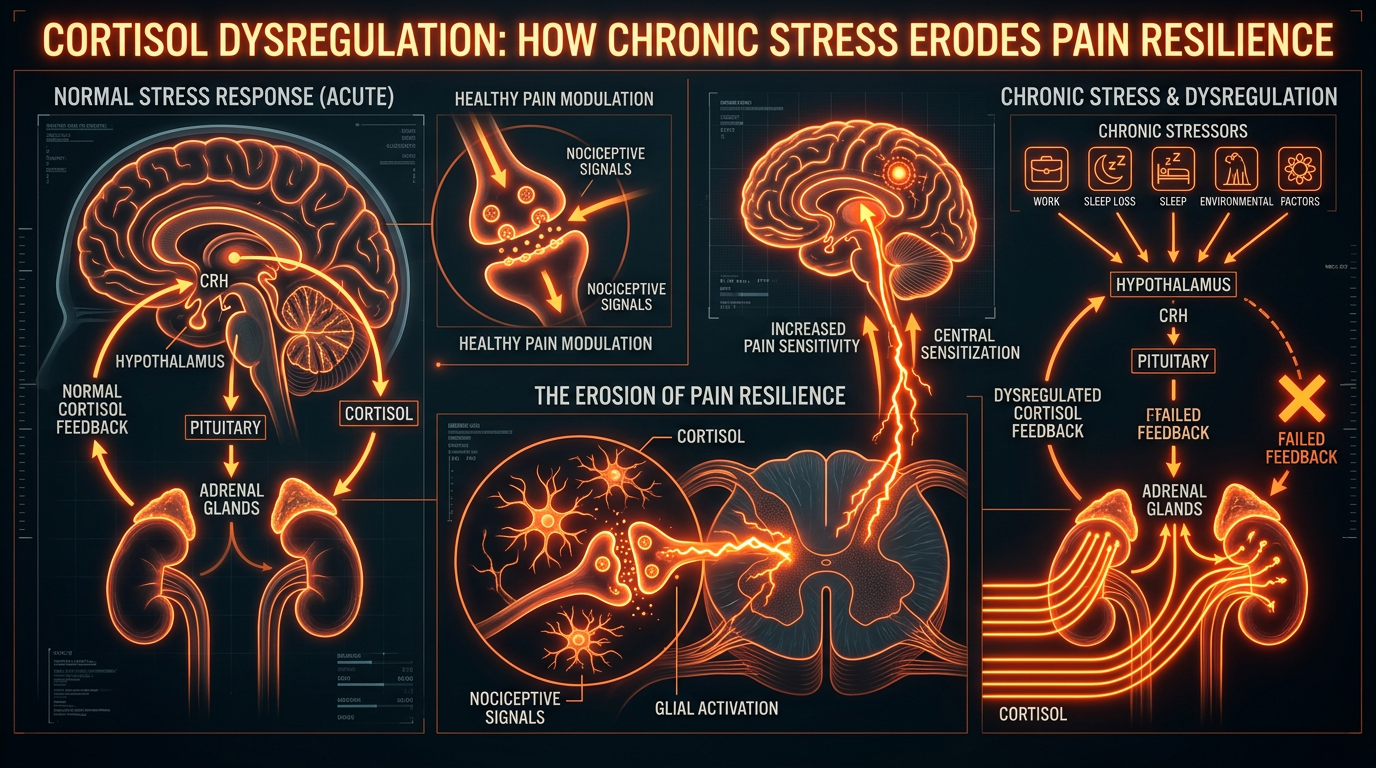
The HPA axis controls the release of cortisol, which is vital for managing inflammation and pain thresholds. When this system is fatigued by modern environmental stressors, the body loses its natural ability to dampen nociceptive signals.
Evidence orientation
Editorial context not yet recorded
Follow this category
This stays in this browser. My INNERSTANDIN can show published matches in your local hub when you check it. It does not send email, push, or alert notifications.
Local learning review
A private browser aid for revisiting ideas. It is not an alert or a health recommendation.
Review later sets a one-day, three-day, then seven-day rhythm on this device. Choose it only when you want to revisit this article.
Overview
In the modern landscape of physiological research, few phenomena are as misunderstood or as catastrophically mismanaged as the relationship between chronic stress and pain resilience. For decades, the medical establishment has viewed pain primarily through a structural lens—focusing on damaged discs, inflamed joints, or compromised nerves. However, as a senior researcher at INNERSTANDING, it has become increasingly evident that the structural integrity of the body is often secondary to the chemical environment in which our nerves reside. At the heart of this environment sits cortisol: the master steroid hormone, the primary glucocorticoid, and the ultimate arbiter of our internal inflammatory state.
Cortisol dysregulation represents a fundamental breakdown of the body’s homeostatic machinery. It is the result of an evolutionary mismatch where our ancient, hard-wired survival mechanisms—designed to help us escape apex predators—are being continuously activated by the mundane stressors of the 24-hour digital economy, economic instability, and environmental toxins. When the Hypothalamic-Pituitary-Adrenal (HPA) axis is pushed into a state of perpetual overdrive, it does not simply "get tired." It undergoes a systemic recalibration that lowers the threshold for pain, amplifies nociceptive signals, and strips away the body's natural opioid-like buffering systems.
To understand why chronic pain has become an epidemic in the United Kingdom and across the Western world, we must look beyond the site of the pain itself. We must examine the biological erosion of resilience. This article explores the intricate mechanics of how a dysregulated HPA axis effectively "turns up the volume" on the nervous system, transforming minor discomfort into debilitating chronic agony and rendering standard analgesic interventions increasingly futile. This is not merely a psychological phenomenon; it is a molecular siege on the human organism.
##
The Biology — How It Works
The HPA axis—the Hypothalamic-Pituitary-Adrenal axis—is the body's primary command-and-control centre for the stress response. Its operation is a masterpiece of endocrine engineering, designed to provide a rapid burst of energy and anti-inflammatory protection during moments of crisis. The process begins in the hypothalamus, which perceives a threat (real or perceived) and releases Corticotropin-Releasing Hormone (CRH). This triggers the anterior pituitary gland to secrete Adrenocorticotropic Hormone (ACTH) into the bloodstream, which eventually reaches the adrenal cortex, stimulating the production and release of cortisol.
Under normal, healthy conditions, cortisol follows a strict diurnal rhythm. It peaks sharply in the early morning—the Cortisol Awakening Response (CAR)—to provide the energy required to start the day and suppress the inflammation that naturally accumulates during sleep. Throughout the day, levels gradually decline, reaching their lowest point around midnight to allow for deep, restorative tissue repair. In the context of pain, cortisol acts as a powerful endogenous anti-inflammatory agent. It stabilises lysosomal membranes, reduces the permeability of capillaries, and prevents the "cytokine storm" that would otherwise lead to excessive swelling and nerve irritation.
However, the HPA axis is governed by a delicate negative feedback loop. When cortisol levels are high, receptors in the hypothalamus and hippocampus should signal the system to shut down production. In a state of chronic stress, this feedback loop becomes blunted. The "thermostat" of the body becomes broken. The system either becomes hyper-responsive, flooding the body with cortisol until the cells become resistant to its effects, or it crashes into a state of hypocortisolism, where the adrenals can no longer produce sufficient levels to meet the body's demands.
In the UK, approximately 28 million adults are estimated to be living with some form of chronic pain, a figure that is intrinsically linked to the nation’s rising rates of stress-related illness and HPA axis dysfunction.
When this system fails, the biological "brakes" on pain are removed. Cortisol is supposed to inhibit the production of pro-inflammatory substances like prostaglandins and leukotrienes. Without this inhibition, the nervous system enters a state of high alert. The relationship between the HPA axis and the autonomic nervous system is symbiotic; as cortisol dysregulation takes hold, the sympathetic nervous system (fight or flight) becomes dominant, leading to increased muscle tension, reduced blood flow to peripheral tissues, and a heightened state of "threat detection" within the brain’s primary somatosensory cortex.
##
Mechanisms at the Cellular Level
To truly appreciate the erosion of pain resilience, we must descend into the cellular and molecular architecture of the body. The primary interface for cortisol’s action is the Glucocorticoid Receptor (GR), which exists in almost every cell in the human body. When cortisol binds to the GR, the complex translocates into the cell nucleus, where it binds to specific DNA sequences to turn off the genes responsible for inflammation. This process is known as transrepression.
The most critical target of this transrepression is Nuclear Factor-kappa B (NF-κB), a protein complex that acts as the "master switch" for the inflammatory response. In a healthy individual, cortisol effectively "mops up" NF-κB, preventing it from entering the nucleus and triggering the production of pro-inflammatory cytokines such as Interleukin-6 (IL-6), Interleukin-1beta (IL-1β), and Tumour Necrosis Factor-alpha (TNF-α). However, in the presence of chronic, unrelenting stress, a condition known as Glucocorticoid Receptor Resistance (GCR) develops.
Much like Insulin Resistance in Type 2 Diabetes, GCR occurs when the body’s cells stop responding to the signals of cortisol. Even if cortisol levels are high in the blood, the receptors are "deaf" to the message. This is the biological equivalent of a fire alarm that won't stop ringing; the brain continues to pump out stress signals, but the "firefighters" (the anti-inflammatory effects of cortisol) never arrive at the scene. This leads to a state of uncontrolled systemic inflammation, which directly irritates nociceptors—the sensory receptors for pain.
Furthermore, cortisol dysregulation profoundly impacts the glial cells in the central nervous system. Once thought to be mere "glue" holding neurons together, we now know that microglia are the immune cells of the brain. Chronic stress primes these microglia into a pro-inflammatory state. When microglia are activated, they release excitatory neurotransmitters like glutamate and substance P, while simultaneously reducing the availability of GABA, the brain’s primary inhibitory (calming) neurotransmitter. This creates a state of Central Sensitisation, where the spinal cord and brain become hyper-excitable. In this state, the brain interprets light touch as pain (allodynia) and moderate pain as excruciating (hyperalgesia). The lack of functional cortisol means there is nothing to "calm" these overactive immune cells in the brain, creating a self-perpetuating cycle of neuroinflammation and agony.
##
Environmental Threats and Biological Disruptors
The erosion of pain resilience is not happening in a vacuum. The modern environment is an unprecedented assault on the HPA axis, featuring a cocktail of stressors that our ancestors never encountered. At INNERSTANDING, we categorise these as "invisible disruptors" that bypass our conscious awareness while wreaking havoc on our endocrine balance.
The first major threat is Circadian Disruption. The HPA axis is fundamentally tied to the light-dark cycle. The blue light emitted by smartphones, tablets, and LED lighting in the evening suppresses the pineal gland's production of melatonin. Because melatonin and cortisol exist in an inverse relationship, the suppression of melatonin prevents the natural midnight "trough" of cortisol. This results in elevated nocturnal cortisol, which prevents the deep sleep required for the glymphatic system to clear metabolic waste from the brain. Without this nightly "wash," the brain remains in an inflamed state, lowering the pain threshold for the following day.
Secondly, the Modern Nutritional Landscape acts as a direct chemical stressor. Ultra-processed foods (UPFs), which now constitute over 50% of the British diet, are loaded with seed oils high in Linoleic Acid and refined sugars. These substances trigger an immediate inflammatory response in the gut, which the HPA axis must then attempt to "quench" with cortisol. Over time, the constant demand for cortisol to manage diet-induced inflammation exhausts the adrenal response. Furthermore, the prevalence of magnesium deficiency—a mineral essential for over 300 enzymatic reactions, including the regulation of the HPA axis—means that most individuals lack the fundamental "biochemical shock absorbers" needed to manage stress.
- Blue Light Exposure: Suppresses melatonin, leading to elevated nocturnal cortisol and neuroinflammation.
- Ultra-Processed Foods: Create a "leaky gut," allowing lipopolysaccharides (LPS) into the bloodstream, which chronically activates the HPA axis.
- Noise Pollution: Chronic exposure to urban noise increases baseline cortisol levels, even during sleep.
- Digital Hyper-connectivity: The "always-on" work culture prevents the HPA axis from ever returning to a "rest and digest" state.
- Endocrine Disruptors: Chemicals like BPA and phthalates mimic hormones, confusing the HPA axis feedback loops.
Finally, we must consider the impact of Psychological Fragmentation. The human brain is not designed to process the sheer volume of information and "micro-threats" delivered via social media and 24-hour news cycles. Each notification, each outrage-inducing headline, and each comparison to a curated digital life triggers a micro-release of cortisol. Individually, these are harmless; collectively, they represent a "death by a thousand cuts" for the adrenal system. When the mind is in a state of perpetual hyper-vigilance, the body responds by maintaining a high-tension state in the musculature, leading to myofascial pain syndromes that become chronic because the underlying stress signal never turns off.
##
The Cascade: From Exposure to Disease
The progression from environmental stress exposure to chronic, debilitating pain is a predictable biological cascade. It rarely happens overnight; rather, it is a slow erosion of the body's compensatory mechanisms. This cascade can be broken down into three distinct phases.
Phase 1: The Alarm Phase (Hypercortisolism). In the initial stages of chronic stress, cortisol levels are persistently elevated. During this phase, the individual may feel "wired but tired." While cortisol is high, it can still manage to suppress some pain, but it begins to deplete the body's reserves of other vital hormones, such as DHEA and progesterone. The high cortisol begins to break down collagen in the joints and connective tissues (proteolysis) to provide glucose for the "fight," paradoxically creating the very structural damage that will later cause pain.
Phase 2: The Resistance Phase (Glucocorticoid Resistance). As the stress continues, the body’s cells begin to downregulate their receptors to protect themselves from the "toxic" levels of cortisol. This is where the erosion of pain resilience truly begins. The individual now has high levels of circulating cortisol but suffers from all the symptoms of low cortisol. Inflammation begins to flare up throughout the body. Old injuries that had healed suddenly start hurting again. The "brakes" are failing, and the nervous system is becoming sensitised.
Phase 3: The Exhaustion Phase (Hypocortisolism/Burnout). Eventually, the HPA axis feedback loop becomes so damaged that the adrenal glands can no longer produce enough cortisol to meet even basic physiological needs. This is the stage of "systemic collapse." Patients in this phase often present with Fibromyalgia, Chronic Fatigue Syndrome (ME/CFS), and widespread nociplastic pain. Because there is almost no endogenous cortisol to dampen inflammation, the slightest physical exertion or emotional stress triggers a massive inflammatory "flare." At this point, the pain is no longer about tissue damage; it is a symptom of a completely exhausted and dysregulated homeostatic system.
Statistics from the Health and Safety Executive (HSE) in the UK indicate that stress, depression, or anxiety accounted for 49% of all work-related ill health cases in 2022/23, with a significant overlap in patients also reporting chronic musculoskeletal pain.
This cascade demonstrates that chronic pain is often the final "smoke signal" of a systemic fire that has been burning for years. By the time a patient seeks help for chronic back pain or migraines, their HPA axis has often been through years of dysregulation, meaning that treating the pain site alone is akin to painting over a damp patch on a wall without fixing the leaking pipe behind it.
##
What the Mainstream Narrative Omits
The mainstream medical narrative regarding chronic pain is fundamentally flawed because it operates on a "siloed" model of the human body. GPs are trained to look at the site of the pain, while psychiatrists look at the "stress," and endocrinologists look at hormones—rarely do the three meet. This fragmentation is the primary reason why chronic pain treatments so often fail.
The standard of care in the UK frequently revolves around the "Analgesic Ladder." This usually starts with NSAIDs (like Ibuprofen), moves to "weak" opioids (like Codeine), and often ends with "strong" opioids or neuropathic agents like Gabapentin or Pregabalin. What the mainstream narrative omits is that these drugs often exacerbate HPA axis dysfunction. For example, long-term opioid use is known to suppress the HPA axis directly, leading to Opioid-Induced Hyperalgesia—a state where the drugs intended to kill pain actually make the patient more sensitive to it by further dysregulating cortisol and the body’s natural endorphin system.
Furthermore, the mainstream narrative almost entirely ignores the role of the Exposome—the sum of environmental exposures over a lifetime. There is a deafening silence regarding the impact of modern agricultural practices, glyphosate exposure, and the depletion of soil minerals on the endocrine system's ability to manage stress. By framing pain as a purely structural or "psychological" issue, the medical establishment avoids confronting the systemic environmental and economic factors that are driving this biological crisis.
The mainstream also fails to acknowledge the Biopsychosocial loop in its true complexity. It is not just that "stress causes pain," but that "dysregulated biology makes the world feel more stressful." When cortisol is low or the receptors are resistant, the amygdala (the brain's fear centre) becomes hyperactive. This means the individual is biologically incapable of "just relaxing." Their biology is forcing them into a state of fear and pain. Telling a patient with HPA axis dysregulation to "stress less" without addressing their underlying biochemistry is not only unhelpful; it is scientifically illiterate.
##
The UK Context
The United Kingdom presents a unique and troubling case study in cortisol-driven pain. The "Stiff Upper Lip" cultural archetype, while often celebrated as a virtue of resilience, frequently serves as a psychological mask for chronic HPA axis over-activation. In British culture, there is a systemic tendency to "soldier on" through high-stress environments, internalising pressure rather than discharging it. This cultural pressure is now colliding with an over-stretched NHS and an economy that demands ever-increasing productivity.
Research published in The Lancet suggests that the UK has one of the highest rates of chronic pain in the developed world, with the economic burden of lost productivity and healthcare costs exceeding £60 billion annually.
The British work culture is also notoriously sedentary and indoor-based. The lack of natural sunlight—particularly during the long winter months—exacerbates the Vitamin D deficiency that is rampant across the UK. Vitamin D is not just a vitamin; it is a secosteroid hormone that acts as a co-factor for cortisol. Without adequate Vitamin D, the Glucocorticoid Receptors cannot function optimally, further eroding pain resilience.
Moreover, the UK’s dependence on a centralised, "one-size-fits-all" healthcare system means that advanced functional testing for the HPA axis—such as the Dutch Test (Dried Urine Test for Comprehensive Hormones) or Salivary Cortisol Awakening Response testing—is virtually non-existent on the NHS. Patients are instead given broad-spectrum blood tests that only look for extreme pathologies like Addison's Disease or Cushing’s Syndrome, completely missing the vast "sub-clinical" middle ground where most cortisol dysregulation and chronic pain reside. This leaves millions of Britons trapped in a cycle of "normal" blood results while their lived experience is one of profound physiological breakdown.
##
Protective Measures and Recovery Protocols
Recovering from cortisol-induced pain erosion requires a radical shift in strategy. We must stop trying to "kill" the pain and start trying to "restore" the HPA axis. This is a multi-dimensional process that requires addressing the environment, the diet, and the nervous system simultaneously.
1. Circadian Re-alignment
The foundation of HPA restoration is the restoration of the diurnal cortisol rhythm. This begins with "View the Sunrise." Exposure to low-angle sunlight in the morning triggers the Cortisol Awakening Response, setting the timer for melatonin production 16 hours later. Conversely, the use of blue-blocking glasses after sunset and the elimination of overhead LED lighting in the evening are non-negotiable for allowing nocturnal cortisol to drop. This allows the body to move from a state of "defense" to a state of "repair."
2. Hormetic Stress and Vagal Toning
While chronic stress erodes resilience, short-term, acute "hormetic" stress can rebuild it. Cold Hydrotherapy (cold showers or ice baths) is a powerful tool for recalibrating the HPA axis. The initial shock triggers a spike in norepinephrine and cortisol, but the subsequent "rebound" activates the parasympathetic nervous system and tones the Vagus nerve. A high Vagal Tone is the biological hallmark of pain resilience, as the Vagus nerve sends anti-inflammatory signals to the gut and brain, bypassing the damaged HPA feedback loops.
3. Targeted Nutritional Support and Adaptogens
To heal the "deaf" cortisol receptors, we must reduce systemic inflammation. This involves:
- Omega-3 Loading: High-dose EPA and DHA (from small fatty fish or high-quality supplements) to restore cell membrane fluidity and GR sensitivity.
- Magnesium Bisglycinate: To "calm" the NMDA receptors in the brain and reduce the excitatory signals that drive pain.
- Adaptogenic Herbs: Ashwagandha (KSM-66), Rhodiola Rosea, and Holy Basil are unique in their ability to "bidirectionally" regulate the HPA axis. They help lower cortisol when it’s too high and support its production when it’s too low, acting as a metabolic thermostat.
4. Cognitive Reframing and Somatic Tracking
Finally, we must address the "software" of the brain. Chronic pain creates a "fear-pain" loop where the brain becomes hyper-vigilant about any sensation in the body. Somatic Tracking—a technique where the individual learns to observe pain sensations with a sense of safety and curiosity rather than fear—can actually "unwire" the neural pathways of pain. When the brain no longer perceives the sensation as a threat, it stops sending the CRH signal to the hypothalamus, finally allowing the HPA axis to stand down.
- Movement as Medicine: Gentle, non-threatening movement like Tai Chi or Qigong helps "flushing" the tissues without triggering a cortisol-spiking stress response.
- Micro-breaks: Implementing the "Pomodoro" technique with 5-minute breathing exercises every hour to prevent the accumulation of allostatic load.
- Elimination of "Chemical Stressors": Removing synthetic fragrances, pesticides, and plastics from the home environment to reduce the endocrine load.
##
Summary: Key Takeaways
The erosion of pain resilience is not an inevitable consequence of aging, nor is it a "mental" failing. It is the predictable outcome of a high-tech, high-stress world acting upon an ancient biological system. Cortisol is the bridge between our environment and our experience of pain; when that bridge is broken, the results are catastrophic.
To summarise the critical insights:
- Cortisol is an Anti-inflammatory Master: Its primary job is to keep the "fire" of inflammation in check. When the HPA axis is dysregulated, the fire burns out of control, leading to systemic pain.
- Glucocorticoid Resistance is the Silent Killer: High blood cortisol means nothing if the receptors aren't listening. This "cellular deafness" is the primary driver of central sensitisation.
- Modernity is the Enemy of Resilience: Blue light, ultra-processed foods, and digital hyper-connectivity are constant "micro-stressors" that drain our adrenal reserves.
- The Mainstream Model is Failing: By focusing on "masking" pain with drugs, the medical establishment often makes the underlying HPA dysfunction worse.
- Restoration is Possible: Through circadian alignment, hormetic stress, targeted nutrition, and somatic retraining, the HPA axis can be recalibrated, and pain resilience can be rebuilt.
At INNERSTANDING, we believe that the path to a pain-free life is not found in a pill bottle, but in the profound understanding of our own biological requirements. The body has an incredible capacity for healing, provided we stop the environmental assault and provide the HPA axis with the signals of safety it needs to function. It is time to move beyond the management of symptoms and toward the restoration of human vitality. Our resilience is not lost; it is simply buried under the weight of a world we were never meant to inhabit. By reclaiming our biology, we reclaim our life.
This article is provided for informational and educational purposes only. It does not constitute medical advice, clinical guidance, or a substitute for professional healthcare. Information reflects cited research at time of publication. Always consult a qualified healthcare professional before acting on any health information.
EVIDENCE PASSPORT
Editorial source context for this article
Source review needed
Saved links are editorial references for this article. They may support specific claims rather than every sentence. Open and assess each source in context. This passport does not independently verify them.
Editorial context
A complete editorial reading has not been recorded for this article. Source links remain available for you to open and assess directly.
Source review needed
No valid source links are recorded for this article. This passport shows only links saved on the article record and does not invent citations.
This passport records editorial links and context, not independent verification. Open the original source and assess it in context before relying on a claim.
Medical Disclaimer
The information in this article is for educational purposes only and does not constitute medical advice, diagnosis, or treatment. Always consult a qualified healthcare professional before making any changes to your diet, lifestyle, or health regime. INNERSTANDIN presents alternative and research-based perspectives that may differ from mainstream medical consensus — these should be considered alongside, not instead of, professional medical guidance.
Read Full DisclaimerContinue the thread
Keep this question moving.
Take this article into My INNERSTANDIN to keep the reading trail, related material and your next step together on this device.
Explore this in the Body Map
See where this hits your biology. Interactive anatomy, threats, and protective protocols.