
Dendritic Pruning in the Digital Age
Updated May 2026
Modern overstimulation in the UK's digital landscape is forcing maladaptive dendritic pruning in developing brains. This article explores how excessive screen time alters physical neural structures permanently.
Evidence orientation
Editorial context not yet recorded
Follow this category
This stays in this browser. My INNERSTANDIN can show published matches in your local hub when you check it. It does not send email, push, or alert notifications.
Local learning review
A private browser aid for revisiting ideas. It is not an alert or a health recommendation.
Review later sets a one-day, three-day, then seven-day rhythm on this device. Choose it only when you want to revisit this article.
Overview
The human brain is an architectural marvel, not because of its static complexity, but because of its radical, almost ruthless, capacity for change. At the heart of this transformation is a biological process known as dendritic pruning. Often described as the "gardening" of the brain, pruning is the programmed elimination of redundant or weak synaptic connections, allowing the more frequently utilised neural pathways to flourish and become more efficient. Historically, this process served an evolutionary imperative: to streamline the adolescent brain for the specific survival demands of its environment.
However, we are no longer living in the environment for which our brains were evolved. The UK, and the broader Western world, has entered an era of unprecedented digital immersion. We are currently witnessing a global, uncontrolled experiment in neurobiology. For the first time in human history, the primary environmental stimuli for the developing brain are not physical, social, or linguistic in the traditional sense, but are instead derived from high-frequency, algorithmically-driven digital interfaces.
This article posits that modern overstimulation is not merely a "distraction"—it is a structural disruptor. We are observing a phenomenon of maladaptive dendritic pruning, where the brain, forced to adapt to the fragmented, rapid-fire nature of digital consumption, is systematically "pruning away" the neural architecture required for deep concentration, empathy, and long-term planning. We are literally thinning our neocortices to accommodate the shallow demands of the digital age.
Biological Fact: In the first two years of life, a child's brain forms approximately one million new neural connections every second. By adolescence, nearly 50% of these connections will be eliminated through pruning to increase processing speed.
This structural overhaul is permanent. Once the window of neuroplasticity closes in early adulthood, the "paved" pathways of the digital brain become the hardware upon which the rest of human life must run. We are not just changing our minds; we are physically redesigning the human organ of thought in ways that may be irreversible.
The Biology — How It Works
To understand the crisis, one must first understand the healthy mechanism of pruning. The brain is born in a state of "synaptic exuberance." This means an infant’s brain is a dense, chaotic forest of connections—far more than it will ever need. This redundancy allows for incredible flexibility; a child can learn any language, adapt to any climate, and master any social custom.
The Synaptic Density Peak
During early childhood, the brain experiences a massive surge in synaptogenesis (the creation of synapses). By the age of two or three, the number of synapses in the brain reaches its peak. However, a brain with too many connections is inefficient. It is slow, noisy, and consumes massive amounts of metabolic energy.
Neural Darwinism: Use It or Lose It
The brain manages this exuberance through a process of "Neural Darwinism." Synapses that are frequently activated are reinforced—a phenomenon governed by Hebbian Theory, which states that "cells that fire together, wire together." These synapses are coated in myelin, a fatty insulating layer that accelerates signal transmission.
Conversely, synapses that are rarely used are identified as "noise." These weak links are targeted for removal. This is dendritic pruning. The goal is to transform a slow, multifaceted "generalist" brain into a high-speed, specialised "specialist" brain.
The Critical Window: Adolescence
The most aggressive phase of pruning occurs during adolescence, specifically within the Prefrontal Cortex (PFC). The PFC is the seat of executive function: impulse control, decision-making, and complex thought. In the healthy development of a British adolescent two decades ago, this pruning was guided by social interaction, physical play, and long-form reading. Today, it is guided by the scroll.
- Phase 1: Proliferation. The brain overproduces connections.
- Phase 2: Selection. The environment dictates which connections are valuable.
- Phase 3: Consolidation. The "gardening" occurs, removing the unused branches.
Mechanisms at the Cellular Level
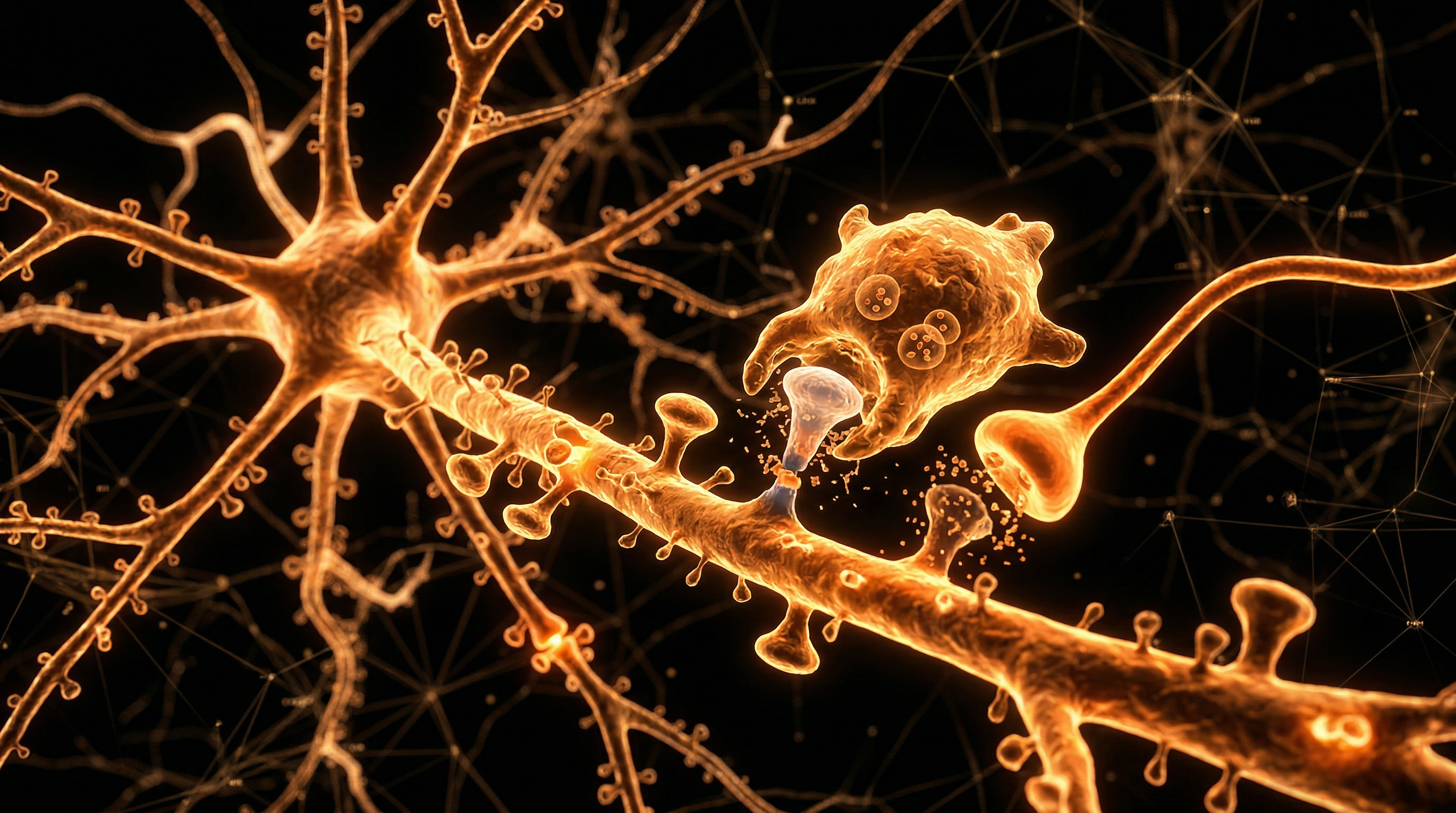
The "gardener" in this neurological metaphor is not a passive force; it is a highly active cellular agent. The primary drivers of dendritic pruning are microglia—the brain’s resident immune cells.
Microglia: The Sculptors of Thought
For decades, microglia were thought to be mere "housekeepers," cleaning up debris. We now know they are the primary architects of the neural landscape. Microglia constantly "survey" the synaptic environment. When they encounter a synapse that has not been sufficiently "tagged" by neural activity, they physically engulf and digest it—a process called phagocytosis.
The Complement System: Molecular "Eat Me" Signals
How do microglia know which synapses to kill? They rely on the Complement System, a group of proteins (primarily C1q and C3) that are part of the innate immune system. In a healthy brain, active synapses express "don't eat me" signals. Inactive synapses, however, become coated in C1q proteins. These act as molecular beacons, signalling to the microglia: This connection is useless. Remove it.
The BDNF Factor
Brain-Derived Neurotrophic Factor (BDNF) acts as the "fertiliser" for the brain. It encourages the growth of new dendrites and protects existing ones. High-intensity digital stimulation has been shown to cause erratic spikes in dopamine which, over time, can disrupt the natural regulation of BDNF. Without sufficient BDNF, the brain becomes more susceptible to over-pruning, as the protective "don't eat me" signals are weakened.
Key Term: Dendritic Spines. These are the tiny protrusions from a neuron's dendrite that receive input from a single axon at the synapse. The density of these spines is a direct measure of the brain's "processing surface area." In digital overstimulation, we see a dramatic reduction in spine density in the prefrontal regions.
Environmental Threats and Biological Disruptors
The digital age has introduced a set of stimuli that the human brain is fundamentally unequipped to process. These threats act as "biological disruptors" that hijack the pruning mechanism.
The High-Frequency Switching Tax
The modern digital landscape is defined by "micro-content"—15-second videos, rapid-fire notifications, and infinite scrolling. Each "switch" in attention requires a burst of neurological energy. In a developing brain, this environment reinforces the neural pathways for distractibility. Because the brain is "firing" in short, disjointed bursts, it never develops the robust, myelinated pathways required for deep, sustained focus. Consequently, the pruning process removes the "long-form" connections as they are seen as metabolically expensive and "unused."
Blue Light and Melatonin Suppression
The UK's high rate of evening screen use directly impacts the Suprachiasmatic Nucleus (SCN). Blue light inhibits the production of melatonin, the hormone responsible for sleep. Sleep is not merely "rest"; it is when the majority of pruning and synaptic consolidation occurs.
The Dopamine Loop
Digital platforms are designed to trigger the Mesolimbic Dopamine Pathway. When a child receives a "like" or a new notification, a surge of dopamine is released. This creates a "reward" signal that is vastly more powerful than the rewards found in the physical world (such as finishing a book or having a conversation). The brain's pruning mechanism then prioritises these dopaminergic pathways, "cutting away" the more subtle circuits required for delayed gratification and emotional regulation.
- Algorithmic Manipulation: Content is served specifically to keep the brain in a state of "orienting reflex," preventing it from entering a "default mode" necessary for internal reflection.
- Sensory Overload: The sheer volume of audiovisual data overwhelms the sensory cortex, leading to a "numbing" effect where only extreme stimuli can trigger neural firing.
- Social Isolation: Despite "social" media, the lack of physical non-verbal cues (oxytocin-driven) means the social brain circuits are being pruned due to underuse.
The Cascade: From Exposure to Disease
The maladaptive pruning of the digital age is not a localized issue; it initiates a systemic "cascade" that often culminates in clinical diagnoses. We are seeing a direct correlation between the "thinning" of certain brain regions and the explosion of neurodevelopmental and psychiatric disorders.
The Atrophy of the Prefrontal Cortex
The most alarming trend is the physical thinning of the Prefrontal Cortex (PFC). Research using longitudinal MRI scans has shown that children with high screen time (exceeding 7 hours a day) show premature thinning of the cortex. In biological terms, their brains are "ageing" prematurely. This thinning is directly linked to:
- ADHD and Attention Fragmentation: The brain lacks the "brake" system to inhibit impulsive thoughts.
- Executive Dysfunction: An inability to plan, prioritise, or execute complex multi-stage tasks.
The Amygdala-PFC Disconnect
Pruning is also responsible for the "cabling" between the Amygdala (the fear centre) and the PFC (the rational centre). In a digitally overstimulated brain, the pathways that allow the PFC to calm the Amygdala are often pruned away. This leaves the individual in a state of chronic "hyper-vigilance" or anxiety. This is not just a "feeling"—it is a structural lack of "wiring" between the rational and emotional brain.
The "Digital Depression" Mechanism
When the brain's reward system is over-pruned to respond only to high-dopamine digital inputs, the "baseline" of joy is raised. Everyday activities—walking in the park, eating a meal, talking to a friend—no longer provide enough "signal" to fire the remaining synapses. This results in Anhedonia (the inability to feel pleasure), a core symptom of clinical depression.
Statistic: According to a 2023 study, adolescents who spent more than 5 hours daily on social media were 70% more likely to experience symptoms of "major depressive disorder" compared to those with low usage.
What the Mainstream Narrative Omits
The mainstream media and public health bodies often frame the "screen time" debate as one of "balance" or "parental choice." This narrative is dangerously reductive and omits several "uncomfortable truths" about the biological reality of the situation.
1. The Permanence of the "Pruning Window"
The most suppressed truth is that dendritic pruning is time-sensitive. There is a biological window—primarily between ages 12 and 22—where the brain's architecture is finalised. Once those "unused" branches are pruned by microglia, they do not simply grow back in adulthood. You cannot "undo" a decade of digital overstimulation with a "digital detox" at age 30. The hardware is set.
2. The Weaponisation of Neuroplasticity
We rarely hear the truth about "Persuasive Design." Silicon Valley engineers use "Brain-Computer Interface" (BCI) principles to intentionally trigger the pruning of the human attention span. By making "switching" more rewarding than "staying," they are physically re-engineering the user's brain to be more susceptible to their products. It is not an addiction; it is a neurological takeover.
3. The Lack of Long-Term Safety Data
The introduction of the iPad and the smartphone occurred without any biological impact studies. We are essentially 15 years into a 50-year study. The "iPad Kids" are only now reaching university age, and we are seeing the first wave of what researchers are calling "Cognitive Atrophy"—a generation with high IQs but a structural inability to apply that intelligence to long-form problems.
4. The "Neurological Inequality" Gap
There is a growing divide. The elite in Silicon Valley and high-performing UK sectors are increasingly sending their children to "Low-Tech" or "No-Tech" schools (like certain Waldorf or Steiner models). They understand that the "digital future" is for the consumers, while a "synaptically dense, non-pruned brain" is the ultimate luxury and competitive advantage for the leaders of tomorrow.
The UK Context
The United Kingdom presents a unique and troubling landscape for dendritic health. As one of the most digitally integrated societies in Europe, the UK serves as a "canary in the coal mine" for neurological erosion.
The OFCOM Reality
Recent data from OFCOM (the UK's communications regulator) suggests that British 3-to-4-year-olds are now spending an average of 6 hours a week online, with that number skyrocketing to 30+ hours by age 12. In a country where "rainy day" indoor culture is common, the digital world has replaced the "Great Outdoors" as the primary environmental sculptor of the British brain.
The NHS Crisis: A Symptom of Structural Change
The UK's CAMHS (Child and Adolescent Mental Health Services) is currently overwhelmed, with referral rates hitting record highs. While many attribute this to "increased awareness," a senior biological perspective suggests we are seeing the literal "structural collapse" of the adolescent prefrontal cortex on a national scale. We are trying to treat a hardware problem with software solutions (therapy and counselling).
The UK Educational Infrastructure
The UK government’s "Digital First" strategy in schools—replacing textbooks with tablets and handwriting with typing—is a biological disaster.
- The Loss of Fine Motor Integration: Handwriting is a complex neurological task that integrates the motor cortex and the language centres. By pruning these connections in favour of the "low-effort" tapping of a screen, we are losing the "cross-talk" between different brain regions that fosters creative thinking.
- The Urban "Sensory Poverty": In many UK urban centres, the lack of "green time" means there is no "biophilic" input to balance the digital output. The British brain is being pruned in a vacuum of natural stimuli.
Protective Measures and Recovery Protocols
While the situation is dire, the "plastic" nature of the brain—even in adulthood—offers a glimmer of hope. For those still within the "pruning window," or those wishing to protect their children, drastic "Neurological Intervention" is required.
1. The "Analogue Offset"
For every hour of digital stimulation, the brain requires two hours of "high-resolution analogue" input. This means activities that require:
- Depth Perception: Physical sports or gardening (engages the parietal lobe).
- Fine Motor Skills: Playing a physical instrument, painting, or woodwork.
- Complex Social Decoding: Face-to-face interaction without the presence of a phone (engages the "Mirror Neuron" system).
2. Biophilia and "Forest Bathing"
Exposure to natural "fractals" (the self-similar patterns in trees and clouds) has been shown to reduce "cortical noise" and lower cortisol levels. For the UK population, regular access to "Green and Blue Spaces" is not a luxury; it is a neurological necessity to prevent hyper-active microglial pruning.
3. Nutritional Support for Synaptic Integrity
To prevent "maladaptive pruning," we must provide the brain with the raw materials for synaptic repair.
- Omega-3 Fatty Acids (DHA): Essential for maintaining the fluidity of the synaptic membrane.
- Magnesium L-Threonate: The only form of magnesium that effectively crosses the blood-brain barrier to increase "synaptic density."
- Anthocyanins: Found in UK-native berries (blueberries, blackcurrants), these protect the brain from the oxidative stress caused by high-intensity screen use.
4. The "Deep Work" Protocol
To re-train the brain, one must "force-fire" the pathways for concentration. This involves:
- Monotasking: Engaging in one task (e.g., reading a physical book) for 40 minutes without interruption.
- Boredom Therapy: Intentionally sitting in silence without a device. This allows the Default Mode Network (DMN) to activate, preventing the "atrophy of the self" that occurs when we are constantly externally stimulated.
5. Radical Digital Hygiene
- Greyscale Mode: Removing the "reward colours" from smartphones to reduce dopaminergic firing.
- The "No-Screen" Hour: No screens for 90 minutes before bed to allow for "synaptic consolidation" during sleep.
- The 20-20-20 Rule: To prevent the "flattening" of visual processing, look at something 20 feet away for 20 seconds every 20 minutes.
Summary: Key Takeaways
The digital age has fundamentally altered the "soil" in which our neural gardens grow. The biological reality of Dendritic Pruning means that the choices we make today are being "hardwired" into the brains of tomorrow.
- Pruning is a "Use It or Lose It" Mechanism: If we do not use our brains for deep thought, empathy, and sustained focus, the microglia will systematically remove those connections.
- Digital Overstimulation is Maladaptive: The rapid-fire nature of the modern internet creates a "shallow" brain architecture, thinning the Prefrontal Cortex and enlarging the reactive centres (Amygdala).
- The Process is Time-Sensitive: The adolescent brain is particularly vulnerable. Once the pruning window closes, the structural changes are largely permanent.
- The UK is at the Epicentre: With high digital integration and a decline in analogue play, the British population is facing a "neurological recession" that the current healthcare and educational systems are failing to address.
- Resistance is Possible: Through "Analogue Offsets," nutritional intervention, and the intentional cultivation of "Deep Work," we can steer the pruning process toward a more resilient, complex, and human brain.
The "Innerstanding" of this crisis is the first step toward reclamation. We are not just "users" of technology; we are its biological subjects. To save the human mind, we must first protect the delicate "branches" of the neural forest before the gardeners of the digital age prune them into oblivion.
This article is provided for informational and educational purposes only. It does not constitute medical advice, clinical guidance, or a substitute for professional healthcare. Information reflects cited research at time of publication. Always consult a qualified healthcare professional before acting on any health information.
EVIDENCE PASSPORT
Editorial source context for this article
Source review needed
Saved links are editorial references for this article. They may support specific claims rather than every sentence. Open and assess each source in context. This passport does not independently verify them.
Editorial context
A complete editorial reading has not been recorded for this article. Source links remain available for you to open and assess directly.
Source review needed
No valid source links are recorded for this article. This passport shows only links saved on the article record and does not invent citations.
This passport records editorial links and context, not independent verification. Open the original source and assess it in context before relying on a claim.
Medical Disclaimer
The information in this article is for educational purposes only and does not constitute medical advice, diagnosis, or treatment. Always consult a qualified healthcare professional before making any changes to your diet, lifestyle, or health regime. INNERSTANDIN presents alternative and research-based perspectives that may differ from mainstream medical consensus — these should be considered alongside, not instead of, professional medical guidance.
Read Full DisclaimerContinue the thread
Keep this question moving.
Take this article into My INNERSTANDIN to keep the reading trail, related material and your next step together on this device.
Explore this in the Body Map
See where this hits your biology. Interactive anatomy, threats, and protective protocols.
Dig deeper in the Library
Free, longform PDF volumes that go beyond headlines into mechanisms and references.