
Detection and Detox: Navigating Herbicide Residues in Organic Farming
Updated May 2026
A guide to the challenges organic farmers face regarding spray drift and environmental contamination, focusing on detection technologies and mitigation strategies.
Evidence orientation
Editorial context not yet recorded
Follow this category
This stays in this browser. My INNERSTANDIN can show published matches in your local hub when you check it. It does not send email, push, or alert notifications.
Local learning review
A private browser aid for revisiting ideas. It is not an alert or a health recommendation.
Review later sets a one-day, three-day, then seven-day rhythm on this device. Choose it only when you want to revisit this article.
The Illusion of the Untouched: The Modern Organic Crisis
In the current agricultural landscape, the term 'Organic' is frequently perceived as a binary state—a definitive absence of synthetic intervention. However, for the discerning practitioner and the informed consumer, the reality is far more nuanced and, arguably, more precarious. We inhabit a closed-loop biosphere where the chemical signatures of industrial agriculture do not respect the arbitrary boundaries of a certified organic fence line.
The prevalence of glyphosate—the phosphonate active ingredient in formulations such as Roundup—has created a global background radiation of toxicity. Despite the stringent standards upheld by bodies such as the Soil Association in the United Kingdom, the organic sector faces an existential challenge: the persistent infiltration of herbicide residues through atmospheric drift, hydrological cycles, and legacy soil contamination. This treatise explores the molecular mechanisms of these residues, the failure of regulatory oversight, and the rigorous protocols required for both soil and biological recovery.
I. The Molecular Trojan Horse: Biological Mechanisms of Glyphosate
The primary deception propagated by agrochemical giants is the assertion that glyphosate is non-toxic to humans because it targets the shikimate pathway—a metabolic route used by plants and bacteria to synthesise essential aromatic amino acids (phenylalanine, tyrosine, and tryptophan) which humans purportedly do not possess.
This is a reductionist fallacy. While human cells do not possess the shikimate pathway, our gut microbiome—the complex internal ecosystem of trillions of bacteria—relies upon it entirely.
The Microbiome Disruption
Glyphosate acts as a potent antimicrobial agent. By inhibiting the enzyme 5-enolpyruvylshikimate-3-phosphate synthase (EPSPS), it selectively decriminates against beneficial microflora (such as Lactobacillus and Bifidobacterium), while allowing pathogenic strains like Clostridium botulinum and Salmonella—which are often glyphosate-resistant—to proliferate. This creates a state of chronic intestinal dysbiosis, the precursor to systemic inflammation and autoimmune dysfunction.
The Glycine Mimicry
Perhaps more insidious is glyphosate’s structural similarity to glycine, the smallest amino acid used in protein synthesis. There is compelling evidence suggesting that the body may mistakenly incorporate glyphosate into protein chains in place of glycine.
- Protein Folding: This substitution leads to misfolded proteins, implicated in neurodegenerative diseases.
- Collagen Integrity: As glycine constitutes one-third of collagen, the incorporation of glyphosate may explain the rise in connective tissue disorders and hypermobility.
- Chelation: Glyphosate is a powerful chelator, stripping the body of vital minerals such as manganese, magnesium, and zinc, which are essential co-factors for enzymatic function.
According to the UK Expert Committee on Pesticide Residues in Food (PRiF), monitoring programmes consistently detect glyphosate in a significant percentage of bread and cereal products sold in British supermarkets. Even when levels fall below the 'Maximum Residue Level' (MRL), the cumulative effect of chronic, low-dose exposure remains unaddressed by statutory health assessments.
II. Environmental Disruptors: The Ghost in the Organic Machine
Organic farmers often inherit land that has been subjected to decades of conventional 'burn-down' protocols. The myth of glyphosate's rapid biodegradation is one of the most successful marketing triumphs in history.
Persistence and the AMPA Factor
When glyphosate does break down, it degrades into aminomethylphosphonic acid (AMPA). AMPA is notably more persistent and potentially more toxic than its parent compound. In many UK soils, the half-life of these residues can extend from weeks to several years, depending on microbial activity and soil pH.
The Vector of Contamination
Organic integrity is compromised through three primary vectors:
- Atmospheric Transport: Herbicide particles can be carried by wind (drift) or volatilise into the atmosphere, returning to organic land via rainfall.
- Hydrological Infiltration: Runoff from neighbouring conventional farms enters the groundwater and irrigation systems, carrying soluble residues directly into the root zones of organic crops.
- Compost and Manure: The 'Killer Compost' phenomenon occurs when organic growers use manure from livestock fed on conventional, glyphosate-sprayed grains. The residues survive the digestive tract of the animal and the composting process, leading to crop failure or contamination.
III. The Failure of Detection: Beyond the MRL
The current regulatory framework in the UK and the EU relies on the Maximum Residue Level (MRL). This is a political and economic construct rather than a biological one.
The "Safe" Level Fallacy
Regulatory toxicology is based on the Sola Dosis Facit Venenum (the dose makes the poison) model. This fails to account for Endocrine Disruption. Many herbicides exhibit non-monotonic dose-response curves, meaning they can be more damaging at parts-per-billion levels—where they mimic hormones—than at higher doses where they might trigger cellular defence mechanisms.
Analytical Limitations
Standard testing often misses the mark for several reasons:
- Metabolite Ignoring: Most labs test for glyphosate but ignore AMPA and other breakdown products.
- The Cocktail Effect: Synergistic toxicity occurs when glyphosate is combined with surfactants like POEA (polyethoxylated tallowamine). These 'inert' ingredients are often 100 times more toxic than glyphosate alone and are rarely tested for in organic produce.
- Detection Thresholds: Standard LC-MS/MS (Liquid Chromatography-Mass Spectrometry) testing often has a detection limit that is too high to capture the endocrine-disrupting reality of these chemicals.
IV. Soil Recovery: Remediation Protocols for the Organic Farmer
To truly claim organic status in a contaminated world, proactive remediation is required. We must move beyond "avoidance" and toward "active detoxification" of the land.
1. Mycoremediation
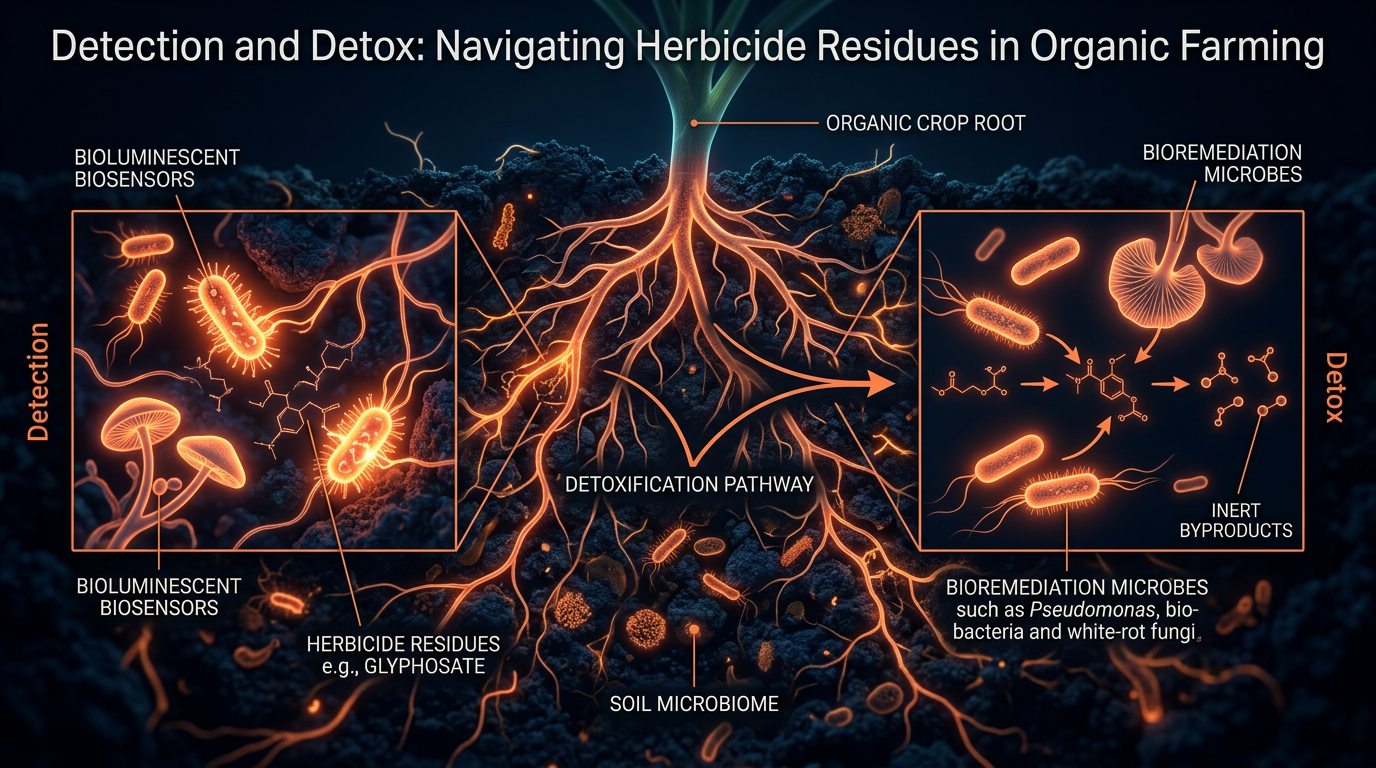
Fungi are nature’s primary decomposers. Certain species of white-rot fungi produce extracellular enzymes (lignin peroxidases) capable of breaking the carbon-phosphorus bond in glyphosate.
- Protocol: Integrating Pleurotus ostreatus (Oyster mushrooms) or Trametes versicolor (Turkey Tail) mycelium into soil buffers can significantly accelerate the breakdown of organophosphonates.
2. Biochar and Humic Substances
High-quality biochar acts as a molecular sieve, sequestering herbicide residues and preventing their uptake by plant roots.
- Application: Amending soil with humic and fulvic acids not only improves nutrient density but also enhances microbial degradation of xenobiotics by providing a carbon source for the beneficial bacteria that "eat" these chemicals.
3. Microbial Inoculation
Targeted application of Pseudomonas and Bacillus species has shown efficacy in metabolising glyphosate as a source of phosphorus. For the organic farmer, brewing aerated compost teas (ACT) rich in these specific strains is an essential defensive strategy.
V. Biological Detox: Navigating Human Residue
If the soil is contaminated, the consumer is inevitably contaminated. Navigating the "Body Burden" of herbicide residues requires a scientific approach to detoxification.
The Glycine Displacement Strategy
To counter the incorporation of glyphosate into proteins, one must saturate the system with high-quality, pure Glycine. By increasing the ratio of Glycine to Glyphosate, the body is less likely to mistakenly utilise the toxic analogue during protein synthesis and DNA repair.
Chelation and Binders
Herbicide residues are notoriously difficult to dislodge from fatty tissues and the interstitial fluid.
- Humic and Fulvic Acid Supplementation: These organic acids act as natural chelators, binding to glyphosate molecules in the digestive tract and systemic circulation, facilitating their excretion.
- Alginates and Pectin: Modified citrus pectin and seaweed-derived alginates provide a non-resorbable matrix in the gut that can trap residues being excreted via the bile.
Supporting the Phase II Detoxification Pathway
The liver must process these residues through the glucuronidation and sulfation pathways.
- Cruciferous Support: Sulforaphane from broccoli sprouts upregulates Nrf2, the body's master antioxidant switch, aiding in the neutralisation of herbicide-induced oxidative stress.
- Glutathione Precursors: N-Acetyl Cysteine (NAC) and Selenium are critical for maintaining the glutathione stores necessary to conjugate and remove xenobiotics.
VI. The Policy Gap: UK Agriculture Post-Brexit
The UK’s departure from the EU has created a regulatory vacuum. While the EU has faced immense public pressure to ban glyphosate, the UK's "evidence-based" approach—often heavily influenced by industry lobbying—remains conservative.
According to data from the Pesticide Action Network (PAN) UK, nearly 25% of all UK land is treated with glyphosate at least once a year. In the absence of a total ban, organic farmers bear the financial and logistical burden of testing and protecting their land from "trespass" by these chemicals.
The lack of a 'Polluter Pays' principle in UK pesticide policy means that an organic farmer whose crop is ruined by neighbour drift has little recourse for compensation, while the residues continue to accumulate in the local trophic levels.
VII. Conclusion: The Path of INNERSTANDING
True organic farming is no longer a passive endeavour. It is an act of resistance against a chemical onslaught that is pervasive, persistent, and profoundly misunderstood. Detection is the first step—moving beyond the superficial "certified" label to rigorous, multi-metabolite testing.
The recovery of our soil and our health demands a transition from chemical dependency to biological mastery. We must employ mycoremediation to heal the earth and nutritional biochemistry to heal ourselves. The presence of herbicide residues in organic farming is a symptom of a broken global system, but through "Innerstanding"—the deep, functional comprehension of these biological mechanisms—we can navigate this toxicity and reclaim the integrity of our food, our land, and our genetic future.
The "truth-exposing" reality is that the organic seal is a shield, not a vacuum. To survive the chemical age, the organic movement must evolve from a set of prohibitions into a sophisticated science of detoxification and regenerative resilience.
- Actionable Summary for the Practitioner:
- Conduct independent soil tests for AMPA, not just Glyphosate.
- Implement biochar buffers on field margins to intercept aqueous runoff.
- Supplement livestock and humans with humic substances to mitigate inevitable background exposure.
- Advocate for the reclassification of glyphosate as a persistent environmental pollutant.
The era of agricultural innocence is over; the era of biological precision has begun.
This article is provided for informational and educational purposes only. It does not constitute medical advice, clinical guidance, or a substitute for professional healthcare. Information reflects cited research at time of publication. Always consult a qualified healthcare professional before acting on any health information.
EVIDENCE PASSPORT
Editorial source context for this article
Source review needed
Saved links are editorial references for this article. They may support specific claims rather than every sentence. Open and assess each source in context. This passport does not independently verify them.
Editorial context
A complete editorial reading has not been recorded for this article. Source links remain available for you to open and assess directly.
Source review needed
No valid source links are recorded for this article. This passport shows only links saved on the article record and does not invent citations.
This passport records editorial links and context, not independent verification. Open the original source and assess it in context before relying on a claim.
Medical Disclaimer
The information in this article is for educational purposes only and does not constitute medical advice, diagnosis, or treatment. Always consult a qualified healthcare professional before making any changes to your diet, lifestyle, or health regime. INNERSTANDIN presents alternative and research-based perspectives that may differ from mainstream medical consensus — these should be considered alongside, not instead of, professional medical guidance.
Read Full DisclaimerContinue the thread
Keep this question moving.
Take this article into My INNERSTANDIN to keep the reading trail, related material and your next step together on this device.
Explore this in the Body Map
See where this hits your biology. Interactive anatomy, threats, and protective protocols.
Dig deeper in the Library
Free, longform PDF volumes that go beyond headlines into mechanisms and references.