
The Endocrine Mirage: Deciphering the Hormonal Disruption in Professional Haircare
Published April 2026
An investigative look at how phthalates and parabens in hair products bypass the scalp barrier to disrupt androgen signaling and mitochondrial function, challenging the safety of regulatory 'safe levels'.
Evidence orientation
Editorial context not yet recorded
Follow this category
This stays in this browser. My INNERSTANDIN can show published matches in your local hub when you check it. It does not send email, push, or alert notifications.
Local learning review
A private browser aid for revisiting ideas. It is not an alert or a health recommendation.
Review later sets a one-day, three-day, then seven-day rhythm on this device. Choose it only when you want to revisit this article.
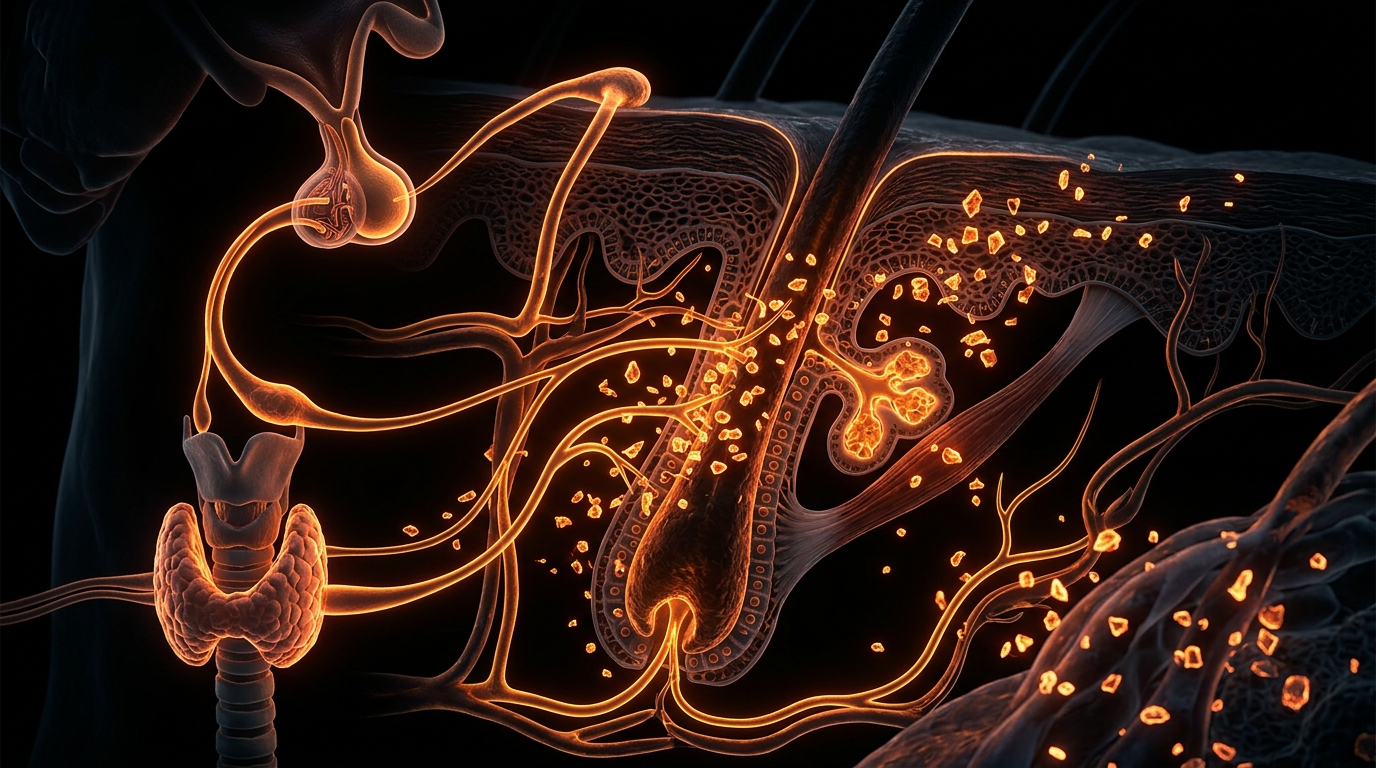
The modern hair salon is often perceived as a sanctuary of self-care, yet beneath the fragrant mists of professional sprays and the sleek textures of high-end conditioners lies a complex landscape of biochemical interference. While mainstream dermatology focuses on immediate contact dermatitis, the 'Innerstanding' perspective examines the deeper systemic impact of endocrine-disrupting chemicals (EDCs), specifically phthalates and parabens, which infiltrate the body through the scalp—one of the most vascularized areas of human skin. Section 1: The Molecular Mimicry of Phthalates and Androgen Interference. Phthalates, often used as solvents and fixatives in hairsprays and mousses, are not chemically bound to the products they inhabit, allowing them to leach easily into the environment and onto the skin. Once absorbed, these compounds act as xenoestrogens, but their most insidious role is the disruption of the androgen receptor (AR) signaling.
Unlike the binary 'on/off' switch described in basic biology, the endocrine system operates on a nuanced gradient. Phthalates interfere with the synthesis of testosterone by inhibiting the activity of the steroidogenic acute regulatory (StAR) protein and the CYP11A1 enzyme within the Leydig cells. For the health-literate adult, it is crucial to recognize that this is not merely a 'hormonal imbalance' but a fundamental redirection of cellular fate. Phthalates also activate Peroxisome Proliferator-Activated Receptors (PPARs), which govern lipid metabolism and glucose homeostasis, potentially linking professional haircare exposure to metabolic dysfunction that mainstream medicine often attributes solely to diet and exercise. Section 2: Parabens and the Mitochondrial Connection.
Parabens, used as preservatives in almost every liquid hair formulation, are frequently dismissed because they are 'rapidly excreted.' However, this ignores the 'Cocktail Effect' and the reality of chronic, daily exposure. Beyond their estrogenic mimicry, parabens have been shown to induce mitochondrial dysfunction. They uncouple oxidative phosphorylation and inhibit the activity of the respiratory chain complexes. When mitochondria in the dermal papilla cells of the hair follicle are compromised, the result isn't just poor hair growth—it is a signal of systemic oxidative stress. This mitochondrial interference can lead to the overproduction of Reactive Oxygen Species (ROS), which damage mitochondrial DNA (mtDNA) and initiate a pro-inflammatory cascade.
This process, known as 'inflammaging,' accelerates the biological age of the skin and scalp, a mechanism rarely discussed in standard cosmetic consultations. Section 3: The Regulatory Myth of 'Safe Levels'. Current UK and EU regulations base safety assessments on 'No Observed Adverse Effect Levels' (NOAEL) for individual chemicals. This methodology is fundamentally flawed for two reasons. First, the endocrine system is sensitive to picomolar concentrations—levels far below the thresholds used in toxicological testing.
Second, the synergistic effect of multiple EDCs is not additive; it is often exponential. When phthalates, parabens, and synthetic musks are combined, they occupy multiple pathways of the detoxification system, particularly the Phase II glucuronidation pathway in the liver. This creates a 'bottleneck' where the body's ability to clear natural hormones and exogenous toxins is severely diminished. Understanding the toxicology of haircare requires looking beyond the label and recognizing the scalp as a portal for chronic, low-dose chemical intrusion that bypasses the first-pass metabolism of the digestive system, leading to a cumulative systemic burden that necessitates a radical shift in our approach to beauty products.
This article is provided for informational and educational purposes only. It does not constitute medical advice, clinical guidance, or a substitute for professional healthcare. Information reflects cited research at time of publication. Always consult a qualified healthcare professional before acting on any health information.
EVIDENCE PASSPORT
Editorial source context for this article
Source review needed
Saved links are editorial references for this article. They may support specific claims rather than every sentence. Open and assess each source in context. This passport does not independently verify them.
Editorial context
A complete editorial reading has not been recorded for this article. Source links remain available for you to open and assess directly.
Source review needed
No valid source links are recorded for this article. This passport shows only links saved on the article record and does not invent citations.
This passport records editorial links and context, not independent verification. Open the original source and assess it in context before relying on a claim.
Medical Disclaimer
The information in this article is for educational purposes only and does not constitute medical advice, diagnosis, or treatment. Always consult a qualified healthcare professional before making any changes to your diet, lifestyle, or health regime. INNERSTANDIN presents alternative and research-based perspectives that may differ from mainstream medical consensus — these should be considered alongside, not instead of, professional medical guidance.
Read Full DisclaimerContinue the thread
Keep this question moving.
Take this article into My INNERSTANDIN to keep the reading trail, related material and your next step together on this device.
Explore this in the Body Map
See where this hits your biology. Interactive anatomy, threats, and protective protocols.
Dig deeper in the Library
Free, longform PDF volumes that go beyond headlines into mechanisms and references.