
The Enterohepatic Circulation: How Your Body Recycles Bile
Updated May 2026
A comprehensive guide to the journey of bile acids from the liver to the intestines and back, and why this cycle is crucial for lipid digestion and metabolic health.
Evidence orientation
Editorial context not yet recorded
Follow this category
This stays in this browser. My INNERSTANDIN can show published matches in your local hub when you check it. It does not send email, push, or alert notifications.
Local learning review
A private browser aid for revisiting ideas. It is not an alert or a health recommendation.
Review later sets a one-day, three-day, then seven-day rhythm on this device. Choose it only when you want to revisit this article.
The Silent Sentinel of Metabolic Integrity
In the hierarchy of human physiological processes, the cardiovascular system and the neurological network often command the majority of clinical attention. Yet, beneath the surface of conventional diagnostic markers lies a sophisticated, closed-loop recycling system that dictates the trajectory of systemic health: the enterohepatic circulation (EHC).
This process—the continuous movement of bile salts from the liver to the small intestine and back again—is not merely a mechanical digestive aid. It is a profound biological masterpiece of efficiency. However, in the modern era, this once-perfect loop has become a liability. The very mechanism designed to conserve precious resources is now being hijacked by environmental toxins, pharmaceutical residues, and a disrupted microbiome, turning a vital recycling system into a circuit for chronic autointoxication.
To understand health at a cellular level, one must "innerstand" the enterohepatic circulation. It is the gatekeeper of hormonal balance, the primary route for lipid metabolism, and the body’s most critical detoxification highway.
## The Biological Engine: Mechanics of the Bile Loop
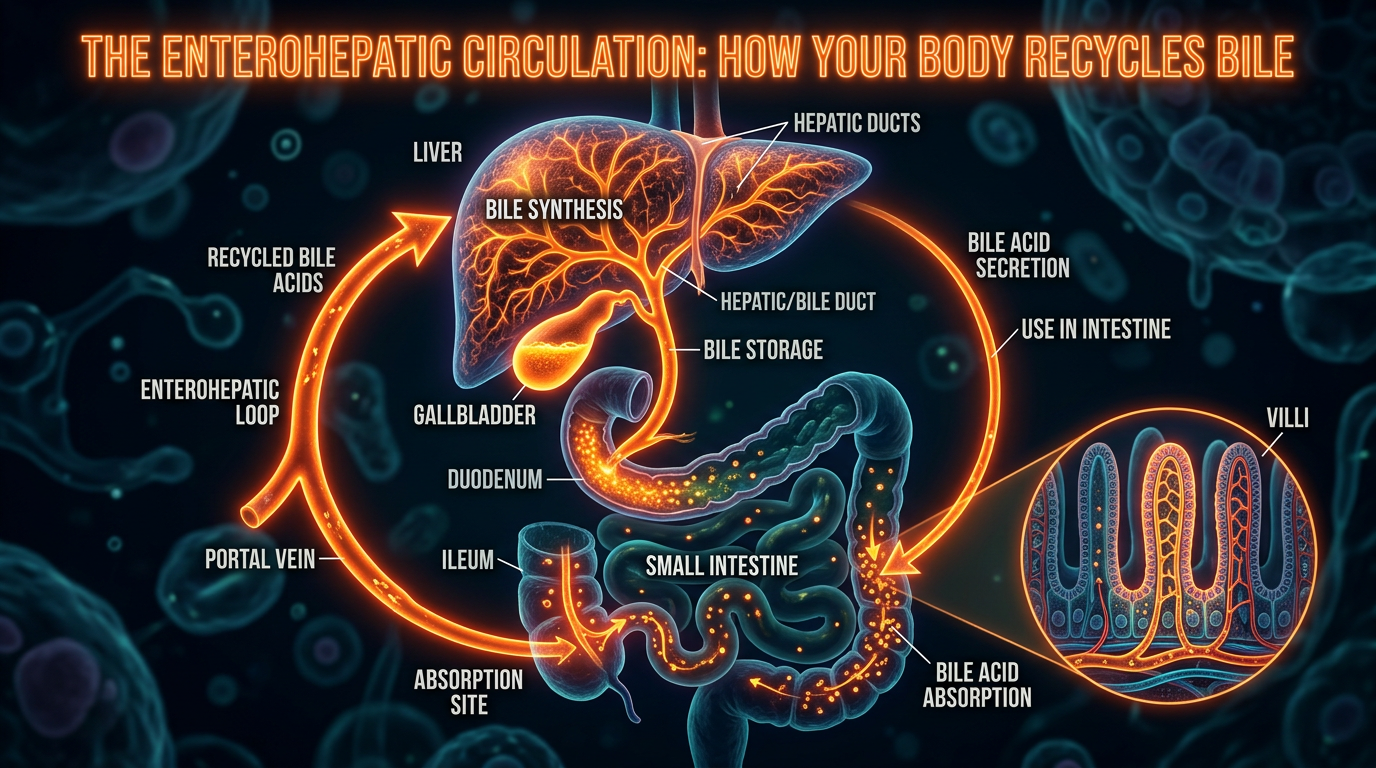
Bile is a complex fluid composed of bile acids (salts), cholesterol, phospholipids, bilirubin, and waste products. The liver produces approximately 500ml to 1000ml of bile daily, yet the total pool of bile acids in the body is only about 3 to 5 grams. To meet the demands of digestion, this small pool must circulate between 4 and 12 times a day.
The Synthesis Phase
The process begins in the hepatocytes (liver cells), where cholesterol is converted into primary bile acids: cholic acid (CA) and chenodeoxycholic acid (CDCA). These are conjugated with amino acids—typically glycine or taurine—to render them water-soluble and less toxic to the biliary tract.
The Secretion and Storage Phase
Once synthesised, bile is transported through the hepatic ducts to the gallbladder. Here, it is concentrated up to tenfold. The gallbladder is not merely a storage pouch; it is a sophisticated pressure-regulator. Upon the ingestion of fats, the hormone cholecystokinin (CCK) is released from the duodenum, triggering the gallbladder to contract and release the concentrated bile into the small intestine.
The Reabsorption Phase (The 95% Rule)
As bile travels through the jejunum, it emulsifies dietary fats and fat-soluble vitamins (A, D, E, and K). However, the body cannot afford to lose these precious bile salts. When they reach the distal ileum (the final section of the small intestine), a highly specific transport protein called the Apical Sodium-dependent Bile acid Transporter (ASBT) recaptures approximately 95% of the bile acids.
These recaptured acids enter the portal vein and are carried back to the liver, where they are re-extracted by hepatocytes and prepared for the next cycle. The remaining 5% is excreted in the faeces—this is the body’s primary method of eliminating cholesterol and fat-soluble toxins.
"According to the NHS and British Society of Gastroenterology, gallstone disease affects approximately 10-15% of the UK adult population, with over 60,000 cholecystectomies (gallbladder removals) performed annually in England alone. This suggests a systemic failure in bile solubility and recycling efficiency across the British populace."
## The "Truth-Exposing" Perspective: The Toxic Trap
In an ancestral environment, the enterohepatic circulation worked flawlessly. Today, however, we are exposed to a "chemical soup" that the human liver was never evolved to process. The EHC has a fatal flaw: it cannot always distinguish between a beneficial bile salt and a fat-soluble toxin.
The Re-circulation of Poison
When the liver filters fat-soluble toxins (such as pesticides, heavy metals, or plasticisers), it binds them to bile for excretion. However, if the gut environment is compromised, these toxins are not excreted. Instead, they are reabsorbed in the terminal ileum alongside the bile salts. This creates a "vicious cycle" where the same toxins circulate through the liver and intestines repeatedly, never actually leaving the body. This is a primary driver of "toxic liver syndrome" and chronic inflammatory states.
The Microbial Sabotage
The health of the EHC is entirely dependent on the microbiome. In the large intestine, bacteria "deconjugate" bile acids, converting them into secondary bile acids like deoxycholic acid (DCA). While some secondary bile acids are necessary, an overgrowth of pathogenic bacteria (as seen in SIBO) can lead to premature deconjugation. This results in:
- Malabsorption: Bile acids become ineffective at emulsifying fats.
- Mucosal Damage: Excess secondary bile acids are highly irritating to the gut lining, potentially leading to "leaky gut" and increased colon cancer risk.
The Pharmaceutical Shadow
Many common medications interfere with this delicate loop. Statins, for example, reduce the raw material (cholesterol) needed for bile synthesis. Proton Pump Inhibitors (PPIs) alter the pH of the stomach and duodenum, disrupting the signal for CCK release. Without the acidic trigger from the stomach, the gallbladder fails to contract fully, leading to "biliary sludge"—the precursor to gallstones.
## Environmental Disruptors: The Modern Assault
The efficiency of your bile recycling is currently under siege by three primary environmental factors:
1. PFAS and "Forever Chemicals"
Per- and polyfluoroalkyl substances (PFAS) are used in non-stick cookware and waterproof fabrics. These chemicals have a high affinity for the ASBT transporters in the ileum. They effectively "hitch a ride" on the bile recycling system, staying in the human body for years because they are constantly reabsorbed through the enterohepatic loop rather than being excreted.
2. Mycotoxins and Mould
For those living in damp UK housing, mycotoxins represent a hidden threat. Many mycotoxins are processed via the liver and excreted into the bile. If the patient does not have sufficient "binders" (like natural fibre) in the gut, these mycotoxins are reabsorbed in the ileum, leading to chronic neurological and fatigue symptoms.
3. Microplastics
Recent studies have identified microplastics within human bile. These particles can physically obstruct the microscopic bile canaliculi, leading to intrahepatic cholestasis—a condition where bile flow slows or stops within the liver itself, causing "stagnant liver."
## The Consequences of a Broken Loop
When the enterohepatic circulation fails, the symptoms are rarely confined to the digestive tract. Because bile is a major signalling molecule (acting on the FXR and TGR5 receptors), the effects are systemic.
- Hormonal Imbalance: The liver is responsible for breaking down used oestrogen. If bile recycling is sluggish or the gut is toxic, oestrogen is reabsorbed into the bloodstream, leading to oestrogen dominance, PMS, and fibroids.
- Sarcopenia and Weight Gain: Bile acids regulate fat burning and muscle mass through the TGR5 receptor. Poor bile flow is a direct contributor to metabolic syndrome and the inability to lose weight.
- SIBO (Small Intestinal Bacterial Overgrowth): Bile is a potent antimicrobial. If the "bile rain" from the gallbladder is insufficient, the small intestine becomes a breeding ground for bacteria that should remain in the colon.
- Neurological Decline: The "Gut-Liver-Brain" axis is real. Stagnant bile leads to an accumulation of ammonia and lipopolysaccharides (LPS), which cross the blood-brain barrier, causing "brain fog" and neuroinflammation.
"Data from the British Liver Trust indicates that liver disease deaths in the UK have risen by 400% since 1970. While alcohol is often blamed, the rise in Non-Alcoholic Fatty Liver Disease (NAFLD) among non-drinkers highlights a crisis in bile metabolism and metabolic processing."
## Recovery Protocols: Restoring the Flow
Restoring the enterohepatic circulation is not a matter of a "weekend detox." It requires a strategic approach to fluidise the bile, support the ileum, and ensure that what goes into the gut actually leaves the body.
1. The Strategy of Binding (Sequestration)
To stop the recycling of toxins, one must use "binders." These substances sit in the digestive tract and "grab" the bile (and its toxic load), ensuring it is excreted in the stool rather than reabsorbed.
- Soluble Fibre: Psyllium husk, apple pectin, and partially hydrolysed guar gum (PHGG).
- Activated Charcoal/Clay: Used strategically to interrupt the toxic cycle during a "flare."
- Chlorella: Particularly effective at binding heavy metals within the bile loop.
2. Fluidising the Bile
Thick, sluggish bile (cholestasis) cannot circulate effectively.
- TUDCA (Tauroursodeoxycholic Acid): A hydrophilic bile acid that helps thin the bile and protects the liver from the toxicity of its own bile acids.
- Choline and Phosphatidylcholine: These are essential components of bile that keep cholesterol in a liquid state.
- Bitter Herbs: Dandelion root, gentian, and artichoke leaf stimulate the "bitter receptors" on the tongue, which signals the liver to produce more bile and the gallbladder to contract.
3. The Gallbladder-Ileum Support
- Magnesium: Essential for the relaxation of the Sphincter of Oddi, the "valve" that allows bile to enter the small intestine.
- Taurine: Necessary for the conjugation of bile acids. A deficiency in taurine leads to more toxic, less effective bile.
- Circadian Rhythms: Bile acid synthesis peaks at specific times of the day (usually early morning). Eating large meals late at night disrupts the liver’s "housekeeping" phase, leading to stagnant bile.
4. Hydration and Electrolytes
Bile is 95% water. Chronic dehydration—common in the UK due to high caffeine consumption and indoor heating—leads to concentrated, stone-forming bile. Proper mineralisation with sea salt and potassium is non-negotiable for biliary health.
## The Future of Innerstanding: Beyond the Symptoms
The conventional medical model in the UK often views the gallbladder as an optional organ. If it becomes inflamed or stones form, the standard procedure is removal. However, "Innerstanding" dictates that we see the gallbladder not as a faulty part, but as a critical node in a complex feedback loop.
Removing the gallbladder does not fix the underlying "toxic bile" problem; it simply removes the reservoir, leading to a constant "leak" of bile into the intestine. This often results in chronic diarrhoea, fat-soluble vitamin deficiencies, and an increased risk of right-sided colon cancer due to the constant irritation of the gut lining by unconjugated bile acids.
To truly heal, we must look at the loop in its entirety. We must:
- Cleanse the Input: Reduce the burden of PFAS and pesticides.
- Optimise the Process: Support the liver's enzymatic pathways.
- Secure the Output: Ensure the bowels move daily and that binders are present to "catch" the waste.
Summary: The Enterohepatic Checklist
To reclaim your metabolic sovereignty, monitor the following:
- Stool Colour: Should be a rich, medium-to-dark brown. Pale or clay-coloured stools indicate a blockage or failure in bile production.
- Fat Tolerance: Nausea after eating fatty meals is a primary sign of biliary insufficiency.
- Skin Health: Itching (pruritus) or yellowish skin/eyes are signs that bile acids are backing up into the bloodstream.
- Right-Side Tension: A dull ache under the right rib cage often signifies a "congested" liver and gallbladder.
The enterohepatic circulation is the body’s ultimate expression of conservation and waste management. When it functions correctly, it is a source of vitality, clear skin, and sharp cognition. When it fails, it becomes a silent engine of disease. By understanding the mechanics of this loop, we move from being passive victims of "ill health" to being the conscious engineers of our own biological integrity.
It is time to stop the cycle of toxicity and restore the cycle of life. This is the essence of Innerstanding.
This article is provided for informational and educational purposes only. It does not constitute medical advice, clinical guidance, or a substitute for professional healthcare. Information reflects cited research at time of publication. Always consult a qualified healthcare professional before acting on any health information.
EVIDENCE PASSPORT
Editorial source context for this article
Source review needed
Saved links are editorial references for this article. They may support specific claims rather than every sentence. Open and assess each source in context. This passport does not independently verify them.
Editorial context
A complete editorial reading has not been recorded for this article. Source links remain available for you to open and assess directly.
Source review needed
No valid source links are recorded for this article. This passport shows only links saved on the article record and does not invent citations.
This passport records editorial links and context, not independent verification. Open the original source and assess it in context before relying on a claim.
Medical Disclaimer
The information in this article is for educational purposes only and does not constitute medical advice, diagnosis, or treatment. Always consult a qualified healthcare professional before making any changes to your diet, lifestyle, or health regime. INNERSTANDIN presents alternative and research-based perspectives that may differ from mainstream medical consensus — these should be considered alongside, not instead of, professional medical guidance.
Read Full DisclaimerContinue the thread
Keep this question moving.
Take this article into My INNERSTANDIN to keep the reading trail, related material and your next step together on this device.
Explore this in the Body Map
See where this hits your biology. Interactive anatomy, threats, and protective protocols.