
The Fragrance Loophole: Endocrine Disruption Behind the Term 'Parfum'
Published April 2026
An investigative look into the 'fragrance' labeling loophole, exploring how undisclosed phthalates and synthetic musks compromise endocrine health and inhibit cellular detoxification mechanisms.
Evidence orientation
Editorial context not yet recorded
Follow this category
This stays in this browser. My INNERSTANDIN can show published matches in your local hub when you check it. It does not send email, push, or alert notifications.
Local learning review
A private browser aid for revisiting ideas. It is not an alert or a health recommendation.
Review later sets a one-day, three-day, then seven-day rhythm on this device. Choose it only when you want to revisit this article.
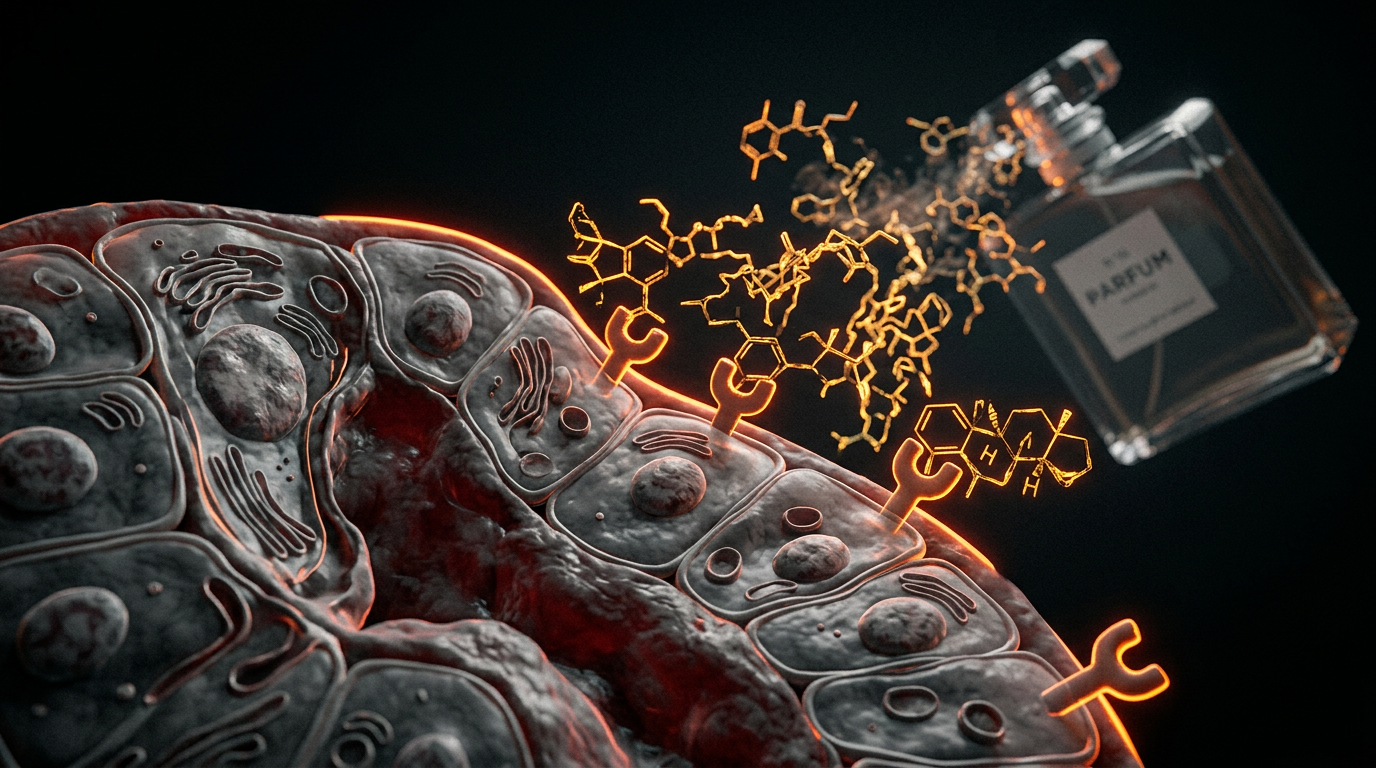
The modern home is often perceived as a sanctuary, yet from a biochemical perspective, it frequently functions as a closed-loop system of synthetic exposure. At the heart of this chemical burden lies the 'Fragrance' loophole, a regulatory artifact that allows manufacturers to list hundreds of undisclosed compounds under the singular term 'Parfum' or 'Aroma'. For the health-literate individual, understanding that these scents are not merely aesthetic choices but complex mixtures of phthalates and synthetic musks is crucial for maintaining endocrine integrity. Phthalates, specifically diethyl phthalate (DEP), serve as fixatives to extend the longevity of a scent. Once inhaled or absorbed transdermally, these molecules act as endocrine-disrupting chemicals (EDCs) by interfering with the body's delicate hormonal signaling.
Unlike the linear toxicology models often cited by mainstream public health bodies, EDCs frequently exhibit non-monotonic dose-response curves, meaning that even infinitesimal concentrations can trigger significant biological shifts by mimicking or blocking endogenous hormones like oestrogen and testosterone. The Molecular Mimicry of Synthetic Musks. Beyond phthalates, synthetic nitro-musks and polycyclic musks represent a persistent threat to cellular homeostasis. These compounds are highly lipophilic, meaning they sequester in adipose tissue and the lipid bilayers of cell membranes. Research into human cell lines indicates that synthetic musks can inhibit the activity of multidrug efflux transporters, such as P-glycoprotein.
These transporters act as the cell's 'security guards', pumping out toxins. By inhibiting these proteins, fragrance chemicals not only enter the cell but also allow other environmental toxins to accumulate, creating a synergistic toxic load that mainstream medicine rarely accounts for when diagnosing idiopathic fatigue or hormonal imbalances. Hepatic Detoxification and the Glutathione Drain. The liver is the primary organ responsible for biotransforming these volatile organic compounds (VOCs). Specifically, Phase II conjugation requires significant quantities of glutathione, the body's master antioxidant.
Constant exposure to scented candles, air fresheners, and fragranced laundry detergents forces the liver into a state of perpetual demand for sulphur-containing amino acids and methyl donors. When glutathione levels are depleted by the sheer volume of household chemicals, the body becomes more susceptible to oxidative stress and DNA damage. This 'silent' depletion often manifests as heightened chemical sensitivity or 'brain fog', symptoms frequently dismissed by standard UK primary care as psychosomatic. Strategies for Olfactory Restoration. To mitigate these risks, one must move beyond the 'safe limits' defined by industry-funded studies.
True mitigation involves the total elimination of synthetic fragrances in favour of pure, CO2-extracted botanicals or, preferably, the restoration of a fragrance-neutral environment. Prioritising mechanical ventilation and the use of activated carbon air purifiers can significantly reduce the concentration of airborne VOCs. By reclaiming the domestic atmosphere, we allow the endocrine system to recalibrate, moving from a state of constant defense to one of physiological resonance.
This article is provided for informational and educational purposes only. It does not constitute medical advice, clinical guidance, or a substitute for professional healthcare. Information reflects cited research at time of publication. Always consult a qualified healthcare professional before acting on any health information.
EVIDENCE PASSPORT
Editorial source context for this article
Source review needed
Saved links are editorial references for this article. They may support specific claims rather than every sentence. Open and assess each source in context. This passport does not independently verify them.
Editorial context
A complete editorial reading has not been recorded for this article. Source links remain available for you to open and assess directly.
Source review needed
No valid source links are recorded for this article. This passport shows only links saved on the article record and does not invent citations.
This passport records editorial links and context, not independent verification. Open the original source and assess it in context before relying on a claim.
Medical Disclaimer
The information in this article is for educational purposes only and does not constitute medical advice, diagnosis, or treatment. Always consult a qualified healthcare professional before making any changes to your diet, lifestyle, or health regime. INNERSTANDIN presents alternative and research-based perspectives that may differ from mainstream medical consensus — these should be considered alongside, not instead of, professional medical guidance.
Read Full DisclaimerContinue the thread
Keep this question moving.
Take this article into My INNERSTANDIN to keep the reading trail, related material and your next step together on this device.
Explore this in the Body Map
See where this hits your biology. Interactive anatomy, threats, and protective protocols.
Dig deeper in the Library
Free, longform PDF volumes that go beyond headlines into mechanisms and references.