
HPA Axis Collapse in the UK Workforce
Updated May 2026
Modern UK corporate structures are driving a silent epidemic of adrenal exhaustion and HPA axis dysregulation. This analysis highlights the physical breakdown of stress-response systems in high-pressure British work environments.
Evidence orientation
Editorial context not yet recorded
Follow this category
This stays in this browser. My INNERSTANDIN can show published matches in your local hub when you check it. It does not send email, push, or alert notifications.
Local learning review
A private browser aid for revisiting ideas. It is not an alert or a health recommendation.
Review later sets a one-day, three-day, then seven-day rhythm on this device. Choose it only when you want to revisit this article.
Overview
The modern United Kingdom workforce is currently the subject of an inadvertent, large-scale biological experiment. Across the skyscrapers of the City of London, the industrial hubs of the Midlands, and the sprawling digital corridors of the "Silicon Fen," a silent epidemic is manifesting. It is not a viral pathogen, but a systemic structural failure of the human biological response system. We are witnessing the widespread collapse of the Hypothalamic-Pituitary-Adrenal (HPA) Axis.
For decades, the corporate lexicon has sanitised this phenomenon under the vague umbrella of "stress" or "burnout." However, as biological researchers, we must look past these sociological euphemisms. What we are observing is Allostatic Overload—a state where the body’s regulatory systems are so consistently overstimulated that they lose the ability to return to homeostasis. This is not a psychological "state of mind"; it is a tangible, measurable, and often permanent alteration of the neuroendocrine architecture.
In the UK, the convergence of "stiff upper lip" cultural expectations, a decade of economic stagnation, and the digital tethering of the workforce has created a perfect storm. The HPA axis, designed for acute survival—fleeing a predator or fighting off an infection—is being forced to run at 100% capacity for years on end. The result is a workforce that is biologically aged beyond its years, suffering from chronic inflammatory conditions, neurocognitive decline, and a profound inability to regulate the internal environment. This article provides a deep dive into the mechanisms of this collapse and the somatic trauma stored within the British professional class.
According to the Health and Safety Executive (HSE), in 2022/23, stress, depression, or anxiety accounted for 49% of all work-related ill health cases in Great Britain, resulting in 17.1 million working days lost.
The Biology — How It Works
To understand the collapse, we must first understand the elegant complexity of the HPA axis. This is the body’s primary neuroendocrine adaptation system. It serves as the interface between the perception of a threat and the physiological execution of a survival response.
The Tripartite Communication
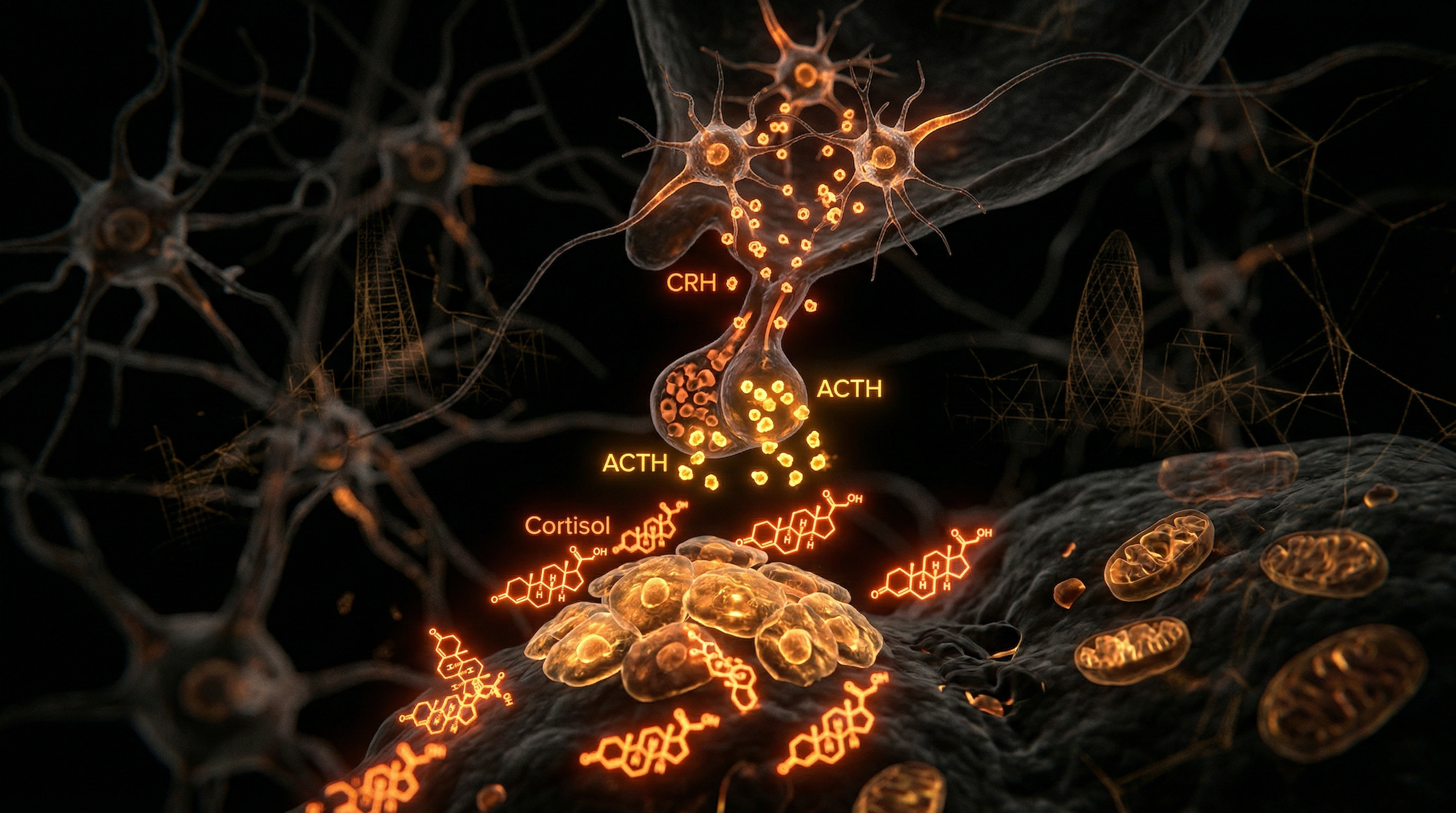
The HPA axis operates through a cascade of hormonal signals involving three distinct anatomical structures:
- The Hypothalamus: Located at the base of the brain, the hypothalamus acts as the command centre. When the amygdala (the brain’s emotional processing centre) detects a threat—whether it’s a predatory lion or a passive-aggressive email from a manager—it signals the hypothalamus.
- The Pituitary Gland: The hypothalamus responds by releasing Corticotropin-Releasing Hormone (CRH). This travels a short distance to the pituitary gland, the "master gland," which then secretes Adrenocorticotropic Hormone (ACTH) into the systemic circulation.
- The Adrenal Glands: Sitting atop the kidneys, the adrenals receive the ACTH signal and begin the mass production of Glucocorticoids, primarily Cortisol, alongside catecholamines like adrenaline and noradrenaline.
The Negative Feedback Loop
In a healthy organism, this system is self-limiting. High levels of circulating cortisol travel back to the brain and bind to receptors in the hypothalamus and hippocampus. This acts as a biological "off switch," telling the brain to stop producing CRH and ACTH. This is known as the Negative Feedback Loop.
In the UK workforce, this off-switch has been broken. When the threat is chronic—job insecurity, the cost-of-living crisis, or the relentless "always-on" culture—the feedback loop becomes desensitised. The brain begins to ignore the signal to stop, leading to a state of hypercortisolemia (excess cortisol), which eventually degrades into the secondary stage of collapse: hypocortisolemia (adrenal exhaustion).
Mechanisms at the Cellular Level
The damage of HPA axis dysregulation is not limited to hormonal imbalances; it penetrates the very fabric of our cellular biology. To truly grasp the severity of the UK workforce’s health crisis, we must look at what is happening inside the mitochondria and the nucleus.
Glucocorticoid Receptor (GR) Resistance
Much like Type 2 Diabetes involves insulin resistance, chronic stress leads to Glucocorticoid Receptor (GR) Resistance. When cells are constantly bathed in cortisol, they protect themselves by "downregulating" their receptors. The receptors become less sensitive, meaning even when cortisol is present, the cell doesn't "hear" the signal to suppress inflammation.
- Consequence: The body loses its primary internal anti-inflammatory mechanism. This is why stressed workers often suffer from lingering "desk-flu," chronic joint pain, and skin conditions like eczema or psoriasis.
Mitochondrial Dysfunction: The Stress Sensors
Recent research in the field of bioenergetics suggests that mitochondria are the primary sensors of psychological stress. Mitochondria do not just produce ATP (energy); they are involved in the synthesis of steroid hormones.
Under chronic HPA activation, the demand for energy production leads to an overproduction of Reactive Oxygen Species (ROS). This oxidative stress damages the mitochondrial DNA (mtDNA). When mitochondria are damaged, they release "danger signals" into the bloodstream, triggering a systemic immune response. We call this sterile inflammation—inflammation in the absence of an external pathogen.
Telomere Attrition
The "biological age" of the UK workforce is accelerating. Chronic HPA axis activation is directly linked to the shortening of telomeres—the protective caps at the ends of our chromosomes. Shortened telomeres are a hallmark of cellular senescence and premature death. High-pressure British work environments are quite literally shortening the lifespans of employees by eroding their genetic integrity.
A landmark study published in Biological Psychiatry demonstrated that individuals with chronic HPA axis dysregulation possessed telomeres equivalent to people 10 years older than their chronological age.
Environmental Threats and Biological Disruptors
The collapse of the HPA axis in the UK is exacerbated by a specific set of environmental stressors unique to modern Western life, which act as biological disruptors.
Circadian Mismatch and Blue Light
The HPA axis is intrinsically linked to the circadian rhythm. Cortisol should naturally peak in the early morning (the Cortisol Awakening Response or CAR) to provide energy and focus, and drop to its lowest point at night to allow for melatonin production and sleep.
The British worker’s environment is a direct assault on this rhythm:
- Artificial Light at Night (ALAN): Blue light from screens inhibits melatonin, keeping the HPA axis in a state of high alert well into the night.
- Shift Work: A significant portion of the UK’s service and industrial sector works irregular hours, leading to "circadian chaos" where the HPA axis no longer knows when to fire.
Ultra-Processed Foods (UPFs) and Endocrine Disruptors
The UK has the highest consumption of Ultra-Processed Foods in Europe. These foods are not just low in nutrients; they are high in additives that act as metabolic stressors. Furthermore, the prevalence of Endocrine Disrupting Chemicals (EDCs)—found in plastics, pesticides, and fire retardants in office furniture—interferes with hormonal signalling, mimicking or blocking the action of natural hormones and further destabilising the HPA axis.
The "Always-On" Digital Tether
The advent of the smartphone has eliminated the biological "recovery zone." In previous generations, the commute home marked the end of the stress response. Today, the HPA axis is triggered by a notification at 9:00 PM on a Sunday. This lack of pulsatile recovery is the single greatest driver of HPA collapse. The system was never designed for constant, low-grade activation; it was designed for bursts.
The Cascade: From Exposure to Disease
HPA axis collapse is not an overnight event; it is a predictable cascade. In clinical practice, we observe three distinct phases in the British professional.
Phase 1: The Hyper-Reactive State (The "Wired and Tired" Phase)
In this initial stage, cortisol levels are pathologically high. The individual feels productive but anxious. They rely heavily on stimulants (caffeine) to get through the day and sedatives (alcohol) to sleep.
- Physical markers: High blood pressure, abdominal fat accumulation (cortisol shifts fat storage to the viscera), and sleep-onset insomnia.
Phase 2: The Resistance Phase
The body begins to struggle to maintain the high cortisol output. The negative feedback loop starts to fray. The individual experiences "crashes" in the afternoon. They are increasingly susceptible to common colds and take longer to recover from exercise.
- Physical markers: Blood sugar instability, mild thyroid suppression (as the body tries to slow down the metabolism to conserve energy), and cognitive "brain fog."
Phase 3: The Exhaustion Phase (HPA Collapse)
This is the state of hypocortisolemia. The adrenal glands are no longer able to produce sufficient cortisol, or the brain has effectively "unplugged" the system to prevent further damage. The individual experiences profound, soul-crushing fatigue that is not remedied by rest.
- The Disease State: This is where we see the transition into chronic conditions: Fibromyalgia, Chronic Fatigue Syndrome (ME/CFS), Autoimmune Thyroiditis (Hashimoto's), and Major Depressive Disorder.
Medical data suggests that approximately 20% of the UK workforce may be in Phase 2 or 3 of HPA dysregulation, often misdiagnosed as simple "iron deficiency" or "ageing."
What the Mainstream Narrative Omits
The mainstream UK medical establishment, including the NHS, is largely ill-equipped to handle HPA axis collapse. This is because the prevailing medical model is based on binary pathology. You either have Addison’s Disease (zero cortisol) or Cushing’s Syndrome (excessive cortisol). There is no "middle ground" in the current diagnostic manuals.
The Myth of "Adrenal Fatigue"
The term "Adrenal Fatigue" is often dismissed by endocrinologists because the adrenal glands themselves haven't usually "failed" in the sense of organ death. However, by dismissing the term, they ignore the reality of HPA Axis Dysregulation. The problem is the signalling and the brain-body connection, not just the glands.
The Pharmaceutical Band-Aid
The standard response to a worker presenting with HPA collapse symptoms is the prescription of SSRIs (Selective Serotonin Reuptake Inhibitors) or Statins.
- SSRIs may mask the psychological symptoms of burnout but do nothing to address the underlying endocrine collapse. In some cases, they can further blunt the HPA axis response.
- Statins address the high cholesterol that often accompanies chronic stress but ignore the fact that the body is producing cholesterol as a precursor to make more stress hormones.
The Suppression of Somatic Trauma
Mainstream narratives also ignore the concept of Somatic Memory. The body stores the "charge" of chronic stress in the fascia and the autonomic nervous system. You cannot "think" your way out of HPA collapse; it is a physical, structural issue that requires biological and somatic intervention.
The UK Context: A Unique Breeding Ground for Collapse
Why is the UK specifically prone to this? Several socio-economic and cultural factors create a unique "stress-trap" for the British worker.
The "Stiff Upper Lip" and Presenteeism
British corporate culture still prizes the "stiff upper lip"—the idea that one must carry on regardless of internal distress. This leads to high rates of presenteeism (being at work while ill). Unlike some European counterparts (e.g., France or Germany) who have "right to disconnect" laws, the UK has a culture of "performative busyness."
The Cost-of-Living and Housing Crisis
Biological stress is not just about workload; it is about perceived safety. The UK's housing market and rising costs have created a baseline of "survival threat" for a large portion of the workforce. When a worker is one missed paycheck away from losing their home, their HPA axis stays in a state of permanent "threat detection."
The Commute and Urban Density
The UK has some of the longest average commute times in Europe. For a worker in the South East, the daily "London grind" involves noise pollution, overcrowding, and the constant micro-stressors of public transport. These environmental triggers keep the sympathetic nervous system dominant, preventing the Parasympathetic Nervous System (Vagus Nerve) from ever engaging.
The Failure of the NHS Safety Net
As the NHS struggles with wait times, workers feel they cannot afford to be ill. This fear of "falling out of the system" creates a secondary layer of stress. If you cannot access a GP for six weeks, you push through the fatigue, further accelerating the collapse from Phase 1 into Phase 3.
Protective Measures and Recovery Protocols
Recovery from HPA axis collapse is not achieved through a two-week holiday in Spain. It requires a systematic, biological re-calibration of the neuroendocrine system. As researchers, we advocate for a multi-pronged "Somatic Recovery Protocol."
1. Re-establishing Circadian Biology
The HPA axis cannot heal without a rhythmic environment.
- Morning Sunlight: View natural sunlight within 30 minutes of waking to set the cortisol peak.
- Blue Light Blocking: Eliminate blue light after 8:00 PM to allow for endogenous melatonin production.
- Temperature Cycling: Using cold exposure (cold showers) in the morning and heat (sauna) in the evening to "exercise" the autonomic nervous system.
2. Micronutrient Support for the Endocrine Cascade
The body "burns through" specific nutrients during chronic stress. Supplementation must be targeted:
- Magnesium Bisglycinate: Essential for modulating the HPA axis and relaxing the nervous system.
- Phosphatidylserine: Proven to lower excessive cortisol levels by blunting the ACTH response.
- Vitamin C and B5: High concentrations of these are found in the adrenal glands and are depleted during high stress.
- Adaptogens: Herbs like Ashwagandha (KSM-66) and Rhodiola Rosea can help "level out" the HPA response, though they should be used with caution in Phase 3.
3. Vagus Nerve Stimulation and Somatic Release
Since the HPA axis is driven by "threat," we must signal "safety" to the brain via the body.
- Breathwork: Controlled, slow exhalations (longer than inhalations) stimulate the Vagus nerve, the "brake" on the stress response.
- Somatic Experiencing (SE): This therapeutic approach helps release stored "trauma" from the fascia and nervous system, preventing the body from staying in a "frozen" stress state.
- Weight-bearing Exercise: While high-intensity cardio (HIIT) can worsen HPA collapse by spiking cortisol, moderate weightlifting helps improve insulin sensitivity and hormonal balance.
4. Radical Boundaries and "The Right to Disconnect"
On an organisational level, recovery requires the re-establishment of the "biological wall" between work and rest.
- Digital Fasting: No work-related digital input after 6:00 PM.
- Cognitive Offloading: Using external systems to manage tasks to reduce the "mental load" that keeps the hypothalamus in a state of vigilance.
Summary: Key Takeaways
The HPA axis collapse in the UK workforce is a systemic biological crisis disguised as a productivity issue. If we are to preserve the health of the nation, we must move beyond the "stress management" seminars and address the cellular and neuroendocrine reality of the modern workplace.
- The HPA Axis is a Survival System: It was never designed for 40 years of corporate emails and 24/7 digital connectivity.
- Allostatic Load is Cumulative: The body keeps a "biological ledger" of every stressor. Eventually, that ledger must be balanced, or the system will crash.
- UK Culture is a Risk Factor: The combination of "stiff upper lip" mentality and economic instability makes British workers uniquely vulnerable to endocrine failure.
- Inflammation is the Bridge: Chronic HPA dysregulation leads to systemic inflammation, which is the root cause of most modern chronic diseases (heart disease, cancer, dementia).
- Recovery is Biological, Not Just Mental: Healing requires light management, nutrient repletion, and somatic work to signal safety to the nervous system.
We are currently witnessing a "hollowing out" of the UK’s human capital. Without a radical shift in how we structure work and how we support our biological systems, the "silent epidemic" of HPA collapse will become the defining health crisis of the 21st century. The body can only remain in a state of emergency for so long before it simply gives up. We are reaching that point.
This article is provided for informational and educational purposes only. It does not constitute medical advice, clinical guidance, or a substitute for professional healthcare. Information reflects cited research at time of publication. Always consult a qualified healthcare professional before acting on any health information.
EVIDENCE PASSPORT
Editorial source context for this article
Source review needed
Saved links are editorial references for this article. They may support specific claims rather than every sentence. Open and assess each source in context. This passport does not independently verify them.
Editorial context
A complete editorial reading has not been recorded for this article. Source links remain available for you to open and assess directly.
Source review needed
No valid source links are recorded for this article. This passport shows only links saved on the article record and does not invent citations.
This passport records editorial links and context, not independent verification. Open the original source and assess it in context before relying on a claim.
Medical Disclaimer
The information in this article is for educational purposes only and does not constitute medical advice, diagnosis, or treatment. Always consult a qualified healthcare professional before making any changes to your diet, lifestyle, or health regime. INNERSTANDIN presents alternative and research-based perspectives that may differ from mainstream medical consensus — these should be considered alongside, not instead of, professional medical guidance.
Read Full DisclaimerContinue the thread
Keep this question moving.
Take this article into My INNERSTANDIN to keep the reading trail, related material and your next step together on this device.
Explore this in the Body Map
See where this hits your biology. Interactive anatomy, threats, and protective protocols.