
Myostatin and Sarcopenia: The Role of High-Leucine Animal Protein in Aging
Updated May 2026
Analyzes the leucine threshold required to trigger muscle protein synthesis in the elderly. It explains why animal protein is superior for preventing frailty.
Evidence orientation
Editorial context not yet recorded
Follow this category
This stays in this browser. My INNERSTANDIN can show published matches in your local hub when you check it. It does not send email, push, or alert notifications.
Local learning review
A private browser aid for revisiting ideas. It is not an alert or a health recommendation.
Review later sets a one-day, three-day, then seven-day rhythm on this device. Choose it only when you want to revisit this article.
Overview
The modern landscape of human longevity is plagued by a silent, progressive, and often ignored catastrophe: the systematic wasting of the human frame. As we age, the gradual loss of skeletal muscle mass, quality, and function—clinically termed Sarcopenia—is increasingly accepted as an inevitable "natural" consequence of getting older. However, biological reality suggests otherwise. Sarcopenia is not a predetermined fate; it is a metabolic failure state, driven by nutritional insufficiency, hormonal dysregulation, and a profound misunderstanding of the Leucine Threshold.
For decades, public health guidelines have pushed a narrative of protein restriction, prioritising "sustainable" plant-based alternatives over the nutrient-dense animal tissues that fuelled human evolution. This shift has precipitated an epidemic of frailty. Skeletal muscle is not merely the machinery of locomotion; it is the body's largest endocrine organ and its primary metabolic sink for glucose. When muscle is lost, metabolic health collapses.
The crux of the issue lies in the molecular "brake" of muscle growth, a protein known as Myostatin, and the "accelerator," the mTORC1 pathway. To override the anabolic resistance inherent in the ageing process, the body requires a specific, high-density signal found only in sufficient quantities within animal-based proteins: Leucine. This article deconstructs the biochemical necessity of high-leucine animal protein, the evolutionary importance of "nose-to-tail" nutrition, and the biological forces conspiring to leave the elderly weak, brittle, and dependent.
The Biology — How It Works
To understand why we wither, we must understand the dualistic nature of muscle homeostasis. At any given moment, the body is balancing Muscle Protein Synthesis (MPS) against Muscle Protein Breakdown (MPB). In a healthy youth, these processes are in equilibrium. In the ageing adult, a phenomenon known as Anabolic Resistance takes hold.
The Role of Myostatin
Myostatin (Growth Differentiation Factor 8) is a member of the TGF-beta superfamily. It acts as a negative regulator of skeletal muscle mass. In essence, myostatin tells the body not to grow too much muscle, likely an evolutionary adaptation to conserve energy in environments where calories were scarce. However, in the context of sarcopenia, myostatin levels can become pathologically influential.
Callout Fact: Animals born with a genetic deficiency in myostatin—such as the Belgian Blue bull—exhibit "double-muscling," showing that the default state of the body is to build muscle unless actively suppressed.
In the elderly, chronic low-grade inflammation and hormonal shifts (such as the decline in testosterone and growth hormone) can lead to an environment where myostatin dominates, suppressing the activation of Satellite Cells (muscle stem cells) and preventing the repair of micro-trauma.
The Leucine Trigger Hypothesis
The primary dietary countermeasure to myostatin-induced wasting is the essential branched-chain amino acid Leucine. While all 20 amino acids are necessary for building the "bricks" of muscle, leucine is the "foreman" on the construction site. It is the only nutrient capable of directly stimulating the molecular machinery required for protein synthesis.
For a young person, a small amount of leucine (approx. 1.2g to 1.8g) is sufficient to trigger MPS. However, the ageing muscle is "deaf" to these low-level signals. To overcome anabolic resistance, an elderly individual must hit a Leucine Threshold—typically 2.5g to 3.5g of leucine in a single bolus. If this threshold is not met, the meal is effectively "wasted" from a muscle-building perspective, even if the total protein for the day seems adequate on paper.
Mechanisms at the Cellular Level
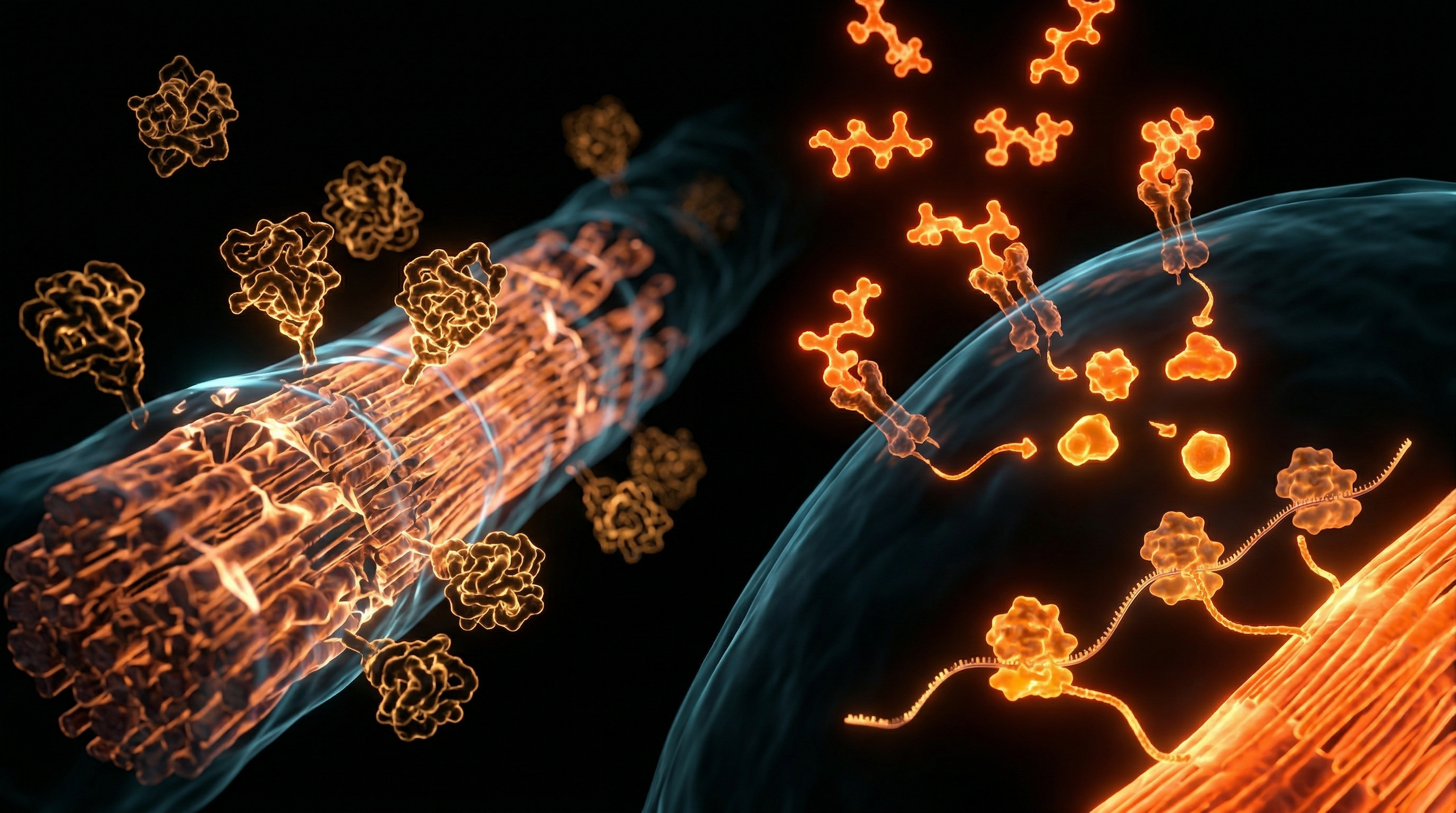
At the heart of muscle hypertrophy and maintenance is a protein complex called mTORC1 (mammalian Target of Rapamycin Complex 1). This is the master nutrient sensor of the cell.
The mTORC1 Pathway
When we ingest protein, it is broken down into amino acids. Specifically, the presence of leucine in the blood causes a series of intracellular events. Leucine binds to a sensor called Sestrin2, which then releases its inhibition of a complex called GATOR1. This ultimately allows the Rag GTPases to recruit mTORC1 to the lysosomal surface, where it can be activated.
Once activated, mTORC1 initiates:
- p70S6K Phosphorylation: A primary driver of protein translation.
- 4E-BP1 Inhibition: Removing the "brakes" on protein assembly.
Without reaching the leucine threshold, mTORC1 activation is fleeting or non-existent. Plant proteins, such as pea, soy, or wheat, are notoriously low in leucine and often lack other essential amino acids like methionine or lysine. To reach the 3g leucine threshold with wheat protein, one would need to consume a calorie-dense, gut-stressing amount of grain (over 1,000 calories), whereas a mere 150-200 calories of Ruminant Meat achieves this effortlessly.
Satellite Cell Depletion
Muscle tissue is not just a static mass; it is alive with Satellite Cells. These are myogenic stem cells located between the sarcolemma and the basal lamina. When muscle is stressed (through resistance training), these cells donate their nuclei to existing muscle fibres, increasing the capacity for protein synthesis.
In sarcopenia, the "niche" environment for satellite cells becomes toxic. High levels of Myostatin and Pro-inflammatory Cytokines (like TNF-alpha) induce senescence in these stem cells. High-leucine animal protein, especially when paired with the collagenous proteins found in "nose-to-tail" eating (glycine, proline), provides the structural scaffolding and the signal needed to maintain the satellite cell pool.
Environmental Threats and Biological Disruptors
The biological drive to maintain muscle is being actively undermined by modern environmental factors. We are living in a "Sarcopenic Environment" that prioritises shelf-stable, low-quality calories over biological imperatives.
The Rise of Seed Oils (PUFAs)
Industrial seed oils (canola, soybean, sunflower) are ubiquitous in the modern diet. These oils are rich in Linoleic Acid, an omega-6 fatty acid that is highly prone to oxidation. When these oxidized lipids incorporate into the muscle cell membranes, they disrupt insulin signalling.
Statistic: Chronic consumption of refined seed oils has been linked to a 30% increase in lipid peroxidation within skeletal muscle mitochondria, directly impairing energy production and promoting Anabolic Resistance.
Antinutrients and Bioavailability
The "Plant-Based" movement ignores the reality of Bioavailability. Plants contain antinutrients such as Phytic Acid, Oxalates, and Trypsin Inhibitors. These compounds bind to minerals and inhibit the enzymes required to break down proteins. Consequently, even if a plant-based meal claims to have 30g of protein, the "absorbable" amino acid yield is significantly lower. This makes hitting the leucine threshold nearly impossible for an elderly digestive system already hampered by lower stomach acid (hypochlorhydria).
Endocrine Disruptors
Widespread exposure to Xenoestrogens (found in plastics, pesticides like glyphosate, and tap water) mimics the female sex hormone oestrogen. In men, this suppresses testosterone—the primary antagonist to myostatin. In women, the loss of natural oestrogen during menopause combined with xenoestrogen exposure creates a hormonal "no-man's land" where muscle cannot be maintained.
The Cascade: From Exposure to Disease
The progression from a low-leucine, high-carbohydrate diet to full-blown sarcopenia and death is a predictable biochemical cascade.
- Stage 1: The Initial Decline (Ages 35-50)
Sedentary lifestyle and the "Standard Western Diet" lead to slight insulin resistance. The leucine threshold begins to creep upward. Myostatin levels begin a slow rise as physical activity diminishes.
- Stage 2: Anabolic Resistance (Ages 50-65)
The body no longer responds to small amounts of protein. The "Tea and Toast" diet becomes common. Without the leucine trigger, the body begins catabolising its own muscle tissue to supply the brain and organs with essential amino acids.
- Stage 3: Metabolic Collapse
Muscle is the body's largest "glucose sink." As muscle mass disappears, blood glucose remains elevated. This leads to Type 2 Diabetes. The interplay between sarcopenia and obesity is termed Sarcopenic Obesity, the most dangerous phenotypic expression of ageing.
- Stage 4: Frailty and the Death Spiral
A simple fall leads to a hip fracture. Because the individual lacks the protein reserves and satellite cell activity to repair bone and muscle, they become bedridden. Immobility further accelerates muscle loss.
Callout Fact: The one-year mortality rate for an individual over 65 who suffers a hip fracture is between 20% and 30%. Muscle mass is the literal "armour" that prevents this outcome.
What the Mainstream Narrative Omits
The current nutritional zeitgeist is not merely mistaken; it is dangerously negligent. There are several "suppressed truths" regarding protein and ageing that are omitted from public health broadcasts.
The Deception of the RDA
The Recommended Dietary Allowance (RDA) for protein is currently set at 0.8g per kilogram of body weight. This figure was calculated based on "Nitrogen Balance" studies in young, healthy adults. It is the minimum amount required to prevent outright malnutrition, not the amount required for optimal health. For the elderly, the requirement is likely double this (1.5g-2.2g/kg), yet the mainstream narrative continues to push the lower figure to align with "planetary health" goals.
The DIAAS Score vs. PDCAAS
For years, the industry used the PDCAAS (Protein Digestibility Corrected Amino Acid Score) to claim that soy protein was equal to beef. This score is flawed because it truncates values at 1.0 and does not account for anti-nutrients. The newer DIAAS (Digestible Indispensable Amino Acid Score) reveals the truth: Animal proteins consistently outperform plant proteins by 30% to 50% in terms of actual amino acid delivery to the bloodstream.
The Evolutionary Context
Human beings are "facultative carnivores." Our digestive tracts are short, designed for the rapid absorption of nutrient-dense animal fats and proteins. We lack the multi-chambered stomachs or long caecums required to ferment plant fibre into usable protein. By forcing an ageing population onto a "grain-based" or "plant-heavy" diet, we are essentially asking a lion to survive on grass—the result is predictable biological atrophy.
The UK Context
In the United Kingdom, the sarcopenia crisis is exacerbated by specific cultural and economic factors. The "Great British Diet" has undergone a radical and detrimental transformation over the last 50 years.
The Decline of the Sunday Roast
Historically, the British diet was centred around Ruminant Meat and Nose-to-Tail consumption. The "Sunday Roast" provided a massive bolus of leucine-rich beef or lamb, accompanied by bone-broth-based gravies rich in glycine. Today, this tradition has been replaced by processed "ready meals" or ultra-processed plant-based alternatives.
The NHS Burden
The National Health Service (NHS) is currently buckling under the weight of "Age-Related Frailty." Billions of pounds are spent annually on treating the symptoms of sarcopenia—falls, fractures, and the resulting social care. Yet, there is almost no focus on Nutritional Intervention involving high-leucine animal protein. Instead, elderly patients in NHS hospitals are often served high-carbohydrate, low-protein meals (porridge, white bread, jam) that further drive muscle wasting.
The Cost of Living and "Meat Poverty"
With rising inflation, the cost of high-quality beef and lamb has surged. This has led many UK pensioners to opt for cheaper, "filler" foods like pasta and biscuits. This "Meat Poverty" is a direct driver of the skyrocketing rates of sarcopenia in the lower socio-economic brackets of the UK.
Protective Measures and Recovery Protocols
To combat myostatin and reverse the trend of sarcopenia, a radical return to biological principles is required. We must treat muscle as a vital organ that requires specific "feeding and weeding."
1. Reaching the Leucine Threshold
The elderly must prioritise Animal Protein at every meal. To hit the ~3g Leucine trigger, one should aim for:
- 150g-200g of Grass-fed Beef
- 4-5 Large Eggs
- 200g of Lamb or Venison
- 1 Scoop of High-Quality Whey Protein (if whole food is not possible)
Key Rule: If you are over 60, every meal must contain at least 30-40g of high-quality animal protein. Anything less is "biologically invisible" to your muscles.
2. The Nose-to-Tail Balance
Muscle meat is high in Methionine. While essential, an excess of methionine in the absence of Glycine can elevate homocysteine, a marker of inflammation. To balance this, the elderly should incorporate:
- Bone Broth: For collagen and glycine.
- Organ Meats (Liver/Heart): For CoQ10, B12, and Vitamin A, which support mitochondrial health within the muscle.
3. Resistance Training: The Mechanical Signal
Nutrition provides the materials, but resistance training provides the "order" to build. Lifting weights or performing bodyweight exercises (like squats) downregulates Myostatin and upregulates Mechano-Growth Factor (MGF). Even two sessions a week can significantly sensitise the muscle to the leucine trigger.
4. Eliminating Biological Disruptors
- Remove Seed Oils: Replace with tallow, lard, or butter. This reduces oxidative stress in the muscle.
- Sunlight and Vitamin D: Vitamin D acts more like a hormone than a vitamin; it is crucial for the expression of the androgen receptors in muscle tissue.
5. Supplemental Support
For those already in a state of frailty, certain supplements can "cheat" the system:
- Creatine Monohydrate: (3-5g daily) Increases cellular hydration and ATP recycling.
- HMB (Beta-hydroxy beta-methylbutyrate): A metabolite of leucine that is particularly effective at preventing muscle breakdown during periods of illness.
Summary: Key Takeaways
The war against Sarcopenia is won in the kitchen and the gym, not in the pharmacy. Understanding the interplay between Myostatin and Leucine is the key to maintaining independence and vitality into the eighth and ninth decades of life.
- Sarcopenia is not inevitable: It is a result of Anabolic Resistance and a failure to hit the Leucine Threshold.
- Animal Protein is Superior: Plant proteins lack the leucine density and bioavailability required to trigger Muscle Protein Synthesis (MPS) in the ageing body.
- Myostatin is the Brake: Chronic inflammation and low protein intake allow myostatin to dominate, preventing muscle repair and growth.
- mTORC1 is the Key: This master sensor must be activated by a bolus of 2.5g-3g of leucine per meal to override age-related wasting.
- The UK Context: The abandonment of traditional meat-heavy diets and the push for "plant-based" sustainability are primary drivers of the British frailty epidemic.
- Nose-to-Tail Nutrition: Balancing muscle meats with collagenous tissues (glycine) and organ meats (micronutrients) creates the optimal environment for muscle retention.
- The Mainstream Narrative is Flawed: RDA guidelines are insufficient for thriving; they are designed for survival, not the prevention of sarcopenia.
In an era of biological confusion, the path to strength is found in our evolutionary past. Prioritise ruminant meat, lift heavy objects, and reject the narrative of inevitable decline. Your muscle is your life insurance; do not let it waste away.
This article is provided for informational and educational purposes only. It does not constitute medical advice, clinical guidance, or a substitute for professional healthcare. Information reflects cited research at time of publication. Always consult a qualified healthcare professional before acting on any health information.
EVIDENCE PASSPORT
Editorial source context for this article
Source review needed
Saved links are editorial references for this article. They may support specific claims rather than every sentence. Open and assess each source in context. This passport does not independently verify them.
Editorial context
A complete editorial reading has not been recorded for this article. Source links remain available for you to open and assess directly.
Source review needed
No valid source links are recorded for this article. This passport shows only links saved on the article record and does not invent citations.
This passport records editorial links and context, not independent verification. Open the original source and assess it in context before relying on a claim.
Medical Disclaimer
The information in this article is for educational purposes only and does not constitute medical advice, diagnosis, or treatment. Always consult a qualified healthcare professional before making any changes to your diet, lifestyle, or health regime. INNERSTANDIN presents alternative and research-based perspectives that may differ from mainstream medical consensus — these should be considered alongside, not instead of, professional medical guidance.
Read Full DisclaimerContinue the thread
Keep this question moving.
Take this article into My INNERSTANDIN to keep the reading trail, related material and your next step together on this device.
Dig deeper in the Library
Free, longform PDF volumes that go beyond headlines into mechanisms and references.