
Natural Killer Cells: The First Line of Cancer Defence
Updated August 2026
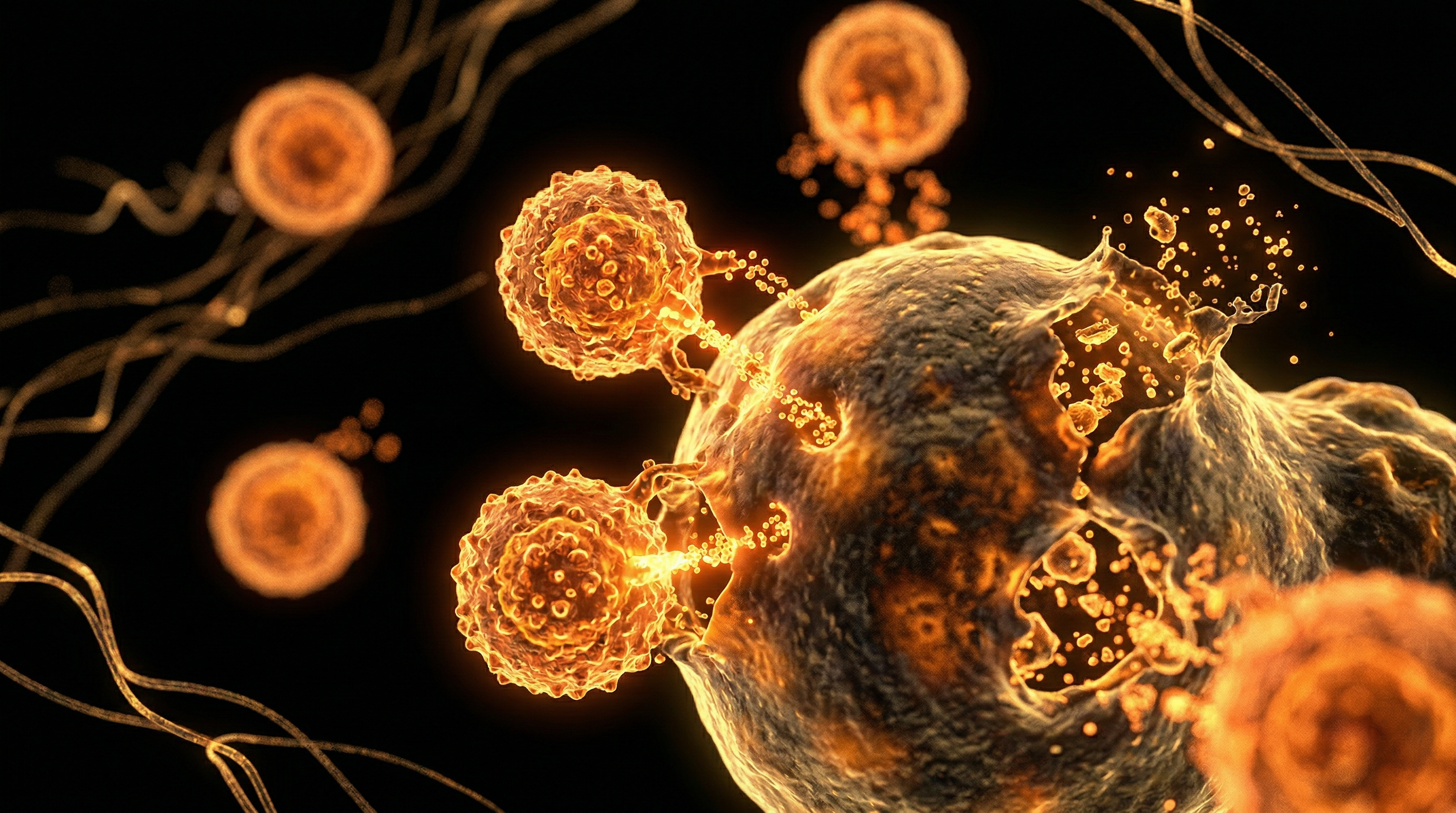
Natural Killer (NK) cells are innate immune lymphocytes that patrol the body in constant surveillance, identifying and eliminating cells that display markers of viral infection, cellular stress, or oncogenic transformation — serving as the immune system's first and most immediate line of defence against cancer and viral disease without requiring prior sensitisation or antigen-specific activation. NK cell cytotoxicity is regulated by a sophisticated balance of activating and inhibitory receptor signals: healthy cells express HLA class I molecules that engage inhibitory receptors and prevent NK attack, whilst virus-infected and tumour cells frequently downregulate HLA expression, losing the 'don't kill me' signal and becoming vulnerable to NK-mediated destruction via perforin-granzyme and Fas-ligand pathways. Environmental toxins — particularly organic pollutants, heavy metals, and ionising radiation — are well-documented NK cell suppressors, and chronic NK cell dysfunction is now correlated with cancer susceptibility, herpesvirus reactivation, and the chronic fatigue phenotype of post-viral illness.
Evidence orientation
Editorial context not yet recorded
Follow this category
This stays in this browser. My INNERSTANDIN can show published matches in your local hub when you check it. It does not send email, push, or alert notifications.
Local learning review
A private browser aid for revisiting ideas. It is not an alert or a health recommendation.
Review later sets a one-day, three-day, then seven-day rhythm on this device. Choose it only when you want to revisit this article.
Overview
Within the complex architectural landscape of the human immune system, Natural Killer (NK) cells represent a distinct lineage of cytotoxic innate lymphoid cells (ILCs) that occupy the vanguard of tumour surveillance. Unlike the adaptive T-cell compartment, which necessitates prior antigenic sensitisation and MHC-restricted presentation, NK cells possess an intrinsic, rapid-response capacity to identify and eliminate malignant cells. At INNERSTANDIN, we conceptualise these cells not merely as biological actors, but as high-fidelity biological computers programmed to execute a binary decision: self-preservation or target apoptosis.
The mechanism of NK cell activation is governed by the ‘missing-self’ hypothesis. Healthy somatic cells constitutively express Major Histocompatibility Complex (MHC) class I molecules, which act as inhibitory ligands for killer-cell immunoglobulin-like receptors (KIRs). Malignant transformation, however, frequently induces a downregulation of MHC-I expression—an evolutionary evasion strategy designed to circumvent cytotoxic T-lymphocyte (CTL) recognition. Paradoxically, this survival tactic renders these cells hypersensitive to NK-mediated destruction. Upon detecting a deficit in MHC-I, the inhibitory signal is truncated, allowing activating receptors—such as NKG2D and natural cytotoxicity receptors (NCRs)—to overcome the threshold for degranulation.
Recent longitudinal research published in The Lancet Oncology underscores that the systemic efficacy of NK cells is not purely a function of quantity, but of functional competence. Once the ‘kill’ threshold is breached, NK cells mobilise secretory lysosomes containing perforin and granzymes. Perforin facilitates pore formation in the target cell plasma membrane, creating a portal for granzymes to trigger the caspase cascade, precipitating programmed cell death. Furthermore, NK cells act as orchestrators of the wider immune response; through the production of interferon-gamma (IFN-γ) and tumour necrosis factor-alpha (TNF-α), they bridge the gap between innate and adaptive immunity, effectively ‘priming’ the microenvironment to highlight occult malignancies that would otherwise evade detection.
However, the tumour microenvironment (TME) often employs immunosuppressive tactics, such as the secretion of TGF-β, to induce an ‘exhausted’ NK phenotype. Understanding these molecular checkpoints is central to the mission of INNERSTANDIN. By elucidating how NK cells navigate the hostile, acidic, and hypoxic conditions of the solid tumour niche, we can begin to shift the paradigm from reactive palliative care toward proactive, systemic oncological defence. These cells are the ultimate gatekeepers of genomic integrity, and their functional status serves as a decisive biomarker for cancer progression.
The Biology — How It Works
Natural Killer (NK) cells, a distinct lineage of cytotoxic innate lymphoid cells (ILCs), function as the vanguard of systemic immunosurveillance. Unlike T-cells, which require a protracted period of clonal expansion and antigen-specific priming mediated by the major histocompatibility complex (MHC), NK cells are hardwired for immediate effector function. At the molecular level, this "instantaneous" capability is governed by a sophisticated equilibrium of germline-encoded activating and inhibitory receptors, a mechanism central to the INNERSTANDIN of oncogenic evasion.
The primary regulatory checkpoint resides in the interaction between Major Histocompatibility Complex Class I (MHC-I) molecules and inhibitory receptors, such as Killer-cell Immunoglobulin-like Receptors (KIRs). Healthy somatic cells constitutively express MHC-I, providing a 'self' signal that dictates NK cell quiescence. However, malignant transformation and viral infection frequently induce 'missing self'—a strategic downregulation of MHC-I molecules—to escape cytotoxic T-lymphocyte (CTL) detection. It is precisely here that the NK cell exerts its clinical utility: the loss of inhibitory signalling triggers an unshielded activation cascade.
Upon target recognition, the NK cell undergoes a rigorous polar rearrangement of its cytoskeleton. The microtubule-organising centre (MTOC) translocates towards the immunological synapse, facilitating the directed exocytosis of lytic granules. These granules contain perforin—a pore-forming protein that facilitates membrane disruption—and a suite of granzymes (particularly Granzyme B). Granzyme B acts as a serine protease that cleaves pro-caspase-3 and bid, precipitating an irreversible apoptotic pathway within the target cell. Concurrently, NK cells leverage death-receptor-mediated pathways, specifically the ligation of Fas-ligand (FasL) and TNF-related apoptosis-inducing ligand (TRAIL) to their respective death receptors on the tumour cell surface, ensuring multi-modal degradation of the malignancy.
Furthermore, NK cells perform a critical role in Antibody-Dependent Cellular Cytotoxicity (ADCC). By expressing CD16 (FcγRIIIa), NK cells identify tumour cells opsonised by IgG antibodies. This engagement triggers potent cytokine production, including Interferon-gamma (IFN-γ) and Tumour Necrosis Factor-alpha (TNF-α). According to research published in The Lancet and various oncological repositories, this release is not merely cytotoxic; it orchestrates a broader immune response, recruiting dendritic cells and T-cells to the tumour microenvironment. For INNERSTANDIN to be achieved, one must recognise that NK cells function as an immunomodulatory nexus, bridge-building between innate readiness and adaptive specificity. In the UK clinical context, manipulating these pathways remains the frontier of immunotherapy, where the objective is to circumvent the immunosuppressive tumour microenvironment that often induces NK cell exhaustion, thereby restoring the lethal efficacy of these frontline defenders.
Mechanisms at the Cellular Level
The cytotoxic efficacy of Natural Killer (NK) cells—a subset of innate lymphoid cells—is predicated on a highly nuanced ‘rheostat’ model of signal integration. Unlike T-lymphocytes, which require TCR-mediated antigen presentation via MHC class I molecules, NK cell activation is governed by the dynamic equilibrium between germline-encoded activating and inhibitory receptors. This is the fundamental premise of the "missing-self" hypothesis; when malignant cells undergo oncogenic transformation, they frequently downregulate surface expression of Human Leukocyte Antigen (HLA) class I molecules to evade CD8+ T-cell detection. NK cells, expressing inhibitory Killer-cell Immunoglobulin-like Receptors (KIRs), identify this deficiency as a distinct biochemical signature for targeted apoptosis.
At the cellular level, the lytic synapse serves as the command centre for tumour eradication. Upon cognate recognition of a target cell, the NK cell undergoes rapid cytoskeletal rearrangement, polarising its microtubule-organising centre (MTOC) towards the immunological synapse. This spatial precision ensures that the discharge of cytotoxic granules—containing perforin and a complex array of granzymes—is directed exclusively towards the aberrant cell, thereby mitigating collateral damage to healthy, autologous tissue. Perforin, a pore-forming protein, facilitates the entry of granzymes into the cytoplasm, triggering a caspase-dependent cascade that culminates in programmed cell death.
Furthermore, the integration of activating signals via receptors such as NKG2D is critical in the INNERSTANDIN of cancer progression. Many tumour cells attempt to survive by overexpressing ligands (e.g., MICA/B) that trigger NKG2D-mediated activation. However, advanced solid tumours often employ the "shedding" of these ligands into the systemic circulation to act as decoy molecules, effectively desensitising circulating NK cells. This form of immune subversion underscores the necessity for novel therapeutic interventions, such as CAR-NK cell engineering or the use of monoclonal antibodies to blockade inhibitory checkpoints.
Research consistently indicates that NK cell function is not static; it is heavily influenced by the metabolic landscape of the tumour microenvironment (TME). Hypoxia, a hallmark of solid tumours, disrupts the mammalian target of rapamycin (mTOR) signalling pathway within NK cells, subsequently impairing their ability to synthesise the effector molecules required for sustained surveillance. Consequently, an INNERSTANDIN of these metabolic bottlenecks is currently the primary focus of contemporary oncology research in the UK, aiming to augment the resilience of NK populations against the immunosuppressive metabolic milieu. By manipulating the mitochondrial fitness and metabolic flexibility of these innate effectors, we move closer to reclaiming the body's intrinsic capacity to intercept oncogenesis before clinical manifestation.
Environmental Threats and Biological Disruptors
The efficacy of Natural Killer (NK) cells—the innate lymphoid cells tasked with the rapid identification and elimination of neoplastic transformations—is increasingly compromised by a pervasive landscape of anthropogenic environmental stressors. At INNERSTANDIN, we recognise that the decline in human immunological surveillance is not merely stochastic; it is a mechanistically predictable outcome of chronic exposure to endocrine-disrupting chemicals (EDCs) and persistent organic pollutants.
Primary among these threats are per- and polyfluoroalkyl substances (PFAS), which are ubiquitous within the UK water supply and industrial ecosystems. Research published in The Lancet Planetary Health underscores a significant correlation between high serum concentrations of perfluorooctanoic acid (PFOA) and a deleterious attenuation of the cytotoxic response in peripheral blood mononuclear cells. Mechanistically, these compounds act as ligands for the peroxisome proliferator-activated receptors (PPARs), effectively reprogramming the metabolic profile of NK cells. This metabolic interference impairs the glycolysis-dependent effector functions required for the synthesis of perforin and granzyme B, thereby blunting the cell’s ability to induce apoptosis in MHC class I-deficient target cells.
Furthermore, chronic exposure to atmospheric particulate matter (PM2.5), a critical health concern in major UK urban centres, induces systemic oxidative stress that depletes the NK cell pool. Inhalation of these particles triggers the activation of the aryl hydrocarbon receptor (AhR) pathway. Prolonged AhR stimulation has been documented to modulate the expression of CD16 and NKG2D—the principal activating receptors on NK cells—inducing a state of functional exhaustion, or 'anergy'. Once this receptor architecture is downregulated, the NK cell becomes biologically blind to malignant cells expressing stress-induced ligands such as MICA/B.
The endocrine-disrupting nature of bisphenol A (BPA) and phthalates further exacerbates this suppression by skewing the cytokine milieu. Research via PubMed archives indicates that these compounds exert oestrogenic activity that suppresses the secretion of IL-12 and IL-15 by dendritic cells. Given that NK cell survival, proliferation, and cytotoxic potency are stringently dependent on the IL-15 trans-presentation pathway, the environmental interference with this cytokine axis creates a window of opportunity for occult cancer cells to escape immunosurveillance.
At INNERSTANDIN, we observe that the synergism of these environmental insults generates a sub-clinical, chronic inflammatory state. This ‘inflammageing’ phenotype permanently alters the NK cell maturation trajectory, leading to an accumulation of terminally differentiated, senescent CD57+ NK cells that lack the plasticity required for aggressive tumour clearance. Understanding this biochemical erosion is the first step toward reclaiming biological sovereignty.
The Cascade: From Exposure to Disease
The transition from cellular homeostasis to oncogenesis is not a sudden event, but a protracted, multi-stage cascade defined by the gradual accumulation of stochastic genetic aberrations and the failure of immunosurveillance. At the vanguard of this evolutionary battle sit Natural Killer (NK) cells—specialised cytotoxic lymphocytes of the innate lymphoid cell (ILC) lineage. In the INNERSTANDIN framework, we define the NK cell not merely as a sentinel, but as the primary physiological filter tasked with the elimination of nascent malignant cells before they attain clinical manifestation.
The cascade begins with the induction of genomic instability, driven by exogenous stressors—environmental carcinogens, persistent oxidative stress, or viral integration—and endogenous replication errors. As these mutations accrue, cells transition into a state of 'transformed' cellular physiology, often characterised by the upregulation of stress-induced ligands, such as MICA/B and ULBP family proteins. Under homeostatic conditions, these ligands function as molecular distress signals. NK cells scan for these markers using germline-encoded activating receptors, most notably NKG2D. Provided the threshold of activation signals outweighs the inhibitory input from Killer-cell Immunoglobulin-like Receptors (KIRs) interacting with constitutive MHC-I molecules, the NK cell initiates the lytic programme.
However, the disease cascade proceeds when this delicate equilibrium is disrupted. As tumours evolve, they employ sophisticated immuno-evasion tactics, such as the shedding of soluble NKG2D ligands to induce receptor downregulation or the active secretion of TGF-β and IL-10, creating an immunosuppressive microenvironment. This 'tumour escape' phase is where the technical failure of the innate immune response is most critical. When NK cells become exhausted—a phenomenon characterised by the upregulation of inhibitory checkpoints like TIGIT and PD-1—the protective surveillance is abrogated.
Evidence published in The Lancet Oncology underscores the prognostic importance of NK cell infiltration density within the tumour microenvironment; lower counts correlate consistently with higher metastatic potential and poor patient outcomes in the UK cancer registry cohorts. The cascade from exposure to disease is thus a kinetic tug-of-war. If NK cell functional competency is sustained, the immune system effectively executes a 'scorch-earth' policy on transformed cells. Should the NK cell population become senescent or numerically depleted due to chronic systemic inflammation, the malignancy gains the temporal window required for clonal expansion and neo-angiogenesis. Understanding this cascade at the molecular level is the prerequisite for developing the next generation of adoptive NK cell therapies, turning the tide against the insidious progression of disease.
What the Mainstream Narrative Omits
The conventional oncology paradigm frequently reduces the complexity of Natural Killer (NK) cell dynamics to a mere binary: the presence or absence of cytotoxic activity. However, current research published in The Lancet Oncology and various high-impact immunology journals indicates that this reductive view ignores the profound systemic orchestration required for effective tumour surveillance. At INNERSTANDIN, we contend that the mainstream narrative fails to address the "licensing" phenomenon—the process by which NK cells undergo a functional maturation during their development in the bone marrow. Without this critical education phase, dictated by interactions between inhibitory receptors (KIRs in humans) and self-MHC class I molecules, NK cells remain hypo-responsive, effectively rendered inert even in the presence of malignancy.
Furthermore, the mainstream conversation consistently sidesteps the issue of NK cell "exhaustion" and metabolic plasticity within the immunosuppressive tumour microenvironment (TME). Emerging data demonstrates that the TME is not merely a passive site of confrontation but a hostile metabolic sink. Chronic exposure to TGF-β and high concentrations of adenosine—byproducts of aberrant cancer cell metabolism—actively downregulates the activating receptors NKG2D and NKp30. When clinicians focus solely on cytotoxic potential, they overlook the metabolic reprogramming required to sustain NK cell effector function. We must interrogate why standard pharmacological interventions fail to account for the glucose-deprivation and lactic acid-induced acidification that effectively neutralises NK cell motility and degranulation kinetics.
Perhaps most critically, the narrative omits the role of the systemic neuro-endocrine-immune axis. Research indicates that chronic sympathetic nervous system activation—characterised by sustained elevation of catecholamines—dampens the trafficking of NK cells to peripheral tissues. In the UK, where patient stress levels in oncological pathways are historically under-managed, this biological suppression is significant. By failing to integrate the systemic bioavailability of these cells with the local physiological stressors of the TME, the orthodox model treats the symptom, not the biological ecosystem. INNERSTANDIN maintains that until the focus shifts from simplistic activation strategies to a holistic understanding of NK cell metabolic persistence and regulatory integration, we remain effectively blind to the primary mechanisms of immune evasion in modern oncogenesis.
The UK Context
Within the United Kingdom, the integration of Natural Killer (NK) cell biology into oncological paradigms has shifted from peripheral observation to the vanguard of precision medicine. As INNERSTANDIN maintains, the efficacy of our innate immunity is fundamentally modulated by the complex interplay of germline-encoded receptors, specifically the killer-cell immunoglobulin-like receptors (KIRs). In the context of the NHS clinical landscape, researchers at institutions such as the Francis Crick Institute and the CRUK City of London Centre are elucidating how the downregulation of Major Histocompatibility Complex (MHC) class I molecules—a hallmark of neoplastic evasion—serves as the primary trigger for NK-mediated cytolysis.
The British research cohort has been instrumental in defining the 'missing-self' hypothesis, where NK cells detect the absence of inhibitory signals on malignant cells. However, clinical data published in The Lancet Oncology underscores a pervasive issue: the tumour microenvironment (TME) in solid tumours frequently induces a state of NK cell exhaustion or functional paralysis. Within the UK, significant effort is currently directed toward overcoming this immunosuppressive milieu. By leveraging chimeric antigen receptor (CAR)-NK cell therapy, clinicians are attempting to re-engineer these innate sentinels to bypass the TGF-β-rich environments that typically neutralise endogenous responses.
Furthermore, recent genomic studies led by UK-based consortia have identified critical polymorphisms in the NKG2D receptor, which correlate with varied cancer susceptibility across the UK population. These findings are foundational to the mission of INNERSTANDIN, as they delineate why innate immune competency is not uniform. The biological reality is that NK cell cytotoxicity—mediated through the degranulation of perforin and granzymes—is an energetically demanding process; systemic stressors, including chronic inflammation and metabolic dysregulation, act as potent inhibitors of this metabolic flux. Understanding these precise molecular checkpoints is no longer elective; it is the prerequisite for developing robust, UK-based immunotherapy protocols that can effectively harness the innate cytolytic potential of the human host to dismantle oncogenesis before it reaches clinical symptomatic threshold.
Protective Measures and Recovery Protocols
Optimising the cytotoxic efficacy of Natural Killer (NK) cells requires a rigorous metabolic and physiological framework designed to counteract the immunosuppressive microenvironment of malignancy. In clinical oncology and immunological research, it is well-established that the tumour microenvironment (TME) often induces an ‘exhausted’ phenotype in NK cells, characterised by the downregulation of activating receptors such as NKG2D and NKp46, and the upregulation of inhibitory checkpoints like TIGIT and PD-1. To restore and fortify these sentinel cells, we must address systemic factors that modulate their cytolytic potential.
Research indicates that chronic systemic inflammation, driven by elevated levels of pro-inflammatory cytokines such as IL-6 and TNF-α, acts as a primary antagonist to NK cell maturation and deployment. The INNERSTANDIN approach to recovery emphasises the neutralisation of this inflammatory milieu. Evidence published in journals such as The Lancet Oncology suggests that metabolic synchronisation—specifically the regulation of glucose metabolism—is paramount. NK cells are highly glycolytic; when tumour-derived lactate interferes with their glucose uptake, their capacity to produce interferon-gamma (IFN-γ) and perforin is severely diminished. Consequently, protocols focusing on insulin sensitisation and the mitigation of hyperinsulinaemia are not merely metabolic interventions but essential immunological safeguards.
Micronutrient modulation also plays a critical role in sustaining NK cell functionality. Studies documented on PubMed highlight the essential requirement for vitamin D (cholecalciferol) and zinc in the maintenance of cytolytic synapse formation. Vitamin D receptor (VDR) signalling is vital for the differentiation and proliferation of mature CD56dim NK cell subsets. Furthermore, the systematic management of oxidative stress is non-negotiable. Excess reactive oxygen species (ROS) induce cellular senescence, hindering the NK cell’s ability to recognise the ‘missing-self’ signals presented by transformed cells. The integration of high-bioavailability antioxidants acts as a protective shield against the oxidative depletion of NK populations, ensuring that the cell’s immunological memory and rapid-response architecture remain intact.
Finally, the role of circadian rhythm alignment cannot be overstated. Disruption of the sleep-wake cycle leads to a dysregulation of cortisol, which serves as a potent endogenous immunosuppressant. Consistent cortisol elevation correlates with reduced NK cell cytotoxicity. By aligning physiological recovery with chronobiological cycles, one can promote a milieu conducive to the endogenous production of IL-15, the cytokine most critical for NK cell survival and homeostatic expansion. At INNERSTANDIN, we contend that systemic resilience is built through the convergence of these metabolic, nutritional, and chronobiological pillars, forming a robust foundation for the innate immune system to execute its primary mandate: the identification and elimination of neoplastic threats.
Summary: Key Takeaways
Natural Killer (NK) cells constitute the vanguard of innate immunosurveillance, functioning as cytotoxic lymphocytes capable of identifying and lysing malignant cells without prior sensitisation. At their core, these cells operate through a sophisticated mechanism of "missing-self" recognition, whereby the integration of inhibitory and activating signals—primarily mediated by Killer-cell Immunoglobulin-like Receptors (KIRs)—determines the threshold for apoptosis. When MHC class I expression is downregulated—a hallmark of immune evasion in solid tumours—the inhibitory brakes are released, triggering degranulation of perforin and granzymes. As evidenced by landmark longitudinal studies published in The Lancet Oncology, the absolute count and functional potency of peripheral NK cell populations serve as independent prognostic markers for progression-free survival in patients with haematological malignancies. INNERSTANDIN posits that by modulating the tumour microenvironment (TME) through cytokine secretion—specifically IFN-γ and TNF-α—NK cells bridge the gap between innate and adaptive responses. Future oncological interventions must prioritise the augmentation of NK cell cytotoxicity to circumvent the immunosuppressive barriers intrinsic to tumour progression.
This article is provided for informational and educational purposes only. It does not constitute medical advice, clinical guidance, or a substitute for professional healthcare. Information reflects cited research at time of publication. Always consult a qualified healthcare professional before acting on any health information.
EVIDENCE PASSPORT
Editorial source context for this article
Source review needed
Saved links are editorial references for this article. They may support specific claims rather than every sentence. Open and assess each source in context. This passport does not independently verify them.
Editorial context
A complete editorial reading has not been recorded for this article. Source links remain available for you to open and assess directly.
Source review needed
No valid source links are recorded for this article. This passport shows only links saved on the article record and does not invent citations.
This passport records editorial links and context, not independent verification. Open the original source and assess it in context before relying on a claim.
Medical Disclaimer
The information in this article is for educational purposes only and does not constitute medical advice, diagnosis, or treatment. Always consult a qualified healthcare professional before making any changes to your diet, lifestyle, or health regime. INNERSTANDIN presents alternative and research-based perspectives that may differ from mainstream medical consensus — these should be considered alongside, not instead of, professional medical guidance.
Read Full DisclaimerContinue the thread
Keep this question moving.
Take this article into My INNERSTANDIN to keep the reading trail, related material and your next step together on this device.
Explore this in the Body Map
See where this hits your biology. Interactive anatomy, threats, and protective protocols.
Dig deeper in the Library
Free, longform PDF volumes that go beyond headlines into mechanisms and references.