
Navigating the BPA-Free Label: Are Current Alternatives Truly Safer?
Updated May 2026
Analysis of the regulatory landscape and the rise of BPA substitutes like BPS and BPF, questioning if these replacements offer better safety profiles.
Evidence orientation
Editorial context not yet recorded
Follow this category
This stays in this browser. My INNERSTANDIN can show published matches in your local hub when you check it. It does not send email, push, or alert notifications.
Local learning review
A private browser aid for revisiting ideas. It is not an alert or a health recommendation.
Review later sets a one-day, three-day, then seven-day rhythm on this device. Choose it only when you want to revisit this article.
The modern consumer has been conditioned to scan labels for a specific badge of safety: "BPA-Free." This label, now ubiquitous on everything from baby bottles to reusable sports flasks, serves as a psychological palliative, suggesting that the industry has purged its products of endocrine-disrupting chemicals. However, beneath this marketing veneer lies a sophisticated chemical shell game.
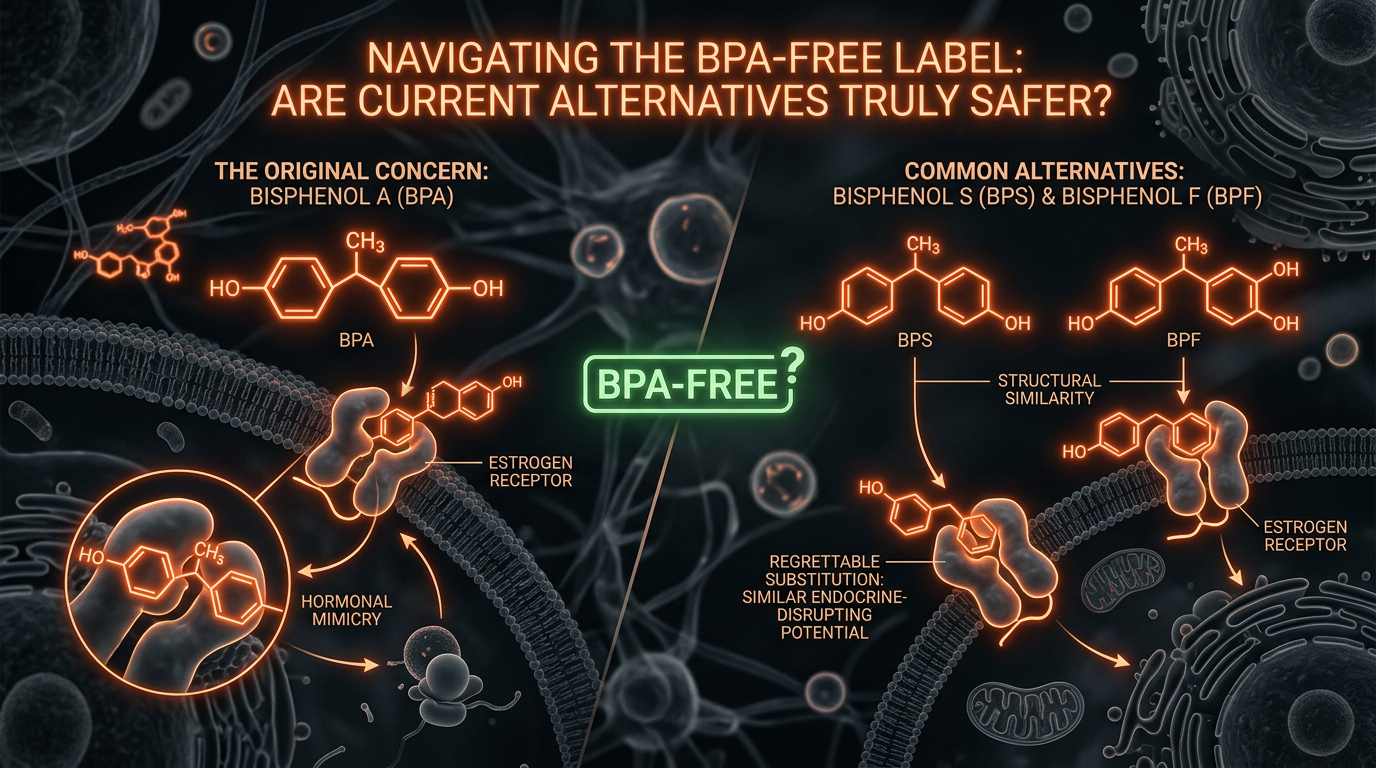
As Bisphenol A (BPA) faced increasing regulatory scrutiny and public outcry, manufacturers did not necessarily transition to inert materials. Instead, they pivoted to structural analogues—predominantly Bisphenol S (BPS) and Bisphenol F (BPF). This phenomenon, known in toxicological circles as "regrettable substitution," involves replacing one known toxin with an under-researched relative that shares the same fundamental molecular architecture.
In this research piece for INNERSTANDING, we dissect the biological mechanisms of bisphenols and phthalates, expose the fallacy of the BPA-free label, and provide a roadmap for systemic recovery.
The Molecular Mimicry: How Endocrine Disruptors Hijack Human Biology
To understand why "BPA-Free" is often a hollow promise, one must understand the mechanism of endocrine disruption. The human endocrine system operates via a delicate "lock and key" mechanism. Hormones (the keys) bind to specific receptors (the locks) to trigger physiological responses.
Bisphenols are structurally similar to 17β-oestradiol, the primary female sex hormone. This structural mimicry allows these chemicals to bind to oestrogen receptors (ERα and ERβ) across the body.
The Non-Monotonic Dose-Response Paradox
Traditional toxicology is built on the Paracelsian principle: "The dose makes the poison." However, bisphenols and phthalates defy this logic through non-monotonic dose-response curves. This means that extremely low doses—equivalent to a drop of water in an Olympic-sized swimming pool—can have more profound biological effects than higher doses. At low concentrations, these chemicals can sensitise receptors or interfere with the body’s natural feedback loops, leading to permanent developmental alterations.
Epigenetic Transgenerational Inheritance
The danger of these substances is not confined to the individual. Research indicates that exposure to endocrine-disrupting chemicals (EDCs) can induce epigenetic changes—chemical tags on the DNA that turn genes on or off. These changes can be passed down to offspring, potentially predispositing future generations to infertility, obesity, and metabolic dysfunction without them ever having been directly exposed to the original chemical.
The Illusion of Safety: BPS, BPF, and the Regrettable Substitution
When the UK and the EU restricted BPA in specific applications, such as thermal paper and baby bottles, the industry required a functional replacement. The result was a shift to Bisphenol S (BPS) and Bisphenol F (BPF).
- Bisphenol S (BPS): Often found in "BPA-Free" plastics and thermal receipts. Studies suggest BPS is more heat-stable and resistant to degradation than BPA, meaning it may persist longer in the environment and the human body.
- Bisphenol F (BPF): Frequently used in high-performance coatings and liners. It exhibits similar oestrogenic potency to BPA.
Recent comparative studies have shown that BPS and BPF are not only oestrogenic but can also interfere with androgen receptors (blocking testosterone) and thyroid hormone signalling.
"A 2020 study published in Environmental Health Perspectives indicated that 97% of UK participants had detectable levels of BPS in their urine, despite the products being labelled as BPA-free. This suggests a systemic saturation of these structural analogues in the British consumer landscape."
Phthalates: The Silent Partners in Plastic Toxicity
While bisphenols provide the rigidity in plastics (polycarbonates), phthalates provide the flexibility (PVC). They are found in food packaging, medical tubing, and personal care products. Unlike bisphenols, phthalates are not chemically bound to the plastic matrix; they are merely mixed in. This makes them highly prone to "leaching" or "outgassing" into the food we eat and the air we breathe.
The Phthalate Syndrome
Phthalates are primarily known for their anti-androgenic effects. In males, exposure during critical developmental windows is linked to "Phthalate Syndrome," characterised by reduced anogenital distance, undescended testes, and lowered sperm quality later in life.
- DEHP (Diethylhexyl phthalate): Used in food wraps; linked to insulin resistance.
- DBP (Dibutyl phthalate): Found in nail polishes and printing inks; linked to thyroid disruption.
- DEP (Diethyl phthalate): Common in "fragrance" or parfum in UK cosmetics; linked to DNA damage in sperm.
Environmental Disruptors: The UK Context
The UK’s reliance on processed food and its legacy of plastic waste have created a unique environmental burden. The "plasticisation" of the British diet is a primary vector for EDC exposure.
Thermal Receipts: The Transdermal Pathway
Many UK consumers are unaware that thermal paper (used for till receipts, bus tickets, and deli labels) is a primary source of BPS. When you touch a receipt, the chemical is absorbed through the skin. If you have recently used hand sanitiser or moisturiser, the absorption rate increases by up to 100-fold due to skin penetration enhancers.
Tap Water and Microplastics
The UK water infrastructure, while treated for pathogens, is not currently designed to filter out molecular-level EDCs or microplastics.
"Data from the UK Environment Agency reveals that 'forever chemicals' and plasticisers are consistently detected in British waterways, with some river systems showing concentrations that exceed safe biological thresholds for aquatic life, posing a long-term risk to the human food chain."
The Health Consequences: From Metabolism to Mind
The systemic presence of these chemicals is not merely a theoretical concern; it is a driver of the modern chronic disease epidemic.
1. The Obesogen Hypothesis
Bisphenols and phthalates are classified as "obesogens." They interfere with lipid metabolism and adipogenesis (the creation of fat cells). They can program the body to produce more fat cells and to store more fat within those cells, regardless of caloric intake. This partially explains the burgeoning obesity crisis in the UK that seems resistant to traditional dietary advice.
2. Neurodevelopment and Behaviour
The brain is highly sensitive to thyroid and sex hormones during development. Exposure to BPS and phthalates has been correlated with increased rates of ADHD, anxiety, and cognitive decline. By mimicking or blocking hormones, these chemicals disrupt the "pruning" and "wiring" of the foetal and infant brain.
3. Reproductive Decline
The "Great Sperm Count Decline" is well-documented in Western nations, including the UK. EDCs are a primary suspect. By mimicking oestrogen and blocking testosterone, these chemicals alter the hormonal milieu required for healthy gamete production in both men and women.
Recovery Protocols: De-Plasticising the Biology
Total avoidance in the modern world is impossible, but significant reduction and systemic recovery are achievable through deliberate protocols.
Environmental Mitigation
- Transition to "The Big Three": Replace all plastic food storage and heating containers with glass, stainless steel, or lead-free ceramic. Never heat plastic, as thermal stress accelerates the leaching of bisphenols by orders of magnitude.
- Ditch the Receipt: Decline paper receipts unless necessary. If you must handle them, wash your hands immediately afterward with soap and water (avoiding alcohol-based sanitisers which increase absorption).
- Water Filtration: Utilise high-quality carbon block or reverse osmosis filtration systems for drinking and cooking water to remove molecular-grade contaminants.
- Dust Management: Phthalates accumulate in household dust. Use a HEPA-filter vacuum and wet-mop surfaces regularly to reduce inhalation and dermal contact.
Biological Support and Detoxification
The body possesses natural pathways for the biotransformation of phenols and phthalates, primarily through the liver’s Phase II detoxification (glucuronidation and sulphation).
- Support Glucuronidation: Consume cruciferous vegetables (broccoli, sprouts, kale) which contain Calcium D-Glucarate and Sulforaphane. These compounds assist the liver in "tagging" bisphenols for excretion.
- Optimise Sulphur Intake: Bisphenols are often detoxified via sulphation. Ensure adequate intake of sulphur-rich foods such as organic eggs, garlic, onions, and grass-fed meats.
- Sweat Therapy: Evidence suggests that certain phthalates and bisphenols are excreted more efficiently through sweat than through urine. Regular use of saunas (particularly infrared saunas) can help mobilise these fat-soluble toxins from adipose tissue.
- Fibre and Binder Protocol: Once the liver processes these chemicals and sends them to the gut via bile, they must be captured to prevent reabsorption (enterohepatic circulation). A high-fibre diet or the use of natural binders like activated charcoal or modified citrus pectin can facilitate permanent removal.
Conclusion: Beyond the Label
The "BPA-Free" label is a masterclass in industrial misdirection. It allows the plastics industry to maintain the status quo while offering a false sense of security to the health-conscious consumer. To truly navigate this landscape, one must look beyond the individual chemical and recognise the broader systemic threat posed by all bisphenols and phthalates.
As we have explored, BPS and BPF are not safer; they are simply less regulated. The path forward requires a return to inert materials and a conscious effort to support the body’s innate detoxification systems. In the pursuit of "Innerstanding," we must acknowledge that our external environment is intimately tied to our internal biochemistry. By purging the plasticites from our lives, we reclaim our hormonal sovereignty and safeguard the health of the generations to come.
"In the UK, the precautionary principle should be the baseline, not the exception. Until a chemical is proven inert across multiple generations, its presence in our food and water must be viewed as a biological intervention without consent."
"References & Technical Notes:"
- Regrettable Substitution: The replacement of a toxic chemical with a structural analogue of similar or greater toxicity.
- Endocrine Disrupting Chemicals (EDCs): Substances that interfere with the synthesis, secretion, transport, binding, action, or elimination of natural hormones.
- UK REACH: The regulatory framework (Registration, Evaluation, Authorisation and Restriction of Chemicals) that governs chemical safety in the UK post-Brexit.
This article is provided for informational and educational purposes only. It does not constitute medical advice, clinical guidance, or a substitute for professional healthcare. Information reflects cited research at time of publication. Always consult a qualified healthcare professional before acting on any health information.
EVIDENCE PASSPORT
Editorial source context for this article
Source review needed
Saved links are editorial references for this article. They may support specific claims rather than every sentence. Open and assess each source in context. This passport does not independently verify them.
Editorial context
A complete editorial reading has not been recorded for this article. Source links remain available for you to open and assess directly.
Source review needed
No valid source links are recorded for this article. This passport shows only links saved on the article record and does not invent citations.
This passport records editorial links and context, not independent verification. Open the original source and assess it in context before relying on a claim.
Medical Disclaimer
The information in this article is for educational purposes only and does not constitute medical advice, diagnosis, or treatment. Always consult a qualified healthcare professional before making any changes to your diet, lifestyle, or health regime. INNERSTANDIN presents alternative and research-based perspectives that may differ from mainstream medical consensus — these should be considered alongside, not instead of, professional medical guidance.
Read Full DisclaimerContinue the thread
Keep this question moving.
Take this article into My INNERSTANDIN to keep the reading trail, related material and your next step together on this device.