
The PFAS Paradigm: Identifying Forever Chemicals in UK Drinking Water
Updated May 2026
Exploring the emerging threat of PFAS contamination in urban water supplies and the regulatory hurdles facing water companies in implementing advanced filtration technologies.
Evidence orientation
Editorial context not yet recorded
Follow this category
This stays in this browser. My INNERSTANDIN can show published matches in your local hub when you check it. It does not send email, push, or alert notifications.
Local learning review
A private browser aid for revisiting ideas. It is not an alert or a health recommendation.
Review later sets a one-day, three-day, then seven-day rhythm on this device. Choose it only when you want to revisit this article.
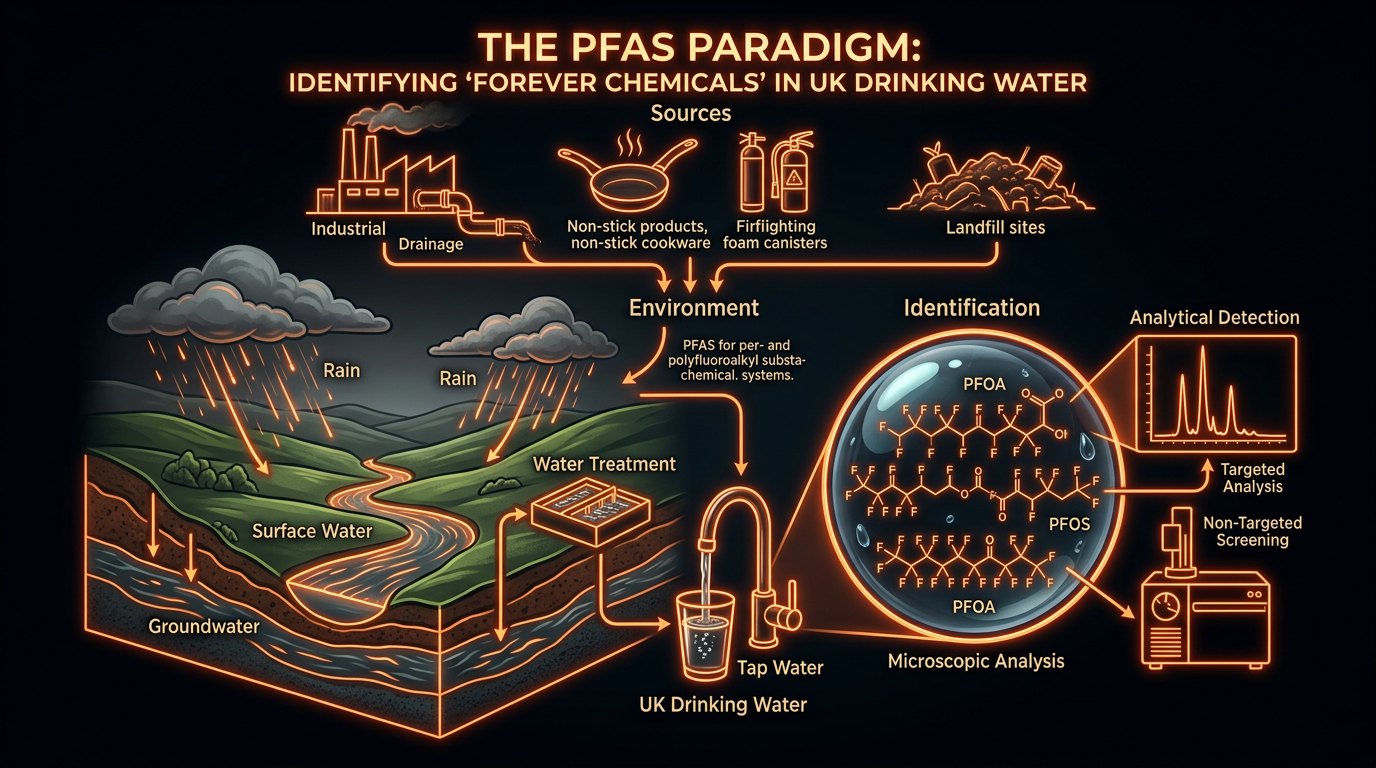
Introduction: The Invisible Persistence
In the lexicon of modern environmental toxicology, few terms carry the weight of "Forever Chemicals." Formally known as Per- and polyfluoroalkyl substances (PFAS), these synthetic organofluorine compounds have become the defining contaminant of the 21st century. For the British public, particularly those served by the aging infrastructure of Thames Water, the narrative of "safe" tap water is undergoing a radical and unsettling transformation.
PFAS are characterised by the carbon-fluorine bond—one of the strongest in organic chemistry. This bond provides the heat resistance and water-repellent properties that made PFAS indispensable to industry, from Teflon pans to firefighting foams. However, this same strength renders them virtually indestructible in the natural environment and within the human physiology. As we investigate the state of UK drinking water, we find a systemic failure to monitor, regulate, and mitigate a xenobiotic burden that is now intrinsically linked to the British hydrologic cycle.
The Molecular Architecture of Toxicity
To understand the danger, one must first understand the chemistry. PFAS is a family of over 12,000 synthetic chemicals. The most notorious are Perfluorooctane sulfonate (PFOS) and Perfluorooctanoic acid (PFOA).
The primary structural concern is their "surfactant" nature. PFAS molecules consist of a hydrophobic (water-fearing) fluorinated tail and a hydrophilic (water-loving) head. This dual nature allows them to migrate through soil and into groundwater with terrifying efficiency. Unlike traditional pollutants that may settle in sediment, PFAS remain dissolved and mobile.
The Bioaccumulation Mechanism
When ingested via contaminated drinking water, PFAS do not follow the typical metabolic pathways of organic toxins. They are not easily broken down by the liver or excreted through traditional phase II detoxification. Instead:
- Protein Binding: PFAS have a high affinity for serum albumin. They hitchhike on proteins in the blood, circulating throughout the body for years.
- Enterohepatic Recirculation: Even when the liver attempts to excrete PFAS into the bile for elimination, they are frequently reabsorbed in the small intestine and returned to the liver. This cycle extends their biological half-life in humans to anywhere between 3 and 10 years.
The UK Landscape: A Regulatory Mirage
While the United States’ Environmental Protection Agency (EPA) has recently slashed its "safe" limits for PFOA and PFOS to near zero (4 parts per trillion), the United Kingdom remains in a state of regulatory inertia.
"In the United Kingdom, the Drinking Water Inspectorate (DWI) currently sets a 'trigger' level of 100 nanograms per litre (ng/L) for individual PFAS. This is 25 times higher than the updated US safety standards, a disparity that suggests British consumers are being exposed to significantly higher risks under the guise of 'acceptable' limits."
The Thames Water Crisis
Thames Water, the UK’s largest water and wastewater company, serves over 15 million people. The "London Loop"—the process by which water is abstracted from the Thames, used, treated, and returned to the river—creates a closed-circuit vulnerability.
Recent investigations have revealed that the Thames catchment area is particularly susceptible to PFAS contamination due to:
- Industrial Legacy: Historical manufacturing along the Thames estuary.
- Aviation Runoff: Significant levels of PFAS have been detected near Heathrow and Gatwick, stemming from the historic use of Aqueous Film-Forming Foams (AFFF) in fire drills.
- Wastewater Treatment Limitations: Current UK wastewater treatment plants (WWTPs) are not equipped with the advanced filtration (such as high-pressure membranes) required to strip PFAS from sewage. Consequently, treated effluent returned to the river often contains the same PFAS load as the raw sewage.
Biological Mechanisms: How PFAS Disrupts Life
The "Innerstanding" of PFAS requires a deep dive into the cellular disruption these chemicals cause. They are not merely "present"; they are bioactive disruptors that mimic essential life molecules.
1. Endocrine Disruption and Mimicry
PFAS are potent endocrine-disrupting chemicals (EDCs). Structurally, they resemble fatty acids. This allows them to activate Peroxisome Proliferator-Activated Receptors (PPARs), which are responsible for regulating gene expression related to energy metabolism, cell differentiation, and inflammatory responses.
- Thyroid Interference: PFAS compete with thyroid hormones for transport proteins, leading to a state of subclinical hypothyroidism that can affect metabolic rate and cognitive function.
- Reproductive Toxicity: Exposure is linked to reduced fertility, polycystic ovary syndrome (PCOS), and lower sperm counts in the British male population.
2. Immunotoxicity: The Silent Suppression
One of the most alarming findings in recent toxicological research is the effect of PFAS on the immune system. Exposure has been shown to reduce the efficacy of childhood vaccinations. PFAS suppress the body's ability to produce antibodies, effectively making the population more vulnerable to both endemic and novel pathogens.
3. Carcinogenesis
In 2023, the International Agency for Research on Cancer (IARC) classified PFOA as "carcinogenic to humans" (Group 1). The mechanism is believed to involve oxidative stress and the inhibition of gap junctional intercellular communication, which allows "immortal" cancer cells to proliferate without the body’s natural apoptotic (cell death) checks.
The Environmental Disruptors: Beyond the Tap
Drinking water is the primary vector, but it exists within a wider ecological context of contamination.
- Biosolids in Agriculture: Thames Water and other utilities frequently sell treated sewage sludge (biosolids) to farmers as fertiliser. This sludge is often concentrated with PFAS. When spread on British farmland, the chemicals move into the soil, are taken up by crops, and enter the food chain via dairy and meat.
- The "Cocktail Effect": Current UK testing typically looks for a handful of specific PFAS. However, the industry has shifted to "short-chain" PFAS (like GenX), which were marketed as safer alternatives but are proving to be equally persistent and perhaps more mobile in water. The synergy of hundreds of different PFAS in a single glass of water creates a "cocktail effect" where the total toxicity exceeds the sum of its parts.
Recovery Protocols: Navigating a Contaminated World
Given the systemic failure to provide PFAS-free water, the responsibility for health has shifted to the individual. Recovery from a "Forever Chemical" burden requires a two-pronged approach: Filtration and Physiological De-burdening.
I. Advanced Filtration: The First Line of Defence
Standard carbon filters (like basic pitcher filters) are largely ineffective against the full spectrum of PFAS. For those within the Thames Water catchment, higher-specification technology is required:
- Reverse Osmosis (RO): RO systems, particularly those with multiple stages and a thin-film composite membrane, are the gold standard for PFAS removal. They can strip up to 99% of long-chain and short-chain compounds.
- Ion Exchange Resins: Specialty resins designed to attract the charged heads of PFAS molecules are becoming increasingly popular for whole-house filtration.
- Granular Activated Carbon (GAC): While more effective than standard carbon, GAC must be changed frequently. Once the carbon "sites" are saturated, the filter may actually begin leaching PFAS back into the water.
II. Biological De-burdening: Enhancing Excretion
While PFAS are difficult to eliminate, specific protocols can assist the body in reducing its toxic load.
- Interrupting Reabsorption: Since PFAS undergo enterohepatic recirculation, the use of "binders" is critical.
- Cholestyramine: A prescription bile-acid sequestrant that has been shown in clinical settings to significantly speed up the excretion of PFOS.
- Activated Charcoal and Chlorella: Non-prescription binders that may help trap PFAS in the digestive tract, preventing reabsorption.
- Supporting the Liver: High-dose Liposomal Glutathione and N-Acetyl Cysteine (NAC) support the liver’s general detoxification capacity, helping it manage the oxidative stress caused by chemical accumulation.
- Sweating and Saunas: While PFAS are primarily excreted through urine and bile, there is emerging evidence that some may be eliminated through sweat. Regular infrared sauna use can assist in mobilizing toxins stored in the interstitial fluids.
- Iodine and Selenium: These minerals are vital for protecting the thyroid from PFAS-mediated disruption. Ensuring optimal levels helps the thyroid compete with the halogenated PFAS molecules for receptor sites.
The Truth Exposed: A Path Forward
The reality of the UK water situation is a testament to the "Precautionary Principle" being sacrificed on the altar of corporate convenience. Thames Water, currently facing a financial and infrastructure crisis, lacks the immediate capital and regulatory mandate to implement the nanofiltration or reverse osmosis systems required at the municipal level to clear PFAS from our supply.
The current "Tiered" approach used by the DWI is reactive rather than proactive. By the time a "trigger level" is reached, the population has already been "pre-loaded" with years of bioaccumulative toxins.
"The true cost of water is not found in the monthly bill from the utility provider, but in the long-term healthcare costs associated with chronic xenobiotic exposure. To 'Innerstand' our water is to acknowledge that the tap is no longer a neutral source of life, but a delivery system for industrial waste that requires personal intervention."
Summary of Actions for the Conscious Consumer:
- Test Your Water: Utilise independent laboratories that offer "Total Organic Fluorine" (TOF) testing, rather than just standard PFOA/PFOS tests.
- Invest in RO: Install an under-sink Reverse Osmosis system with a remineralisation stage to ensure the water is not only clean but biologically compatible.
- Nutritional Shielding: Maintain high fibre intake and consider periodic use of natural binders to mitigate the impact of unavoidable environmental exposure.
- Demand Transparency: Lobby local MPs for the UK to adopt the more stringent US or EU standards for PFAS (The EU's "PFAS 20" standard).
Conclusion
The PFAS paradigm is a wake-up call for the British public. The illusion of the "pristine" Thames has been replaced by the reality of a chemical-laden artery. However, through scientific understanding and proactive recovery protocols, we can navigate this landscape. Knowledge is the ultimate filter; once we see the "Forever Chemicals" for what they are, we can take the necessary steps to ensure our biological integrity remains untainted by the industrial legacy of the 20th century.
True "Innerstanding" begins with the water we consume, for it becomes the very fluid that powers our cellular existence. Protect the source, protect the self.
This article is provided for informational and educational purposes only. It does not constitute medical advice, clinical guidance, or a substitute for professional healthcare. Information reflects cited research at time of publication. Always consult a qualified healthcare professional before acting on any health information.
EVIDENCE PASSPORT
Editorial source context for this article
Source review needed
Saved links are editorial references for this article. They may support specific claims rather than every sentence. Open and assess each source in context. This passport does not independently verify them.
Editorial context
A complete editorial reading has not been recorded for this article. Source links remain available for you to open and assess directly.
Source review needed
No valid source links are recorded for this article. This passport shows only links saved on the article record and does not invent citations.
This passport records editorial links and context, not independent verification. Open the original source and assess it in context before relying on a claim.
Medical Disclaimer
The information in this article is for educational purposes only and does not constitute medical advice, diagnosis, or treatment. Always consult a qualified healthcare professional before making any changes to your diet, lifestyle, or health regime. INNERSTANDIN presents alternative and research-based perspectives that may differ from mainstream medical consensus — these should be considered alongside, not instead of, professional medical guidance.
Read Full DisclaimerContinue the thread
Keep this question moving.
Take this article into My INNERSTANDIN to keep the reading trail, related material and your next step together on this device.
Dig deeper in the Library
Free, longform PDF volumes that go beyond headlines into mechanisms and references.