
The Science of Screen Time: Combating Digital Eye Strain in a Remote World
Updated May 2026
Understanding the physiological effects of blue light and prolonged screen use, with evidence-based tips for maintaining ocular comfort.
Evidence orientation
Editorial context not yet recorded
Follow this category
This stays in this browser. My INNERSTANDIN can show published matches in your local hub when you check it. It does not send email, push, or alert notifications.
Local learning review
A private browser aid for revisiting ideas. It is not an alert or a health recommendation.
Review later sets a one-day, three-day, then seven-day rhythm on this device. Choose it only when you want to revisit this article.
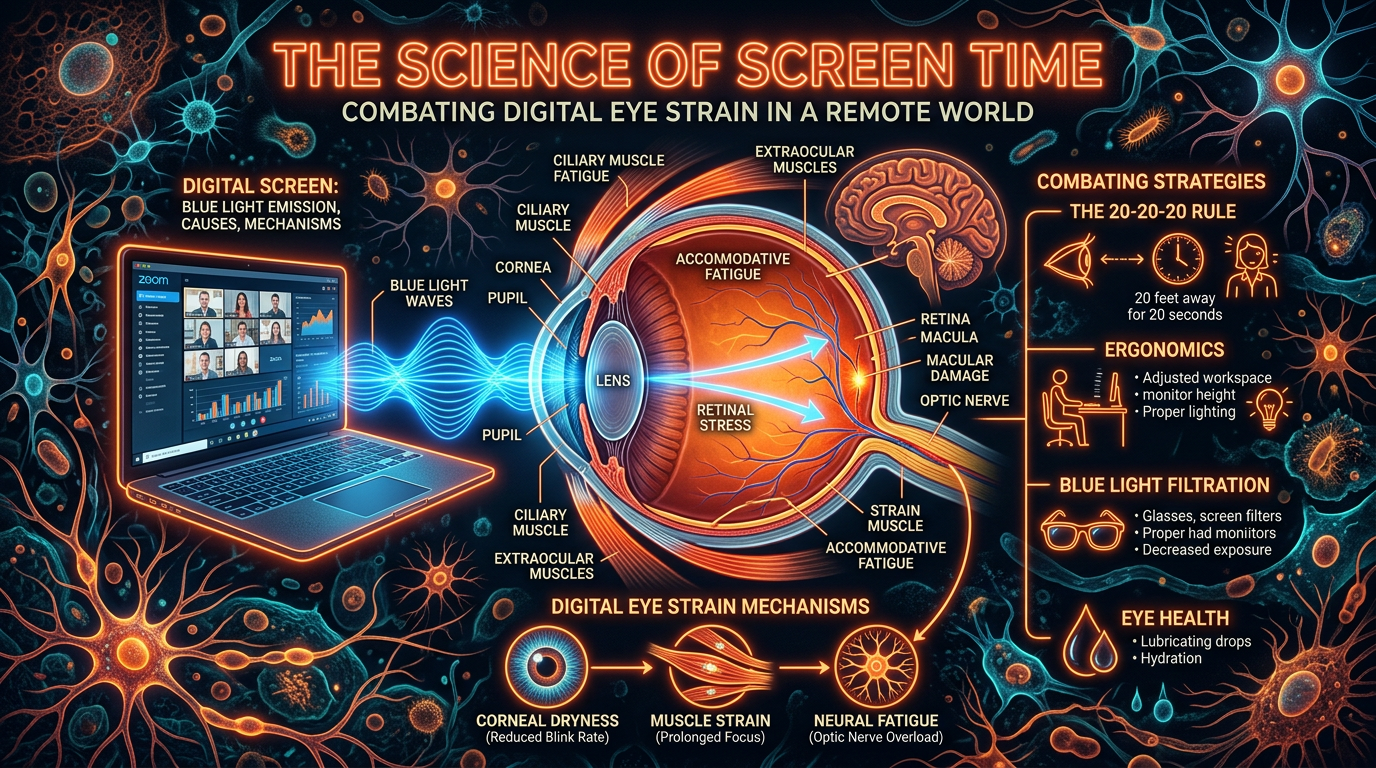
Introduction: The Great Ocular Experiment
The modern workspace has undergone a radical, un-consented metamorphosis. Over the past decade, and accelerated by the global shift towards remote labour, the human visual system has been conscripted into an evolutionary anomaly. For the first time in hominid history, the primary focus of our waking hours is no longer the expansive horizon or the three-dimensional depth of the natural world, but a two-dimensional, backlit, high-flicker rectangle positioned mere centimetres from the nose.
This shift has birthed a clinical phenomenon known as Computer Vision Syndrome (CVS), or Digital Eye Strain (DES). While the corporate world celebrates the "efficiency" of the remote revolution, a silent biological cost is being extracted. This article serves as a high-authority interrogation of the biological mechanisms at play, the environmental disruptors inherent in our "smart" homes, and the rigorous protocols required to preserve our most vital sensory asset.
The Biological Mechanisms: How Screens Hijack Vision
To understand the pathology of digital eye strain, one must first appreciate the intricate biomechanics of the human eye. The eye was designed for dynamic movement and varying focal lengths. The "Remote World" demands the opposite: static, near-point fixation for hours on end.
1. The Ciliary Muscle and Accommodative Stress
The crystalline lens of the eye is controlled by the ciliary muscle. To see objects at a distance, this muscle relaxes. To focus on a laptop screen—a process known as accommodation—the ciliary muscle must contract.
In a remote working environment, the average professional maintains this contraction for 8 to 10 hours daily. This is the physiological equivalent of holding a 10kg dumbbell at a 90-degree bicep curl without pause. The resulting fatigue, known as accommodative asthenopia, manifests as a dull ache behind the globes and a loss of "focusing flexibility" when finally looking away from the screen.
2. The Blink Rate and Evaporative Dry Eye
The cornea is covered by a delicate trilayer of tear film: the mucin layer, the aqueous layer, and the lipid layer. This film must be replenished constantly through blinking. Under normal conditions, humans blink approximately 15 to 20 times per minute.
However, studies in visual science have confirmed that when we engage with digital interfaces, our blink rate plummets by as much as 60% to 70%. Furthermore, "incomplete blinks"—where the eyelid fails to make full contact with the lower lid—become the norm.
"According to data from the College of Optometrists, approximately 31% of UK adults reported a deterioration in their vision since the pandemic, primarily attributed to increased screen time and the subsequent disruption of the lacrimal functional unit."
This leads to corneal desiccation. Without the protective lipid layer, moisture evaporates, leaving the eye vulnerable to micro-abrasions, inflammation, and the burning sensation often mistaken for simple tiredness.
3. High-Energy Visible (HEV) Light and the Macula
Screens emit High-Energy Visible (HEV) light, commonly referred to as blue light (wavelengths between 400nm and 450nm). Unlike longer wavelengths, HEV light penetrates deep into the eye, reaching the retina. While the "blue light causes blindness" narrative is often hyperbolic, the truth is more nuanced: chronic exposure to HEV light induces oxidative stress in the retinal pigment epithelium, potentially accelerating the onset of age-related macular degeneration (AMD) in later life.
Environmental Disruptors: The Invisible Ocular Hazards
In a controlled office environment, lighting and ergonomics are (ideally) regulated. In the remote world, we are often working in "hostile" visual environments that exacerbate the biological stressors mentioned above.
The Flicker Phenomenon (Pulse Width Modulation)
Most modern LED and LCD screens do not dim by lowering the current; instead, they use Pulse Width Modulation (PWM). The screen rapidly cycles between "on" and "off" states—hundreds or thousands of times per second. While the human brain perceives this as a continuous stream of light, the iris and the visual cortex detect the flicker.
This constant, rapid adjustment causes neurological fatigue. It is a "hidden" disruptor that contributes significantly to the "screen brain" fog experienced at the end of a workday.
The Contrast and Glare Trap
In many UK home offices, the positioning of screens relative to windows is suboptimal.
- Direct Glare: Sunlight hitting the screen directly.
- Indirect Glare: Reflections of lamps or windows on the glossy glass.
- High Contrast: Working on a bright screen in a dark room.
These factors force the eye to work exponentially harder to distinguish characters on the screen from the background noise of reflections, leading to contrast sensitivity depletion.
The Vergence-Accommodation Conflict
In the natural world, when your eyes converge to look at a near object, they also focus (accommodate). Digital screens present a conflict: the screen is at a fixed distance, but the 3D imagery or the depth within high-resolution interfaces tricks the brain into attempting to focus at different depths. This "mismatch" is a primary driver of the nausea and headaches associated with prolonged VR use and high-intensity digital labour.
The Truth-Exposing Reality of Blue Light Glasses
There is a burgeoning industry dedicated to "Blue Light Blocking" spectacles. However, scientific rigor demands we separate marketing from physiology. Most over-the-counter blue light glasses are ineffective because they target the wrong wavelengths or offer a negligible percentage of filtration.
The real danger of HEV light isn't just retinal damage; it is the Circadian Disruption. The melanopsin-expressing retinal ganglion cells (ipRGCs) are highly sensitive to blue light. These cells signal the suprachiasmatic nucleus (the body's master clock) to suppress melatonin. By using screens late into the evening without proper filtration, remote workers are effectively telling their brains it is midday, leading to systemic inflammation and poor sleep quality, which in turn prevents the eyes from repairing themselves overnight.
Recovery Protocols: Restoring the Ocular Ecosystem
To combat the degradation of our vision, we must move beyond "breaks" and implement scientifically backed recovery protocols.
1. The 20-20-20-20 Rule (Enhanced)
The standard 20-20-20 rule suggests looking at something 20 feet away for 20 seconds every 20 minutes. For high-authority ocular hygiene, we add a fourth "20":
- 20 Minutes: Frequency of break.
- 20 Feet: Distance for focal relaxation.
- 20 Seconds: Duration.
- 20 Full Blinks: Deliberately squeezing the eyelids shut to engage the Meibomian glands and oil the eye surface.
2. Peripheral Expansion and The Bates Method (Revisited)
Static fixation causes "tunnel vision" and sympathetic nervous system dominance. To counter this, practitioners should engage in Peripheral Expansion.
- Soften your gaze.
- Without moving your eyes, become aware of the ceiling, the floor, and the walls to your left and right.
- This shifts the brain from a "stress-focus" (beta waves) to a "relaxed-awareness" (alpha waves), relaxing the extrinsic eye muscles.
3. Environmental Optimisation
- The Arm’s Length Rule: Your screen should be at least 50cm to 70cm from your eyes.
- The Top-Down Alignment: The top of your monitor should be at or slightly below eye level. Looking slightly downward exposes less of the ocular surface to the air, reducing tear evaporation.
- Warm Lighting: Switch to 2700K (warm) bulbs in your workspace and use software-level "night modes" (like f.lux) that adjust the colour temperature of the screen based on the sun's position.
4. Nutritional Ocular Support
The macula relies on specific carotenoids to filter HEV light naturally. A "digital-first" diet should include:
- Lutein and Zeaxanthin: Found in kale, spinach, and egg yolks. These act as "internal sunglasses."
- Astaxanthin: A potent antioxidant that has been clinically shown to improve accommodative recovery.
- Omega-3 Fatty Acids (EPA/DHA): Crucial for maintaining the lipid layer of the tear film.
"A UK-based study found that supplement-based intervention with Lutein and Zeaxanthin increased macular pigment optical density (MPOD) by 15% over six months, significantly improving contrast sensitivity in subjects with high screen usage."
The Neuro-Ocular Connection: Vision is Brain Power
We must stop viewing the eyes as isolated cameras. They are, in fact, the only part of the central nervous system that sits outside the skull. When our eyes are strained, our entire cognitive processing power is throttled.
The "Remote World" has given us autonomy over our schedules, but it has enslaved our visual system to a flat, flickering reality. Combating digital eye strain is not merely about comfort; it is about protecting the neurological gateway through which we perceive the world.
Summary of Daily Ocular Hygiene:
- Morning: Seek 10 minutes of direct, natural sunlight (no glasses) to reset the circadian clock.
- Workday: Implement the 20-20-20-20 rule. Use a humidifier to maintain 45% humidity in the home office.
- Evening: Zero HEV light exposure 2 hours before bed. Use red-shifted lighting.
- Night: Total darkness. The eyes require a complete absence of photons to facilitate the regeneration of rhodopsin.
Conclusion
The science is clear: our biology is not yet adapted to the digital-remote paradigm. The "flicker," the "blue light," and the "near-point stress" are all environmental disruptors that demand a conscious, disciplined response. By understanding the biological mechanisms of the ciliary muscle and the tear film, we can move from being victims of our screens to masters of our visual environment.
True "INNERSTANDING" begins with the realisation that our vision is not a permanent gift, but a biological system that requires maintenance, nourishment, and, above all, the space to look away from the digital void and back toward the depth of the real world.
This article is provided for informational and educational purposes only. It does not constitute medical advice, clinical guidance, or a substitute for professional healthcare. Information reflects cited research at time of publication. Always consult a qualified healthcare professional before acting on any health information.
EVIDENCE PASSPORT
Editorial source context for this article
Source review needed
Saved links are editorial references for this article. They may support specific claims rather than every sentence. Open and assess each source in context. This passport does not independently verify them.
Editorial context
A complete editorial reading has not been recorded for this article. Source links remain available for you to open and assess directly.
Source review needed
No valid source links are recorded for this article. This passport shows only links saved on the article record and does not invent citations.
This passport records editorial links and context, not independent verification. Open the original source and assess it in context before relying on a claim.
Medical Disclaimer
The information in this article is for educational purposes only and does not constitute medical advice, diagnosis, or treatment. Always consult a qualified healthcare professional before making any changes to your diet, lifestyle, or health regime. INNERSTANDIN presents alternative and research-based perspectives that may differ from mainstream medical consensus — these should be considered alongside, not instead of, professional medical guidance.
Read Full DisclaimerContinue the thread
Keep this question moving.
Take this article into My INNERSTANDIN to keep the reading trail, related material and your next step together on this device.