
Screen Time and Pediatric Vision: The Physiological Cost of the Digital Childhood
Updated May 2026
Assessing the impact of blue light and constant accommodation on the developing eyes of UK children. We provide biological strategies to mitigate digital strain and prevent long-term visual impairment in the next generation.
Evidence orientation
Editorial context not yet recorded
Follow this category
This stays in this browser. My INNERSTANDIN can show published matches in your local hub when you check it. It does not send email, push, or alert notifications.
Local learning review
A private browser aid for revisiting ideas. It is not an alert or a health recommendation.
Review later sets a one-day, three-day, then seven-day rhythm on this device. Choose it only when you want to revisit this article.
Overview
The modern British childhood has undergone a radical biological translocation. In less than two decades, the primary sensory environment for children has shifted from the three-dimensional, high-lux, multi-focal natural world to the two-dimensional, low-lux, fixed-focal digital landscape. While the educational and social benefits of technology are frequently championed by policymakers, as a senior biological researcher at INNERSTANDING, I must present the uncomfortable reality: we are currently conducting an unregulated physiological experiment on the ocular development of an entire generation.
The human eye did not evolve to stare at a self-illuminated, flickering plane for eight hours a day. Evolutionarily, our visual system is designed for dynamic scanning, distant horizon tracking, and immersion in the full solar spectrum. The "Digital Childhood" is characterized by a pathological state of chronic near-work and spectral malnutrition. This is not merely a matter of "tired eyes"; it is a fundamental restructuring of the eye’s physical anatomy—specifically the axial length of the globe—leading to an unprecedented surge in paediatric myopia (short-sightedness) and retinal stress.
In this comprehensive analysis, we will peel back the superficial "screen time" debate to examine the cellular, molecular, and biomechanical costs of our digital existence. From the disruption of retinal dopamine to the oxidative stress induced by high-energy visible (HEV) light, we will expose why the current UK guidelines are woefully inadequate and what must be done to protect the biological integrity of the next generation.
The Biology — How It Works
To understand why screens are so damaging to children, we must first understand the process of emmetropization. This is the biological mechanism by which the eye coordinates its optical power with its physical length so that images are focused perfectly on the retina.
In a developing child, the eye is highly plastic. It "listens" to the environment to determine how much it should grow. The primary signals for this growth are light intensity and focal distance.
The Mechanism of Accommodation
When a child looks at a screen, the ciliary muscle inside the eye must contract to increase the refractive power of the lens. This is known as accommodation. In a natural environment, accommodation is transient; a child looks at a bug on the ground (near) and then at a bird in a tree (far). This constant "flexing and relaxing" maintains the health of the muscle and the flexibility of the lens.
Digital screens, however, demand sustained, static accommodation. For hours at a time, the ciliary muscle remains in a state of tonic contraction. This creates a biomechanical feedback loop: the eye perceives the constant near-focus as the "new normal" and signals the sclera (the white outer layer of the eye) to elongate. Once the eye elongates, the change is permanent. The child is now myopic.
The Dopamine Connection
The retina is not just a sensor; it is a neurochemical factory. One of its most critical products is dopamine, which is released in response to high-intensity light (daylight). Retinal dopamine acts as a "stop" signal for ocular growth.
Callout Fact 1: Natural sunlight can reach intensities of over 100,000 lux, whereas a typical brightly lit classroom or living room provides only 300 to 500 lux. Screens, despite appearing "bright," provide negligible lux in terms of dopamine stimulation.
Without the "stop" signal provided by sufficient daylight, and under the constant "grow" signal of near-work, the eye continues to stretch. This is why the lack of outdoor time is now considered as significant a risk factor for myopia as screen use itself.
Mechanisms at the Cellular Level
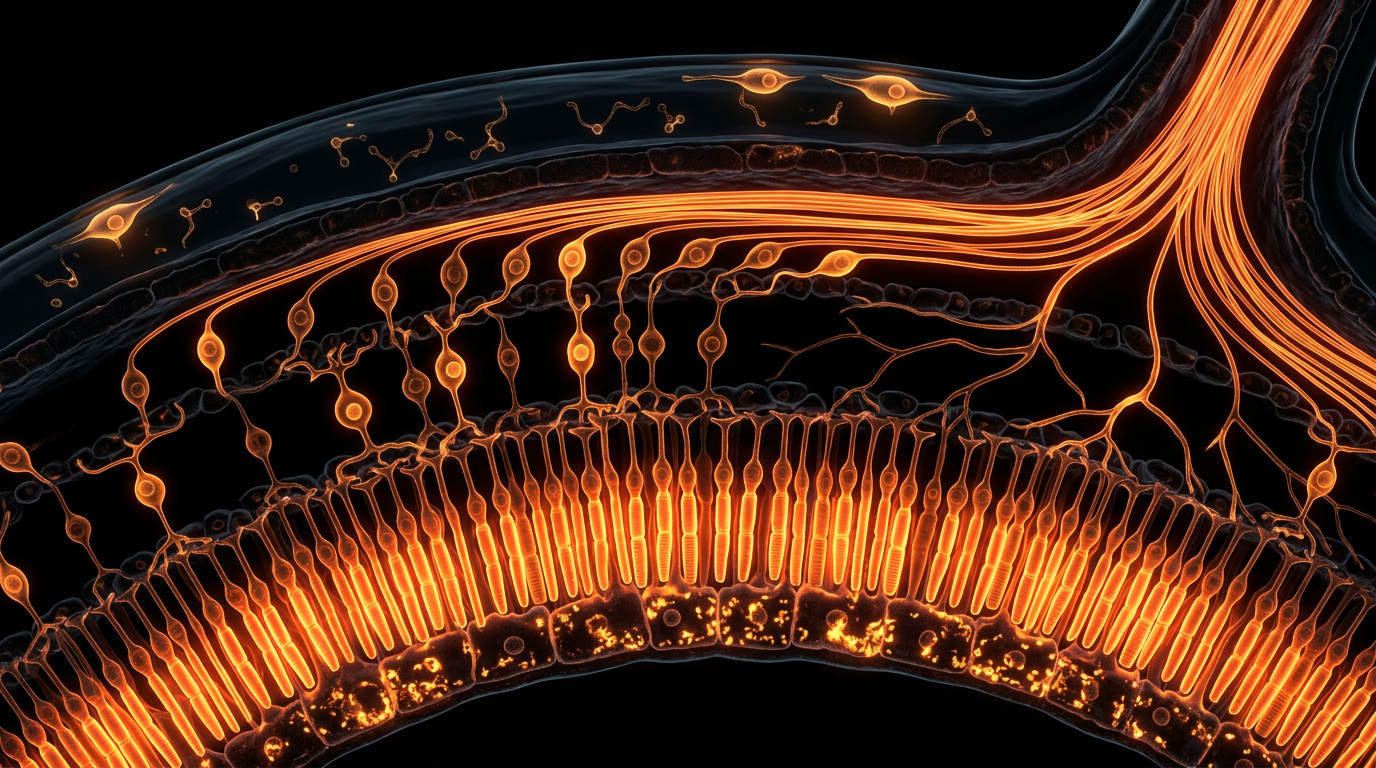
Beyond the macro-mechanics of eye growth, screen time exerts a profound toll on the cellular architecture of the retina, particularly the Retinal Pigment Epithelium (RPE) and the photoreceptors.
Mitochondrial Dysfunction and Oxidative Stress
The retina is one of the most metabolically active tissues in the human body, possessing a higher concentration of mitochondria than almost any other tissue. These mitochondria are highly sensitive to specific wavelengths of light.
Digital screens are "blue-heavy." They emit a concentrated spike in the 435–450 nm range, often referred to as High-Energy Visible (HEV) light. Unlike the broad, balanced spectrum of the sun—which includes protective Near-Infrared (NIR) light—LED screens provide a narrow, aggressive stimulus. HEV light penetrates deep into the eye, reaching the retina and triggering the production of Reactive Oxygen Species (ROS).
In children, the lens is exceptionally clear, meaning it lacks the protective "yellowing" that occurs in adults. This allows a much higher percentage of damaging HEV light to hit the macula. Over time, this oxidative stress damages the mitochondrial membranes, leading to cellular fatigue and, eventually, the early onset of degenerative changes traditionally seen only in the elderly.
The Role of Melanopsin
Within the retina, we have specialised cells called Intrinsically Photosensitive Retinal Ganglion Cells (ipRGCs). These cells contain melanopsin, a photopigment specifically tuned to blue light. These cells do not help us "see" in the traditional sense; instead, they send signals directly to the Suprachiasmatic Nucleus (SCN), the body’s master clock.
When a child is exposed to screen light in the evening, these melanopsin cells signal the brain that it is midday. This suppresses the release of melatonin from the pineal gland. Melatonin is not just a "sleep hormone"; it is a potent antioxidant and DNA repair molecule. By suppressing melatonin, screens deprive the child’s developing brain and eyes of their primary nightly recovery mechanism.
Callout Fact 2: A single hour of screen exposure in the evening can suppress melatonin production in a child by up to 90%, significantly more than the 50% suppression seen in adults.
Environmental Threats and Biological Disruptors
The "physiological cost" is not just about what is in the screen, but what the screen replaces. We call this the Environmental Displacement Effect.
The Flicker Effect and PWM
Most modern LED screens (phones, tablets, and laptops) control brightness using Pulse Width Modulation (PWM). This means the backlight is not actually "dimmed"; it is turned on and off hundreds of times per second. While this is too fast for the conscious mind to perceive, the nervous system and the retina can detect the "flicker."
This rapid flickering forces the visual system to constantly re-adjust, leading to neurological fatigue. In children, whose nervous systems are still myelinating (insulating), this constant "strobe" effect can manifest as irritability, headaches, and a decreased ability to maintain focus on non-digital tasks (like reading a physical book).
The Monochromatic Trap
Natural light is a continuous spectrum. Screens are "trichromatic," composed of red, green, and blue spikes. This creates a state of chromatic aberration where the eye struggles to find a single point of focus. To the brain, the image on a screen is never truly "sharp" in the way a physical object is. The constant micro-adjustments required to resolve this "digital blur" lead to what is clinically known as Computer Vision Syndrome (CVS).
Spectral Malnutrition
We must view light as a nutrient. Just as a child requires a balance of macronutrients for physical growth, the eye requires a balance of spectral wavelengths for ocular health.
- Red and Near-Infrared (600nm - 1000nm): Abundant in sunlight, these wavelengths promote mitochondrial healing and blood flow.
- Blue (400nm - 490nm): Promotes alertness but induces oxidative stress in isolation.
The digital childhood is a state of "spectral malnutrition"—an excess of "junk" blue light and a total deficiency of "healing" red and infrared light.
Callout Fact 3: The UK’s Royal College of Ophthalmologists has noted a sharp increase in "pseudo-myopia"—a temporary locking of the eye's focusing muscle—directly linked to the increased digitisation of primary school curriculums.
The Cascade: From Exposure to Disease
The physiological cost of screen time is not a single event, but a cascade of biological failures that accumulate over time.
- Stage 1: Accommodative Spasm (The "Lock"). The ciliary muscle becomes "stuck" in a near-focus state. The child complains of blurred distance vision after using a tablet. This is often misdiagnosed as permanent myopia and "corrected" with glasses, which only accelerates the problem.
- Stage 2: Axial Elongation (The "Stretch"). In response to the chronic near-signal and lack of outdoor dopamine, the eyeball physically grows too long. This is "true" myopia.
- Stage 3: Scleral Thinning. As the eye elongates, the tissues (the retina, choroid, and sclera) are stretched thin. Think of a balloon being inflated; the more it stretches, the thinner and more fragile the walls become.
- Stage 4: Pathological Myopia (The "Crisis"). When the eye elongates beyond a certain point (typically an axial length of 26mm or more), the risk of "blindness-causing" complications increases exponentially. These include:
- Retinal Detachment: The thinned retina peels away from the back of the eye.
- Myopic Maculopathy: Damage to the central vision area due to stretching.
- Glaucoma: Increased pressure and optic nerve damage due to the structural changes in the elongated eye.
Callout Fact 4: A child who develops myopia before the age of 10 is at a significantly higher risk of "High Myopia" (over -6.00 dioptres), which carries a 40% lifetime risk of permanent vision loss.
What the Mainstream Narrative Omits
The mainstream health narrative in the UK often frames screen time as a "parenting" or "behavioural" issue. This is a profound oversimplification that omits three critical biological truths.
1. The "Blue Light Filter" Fallacy
Many parents believe that "Night Mode" or blue-light-blocking glasses solve the problem. They do not. While they may slightly reduce oxidative stress and help with melatonin, they do nothing to address static accommodation or lack of lux intensity. A child wearing blue-light glasses while staring at a tablet for four hours is still signaling their eye to elongate. The "filter" is a band-aid on a structural wound.
2. The Educational Industrial Complex
There is a massive, corporate-driven push to digitise UK classrooms. Tablets are marketed as "essential learning tools," yet there is almost no discussion regarding the biological cost of this shift. We are replacing physical textbooks (which reflect ambient light and provide a stable focal plane) with emissive screens (which project light and flicker). The mainstream narrative omits the fact that paper-based learning is biologically superior for the developing eye.
3. The Peripheral Deficit
Our eyes are designed to perceive a wide peripheral field. Screens "tunnel" the child’s vision, creating a state of peripheral deprivation. Research suggests that peripheral stimulation (what we see out of the "corner of our eye") is essential for regulating eye growth. By confining a child's visual world to a 10-inch rectangle, we are starving the peripheral retina of the signals it needs to maintain proper eye shape.
The UK Context
The United Kingdom presents a unique "perfect storm" for pediatric visual decline.
- The Weather Factor: The UK’s temperate, often overcast climate means children naturally spend less time in high-intensity sunlight. When this is coupled with high screen use, the "dopamine stop-signal" for eye growth is almost never fully activated.
- The Urban Jungle: Many UK children living in densely populated cities like London, Birmingham, or Manchester have limited access to "distant horizons." The visual environment is "closed in" by buildings, further reinforcing near-work biology.
- NHS Strain: The NHS is currently facing a massive backlog in pediatric ophthalmology. Many children are not receiving their first comprehensive eye exam until they are already symptomatic, by which time the axial elongation has already occurred.
- The "Digital Schoolhouse": The UK government’s "EdTech" strategy has seen a record number of laptops and tablets distributed to schools. While intended to bridge the "digital divide," it has inadvertently created a "biological divide" where children from all backgrounds are now subjected to the same ocular stressors.
Callout Fact 5: Recent studies of UK schoolchildren show that myopia rates have doubled in the last 50 years, with the age of onset becoming progressively younger—now frequently occurring in children as young as six or seven.
Protective Measures and Recovery Protocols
As biological researchers at INNERSTANDING, we do not advocate for a total "return to the stone age." However, we do advocate for a radical shift in how we manage the "biological interface" between children and technology. We propose the following Ocular Recovery Protocol.
1. The 10,000 Lux Mandate
The most powerful tool for preventing myopia is not a gadget, but the sun.
- Protocol: Children should spend a minimum of 120 minutes per day outdoors in daylight. This is effective even if it is a cloudy day in the UK, as outdoor lux levels remain significantly higher than indoors.
- Biology: This triggers the necessary retinal dopamine release to "brake" eye growth.
2. The 20-20-20-20 Rule
We have expanded the traditional rule to include a crucial fourth step.
- Every 20 minutes, look at something 20 feet away, for at least 20 seconds, and blink 20 times.
- Biology: This relaxes the ciliary muscle, resets the focal plane, and re-lubricates the cornea (as blink rates drop by 60-70% when looking at screens).
3. Spectral Hygiene
- Ambient Lighting: Never allow a child to use a screen in a dark room. The contrast between the bright screen and dark surroundings increases retinal stress. Use "Full Spectrum" LED bulbs in the home that mimic the solar spectrum.
- The "Two-Foot" Rule: Ensure screens are at least 50-60cm away from the eyes. The closer the screen, the higher the "accommodative demand."
- Screen Height: Position the screen below eye level. This forces the upper eyelid to cover more of the eye, reducing evaporation of the tear film and preventing "Dry Eye."
4. Nutritional Support for the Retinal Shield
The eye can be "armoured" from the inside out through specific phytonutrients.
- Lutein and Zeaxanthin: These are "internal sunglasses." They accumulate in the macula and physically filter blue light before it reaches the photoreceptors. Found in spinach, kale, and orange peppers.
- Anthocyanins: Found in bilberries and blackcurrants (common in the UK), these promote blood flow to the retina and speed up the regeneration of visual purple (rhodopsin).
- Astaxanthin: One of the few antioxidants that can cross the blood-retinal barrier, providing potent mitochondrial protection.
5. Digital Fasting and the "Paper First" Policy
- The 2-Hour Buffer: No screens at least two hours before bed. This allows the natural melatonin rise to occur.
- Physical Books: Encourage "analog" reading for pleasure. The texture of paper and the lack of flicker provide a "biological rest" for the visual system.
Summary: Key Takeaways
The "Digital Childhood" is not a benign evolution of human culture; it is a direct challenge to our biological heritage. The physiological cost of screen time is paid in the currency of permanent structural changes to the eye.
- The Eye Elongates: Chronic near-work and lack of sunlight physically stretch the eyeball, leading to permanent myopia.
- Mitochondrial Fatigue: High-energy blue light induces oxidative stress in the retina, damaging the cellular "powerhouses" and potentially leading to long-term degeneration.
- Circadian Disruption: Screen use suppresses melatonin, interfering with the child’s fundamental repair and recovery processes.
- The UK Crisis: Our climate and educational policies have made UK children particularly vulnerable to this "myopia pandemic."
- The Solution is Biological: To mitigate the damage, we must prioritise outdoor light, implement strict focal breaks, and provide the nutritional building blocks necessary for ocular resilience.
As we move forward, we must stop asking how we can fit more technology into children's lives and start asking how we can protect the biological integrity of their vision. The "Digital Childhood" may be inevitable, but the "Visual Impairment" that currently follows it does not have to be. We must act now, before the "stretch" becomes a "break."
Author: Senior Biological Researcher, INNERSTANDING Field: Eye Health & Visual Science Focus: Pediatric Ocular Biomechanics and Spectral Biology
This article is provided for informational and educational purposes only. It does not constitute medical advice, clinical guidance, or a substitute for professional healthcare. Information reflects cited research at time of publication. Always consult a qualified healthcare professional before acting on any health information.
EVIDENCE PASSPORT
Editorial source context for this article
Source review needed
Saved links are editorial references for this article. They may support specific claims rather than every sentence. Open and assess each source in context. This passport does not independently verify them.
Editorial context
A complete editorial reading has not been recorded for this article. Source links remain available for you to open and assess directly.
Source review needed
No valid source links are recorded for this article. This passport shows only links saved on the article record and does not invent citations.
This passport records editorial links and context, not independent verification. Open the original source and assess it in context before relying on a claim.
Medical Disclaimer
The information in this article is for educational purposes only and does not constitute medical advice, diagnosis, or treatment. Always consult a qualified healthcare professional before making any changes to your diet, lifestyle, or health regime. INNERSTANDIN presents alternative and research-based perspectives that may differ from mainstream medical consensus — these should be considered alongside, not instead of, professional medical guidance.
Read Full DisclaimerContinue the thread
Keep this question moving.
Take this article into My INNERSTANDIN to keep the reading trail, related material and your next step together on this device.