
Sensory Processing Issues in Children
Updated May 2026
Understanding how neurodivergent children process sensory information and the impact on their daily lives.
Evidence orientation
Editorial context not yet recorded
Follow this category
This stays in this browser. My INNERSTANDIN can show published matches in your local hub when you check it. It does not send email, push, or alert notifications.
Local learning review
A private browser aid for revisiting ideas. It is not an alert or a health recommendation.
Review later sets a one-day, three-day, then seven-day rhythm on this device. Choose it only when you want to revisit this article.
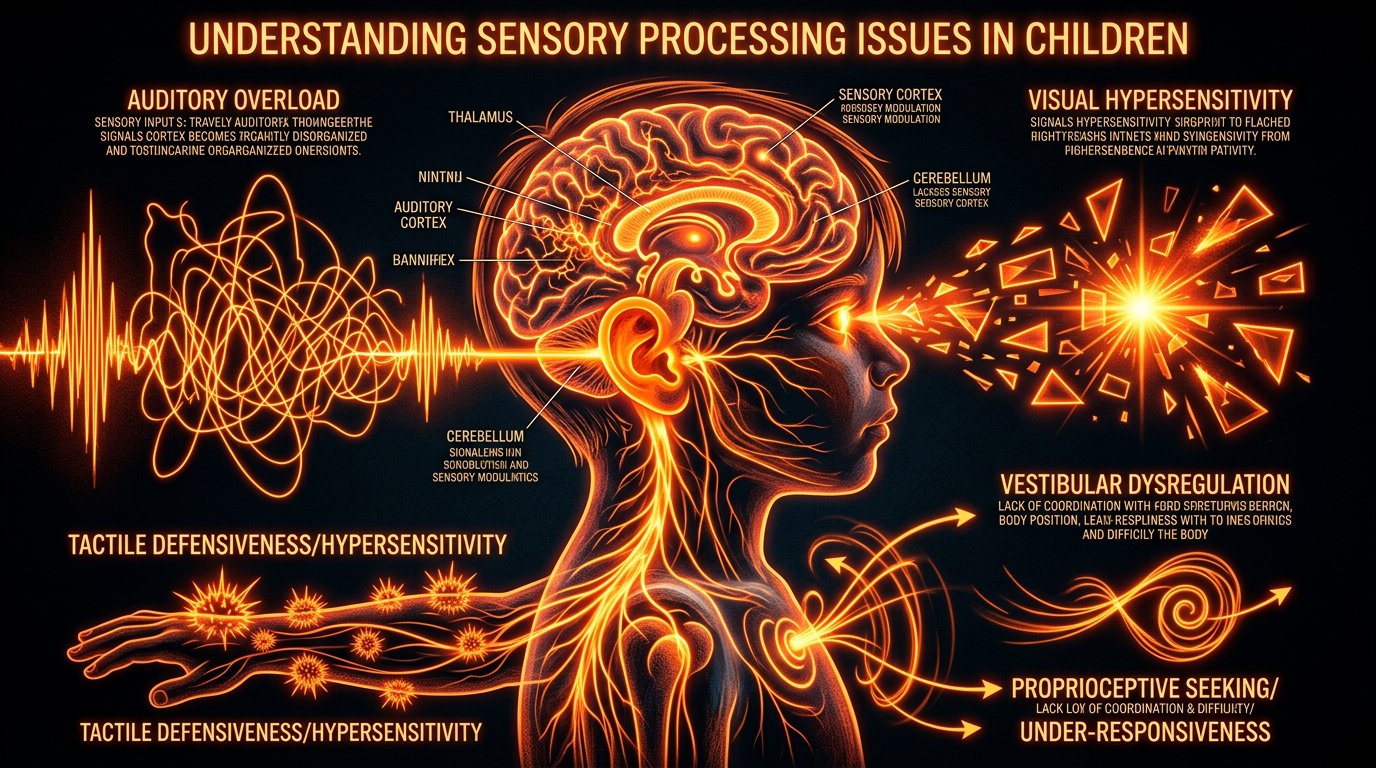
For most of us, the world is a manageable stream of information. We hear a car go by, we feel the fabric of our shirt, we smell coffee brewing, and our brains seamlessly categorise these inputs, allowing us to focus on the task at hand. However, for a significant number of children—particularly those with ADHD and other neurodevelopmental conditions—the world is not a stream, but a tidal wave.
Sensory processing issues (often referred to in clinical circles as Sensory Processing Disorder or SPD, though not yet a standalone diagnosis in the DSM-5) affect how the brain receives, organises, and responds to information coming in through the senses. In the United Kingdom, where classroom sizes are often large and sensory-rich environments are the norm, understanding these difficulties is crucial for supporting a child’s development, education, and emotional well-being.
This article explores the mechanics of sensory processing, the link with neurodiversity, the UK diagnostic pathway, and practical strategies for home and school.
1. The Eight Senses: Beyond the Big Five
To understand sensory processing, we must first expand our definition of "the senses." While we are taught about the five basic senses in school, humans actually rely on eight distinct sensory systems to navigate the world.
The External Senses
- Visual (Sight): Not just clarity of vision, but how the brain interprets light, colour, and movement.
- Auditory (Hearing): The ability to filter out background noise and focus on specific sounds (like a teacher’s voice).
- Olfactory (Smell): Processing scents, which are tied closely to the brain’s emotional centres.
- Gustatory (Taste): Interpreting flavours and textures in the mouth.
- Tactile (Touch): Detecting pressure, vibration, temperature, and pain.
The Internal (Hidden) Senses
- Vestibular (Balance and Movement): Located in the inner ear, this tells us where our head is in space and helps us maintain balance and posture.
- Proprioception (Body Awareness): Receptors in our muscles and joints that tell us where our body parts are and how much force to use (e.g., how hard to grip a pencil).
- Interoception (Internal State): The ability to feel what is happening inside the body, such as hunger, thirst, the need for the toilet, or a racing heartbeat.
When a child has sensory processing issues, one or more of these systems is either "hypersensitive" (over-responsive) or "hyposensitive" (under-responsive).
2. Sensory Modulation: Highs and Lows
Sensory processing issues generally fall into three patterns, though a child can fluctuate between them depending on the day, the environment, or their stress levels.
The Over-Responder (Hypersensitive)
These children feel "too much." A flickering fluorescent light in a classroom might feel like a strobe light. The scratchy label on a school jumper might feel like sandpaper. These children often live in a state of "fight or flight," as their nervous system perceives harmless stimuli as threats.
- Common signs: Covering ears at loud noises, extreme pickiness with food textures, avoiding messy play, or becoming distressed in crowds.
The Under-Responder (Hyposensitive)
These children feel "too little." They may have a high pain threshold or fail to notice when their face is messy or their clothes are twisted. Because they aren't getting enough input from their environment, they may seem withdrawn or "in a fog."
- Common signs: Not responding when called, failing to notice bruises or scrapes, or a lack of reaction to extreme temperatures.
The Sensory Seeker
Seeking is a form of under-responsiveness where the child actively looks for intense sensory input to "wake up" their nervous system or find a sense of calm.
- Common signs: Crashing into furniture, constant fidgeting, chewing on sleeves, or spinning in circles without getting dizzy.
3. The ADHD and Neurodevelopmental Connection
In the UK, sensory processing issues are most frequently discussed within the context of the "neurodevelopmental umbrella," which includes ADHD, Autism Spectrum Disorder (ASD), and Dyspraxia (Developmental Coordination Disorder).
The ADHD Link
Research suggests that up to 60% of children with ADHD also experience significant sensory processing challenges. There is a profound overlap in symptoms:
- Distractibility: Is the child distracted by their own thoughts (ADHD) or by the hum of the refrigerator in the next room (Sensory)?
- Impulsivity: Is the child jumping off the sofa because they lack impulse control (ADHD) or because their proprioceptive system is starving for input (Sensory)?
For a child with ADHD, the brain’s "filter" is already porous. When you add sensory over-responsivity, the child becomes neurologically overloaded very quickly, leading to the "meltdowns" or "shutdowns" often mistaken for "naughty" behaviour.
Sensory vs. Behaviour
It is vital to distinguish between a "tantrum" and a "sensory meltdown." A tantrum is goal-oriented (e.g., wanting a toy). A meltdown is a neurological collapse where the child has lost control because their brain can no longer process the environment. Punishment does not work for meltdowns; only regulation and safety do.
4. The Impact on Daily Life in the UK
The School Environment
The British primary school classroom is often a sensory minefield. Bright displays on every wall, the scraping of chairs on hard floors, the smell of the school canteen, and the unpredictable nature of the playground can make learning nearly impossible for a sensory-sensitive child.
- Executive Function: When a child is using all their mental energy to ignore a buzzing light, they have no "bandwidth" left for maths or literacy.
The Home Front
Sensory issues often peak during "transition times." The morning rush (dressing in uncomfortable uniforms) and the evening wind-down (bath time and hair washing) are common flashpoints. Many UK parents report the "after-school restraint collapse," where a child holds it together all day at school only to explode the moment they reach the safety of home.
Social and Emotional Well-being
Children who struggle with proprioception may be seen as "clumsy" or "aggressive" because they play too roughly without meaning to. This can lead to social isolation and low self-esteem.
5. The Diagnostic Journey in the UK
Navigating the healthcare system for sensory issues in the UK can be complex. Unlike ADHD or Autism, "Sensory Processing Disorder" is not currently a formal diagnosis in the ICD-11 (used by the NHS). However, sensory difficulties are officially recognised as a core symptom of Autism and are widely acknowledged by clinicians.
The NHS Route
- The GP/Health Visitor: The first port of call. You should request a referral to a Paediatric Occupational Therapist (OT).
- The Role of the OT: Occupational Therapists are the lead professionals for sensory processing. They assess how sensory issues impact "occupations"—the things a child needs to do every day (playing, eating, dressing, schoolwork).
- Wait Times: It is important to be realistic. NHS waiting lists for OT assessments can be long, sometimes exceeding 12–18 months depending on the local authority.
The Private Route
Many UK parents choose to see a private HCPC-registered Occupational Therapist for a "Sensory Integration" assessment. While this can be costly (ranging from £500 to £1,500 for a full report), it often provides a much more detailed breakdown of the child’s sensory profile and quicker access to support.
Assessment Tools
Clinicians typically use the Sensory Profile 2 or the Sensory Processing Measure (SPM)—questionnaires completed by parents and teachers—alongside clinical observations of the child’s movement and reactions.
6. Strategies for Support: The "Sensory Diet"
The gold-standard intervention for sensory issues is a Sensory Diet. This is not about food; it is a bespoke activity plan designed to provide the specific sensory input a child needs to stay regulated throughout the day.
Proprioceptive Activities ("Heavy Work")
Heavy work is the most "organising" type of input for the brain. It involves pushing, pulling, or carrying weight.
- At Home: Helping carry the shopping, pushing a heavy vacuum cleaner, wall pushes, or "animal walks" (like crawling like a bear).
- At School: Carrying a pile of books to the library, wearing a slightly weighted lap pad, or using a "fidget" during assembly.
Vestibular Activities
- For Seekers: Swings, trampolines, and rocking chairs.
- For Avoiders: Slow, linear movement (rather than spinning) and ensuring their feet are always touching the floor to feel secure.
Tactile Strategies
- Clothing: Seamless socks (available from UK retailers like Sensory Smart), removing tags, or using soft bamboo fabrics.
- Messy Play: Gradually introducing textures like shaving foam, dry rice, or "slime" to desensitise the tactile system.
Auditory Adjustments
- Ear Defenders: Brands like Peltor Kid or Loop earplugs are popular in the UK for school discos, fireworks, or busy shopping centres.
- White Noise: Using a fan or a white noise machine at night to mask sudden house noises.
7. Education, EHCPs, and the Law
In the UK, children with sensory processing issues are protected under the Equality Act 2010 and the SEND (Special Educational Needs and Disability) Code of Practice.
SEN Support
Schools have a duty to make "reasonable adjustments." This might include:
- Allowing a child to leave lessons 5 minutes early to avoid crowded corridors.
- Providing a "work workstation" with visual barriers.
- Allowing the use of ear defenders or "chewy" necklaces (chewigems).
- Providing a "sensory break" or access to a "nurture room."
Education, Health and Care Plans (EHCP)
If a child’s sensory needs are so significant that they cannot access the curriculum even with standard school support, an EHCP may be necessary. An EHCP is a legal document that binds the Local Authority to provide specific support.
- Tip: When applying for an EHCP, ensure the OT report explicitly states the "provision" required (e.g., "The child requires 30 minutes of sensory integration therapy per week delivered by a trained TA").
8. Interoception: The "Inner" Challenge
One of the most overlooked aspects of sensory processing in the UK clinical landscape is interoception. If a child cannot feel their internal signals, they may:
- Not realise they are hungry until they are "hangry" and having a meltdown.
- Have delayed toilet training or frequent accidents because they don't feel the "full bladder" signal.
- Not realise they are getting angry until they have already hit someone.
"Strategies for Interoception:"
- Body Mapping: Helping the child link physical sensations to emotions (e.g., "My heart is beating fast, that means I might be nervous").
- Scheduled Breaks: Prompting the toilet or a snack on a schedule rather than waiting for the child to ask.
9. The Parent’s Journey: Burnout and Advocacy
Raising a child with sensory processing issues is exhausting. The constant "scanning" of the environment to pre-empt triggers is a form of hyper-vigilance that can lead to parental burnout.
The "Double Empathy" Problem
It is often hard for neurotypical parents to understand why a "small" thing, like a change in the brand of baked beans, causes a total collapse. It is important to remember: The child isn't giving you a hard time; they are having a hard time.
Support Networks
In the UK, several organisations offer invaluable support:
- National Autistic Society (NAS): Provides extensive guides on sensory issues.
- ADHD UK & ADHD Foundation: Offer webinars and resources for parents.
- Sensory Integration Education: A UK-based organisation for both professionals and parents.
- Local "Parent Carer Forums": Every UK local authority has one; they are excellent for navigating local SEND services.
10. Summary and Outlook
Sensory processing is the foundation upon which all other development is built. If a child’s sensory system is dysregulated, they cannot attend to lessons, they cannot socialise effectively, and they cannot manage their emotions.
By shifting our perspective—from seeing "bad behaviour" to seeing "sensory distress"—we change the narrative for the child. In the UK, while the system can be slow and bureaucratic, the level of understanding in schools and the medical community is growing every year.
With the right "sensory lens," we can adapt the environment to fit the child, rather than forcing the child to break themselves against an environment that doesn't fit them. Whether it’s through a bespoke sensory diet, an EHCP, or simply buying seamless socks, every small adjustment reduces the child’s neurological load, allowing their true personality and potential to shine through.
Quick Reference: Sensory Red Flags for Parents
| Sense | Sign of Over-Responsivity (Avoidance) | Sign of Under-Responsivity (Seeking) | | :--- | :--- | :--- | | Touch | Dislikes hugs, hates hair-washing, picky with clothes. | Touches everything, high pain threshold, messy face. | | Noise | Covers ears at hand dryers/vacuums. | Makes own loud noises, loves volume, ignores names. | | Movement | Fearful of swings/slides, gets motion sick. | Can't sit still, spins, rocks, "thrill-seeker." | | Proprioception | Moves stiffly, avoids physical play. | Crashes into things, bites objects/sleeves, "clumsy." | | Visual | Squints in sunlight, bothered by bright posters. | Loves flickering lights, stares at moving objects. |
Authoritative Resources for UK Families
- The Royal College of Occupational Therapists (RCOT): Information on how OT helps.
- IPSEA (Independent Provider of Special Education Advice): Vital for legal advice on EHCPs and school support.
- Contact (For families with disabled children): Provides a helpline for UK parents navigating the SEND system.
Disclaimer: This article is for informational purposes and does not constitute medical advice. If you are concerned about your child’s development, please consult your GP or a qualified Occupational Therapist.
This article is provided for informational and educational purposes only. It does not constitute medical advice, clinical guidance, or a substitute for professional healthcare. Information reflects cited research at time of publication. Always consult a qualified healthcare professional before acting on any health information.
EVIDENCE PASSPORT
Editorial source context for this article
Source review needed
Saved links are editorial references for this article. They may support specific claims rather than every sentence. Open and assess each source in context. This passport does not independently verify them.
Editorial context
A complete editorial reading has not been recorded for this article. Source links remain available for you to open and assess directly.
Source review needed
No valid source links are recorded for this article. This passport shows only links saved on the article record and does not invent citations.
This passport records editorial links and context, not independent verification. Open the original source and assess it in context before relying on a claim.
Medical Disclaimer
The information in this article is for educational purposes only and does not constitute medical advice, diagnosis, or treatment. Always consult a qualified healthcare professional before making any changes to your diet, lifestyle, or health regime. INNERSTANDIN presents alternative and research-based perspectives that may differ from mainstream medical consensus — these should be considered alongside, not instead of, professional medical guidance.
Read Full DisclaimerContinue the thread
Keep this question moving.
Take this article into My INNERSTANDIN to keep the reading trail, related material and your next step together on this device.
Explore this in the Body Map
See where this hits your biology. Interactive anatomy, threats, and protective protocols.
Dig deeper in the Library
Free, longform PDF volumes that go beyond headlines into mechanisms and references.