
Silent Streams: Mapping the Surge of Raw Sewage Discharges in the Thames Basin
Updated May 2026
An analysis of environmental data revealing the frequency of untreated sewage discharges into the River Thames and the resulting ecological damage to local biodiversity.
Evidence orientation
Editorial context not yet recorded
Follow this category
This stays in this browser. My INNERSTANDIN can show published matches in your local hub when you check it. It does not send email, push, or alert notifications.
Local learning review
A private browser aid for revisiting ideas. It is not an alert or a health recommendation.
Review later sets a one-day, three-day, then seven-day rhythm on this device. Choose it only when you want to revisit this article.
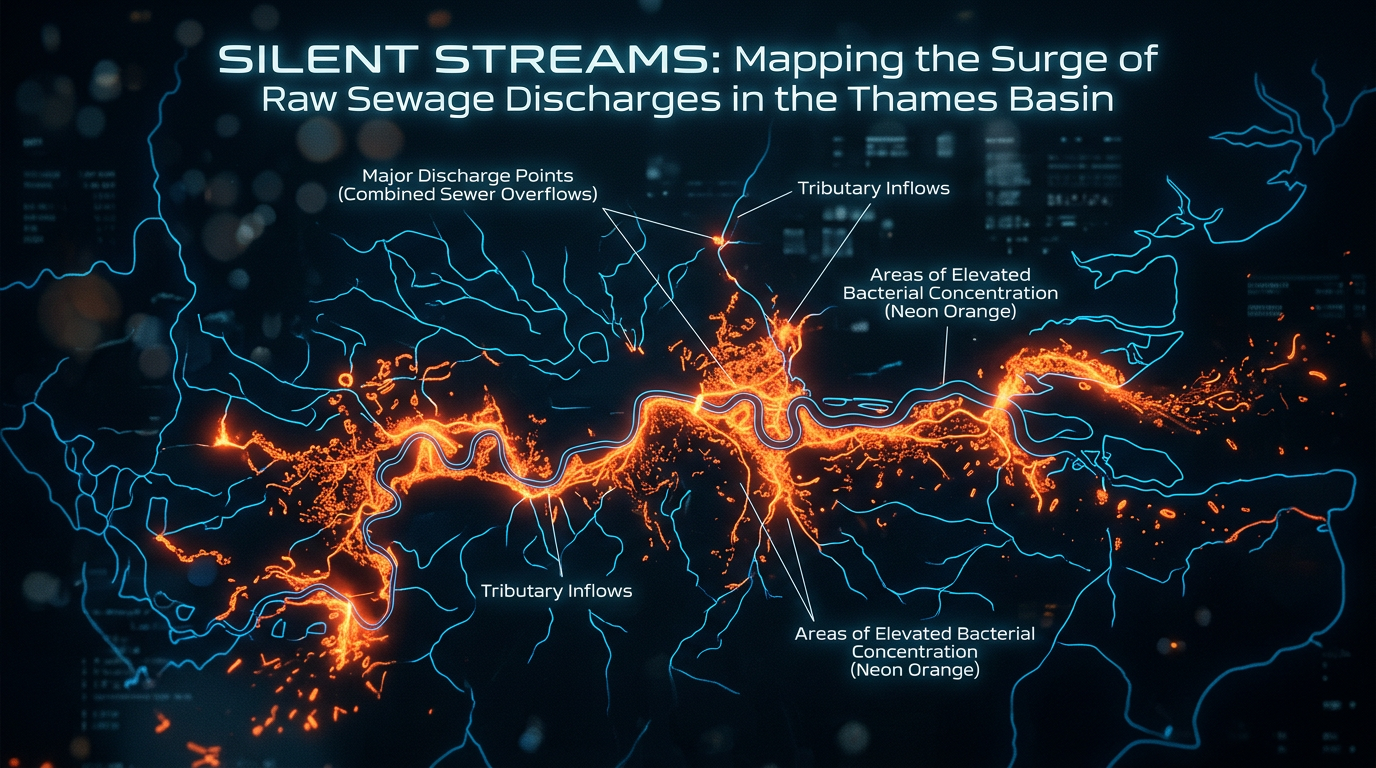
Silent Streams: Mapping the Surge of Raw Sewage Discharges in the Thames Basin
The River Thames has long served as the arterial lifeline of Southern England, a symbol of resilience and the historical engine of British commerce. However, beneath its shimmering surface lies a developing ecological catastrophe. While the "Great Stink" of 1858 was resolved by the engineering marvels of Joseph Bazalgette, the 21st century has ushered in a more insidious, invisible crisis. Today, the Thames Basin is being subjected to a relentless bombardment of untreated effluent, pharmaceutical residues, and industrial chemical cocktails.
This research piece explores the systemic surge in raw sewage discharges by Thames Water, the biological mechanisms of aquatic degradation, and the urgent protocols required to salvage the United Kingdom’s most iconic waterway.
1. The Quantitative Crisis: Data of Disruption
The scale of sewage discharge within the Thames Basin is no longer a matter of periodic "accidental" spills; it is a systemic operational reality. Under the guise of "Combined Sewer Overflows" (CSOs)—mechanisms designed to prevent flooding during extreme rainfall—unfiltered human waste is being diverted directly into the river system with alarming frequency.
According to Environment Agency data, Thames Water was responsible for 16,939 separate sewage spill events in 2023 alone, representing a total discharge duration of 196,414 hours. This constitutes a 105% increase in spill duration compared to the previous year.
The disparity between corporate profit and infrastructure investment has reached a critical tipping point. While the Victorian architecture of the London sewer system remains a feat of engineering, it was never intended to support a megalopolis of nine million people, nor was it designed to withstand the increasingly volatile precipitation patterns of a changing climate.
The Geography of Contamination
- The Upper Thames: Nutrient loading from agricultural runoff combined with sewage from rural treatment works is leading to massive algal blooms.
- The Tidal Thames: Industrial-scale discharges in the Greater London area are creating "hypoxic zones" where dissolved oxygen levels plummet.
- Tributaries (The River Lea & Colne): These "chalk streams," globally rare ecosystems, are being decimated by high concentrations of phosphates and nitrates.
2. Biological Mechanisms: The Physiology of a Dying River
When raw sewage enters a lotic (flowing water) ecosystem, it initiates a cascade of destructive biological processes. This is not merely "dirt" in the water; it is a fundamental disruption of the river’s metabolic balance.
Biochemical Oxygen Demand (BOD)
The primary mechanism of immediate fish kills following a sewage spill is the spike in Biochemical Oxygen Demand. Raw sewage is rich in organic matter. As aerobic bacteria rush to decompose this matter, they consume the Dissolved Oxygen (DO) available in the water column.
- Hypoxia: When DO levels fall below 5mg/L, aquatic life begins to suffocate.
- Anoxia: At 0mg/L, the river becomes a "dead zone," supporting only anaerobic bacteria that produce toxic hydrogen sulphide.
The Nitrogen-Phosphorus Feedback Loop
Sewage is a concentrated source of nitrates and phosphates. While these are essential nutrients, their overabundance triggers eutrophication. This leads to the rapid proliferation of cyanobacteria (blue-green algae). These blooms block sunlight from reaching submerged macrophytes (aquatic plants), leading to a total collapse of the primary production layer of the food web.
Pathogenic Proliferation
The Thames is currently acting as a vector for zoonotic and human pathogens. Monitoring near outfalls has consistently detected:
- Escherichia coli (E. coli): Indicative of recent faecal contamination.
- Norovirus and Hepatitis A: Viral loads that persist in sediment.
- Intestinal Enterococci: Highly resilient bacteria that pose significant risks to human recreational users.
3. Environmental Disruptors: The Chemical "Cocktail Effect"
Perhaps more concerning than the visible waste is the "silent" chemical load. Traditional wastewater treatment plants (WWTPs) are not designed to filter out modern synthetic compounds. When raw sewage is bypassed via CSOs, these substances enter the Thames Basin in their most potent forms.
Endocrine Disrupting Chemicals (EDCs)
The presence of synthetic hormones, particularly 17α-ethinylestradiol (from oral contraceptives), has been linked to the feminisation of fish populations in the Thames. Male roach and perch have been found producing vitellogenin (an egg-yolk protein) and, in some cases, developing eggs in their testes. This "intersex" phenomenon threatens the reproductive viability of entire species.
The Pharmaceutical Burden
The Thames Basin acts as a sink for a vast array of metabolised and un-metabolised drugs. Research indicates significant concentrations of:
- SSRIs (Antidepressants): Altering the behaviour and predator-avoidance instincts of aquatic invertebrates.
- NSAIDs (Ibuprofen/Diclofenac): Causing renal failure in certain fish species.
- Antimicrobials: Contributing to the global crisis of Antimicrobial Resistance (AMR). The river is becoming a "genetic swap-shop" where bacteria exchange resistance genes in the presence of sub-lethal antibiotic concentrations.
Microplastics and PFAS
Sewage contains high volumes of microfibres from synthetic clothing and "forever chemicals" (PFAS). These do not biodegrade. They bioaccumulate up the food chain—from daphnia to macro-invertebrates, to fish, and eventually to the avian and mammalian predators that rely on the Thames for sustenance.
4. Systemic Failures and Corporate Accountability
The surge in discharges is frequently blamed on "exceptional rainfall." However, internal data suggests that "dry-spilling"—the illegal discharge of sewage during periods of little to no rain—is becoming a routine method of managing capacity issues without incurring the costs of proper treatment.
In 2023, it was revealed that Thames Water had failed to accurately report thousands of hours of discharges, a lack of transparency that masks the true extent of the ecological "cocktail effect" on the Thames Estuary.
Infrastructure Neglect
- Decapitalisation: Since privatisation, billions have been paid out in dividends while the underlying pipe network has aged beyond its functional lifespan.
- Permit Creep: Regulatory agencies have been accused of "regulatory capture," issuing permits that allow for excessive discharges under the guise of operational necessity.
5. Recovery Protocols: A Roadmap to Restoration
The restoration of the Thames Basin requires more than incremental changes; it necessitates a paradigm shift in how we value water as a public asset rather than a corporate commodity.
Technical and Engineering Solutions
The London Tideway Tunnel (the "Super Sewer") is a significant step forward, designed to capture 95% of the spills in the central London reach. However, this does not address the issues in the Upper Thames or the tributaries.
- Separated Sewer Systems: The long-term goal must be the separation of surface rainwater from foul sewage to prevent system overloads.
- Tertiary Treatment Upgrades: Implementing Advanced Oxidation Processes (AOPs) and activated carbon filtration to catch micro-pollutants and EDCs.
Nature-Based Solutions (NbS)
- Integrated Constructed Wetlands (ICWs): Using reed beds and natural filtration to treat "grey water" before it enters the river. Wetlands act as biological kidneys, sequestering carbon and filtering nitrates.
- Riparian Buffer Zones: Mandating 50-metre no-spray/no-build zones along all Thames tributaries to reduce agricultural and urban runoff.
Legal and Policy Reform
- Strict Liability: Moving toward a "Polluter Pays" model where fines for illegal discharges are tethered to corporate turnover, not fixed sums that can be written off as "the cost of doing business."
- Real-Time Monitoring: Mandatory, independent, and publicly accessible AI-driven monitoring of every CSO outfall in the UK.
6. The Human Health Dimension
The contamination of the Thames is not an isolated environmental issue; it is a public health crisis. The rise in "wild swimming" and rowing participation in the Thames has led to a documented increase in gastrointestinal illnesses.
A recent study of the Henley-on-Thames reach, home to the world-famous Royal Regatta, found levels of E. coli up to 10 times higher than those designated "sufficient" by the Environment Agency for bathing water.
The "Silent Streams" are now shouting. The surge in sewage discharges is a symptom of a systemic failure to respect the biological limits of our environment. The Thames Basin is a complex, living organism; to continue treating it as an open sewer is to court an ecological collapse from which there may be no recovery.
The exposure of these truths is the first step toward reclamation. The Thames belongs to the people and the complex web of life it supports—not to the balance sheets of failing infrastructure giants. Through rigorous scientific monitoring, nature-based restoration, and uncompromising legal accountability, the "Silent Streams" can once again become the vibrant, life-giving veins of the British landscape.
This article is provided for informational and educational purposes only. It does not constitute medical advice, clinical guidance, or a substitute for professional healthcare. Information reflects cited research at time of publication. Always consult a qualified healthcare professional before acting on any health information.
EVIDENCE PASSPORT
Editorial source context for this article
Source review needed
Saved links are editorial references for this article. They may support specific claims rather than every sentence. Open and assess each source in context. This passport does not independently verify them.
Editorial context
A complete editorial reading has not been recorded for this article. Source links remain available for you to open and assess directly.
Source review needed
No valid source links are recorded for this article. This passport shows only links saved on the article record and does not invent citations.
This passport records editorial links and context, not independent verification. Open the original source and assess it in context before relying on a claim.
Medical Disclaimer
The information in this article is for educational purposes only and does not constitute medical advice, diagnosis, or treatment. Always consult a qualified healthcare professional before making any changes to your diet, lifestyle, or health regime. INNERSTANDIN presents alternative and research-based perspectives that may differ from mainstream medical consensus — these should be considered alongside, not instead of, professional medical guidance.
Read Full DisclaimerContinue the thread
Keep this question moving.
Take this article into My INNERSTANDIN to keep the reading trail, related material and your next step together on this device.
Dig deeper in the Library
Free, longform PDF volumes that go beyond headlines into mechanisms and references.