
Silver Nanoparticles and Gut Microbiome Depletion
Updated May 2026
Exploring the antimicrobial mechanism of nano-silver used in consumer textiles and its impact on beneficial bacteria. Chronic exposure may lead to irreversible shifts in intestinal ecology.
Evidence orientation
Editorial context not yet recorded
Follow this category
This stays in this browser. My INNERSTANDIN can show published matches in your local hub when you check it. It does not send email, push, or alert notifications.
Local learning review
A private browser aid for revisiting ideas. It is not an alert or a health recommendation.
Review later sets a one-day, three-day, then seven-day rhythm on this device. Choose it only when you want to revisit this article.
Overview
In the silent, microscopic theatre of the human body, a quiet revolution—or perhaps a silent coup—is taking place. Over the last two decades, the proliferation of nanotechnology has transitioned from the realm of speculative science fiction to a ubiquitous reality of industrial manufacturing. At the vanguard of this movement are Silver Nanoparticles (AgNPs). Valued for their potent antimicrobial properties, AgNPs have been integrated into thousands of consumer products, from "odour-resistant" athletic wear and medical dressings to food packaging and domestic appliances.
However, as a senior researcher at INNERSTANDING, I must posit a harrowing truth that the regulatory bodies have been slow to acknowledge: we are currently participating in a global, uncontrolled experiment. While the "silver bullet" of nano-silver is marketed as a pinnacle of hygiene and safety, its impact on the human microbiome—the complex ecosystem of trillions of microbes residing within our gastrointestinal tract—is proving to be nothing short of catastrophic.
The gut microbiome is not merely a collection of passive passengers; it is a metabolic organ in its own right, regulating our immune systems, synthesising vitamins, and modulating the "gut-brain axis." The indiscriminate nature of AgNPs means they do not distinguish between a pathogen on a hospital surface and the beneficial commensal bacteria that facilitate our survival. This article serves as a deep dive into the molecular mechanics of silver-induced depletion, the systemic fallout of chronic exposure, and the regulatory negligence that has allowed this synthetic biological disruptor to infiltrate our very biology.
Key Statistic: Since 2005, the use of silver nanoparticles in consumer products has increased by over 500%, yet long-term epidemiological studies regarding their impact on human gut biodiversity remain virtually non-existent.
The Biology — How It Works
To understand the threat, we must first define the medium. Silver Nanoparticles are particles of silver ranging from 1 to 100 nanometres in size. To put this into perspective, a human hair is approximately 80,000 to 100,000 nanometres wide. This extreme reduction in size confers unique physiochemical properties that bulk silver does not possess.
The primary driver of AgNP toxicity is the high surface-area-to-volume ratio. As silver is reduced to the nanoscale, a significantly higher percentage of its atoms are exposed on the surface, making the material highly reactive.
The Ionic Release (The "Trojan Horse" Effect)
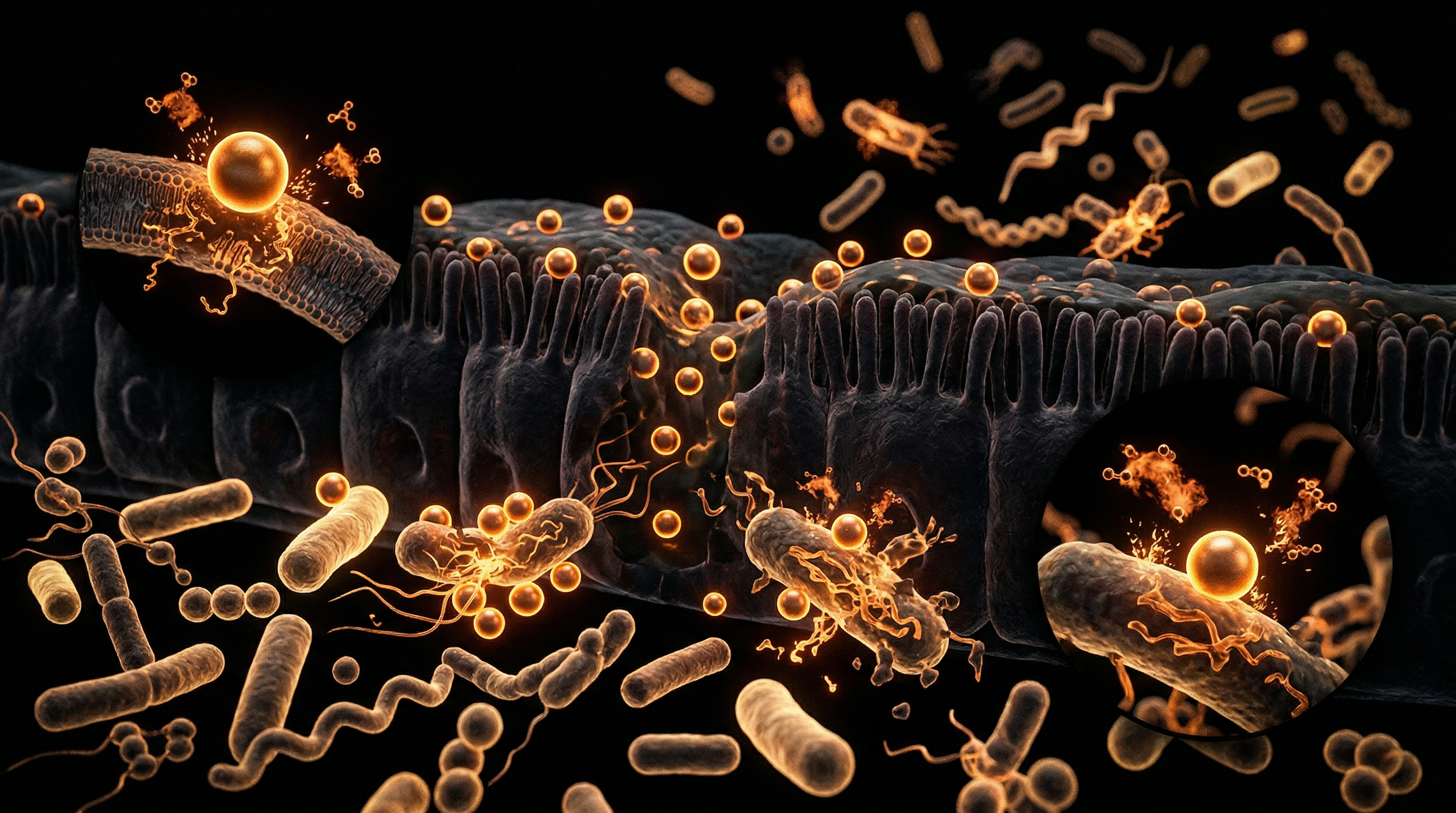
The efficacy of AgNPs as antimicrobials is primarily attributed to the continuous release of silver ions ($Ag^+$). In a process known as the Trojan Horse mechanism, nanoparticles are small enough to penetrate cellular membranes that would typically block bulk silver. Once inside the relatively acidic environment of the cell or the gastrointestinal tract, the nanoparticles undergo rapid oxidation, releasing a concentrated burst of $Ag^+$ ions.
Why the Gut is the Primary Target
While AgNPs are found in textiles (socks, underwear, sportswear), they do not remain bonded to the fabric. Studies have shown that a single wash cycle can release up to 30% of the silver content into the wastewater. More importantly for human health, through dermal absorption and the inevitable "hand-to-mouth" transfer—especially in children—these particles are ingested. Once they reach the stomach and intestines, they interact directly with the delicate mucosal lining and the microbial inhabitants thereof.
- Dermal Transfer: AgNPs can penetrate damaged skin or be absorbed through hair follicles.
- Ingestion: Direct consumption via food packaging or contaminated water.
- Inhalation: Fine sprays and powders used in domestic "sanitising" products.
Mechanisms at the Cellular Level
The destruction of beneficial bacteria by AgNPs is not a single-event trauma but a multi-pronged assault on cellular integrity. The biological "kill switch" involves several distinct pathways that effectively deconstruct bacterial life from the inside out.
1. Disruption of the Cell Envelope
The bacterial cell wall and plasma membrane are the first line of defence. AgNPs have a high affinity for sulphur-containing proteins and phosphorus-containing compounds like DNA. When AgNPs anchor to the bacterial cell wall, they cause physical structural changes, increasing membrane permeability. This leads to a "leakage" of the intracellular contents, effectively causing the cell to bleed out its vital minerals and proteins.
2. Generation of Reactive Oxygen Species (ROS)
Perhaps the most devastating mechanism is the induction of Oxidative Stress. Silver ions stimulate the production of Reactive Oxygen Species (ROS), such as superoxide radicals and hydrogen peroxide, within the bacterial cell.
- These radicals overwhelm the bacteria’s natural antioxidant defences.
- They lead to lipid peroxidation, where the fats in the cell membrane are systematically "rusted" and broken down.
- The resulting "oxidative burst" causes irreversible damage to proteins and enzymes.
3. Inhibition of ATP Synthesis
Bacteria require Adenosine Triphosphate (ATP) for energy. Silver ions interfere with the respiratory chain located on the bacterial cytoplasmic membrane. By binding to the thiol groups (-SH) of essential metabolic enzymes (such as NADH dehydrogenase), AgNPs decouple the electron transport chain. The bacteria essentially starve of energy at a cellular level, even if nutrients are abundant.
4. Genotoxicity and DNA Fragmentation
AgNPs are small enough to enter the nucleus of a cell (in eukaryotes) or the nucleoid region (in prokaryotes). Once inside, they bind with the phosphorus moieties in the DNA backbone. This inhibits DNA replication and leads to transcription errors. In the context of the gut microbiome, this means that even if a bacterium is not killed outright, its ability to reproduce and maintain its population is permanently crippled.
Callout Fact: Silver ions are approximately 1,000 times more toxic to bacteria than they are to mammalian cells, but this "selectivity" disappears when the protective mucosal barrier of the gut is compromised.
Environmental Threats and Biological Disruptors
The narrative that silver nanoparticles stay "on the product" is a fabrication. We are witnessing an environmental leaching event that is re-engineering the microbial landscape of the planet.
The Textile Pipeline
Consumer textiles are the largest source of AgNP environmental leakage. Antimicrobial "activewear" is treated with silver to kill the bacteria that cause sweat to smell. However, the mechanical and chemical stress of a domestic washing machine breaks these particles loose.
- These particles enter the sewage sludge.
- Sewage sludge is frequently processed and used as "biosolid" fertiliser for agricultural land.
- The AgNPs then enter the soil, killing the beneficial nitrifying bacteria required for plant growth, and eventually find their way into our vegetable crops.
Food Packaging and the "Smart" Kitchen
The food industry has embraced "Active Packaging." By incorporating AgNPs into plastic films and storage containers, shelf life is extended by suppressing microbial growth. The "unintended" consequence is the migration of these particles into the food itself. Acidic foods (like tomatoes or citrus) are particularly efficient at leaching silver from the packaging. When consumed, these "silver-plated" meals deliver a direct hit to the ileum and colon, the primary residences of our beneficial bacteria.
The Rise of Antibiotic Resistance
A critical but often overlooked threat is the development of co-resistance. Bacteria exposed to sub-lethal doses of silver nanoparticles often develop efflux pumps—microscopic "sump pumps" that kick the silver out of the cell. These same pumps are often effective against common antibiotics. By saturating our environment with nano-silver, we are inadvertently breeding "superbugs" that are resistant to both silver and modern medicine.
The Cascade: From Exposure to Disease
What happens when the gut microbiome is systematically "thinned" by chronic silver exposure? The result is not an overnight illness, but a slow, systemic collapse known as Dysbiosis.
The Depletion of Keystone Species
Our gut relies on "Keystone Species"—bacteria like *Akkermansia muciniphila and Faecalibacterium prausnitzii*. These species are responsible for maintaining the integrity of the gut barrier by stimulating mucus production. Studies have indicated that AgNPs are particularly hostile to Gram-negative beneficial bacteria.
- The Result: A thinning of the protective mucus layer.
- The Consequence: "Leaky Gut" (Intestinal Permeability), where undigested food particles and endotoxins (LPS) leak into the bloodstream.
The Inflammatory Cascade
Once the gut barrier is breached, the immune system goes into a state of permanent "high alert." This chronic low-grade inflammation is the root cause of the modern epidemic of Autoimmune Disorders.
- Metabolic Impact: Dysbiosis is linked to obesity and Type 2 Diabetes. When the microbiome is depleted, the body’s ability to regulate glucose and harvest energy is compromised.
- Neuropsychiatric Impact: The gut produces 90% of the body’s serotonin. By disrupting the microbial balance, AgNPs indirectly impact mood, anxiety levels, and cognitive function—a phenomenon known as "Nano-induced Brain Fog."
Irreversibility and the "Extinction Event"
The most alarming aspect of AgNP exposure is the potential for permanent ecological shifts. Much like an island whose native species have been wiped out by an invasive predator, a gut microbiome decimated by silver may never return to its original state of diversity. We are seeing a generational decline in microbial richness, which many researchers believe is linked to the rising rates of asthma, allergies, and Crohn’s disease in children.
What the Mainstream Narrative Omits
The corporate and regulatory discourse around nanotechnology is a masterclass in obfuscation. To understand why these products are on the shelves, one must look at the "regulatory gaps" and the financial incentives of the "Hygiene Theatre."
The "GRAS" Loophole
In many jurisdictions, manufacturers take advantage of the Generally Recognized As Safe (GRAS) designation. This allows substances that have been used for decades (like bulk silver) to be grandfathered in, despite the fact that nanoscale silver behaves in a fundamentally different—and more toxic—manner. There is a deliberate refusal to classify AgNPs as a "new chemical entity," which would require far more rigorous safety testing.
The Absence of Chronic Testing
Most safety studies on AgNPs are short-term (14 to 28 days). They measure acute toxicity—does the subject die immediately? They do not measure the subtle, long-term erosion of the microbiome or the transgenerational epigenetic changes caused by chronic, low-level ingestion.
The Profitability of "Antimicrobial" Branding
In a post-pandemic world, "antimicrobial" is a powerful marketing buzzword. Companies charge a premium for silver-infused products, playing on the public’s fear of germs. The irony is that by "sanitising" our external environment with nanotechnology, we are destroying our internal biological defences.
Suppression of Independent Research
Researchers who highlight the risks of AgNPs often find their funding diverted or their work buried in obscure journals. The "Nano-Industrial Complex" has a vested interest in ensuring that silver remains the gold standard of modern sanitisation.
The UK Context
In the United Kingdom, the regulation of silver nanoparticles presents a unique set of challenges, particularly in the post-Brexit landscape.
Regulatory Frameworks: HSE and DEFRA
The Health and Safety Executive (HSE) and the Department for Environment, Food & Rural Affairs (DEFRA) are tasked with monitoring chemical safety. However, since the UK’s departure from the European Union, there has been concern regarding the "divergence" from REACH (Registration, Evaluation, Authorisation and Restriction of Chemicals) standards.
- While the EU has moved toward tighter restrictions on AgNPs in food-contact materials, the UK's UK-REACH is still in its formative stages.
- This creates a "regulatory lag," where products restricted in France or Germany may still find their way onto British high streets in London, Manchester, and Birmingham.
The British Consumer Market
The UK is one of the largest consumers of "smart textiles" in Europe. Major British retailers have extensively stocked silver-treated sportswear and school uniforms. The cultural obsession with "hygienically clean" laundry, driven by aggressive domestic cleaning product marketing, has made the UK a prime dumping ground for nano-silver technologies.
Important Callout: In the UK, sewage sludge contains some of the highest recorded concentrations of AgNPs in Europe, directly threatening the microbial health of British topsoil and the sustainability of domestic organic farming.
Protective Measures and Recovery Protocols
If we accept that the environment is saturated with AgNPs, the question shifts from "how do we avoid them?" to "how do we survive them?" As a biological researcher, I suggest a multi-layered approach to protection and microbial restoration.
1. Conscious Consumerism (The "Nano-Detox")
The first step is to halt the influx of nanoparticles into your immediate environment.
- Natural Fibres: Opt for organic cotton, wool, or bamboo. These fibres are naturally breathable and do not require chemical antimicrobial treatments. Avoid any clothing marketed as "permanent odour control."
- Glass over Plastic: Transition away from plastic food containers, especially those marketed as "antibacterial." Use glass or stainless steel for food storage.
- Filtration: Use high-quality water filtration systems (Reverse Osmosis is most effective) to remove nanoparticles from drinking water.
2. Buffering the Microbiome
To protect the gut from the "oxidative burst" of silver ions, one must reinforce the mucosal barrier.
- Prebiotic Fibre: Diets rich in Inulin and Resistant Starch provide the fuel for beneficial bacteria to produce Short-Chain Fatty Acids (SCFAs) like butyrate. Butyrate strengthens the intestinal wall and reduces the "leaky gut" effect.
- Polyphenols: Compounds found in dark berries, green tea, and cocoa act as natural antioxidants, helping to neutralise the ROS generated by AgNPs.
3. Microbial Re-inoculation
Recovery from silver-induced depletion requires a strategic reintroduction of lost species.
- Spore-Based Probiotics: Unlike standard probiotics, spore-based strains (e.g., Bacillus coagulans) are highly resistant to environmental stressors and may survive the "ionic gauntlet" of a silver-contaminated gut more effectively.
- Fermented Foods: Traditional ferments like kefir, sauerkraut, and kimchi provide a diverse array of bacterial strains that can help "re-seed" the intestinal landscape.
4. Chelation and Binding Agents
In cases of suspected heavy metal accumulation, certain natural binders may assist in the removal of silver ions.
- Modified Citrus Pectin (MCP): Research suggests MCP can bind to heavy metals in the bloodstream without depleting essential minerals.
- Chlorella: This green algae has been studied for its ability to bind to various heavy metals, though it must be sourced from pristine environments to ensure it isn't already contaminated.
Summary: Key Takeaways
The integration of silver nanoparticles into the fabric of our lives is a testament to human ingenuity—and human hubris. As we have explored, the very properties that make AgNPs effective at killing bacteria on a "stink-free" t-shirt are the same properties that threaten the foundational ecology of our health.
- Unmatched Potency: AgNPs are highly reactive due to their size, releasing toxic $Ag^+$ ions that decimate bacterial populations via oxidative stress and DNA damage.
- Systemic Erosion: Chronic exposure leads to the depletion of keystone gut species, causing chronic inflammation, leaky gut, and a host of modern metabolic and autoimmune diseases.
- Environmental Bio-accumulation: Silver does not disappear; it cycles from our clothing to our water, our soil, and back into our food, creating a feedback loop of microbial depletion.
- Regulatory Failure: The "Mainstream Narrative" ignores the long-term biological cost of nanotechnology, favouring corporate profit over the precautionary principle.
- Proactive Defence: By choosing natural materials, supporting the gut barrier, and avoiding "antibacterial" consumer traps, individuals can mitigate the impact of this invisible threat.
The silent depletion of the gut microbiome is perhaps the greatest biological challenge of the nanotechnological age. At INNERSTANDING, we believe that only through rigorous scientific inquiry and the courage to expose suppressed truths can we hope to reclaim our biological sovereignty from the "silver bullet" of modern industry. The choice is ours: a synthetic, sterile world, or a vibrant, diverse, and naturally resilient internal ecosystem.
This article is provided for informational and educational purposes only. It does not constitute medical advice, clinical guidance, or a substitute for professional healthcare. Information reflects cited research at time of publication. Always consult a qualified healthcare professional before acting on any health information.
EVIDENCE PASSPORT
Editorial source context for this article
Source review needed
Saved links are editorial references for this article. They may support specific claims rather than every sentence. Open and assess each source in context. This passport does not independently verify them.
Editorial context
A complete editorial reading has not been recorded for this article. Source links remain available for you to open and assess directly.
Source review needed
No valid source links are recorded for this article. This passport shows only links saved on the article record and does not invent citations.
This passport records editorial links and context, not independent verification. Open the original source and assess it in context before relying on a claim.
Medical Disclaimer
The information in this article is for educational purposes only and does not constitute medical advice, diagnosis, or treatment. Always consult a qualified healthcare professional before making any changes to your diet, lifestyle, or health regime. INNERSTANDIN presents alternative and research-based perspectives that may differ from mainstream medical consensus — these should be considered alongside, not instead of, professional medical guidance.
Read Full DisclaimerContinue the thread
Keep this question moving.
Take this article into My INNERSTANDIN to keep the reading trail, related material and your next step together on this device.
Explore this in the Body Map
See where this hits your biology. Interactive anatomy, threats, and protective protocols.
Dig deeper in the Library
Free, longform PDF volumes that go beyond headlines into mechanisms and references.