
Standardized Extracts vs. Whole Plant Medicine: Bridging the Gap
Updated May 2026
Exploring the pharmaceutical debate between isolated active compounds and the synergistic effects of full-spectrum herbal preparations in modern medicine.
Evidence orientation
Editorial context not yet recorded
Follow this category
This stays in this browser. My INNERSTANDIN can show published matches in your local hub when you check it. It does not send email, push, or alert notifications.
Local learning review
A private browser aid for revisiting ideas. It is not an alert or a health recommendation.
Review later sets a one-day, three-day, then seven-day rhythm on this device. Choose it only when you want to revisit this article.
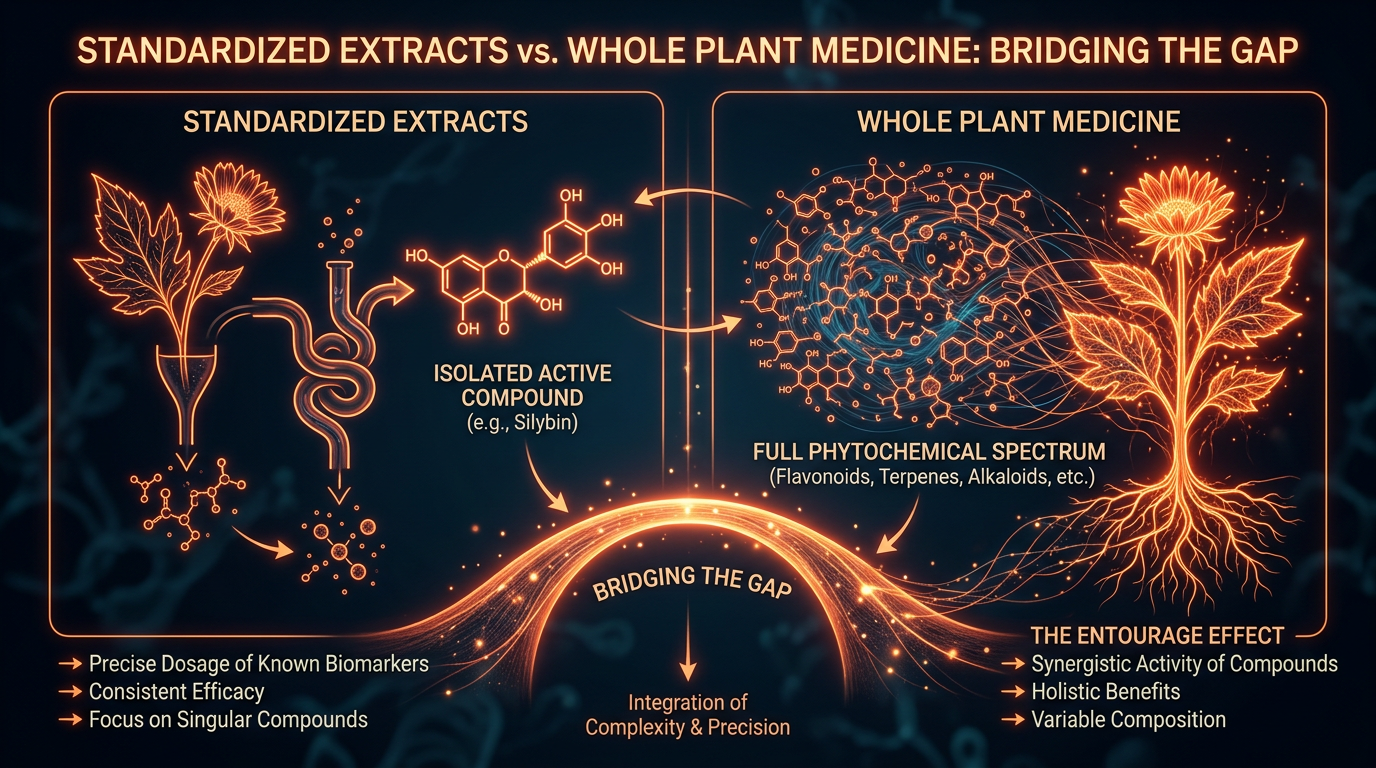
The Reductionist Trap: Pharmacognosy at a Crossroads
In the contemporary landscape of Western phytotherapy, a profound schism has emerged. On one side stands the traditionalist, advocating for the "spirit" and complexity of the whole plant. On the other stands the clinical researcher, demanding "standardised extracts" to ensure safety, potency, and reproducibility.
The industrialisation of herbal medicine has, in many ways, mirrored the pharmaceutical model—a reductionist approach that seeks to identify, isolate, and concentrate a single 'active' constituent. While this has allowed herbal medicine to enter the hallowed halls of evidence-based practice, it has simultaneously stripped the medicine of its evolutionary intelligence. To understand the gap between these two methodologies is to understand the very nature of biological resonance.
At INNERSTANDING, we assert that the truth lies not in a binary choice, but in a sophisticated synthesis. To bridge this gap, we must examine the molecular orchestration of the whole plant against the clinical precision of the isolate, particularly within the context of a modern environment that is increasingly hostile to human physiology.
The Anatomy of Standardisation: Precision or Profit?
Standardisation is the process by which a specific chemical marker in a plant is guaranteed to be present at a certain percentage. For example, a Milk Thistle extract might be standardised to 80% Silymarin.
From a regulatory and clinical perspective, this is invaluable. It allows for dosage consistency and predictable outcomes in a trial setting. However, the "truth-exposing" reality is that standardisation is often a marketing tool and a patenting strategy. By focusing on a single molecule, the industry can treat a plant like a drug.
The Marker Compound Fallacy
The primary issue with standardisation is the assumption that we have identified the only active component. History has repeatedly proven this false.
- St. John’s Wort (Hypericum perforatum): Early extracts were standardised solely to hypericin. Later research revealed that hyperforin was equally, if not more, responsible for its antidepressant effects. Consumers using hypericin-only isolates were missing the therapeutic breadth of the plant.
- Turmeric (Curcumin): While curcumin is the most studied polyphenol in turmeric, the whole root contains over 200 compounds, including turmerones, which have been shown to facilitate the absorption of curcumin and possess their own neuroprotective properties.
In the United Kingdom, the herbal supplement market is valued at approximately £500 million annually. Despite this, the Medicines and Healthcare products Regulatory Agency (MHRA) notes that a significant percentage of products fail to meet the "Traditional Herbal Registration" (THR) standards for chemical consistency, leading to a reliance on hyper-processed isolates over nuanced whole-plant formulations.
The Intelligence of the Whole: Synergetic Phytochemistry
Nature does not produce "actives" in isolation. It produces suites of compounds that work in tandem to modulate biological systems. This is known as Synergy or the Entourage Effect.
Biological Mechanisms of Synergy
When we ingest a whole plant, our biology interacts with a complex matrix. The secondary metabolites (alkaloids, terpenes, flavonoids, and phenols) perform several key roles:
- Pharmacokinetic Chaperoning: Minor compounds can act as surfactants, increasing the solubility and bioavailability of the primary active.
- Receptor Site Sensitisation: Certain plant compounds do not trigger a response themselves but sensitise cellular receptors, allowing the primary constituent to work at a lower, non-toxic dose.
- Antagonistic Buffering: Often, a plant contains "side-effect limiters." For instance, Meadowsweet contains salicylic acid (the precursor to aspirin) but also contains tannins and mucilage that protect the stomach lining from the irritation that pure aspirin causes.
The Matrix Effect
The "Matrix Effect" refers to the way fiber, minerals, and enzymes within the whole plant slow down the absorption of potent alkaloids, preventing the "spike and crash" associated with isolated extracts. This leads to a more sustainable homeostatic rheostat—a steady balancing of the body's internal environment.
Environmental Disruptors: The Modern Host
The debate between extracts and whole plants cannot take place in a vacuum. We must consider the state of the modern human body. We are currently inhabiting a "Xenobiotic Age," characterised by unprecedented exposure to environmental disruptors.
- Endocrine Disruptors (EDCs): Phthalates and bisphenols mimic oestrogen, clogging receptor sites.
- Glyphosate: This ubiquitous herbicide disrupts the shikimate pathway in our gut microbiome, leading to "leaky gut" and systemic inflammation.
- Microplastics: Now found in human blood and lung tissue, these act as physical irritants and chemical carriers.
In this high-toxin environment, the liver and the lymphatic system are perpetually overwhelmed. An isolated, high-dose standardised extract can sometimes act as a further "metabolic insult." If the liver’s Phase I and Phase II detoxification pathways are sluggish, a concentrated isolate can lead to the accumulation of toxic intermediates.
Conversely, the whole plant provides the co-factors necessary for the liver to process these compounds safely. For example, using a whole Dandelion root provides the bitter compounds to stimulate bile flow, alongside the inulin to feed the microbiome and the potassium to offset the diuretic effect.
Bridging the Gap: The Strategic Synthesis
How do we move forward? The solution is not to abandon technology, but to use it to enhance, rather than replace, nature.
When to Use Standardised Extracts
Standardised extracts are "biological scalpels." They are appropriate for:
- Acute Intervention: When a specific pathway needs immediate modulation (e.g., high-dose Cranberry proanthocyanidins for an active UTI).
- Crisis Management: Using standardised Boswellia to down-regulate the 5-LOX inflammatory enzyme during an autoimmune flare.
- Clinical Validation: When a practitioner needs to match the exact dosage used in a successful clinical trial for a specific pathology.
When to Use Whole Plant Medicine
Whole plant preparations (tinctures, powders, teas) are "biological nourishment." They are essential for:
- Chronic Recovery: Rebuilding systemic resilience over months or years.
- Nutritional Support: Providing the minerals and vitamins that are stripped during the extraction process.
- Harmonisation: When the goal is to balance multiple systems simultaneously (e.g., the HPA axis, the gut, and the immune system).
Research from the University of Westminster indicates that over 60% of UK herbal practitioners prefer "multi-constituent" tinctures over isolated tablets, citing a lower incidence of adverse reactions and a more holistic patient outcome.
The INNERSTANDING Recovery Protocol: Systemic Restoration
To bridge the gap in your own health journey, we propose a tiered protocol that respects both the precision of science and the wisdom of the whole.
Phase 1: The Clearing (Environmental Neutralisation)
Before introducing potent extracts, the biological terrain must be prepared.
- The Whole Plant Approach: Use Nettles and Cleavers (as infusions) to flush the lymphatic system and provide bioavailable minerals.
- The Rationale: This clears the "extracellular matrix," ensuring that future herbal signals can reach the cells without interference from accumulated metabolic waste.
Phase 2: Targeted Modulation (Strategic Standardisation)
Once the pathways are clear, use standardised extracts to address specific dysfunctions.
- The Extract Approach: Use a standardised Milk Thistle (80% Silymarin) alongside a high-potency Berberine extract.
- The Rationale: These "scalpels" target liver regeneration and insulin sensitivity, addressing the core metabolic damage caused by modern diets and EDCs.
Phase 3: The Integration (Whole Plant Longevity)
To maintain the gains, transition back to whole-plant formulations.
- The Synthesis: Use a "Full-Spectrum" Ashwagandha (which retains the natural ratios of withanolides) rather than an ultra-isolated version.
- The Rationale: This provides the body with the adaptogenic intelligence to handle stress without over-stimulating the adrenal glands.
The Truth Exposed: The Future of Phytotherapy
The gap between standardised extracts and whole plant medicine is an artificial construct of the industrial-medical complex. True phytotherapy is a continuum.
We must be wary of "Green Pharmacy"—the practice of using herbs exactly like drugs, ignoring the underlying causes of disease and the synergistic potential of the plant kingdom. When we isolate a compound, we are effectively trying to "mute" the plant's conversation with our DNA.
However, we must also be wary of dogmatic traditionalism that ignores the reality of 21st-century toxicity. A simple tea may not be enough to counter the onslaught of glyphosate and heavy metals. We need the concentrated power of extracts to "punch through" the noise of modern environmental disruption.
The Metrics of Quality
To truly bridge the gap, the consumer and practitioner must look for "Full-Spectrum Standardisation." This is a process where the extract is standardised to a marker, but then reunited with the remaining "waste" material of the plant to ensure the co-factors are present. This is the gold standard of INNERSTANDING.
- Check the Label: Look for "Full-Spectrum" alongside "Standardised to X%."
- Source Matters: UK-grown organic herbs often have a more complex secondary metabolite profile than mass-produced herbs from depleted soils.
- The Solvent Reality: Ensure the extraction didn't use harsh chemicals like hexane; ethanol and CO2 extractions are superior for maintaining the plant's integrity.
Conclusion: Restoring the Hierarchy of Healing
The hierarchy of healing should always begin with the terrain. No extract, no matter how potent or standardised, can thrive in a toxic, nutrient-depleted host.
By bridging the gap—using whole plants to nourish and prepare the body, and standardised extracts to provide targeted therapeutic force—we create a healthcare model that is both scientifically rigorous and evolutionarily sound.
The future of herbal medicine is not a return to the past, nor a surrender to the laboratory. It is an "innerstanding" of the complex dialogue between human biology and the botanical world. We are not separate from the plants; we are part of the same molecular tapestry. It is time we started treating our medicine with the same complexity we afford our own lives.
"References & Further Reading:"
- British Pharmacopoeia (2023): Standards for Herbal Medicines.
- The Journal of Ethnopharmacology: "Synergy and Polyvalence: The Case for Whole Plant Medicine."
- MHRA Guidance on Traditional Herbal Registrations (THR).
- INNERSTANDING Research Archives: "Xenobiotics and the Degradation of the Human Host."
This article is provided for informational and educational purposes only. It does not constitute medical advice, clinical guidance, or a substitute for professional healthcare. Information reflects cited research at time of publication. Always consult a qualified healthcare professional before acting on any health information.
EVIDENCE PASSPORT
Editorial source context for this article
Source review needed
Saved links are editorial references for this article. They may support specific claims rather than every sentence. Open and assess each source in context. This passport does not independently verify them.
Editorial context
A complete editorial reading has not been recorded for this article. Source links remain available for you to open and assess directly.
Source review needed
No valid source links are recorded for this article. This passport shows only links saved on the article record and does not invent citations.
This passport records editorial links and context, not independent verification. Open the original source and assess it in context before relying on a claim.
Medical Disclaimer
The information in this article is for educational purposes only and does not constitute medical advice, diagnosis, or treatment. Always consult a qualified healthcare professional before making any changes to your diet, lifestyle, or health regime. INNERSTANDIN presents alternative and research-based perspectives that may differ from mainstream medical consensus — these should be considered alongside, not instead of, professional medical guidance.
Read Full DisclaimerContinue the thread
Keep this question moving.
Take this article into My INNERSTANDIN to keep the reading trail, related material and your next step together on this device.