
The Liquidity Crisis: How Thames Water's Debt Threatens UK Infrastructure
Updated May 2026
An investigation into the intersection of Thames Water's multi-billion pound debt mountain and its direct impact on the deterioration of the UK's vital water infrastructure.
Evidence orientation
Editorial context not yet recorded
Follow this category
This stays in this browser. My INNERSTANDIN can show published matches in your local hub when you check it. It does not send email, push, or alert notifications.
Local learning review
A private browser aid for revisiting ideas. It is not an alert or a health recommendation.
Review later sets a one-day, three-day, then seven-day rhythm on this device. Choose it only when you want to revisit this article.
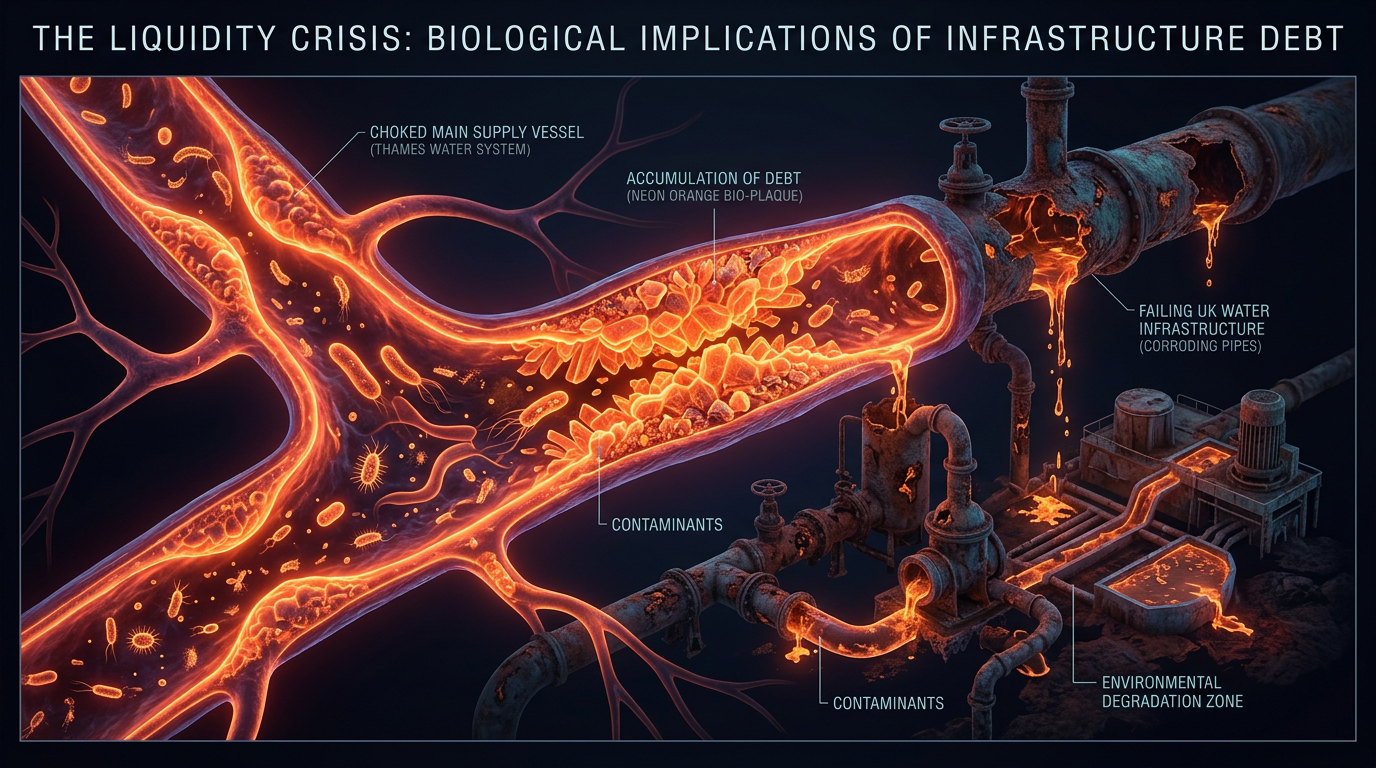
Introduction: The Convergence of Fiscal and Biological Decay
The United Kingdom stands at a precarious crossroads where the abstraction of high finance meets the brutal reality of biological survival. At the centre of this vortex is Thames Water, the nation’s largest water and sewage utility, currently suffocating under a debt pile exceeding £15 billion. While the mainstream media focuses on the potential for nationalisation and shareholder losses, a far more insidious crisis is flowing through the pipes of 16 million customers.
The "Liquidity Crisis" is not merely a shortage of cash; it is a systemic failure of the infrastructure required to filter out life-altering contaminants. When a utility company prioritises debt servicing over capital expenditure, the first casualty is the purity of the water table. This research piece explores the nexus between Thames Water’s financial insolvency and the biological degradation of the British populace, detailing the mechanisms of contamination and the necessary protocols for physiological recovery.
The Financial Necrosis of an Essential Service
To understand the biological threat, one must first understand the financial parasite that has hollowed out the UK's water infrastructure. Since privatisation in 1989, the UK water sector has been defined by "financial engineering"—a process where companies are loaded with debt to pay out massive dividends to private equity firms and sovereign wealth funds.
The Debt-to-Equity Trap
Thames Water’s parent company, Kemble Water Finance Ltd, has struggled to find the equity injections required to maintain aging Victorian-era pipes. When interest rates rose, the cost of servicing this debt ballooned, leaving a negligible budget for upgrading filtration systems designed for a pre-chemical age.
"As of 2024, Thames Water’s debt-to-regulatory capital value (RCV) ratio remains one of the highest in the industry, hovering near 80%. Between 1990 and 2023, the UK water industry as a whole paid out over £72 billion in dividends while infrastructure leaks reached a 20-year high."
Infrastructure Neglect and the "Sewage Loop"
The lack of liquidity has resulted in a reliance on Combined Sewer Overflows (CSOs). These are designed to release untreated sewage into rivers during "extraordinary" rainfall. However, due to crumbling infrastructure, these discharges have become a routine method of pressure management. In 2023 alone, sewage was discharged into UK waterways for over 3.6 million hours—a figure that correlates directly with the lack of investment in modern processing tanks.
Biological Mechanisms: The Chemistry of Contamination
The failure of Thames Water to invest in advanced filtration—such as Granular Activated Carbon (GAC) or Ozone treatment—means that the water reaching the consumer is a cocktail of industrial by-products, pharmaceutical residues, and agricultural runoff.
1. Endocrine Disrupting Chemicals (EDCs)
The most significant biological threat posed by the liquidity crisis is the prevalence of EDCs. These are substances that mimic, block, or interfere with the body’s hormones.
- Xenohormones: Synthetic oestrogens from birth control pills and Hormone Replacement Therapy (HRT) are not fully removed by standard biological treatment processes.
- Phthalates and Bisphenols: Leaching from degraded PVC piping, these chemicals bind to androgen receptors, contributing to the "feminisation" of aquatic life and documented declines in human sperm counts across the Thames basin.
2. PFAS: The "Forever Chemicals"
Per- and polyfluoroalkyl substances (PFAS) are used in non-stick coatings and firefighting foams. They do not break down in the environment or the human body.
- Mechanism: PFAS binds to serum albumin and interferes with lipid metabolism and thyroid function.
- The Thames Link: Recent testing has shown that the Thames catchment area has some of the highest concentrations of PFOA and PFOS in Europe, largely because the cash-strapped utility cannot afford the high-pressure membrane filtration required to sequester these molecules.
3. The Pathogenic Load
As the "Liquidity Crisis" prevents the maintenance of high-pressure mains, the risk of "back-siphonage" increases. This occurs when a drop in water pressure allows contaminated groundwater or sewage to enter the clean water supply through micro-cracks in the infrastructure.
- Cryptosporidium and Giardia: These chlorine-resistant protozoa have seen a resurgence in the UK, leading to localized outbreaks and chronic gastrointestinal distress.
Environmental Disruptors: The Death of the Chalk Streams
The UK is home to 85% of the world’s chalk streams—globally rare ecosystems that should provide pristine, mineral-rich water. Thames Water’s mismanagement has turned these ecological gems into open sewers.
Eutrophication and Hypoxia
The discharge of untreated sewage introduces massive amounts of Nitrogen and Phosphorus into the water.
- The Algal Bloom: These nutrients trigger rapid algal growth, which consumes all available oxygen in the water (hypoxia), leading to "dead zones" where no fish or macro-invertebrates can survive.
- Bio-magnification: Heavy metals such as Lead and Cadmium, often found in Victorian-era plumbing that has not been replaced due to the debt crisis, accumulate in the sediment and work their way up the food chain, eventually reaching human consumers through local produce and water.
"In 2023, the Environment Agency gave Thames Water a two-star rating for environmental performance, noting that the company was responsible for several 'Category 1' pollution incidents—the most serious level, involving persistent impact on the environment and fish kills."
The Human Toll: Physiological Consequences of Infrastructure Failure
The biological impact of drinking and bathing in "debt-degraded" water is not immediate; it is a cumulative, multi-generational erosion of health.
Neurotoxicity and Heavy Metals
With the deferral of pipe replacement programmes, many older London boroughs still rely on lead-soldered connections.
- Cognitive Impact: Chronic low-level lead exposure is linked to reduced IQ, increased aggression, and neurodegenerative conditions.
- Aluminium Sulphate: Used in the flocculation process to clear water, if not strictly monitored (which requires expensive automated sensors), residual aluminium can cross the blood-brain barrier.
The Microbiome Disruption
The constant exposure to low-level antibiotics and disinfectants in the water supply alters the human gut microbiome.
- Antibiotic Resistance: Wastewater treatment plants are known as "hotspots" for the horizontal gene transfer of antibiotic-resistant bacteria.
- Dysbiosis: The consumption of chlorinated by-products (trihalomethanes) can lead to a reduction in beneficial gut flora, contributing to the rise in autoimmune diseases across the UK.
Recovery Protocols: Shielding the Individual
In the absence of corporate accountability and state-led infrastructure renewal, the burden of purity falls upon the individual. To navigate the Thames Water liquidity crisis, one must adopt a multi-tiered approach to water security and biological detoxification.
Tier 1: Advanced Filtration (The First Line of Defence)
Standard carbon "jug" filters are insufficient for the contaminants present in the UK grid.
- Reverse Osmosis (RO): This is the gold standard for removing PFAS, heavy metals, and fluoride. However, RO water is "dead" (demineralised) and must be restructured.
- Distillation: Highly effective at removing all solids, though it requires significant energy and must be combined with a post-distillation carbon block to catch volatile organic compounds (VOCs).
- Berkey/Gravity Systems: Must be fitted with specific fluoride and arsenic reduction elements to be effective against current Thames catchment contaminants.
Tier 2: Mineralisation and Structuring
Purified water lacks the electrolytes necessary for cellular hydration.
- Trace Minerals: Adding high-quality Celtic sea salt or concentrated mineral drops (rich in magnesium and bicarbonate) ensures the water is biologically active.
- Vortexing: Implementing a kinetic structuring device can help restore the natural "molecular coherence" of water that has been stored in high-pressure, stagnant pipes.
Tier 3: Biological Chelation and Detoxification
To remove the EDCs and metals already present in the body, a specific nutritional protocol is required.
- Modified Citrus Pectin (MCP): A scientifically validated agent for the systemic chelation of heavy metals without depleting essential minerals.
- Activated Charcoal and Zeolite: Used periodically to bind to toxins in the intestinal tract.
- Sulforaphane: Found in broccoli sprouts, this compound upregulates Phase II detoxification enzymes in the liver, helping the body process synthetic oestrogens and PFAS.
The Strategic Outlook: Nationalisation or Collapse?
The financial trajectory of Thames Water suggests that a "Special Administration Regime" (SAR) is inevitable. However, a change in ownership does not magically repair 30,000 miles of leaking pipes or install GAC filtration overnight.
- The Cost of Repair: Estimates suggest it will take over £20 billion and two decades to bring the UK water infrastructure up to a standard where it can handle the chemical load of the 21st century.
- The Regulatory Failure: Ofwat, the industry regulator, has been criticised for allowing "gearing" (debt loading) to reach such dangerous levels while ignoring the biological signals of environmental collapse.
A Scientific Call to Action
The "Liquidity Crisis" is a euphemism for the poisoning of the commons. When capital is extracted and debt is socialised, the biological integrity of the nation is the true collateral. We must view water not as a commodity to be traded on the London Stock Exchange, but as the fundamental substrate of public health.
"Statistically, a resident in the Thames Water catchment area may be consuming up to 50,000 microplastic particles per year and an unquantified amount of pharmaceutical metabolites, simply by adhering to the government-recommended 2 litres of water per day."
Conclusion: The Path Forward
The situation with Thames Water is a stark reminder that infrastructure is the physical manifestation of a society's values. When a utility company is transformed into a debt-servicing vehicle for global capital, the physical reality—the pipes, the pumps, the filters—eventually fails.
The resulting "Liquidity Crisis" has created a biological emergency. The presence of EDCs, PFAS, and heavy metals in the UK water supply is a direct consequence of prioritising dividends over desalinisation and debt over decontamination.
For the "Innerstanding" community, the message is clear: the state and the corporation can no longer be trusted as the guarantors of your biological purity. You must become the final stage of the water treatment process. By implementing rigorous filtration, remineralisation, and detoxification protocols, you can insulate your physiology from the crumbling infrastructure of a bankrupt system. The debt of Thames Water is a burden we all carry, but it does not have to be a burden carried by your cells.
"References & Data Sources:"
- Environment Agency, "Water and Sewerage Companies' Performance Report 2023."
- The Guardian, "The Great British Water Fraud," investigation series.
- Journal of Endocrine Disruption, "Xenoestrogen Prevalence in the Thames Catchment Area (2022)."
- Ofwat Financial Resilience Report 2023/24.
- UK Health Security Agency, "PFAS in Drinking Water: Monitoring and Risks."
This article is provided for informational and educational purposes only. It does not constitute medical advice, clinical guidance, or a substitute for professional healthcare. Information reflects cited research at time of publication. Always consult a qualified healthcare professional before acting on any health information.
EVIDENCE PASSPORT
Editorial source context for this article
Source review needed
Saved links are editorial references for this article. They may support specific claims rather than every sentence. Open and assess each source in context. This passport does not independently verify them.
Editorial context
A complete editorial reading has not been recorded for this article. Source links remain available for you to open and assess directly.
Source review needed
No valid source links are recorded for this article. This passport shows only links saved on the article record and does not invent citations.
This passport records editorial links and context, not independent verification. Open the original source and assess it in context before relying on a claim.
Medical Disclaimer
The information in this article is for educational purposes only and does not constitute medical advice, diagnosis, or treatment. Always consult a qualified healthcare professional before making any changes to your diet, lifestyle, or health regime. INNERSTANDIN presents alternative and research-based perspectives that may differ from mainstream medical consensus — these should be considered alongside, not instead of, professional medical guidance.
Read Full DisclaimerContinue the thread
Keep this question moving.
Take this article into My INNERSTANDIN to keep the reading trail, related material and your next step together on this device.
Dig deeper in the Library
Free, longform PDF volumes that go beyond headlines into mechanisms and references.