
The Estrobolome: Bacterial Regulation of Estrogen
Updated May 2026
The estrobolome is the collection of gut bacteria capable of metabolising and recirculating estrogen. Imbalances in this system are linked to hormone-driven health issues across the UK.
Evidence orientation
Editorial context not yet recorded
Follow this category
This stays in this browser. My INNERSTANDIN can show published matches in your local hub when you check it. It does not send email, push, or alert notifications.
Local learning review
A private browser aid for revisiting ideas. It is not an alert or a health recommendation.
Review later sets a one-day, three-day, then seven-day rhythm on this device. Choose it only when you want to revisit this article.
Overview
In the landscape of modern endocrinology, we have long viewed hormones as the product of isolated glandular secretion. We were taught that the ovaries, adrenals, and adipose tissue dictate the oestrogenic rhythm of the human body. However, this view is not only incomplete; it is dangerously reductionist. As a senior biological researcher for INNERSTANDING, it is my duty to expose the hidden regulatory layer that sits between our endocrine system and our systemic health: the estrobolome.
The term estrobolome, first coined by Plottel and Blaser in 2011, refers to the aggregate of enteric bacterial genes whose products are capable of metabolising and modulating the body's oestrogen levels. This is not a passive community of microbes; it is a dynamic, enzymatic engine that determines whether oestrogen is safely excreted from the body or reabsorbed into the bloodstream to wreak havoc on sensitive tissues.
Across the United Kingdom, we are witnessing an unprecedented surge in oestrogen-dominant conditions—endometriosis, PCOS, fibroids, and hormone-driven cancers. While the mainstream medical establishment continues to treat these as "bad luck" or purely genetic predispositions, the biological reality points to a catastrophic failure of the estrobolome. When the gut microbiome is disrupted, the delicate balance of oestrogen recycling is broken, leading to a state of chronic hormonal toxicity.
Fact: The human gut contains upwards of 100 trillion microbial cells, outnumbering human cells. The genetic diversity within the estrobolome allows for metabolic processes that the human genome simply cannot perform on its own.
This article provides a deep-dive into the biochemical pathways of the estrobolome, the environmental toxins currently dismantling this system, and the necessary protocols to restore hormonal equilibrium in an increasingly toxic world.
The Biology — How It Works
To understand the estrobolome, one must first understand the enterohepatic circulation of oestrogen. Oestrogen is not a "one-and-done" molecule. Once it has performed its signalling duties in the breast, uterus, or brain, it must be deactivated and removed to prevent over-stimulation of oestrogen receptors.
The Three Phases of Detoxification
The body processes oestrogen through a tripartite system:
- Phase I (Liver): Oestrogen (primarily oestradiol and oestrone) undergoes hydroxylation via the Cytochrome P450 enzymes. This converts them into metabolites such as 2-OH, 4-OH, or 16-OH oestrone.
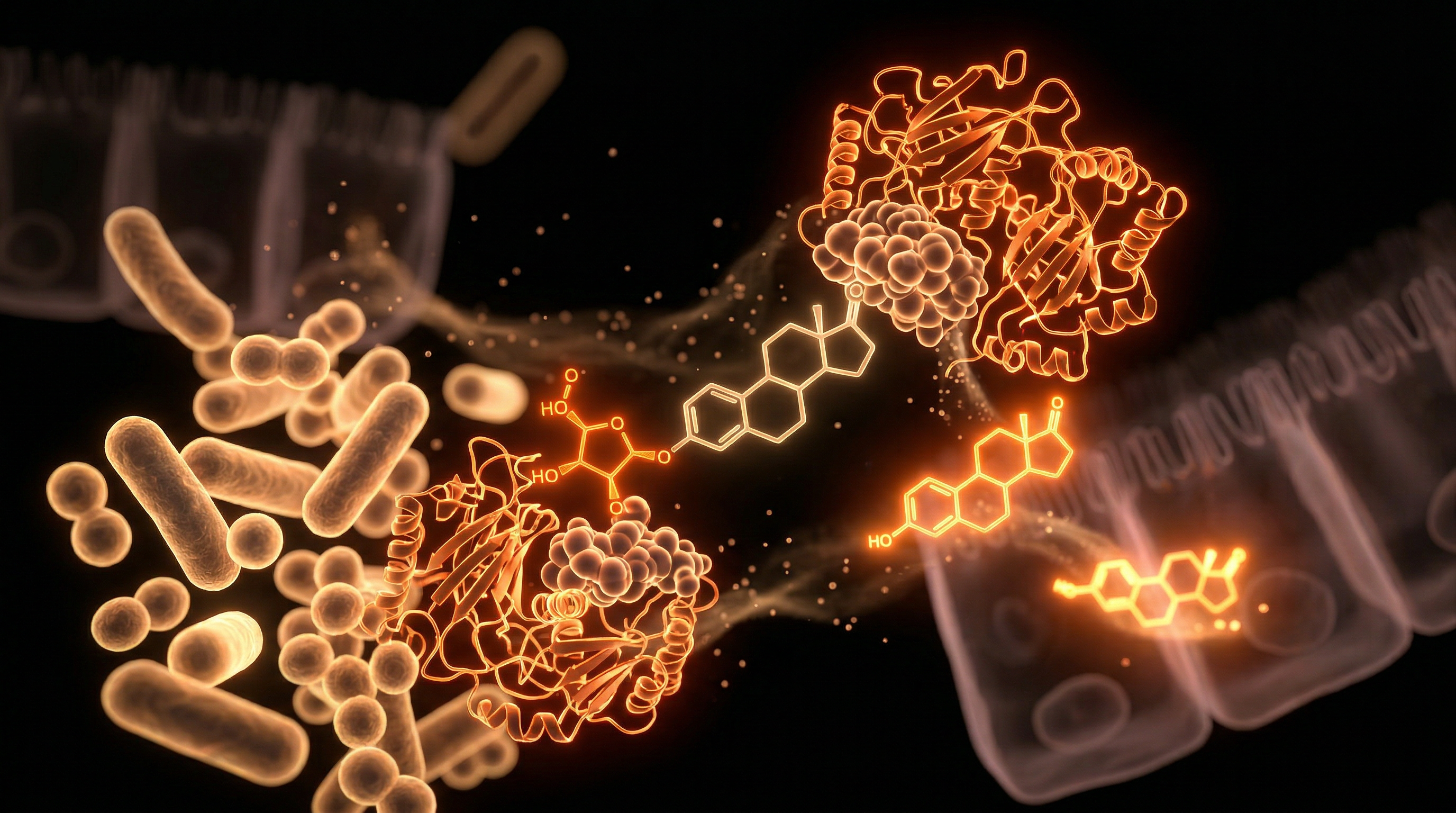
- Phase II (Liver): These metabolites are then "tagged" for excretion through a process called glucuronidation. A glucuronic acid molecule is attached to the oestrogen, making it water-soluble and inert. This "conjugated" oestrogen is then secreted into the bile and sent to the small intestine.
- Phase III (Gut): This is where the estrobolome takes centre stage. Under ideal conditions, the conjugated oestrogen travels through the digestive tract and is excreted via the faeces.
The Role of Beta-Glucuronidase
The estrobolome consists of specific bacteria—including species from the Bacteroidetes and Firmicutes phyla—that produce an enzyme called $\beta$-glucuronidase.
In a balanced microbiome, levels of this enzyme are kept in check. However, in a state of dysbiosis (microbial imbalance), certain bacteria overproduce $\beta$-glucuronidase. This enzyme acts as molecular scissors, snipping the glucuronic acid bond off the oestrogen. This "de-conjugates" the hormone, reverting it to its active, lipophilic form. Once de-conjugated, the oestrogen is no longer destined for the toilet; it is reabsorbed through the gut lining, back into the portal vein, and returned to the systemic circulation.
The Feedback Loop
This creates a vicious cycle. The liver works to detoxify oestrogen, but the gut un-does the work, effectively "recycling" old hormones. This leads to an elevated Total Estrogen Load, regardless of how much oestrogen the ovaries are actually producing.
Mechanisms at the Cellular Level
At the microscopic level, the estrobolome’s influence extends far beyond simple recycling. It interacts directly with Oestrogen Receptors (ERs) throughout the body, influencing gene expression and cellular proliferation.
Oestrogen Receptor Modulation
There are two primary types of oestrogen receptors: ER$\alpha$ (often associated with cell growth and proliferation) and ER$\beta$ (often associated with apoptosis and anti-proliferative effects). A healthy estrobolome helps maintain a specific ratio of oestrogen metabolites. For instance, 2-hydroxyestrone (2-OH) is generally considered "protective," while 16$\alpha$-hydroxyestrone (16-OH) is highly proliferative and linked to DNA damage.
When the estrobolome is skewed by dysbiosis, it doesn't just increase the quantity of oestrogen; it alters the metabolite profile. High $\beta$-glucuronidase activity is frequently correlated with a shift toward the more aggressive 16-OH pathway, increasing the risk of neoplastic changes in breast and endometrial tissue.
The Epigenetic Connection
Recent research suggests that the estrobolome communicates with the host through Short-Chain Fatty Acids (SCFAs) like butyrate. Butyrate is a powerful epigenetic modulator that maintains the integrity of the tight junctions in the gut lining.
- If the estrobolome is compromised, SCFA production drops.
- This leads to Intestinal Permeability (Leaky Gut).
- Endotoxins, such as Lipopolysaccharides (LPS), leak into the bloodstream.
- LPS triggers systemic inflammation, which further inhibits the liver's Phase II detoxification enzymes.
Statistic: Studies have shown that women with breast cancer often possess a significantly less diverse estrobolome compared to healthy controls, with a higher prevalence of oestrogen-deconjugating bacterial species.
Environmental Threats and Biological Disruptors
The modern world is an assault on the estrobolome. We are living in an era of "biochemical interference," where external factors are systematically dismantling our microbial defences.
The Antibiotic Apocalypse
Broad-spectrum antibiotics are the most direct threat. A single course of antibiotics can permanently alter the composition of the estrobolome, wiping out the beneficial species that regulate oestrogen and allowing $\beta$-glucuronidase-producing pathobionts to thrive. In the UK, despite efforts to reduce prescriptions, the historical overuse of antibiotics in both medicine and livestock has left a lasting scar on the national microbiome.
Xenoestrogens and EDCs
We are submerged in a "sea of oestrogen." Endocrine Disrupting Chemicals (EDCs) such as Bisphenol A (BPA), phthalates, and parabens mimic the shape of natural oestrogen.
- These chemicals saturate oestrogen receptors.
- They also alter the microbial composition of the gut, favouring bacteria that thrive in high-oestrogen environments.
- This creates a "double-hit" effect: the body is flooded with fake oestrogens, and the estrobolome is conditioned to keep recycling them.
Glyphosate: The Microbiome Killer
Glyphosate, the active ingredient in many common herbicides used across UK farmland, is a patented antibiotic. It specifically targets the Shikimate pathway, which, while absent in humans, is present in our gut bacteria. By selectively killing beneficial microbes, glyphosate creates a "niche" for hardy, $\beta$-glucuronidase-producing bacteria to colonise, fundamentally breaking the oestrogen clearance mechanism.
The Role of Ultra-Processed Foods (UPFs)
The UK has the highest consumption of UPFs in Europe. These foods are devoid of the fermentable fibre required to feed the "good" estrobolome. Without fibre, the bacteria that produce protective SCFAs die off, and the gut transit time slows down. The longer faeces sit in the colon, the more time the estrobolome has to de-conjugate oestrogen and send it back into the blood.
The Cascade: From Exposure to Disease
When the estrobolome fails, the resulting "Oestrogen Dominance" manifests in a predictable cascade of physiological breakdown.
1. Reproductive Pathology
The most immediate victims are the hormone-sensitive tissues. Endometriosis, a condition where tissue similar to the lining of the womb grows elsewhere, is fuelled by high systemic oestrogen. If the estrobolome is constantly recycling oestrogen, the inflammatory lesions of endometriosis are never allowed to regress. Similarly, Polycystic Ovary Syndrome (PCOS) is often exacerbated by the insulin-disrupting effects of a dysbiotic gut.
2. The Weight Gain Trap
Oestrogen and insulin are closely linked. Excess oestrogen reabsorbed via the estrobolome promotes adipogenesis (the creation of fat cells), particularly in the abdominal and hip areas. These fat cells themselves produce more oestrogen via the aromatase enzyme, creating a self-sustaining loop of weight gain and hormonal imbalance that is nearly impossible to break with "calorie counting" alone.
3. Mental Health and the Gut-Brain Axis
Oestrogen significantly influences neurotransmitter production, particularly serotonin and dopamine. The "highs and lows" of the menstrual cycle are often attributed to the ovaries, but the estrobolome is the true regulator of these fluctuations. Chronic oestrogen recycling is a major, yet ignored, driver of Premenstrual Dysphoric Disorder (PMDD) and anxiety.
4. Oncogenesis
The most severe outcome is the development of oestrogen-receptor-positive (ER+) breast cancer. By maintaining a high "lifetime oestrogen exposure," a dysfunctional estrobolome acts as a silent carcinogen. The constant stimulation of breast tissue by recycled oestrogen metabolites promotes DNA mutations and inhibits the natural "cell suicide" (apoptosis) that prevents tumours.
What the Mainstream Narrative Omits
The current medical paradigm is failing women because it ignores the biotransformation of hormones in favour of "symptom management."
The "Pill" as a Mask
When a woman presents with heavy periods, acne, or mood swings (all signs of estrobolome failure), she is typically prescribed the Combined Oral Contraceptive Pill. This does not fix the estrobolome; in fact, synthetic oestrogens and progestins further disrupt gut motility and microbial diversity. It is a chemical veil that hides the underlying problem while allowing the internal oestrogen toxicity to worsen.
The HRT Misconception
In the context of menopause, Hormone Replacement Therapy (HRT) is often touted as a panacea. While it can be life-changing, the mainstream narrative fails to address the "clearance" side of the equation. If a woman has a high $\beta$-glucuronidase estrobolome, adding exogenous hormones—even "bioidentical" ones—is like pouring petrol on a fire. Without addressing the gut, the body cannot safely process the HRT, leading to side effects and increased cancer risks.
The Silencing of the Microbiome
The pharmaceutical industry has no "patentable" solution for the estrobolome. You cannot patent a diverse gut or the consumption of broccoli. Therefore, the vital role of $\beta$-glucuronidase is rarely discussed in primary care settings. The focus remains on blood tests that measure "static" hormone levels, which fail to capture the "dynamic" recycling happening in the gut.
The UK Context
The United Kingdom faces a unique set of challenges regarding estrobolome health.
The Water Crisis
Recent investigations into UK water companies have revealed shocking levels of untreated sewage being dumped into rivers and coastal waters. This sewage is laden with synthetic oestrogens from contraceptive pills and HRT, which are not fully removed by standard filtration. When these "environmental oestrogens" re-enter the food chain or the water supply, they act as potent disruptors of the British estrobolome.
The British Diet
The "Western" diet in the UK is notoriously low in diversity. The average Briton consumes less than half the recommended daily intake of fibre. Fibre is the "scaffold" upon which the estrobolome is built. Without it, the gut becomes an environment that favours the very bacteria that recycle oestrogen.
NHS Limitations
The NHS is currently overburdened, and "preventative" gut-health testing is virtually non-existent in standard care. Tests for $\beta$-glucuronidase or specific microbial strains are only available through private, expensive functional medicine labs. This creates a two-tier health system where only those with financial means can uncover the root cause of their hormonal distress.
Statistic: Endometriosis affects 1 in 10 women in the UK, yet the average time to diagnosis is a staggering 7.5 years. A significant portion of this delay is due to the failure to investigate the gut-hormone axis.
Protective Measures and Recovery Protocols
Restoring the estrobolome requires a multi-faceted approach that addresses both the microbes themselves and the enzymatic pathways they control.
1. Targeted Dietary Intervention
The foundation of estrobolome health is fibre.
- Cruciferous Vegetables: Broccoli, kale, Brussels sprouts, and cauliflower contain Indole-3-Carbinol (I3C), which the body converts into DIM (Diindolylmethane). DIM promotes the protective 2-OH oestrogen pathway in the liver.
- Fermentable Fibres: Artichokes, leeks, onions, and garlic provide the prebiotics necessary for SCFA-producing bacteria.
- Seeds: Flaxseeds contain lignans, which can bind to oestrogen receptors and provide a "weak" oestrogen effect, blocking more potent, recycled oestrogens from causing damage.
2. The Role of Calcium D-Glucarate
This is perhaps the most critical supplement for those with a compromised estrobolome. Calcium D-Glucarate is a substance that inhibits the $\beta$-glucuronidase enzyme. By "locking" the molecular scissors, it ensures that oestrogen stays conjugated and is successfully excreted. It is an essential tool for "mopping up" excess hormones during a detox protocol.
3. Probiotic Refinement
Not all probiotics are created equal. For the estrobolome, focus on:
- Lactobacillus acidophilus: Shown to decrease $\beta$-glucuronidase activity.
- Bifidobacterium longum: Helps maintain gut barrier integrity to prevent oestrogen reabsorption.
- Saccharomyces boulardii: A beneficial yeast that helps clear pathogens and reduces inflammation in the gut lining.
4. Eliminating the "External Load"
To give the estrobolome a chance to recover, one must stop the influx of EDCs.
- Filter Your Water: Use high-quality filters (e.g., reverse osmosis or activated carbon) to remove environmental oestrogens and fluoride.
- Ditch Plastic: Never heat food in plastic containers and switch to glass or stainless steel.
- Organic Preference: Prioritise organic produce for the "Dirty Dozen" to avoid glyphosate and other microbiome-disrupting pesticides.
5. Liver Support
Since the gut and liver are two sides of the same coin, support Phase II detoxification with:
- N-Acetyl Cysteine (NAC): To boost glutathione production.
- Milk Thistle: To protect hepatocytes and promote bile flow.
- Magnesium: Essential for the COMT enzyme, which further processes oestrogen metabolites.
Summary: Key Takeaways
The estrobolome represents a paradigm shift in how we understand women’s health and hormonal regulation. It is the missing link in the "Oestrogen Dominance" epidemic.
- The Gut is an Endocrine Organ: The estrobolome is the ultimate arbiter of oestrogen levels, deciding whether hormones are excreted or recycled.
- Enzymatic Sabotage: Overgrowth of $\beta$-glucuronidase-producing bacteria is the primary mechanism behind hormonal toxicity.
- Environmental Warfare: Antibiotics, glyphosate, and UPFs are the primary drivers of estrobolome dysfunction in the UK.
- Beyond Symptoms: Real recovery requires moving past "the pill" and focusing on microbial diversity and enzymatic inhibition.
- The Protocol: Combining high-fibre intake, cruciferous vegetables, and targeted supplements like Calcium D-Glucarate can restore balance and protect against hormone-driven diseases.
The truth is that our health is not just dictated by the genes we were born with, but by the microbial genes we cultivate. To master your hormones, you must first master your estrobolome. The mainstream narrative will continue to ignore this, but the biological evidence is undeniable. It is time to take back control of your internal terrain.
"References & Further Reading:"
- Plottel, C. S., & Blaser, M. J. (2011). Microbiome and Malignancy. Cell Host & Microbe.
- Baker, J. M., et al. (2017). Estrogen–gut microbiome axis: Physiological and clinical implications. Maturitas.
- Kwa, M., et al. (2016). The Intestinal Microbiome and Estrogen Receptor–Positive Female Breast Cancer. JNCI: Journal of the National Cancer Institute.
This article is provided for informational and educational purposes only. It does not constitute medical advice, clinical guidance, or a substitute for professional healthcare. Information reflects cited research at time of publication. Always consult a qualified healthcare professional before acting on any health information.
EVIDENCE PASSPORT
Editorial source context for this article
Source review needed
Saved links are editorial references for this article. They may support specific claims rather than every sentence. Open and assess each source in context. This passport does not independently verify them.
Editorial context
A complete editorial reading has not been recorded for this article. Source links remain available for you to open and assess directly.
Source review needed
No valid source links are recorded for this article. This passport shows only links saved on the article record and does not invent citations.
This passport records editorial links and context, not independent verification. Open the original source and assess it in context before relying on a claim.
Medical Disclaimer
The information in this article is for educational purposes only and does not constitute medical advice, diagnosis, or treatment. Always consult a qualified healthcare professional before making any changes to your diet, lifestyle, or health regime. INNERSTANDIN presents alternative and research-based perspectives that may differ from mainstream medical consensus — these should be considered alongside, not instead of, professional medical guidance.
Read Full DisclaimerContinue the thread
Keep this question moving.
Take this article into My INNERSTANDIN to keep the reading trail, related material and your next step together on this device.
Explore this in the Body Map
See where this hits your biology. Interactive anatomy, threats, and protective protocols.
Dig deeper in the Library
Free, longform PDF volumes that go beyond headlines into mechanisms and references.