
Wnt Signaling Pathways: The Master Controllers of Tissue Growth
Updated May 2026
The Wnt pathway is a fundamental regulator of stem cell self-renewal and tissue patterning. Understanding this mechanism is key to unlocking the body's natural ability to regrow complex structures.
Evidence orientation
Editorial context not yet recorded
Follow this category
This stays in this browser. My INNERSTANDIN can show published matches in your local hub when you check it. It does not send email, push, or alert notifications.
Local learning review
A private browser aid for revisiting ideas. It is not an alert or a health recommendation.
Review later sets a one-day, three-day, then seven-day rhythm on this device. Choose it only when you want to revisit this article.
Overview
In the intricate tapestry of biological existence, few molecular mechanisms command as much authority as the Wnt signaling pathway. From the first division of a zygote to the relentless repair of the adult intestinal lining, Wnt proteins act as the master architects, providing the spatial and temporal instructions necessary for life to take shape and maintain its form.
The term "Wnt" is a portmanteau of Wingless (a gene discovered in Drosophila) and Int-1 (a proto-oncogene identified in mice). Since their discovery in the early 1980s, these pathways have emerged as the primary regulators of stem cell self-renewal, cell fate determination, and organogenesis. Without functional Wnt signaling, multicellular life—as we understand it—would cease to exist.
However, we are currently witnessing a global crisis in biological integrity. The modern environment is saturated with industrial pollutants, synthetic hormones, and electromagnetic frequencies that interfere with this ancient signaling language. When the Wnt "conversation" is garbled, the results are catastrophic: oncogenesis, neurodegeneration, and a total failure of the body’s regenerative capacity. This article provides a deep-dive into the mechanics of Wnt signaling, the environmental factors threatening its stability, and the suppressed truths regarding how we might reclaim our biological sovereignty through targeted restoration.
The Biology — How It Works
Wnt signaling is not a single linear pathway, but a complex network of protein-to-protein interactions that communicate signals from the outside of a cell to its nucleus. In humans, there are 19 Wnt ligands—secreted glycoproteins that act as the "messengers."
The Three Major Branches
Biologists generally categorise Wnt signaling into three distinct pathways:
- The Canonical Wnt Pathway (β-catenin dependent): This is the most studied and arguably the most vital. it controls gene expression and cell proliferation. Its primary vehicle is a protein called β-catenin.
- The Non-canonical Planar Cell Polarity (PCP) Pathway: This branch regulates the cytoskeleton, giving cells their orientation and "sense of direction" within a tissue. It is crucial for the shaping of the nervous system.
- The Non-canonical Wnt/Calcium Pathway: This regulates the flow of calcium ions within the cell, influencing cell adhesion and movement, particularly during embryonic development.
The Palmitoylation Process
Before a Wnt protein can even leave the cell that produced it, it must undergo a specific modification called palmitoylation. This involves the attachment of a fatty acid (palmitoleic acid) by an enzyme called Porcupine. This lipid modification is essential; without it, the Wnt protein cannot bind to its receptors.
Key Fact: The lipid modification of Wnt proteins makes them highly hydrophobic, meaning they do not travel well through the watery extracellular space without the assistance of specialized carrier proteins like Wntless (Wls).
The Receptor Complex
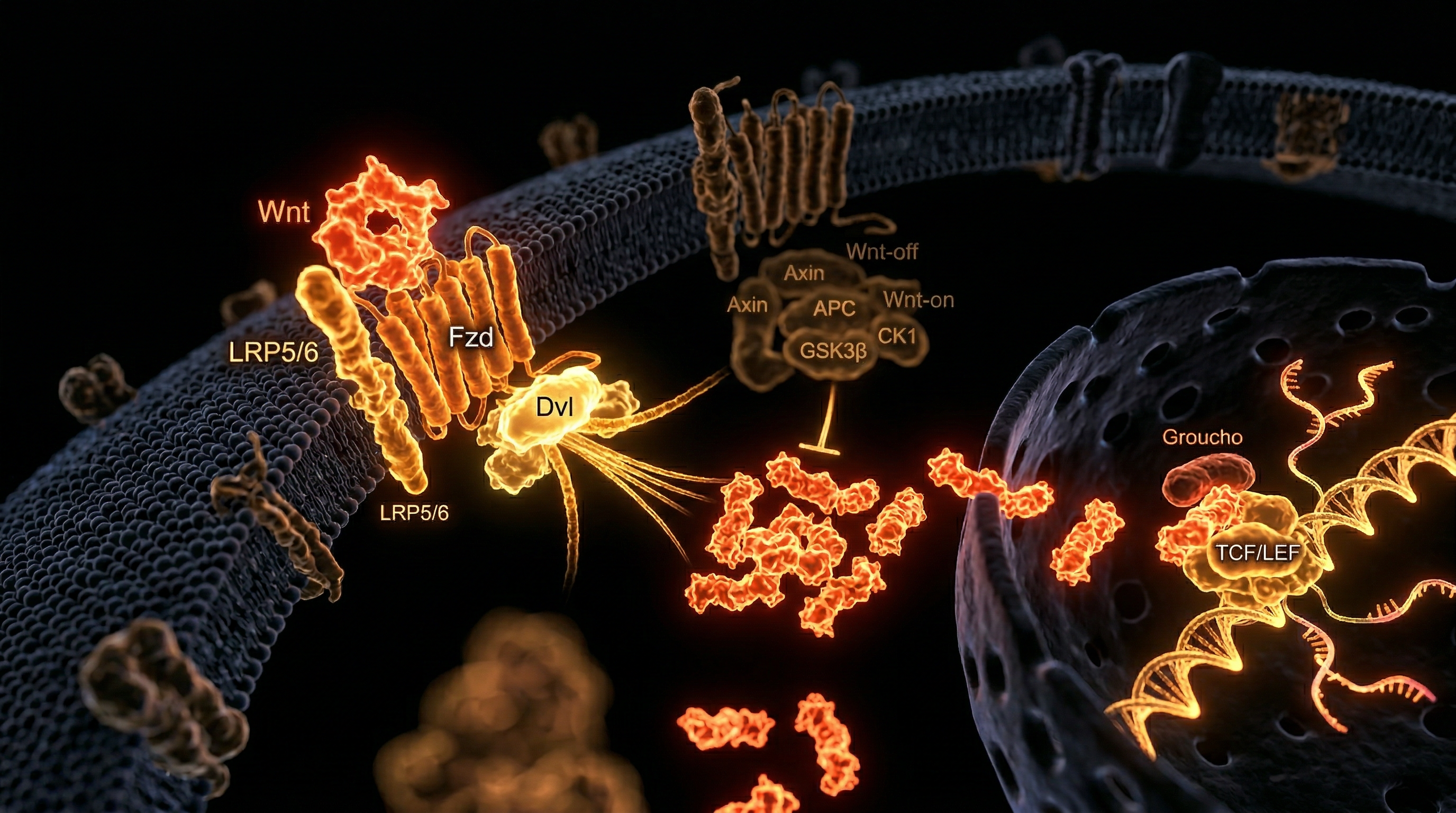
To initiate a signal, a Wnt ligand must bind to a primary receptor called Frizzled (Fzd) and a co-receptor known as LRP5/6 (Low-density lipoprotein receptor-related protein). This binding acts like a key turning a lock, triggering a cascade of events inside the cell that ultimately changes what the DNA is doing.
Mechanisms at the Cellular Level
To understand how Wnt controls tissue growth, we must look at the "Off" and "On" states of the canonical pathway.
The "Off" State: Constant Destruction
In a cell where no Wnt signal is present, the level of β-catenin in the cytoplasm is kept extremely low. This is achieved by a "destruction complex" consisting of several proteins:
- Axin (the scaffold)
- APC (Adenomatous Polyposis Coli)
- GSK3β (Glycogen Synthase Kinase 3 Beta)
- CK1 (Casein Kinase 1)
This complex captures β-catenin and tags it with phosphate molecules. These tags signal the cell's waste disposal system (the proteasome) to degrade the β-catenin. Consequently, the genes responsible for growth remain "locked" by a repressor protein called Groucho.
The "On" State: Nuclear Translocation
When a Wnt ligand binds to the Frizzled/LRP complex, it recruits a protein called Dishevelled (Dvl). This leads to the inactivation of the destruction complex. With the "shredder" turned off, β-catenin begins to accumulate in the cytoplasm.
Once the concentration reaches a threshold, β-catenin moves into the nucleus. It kicks out the repressor Groucho and binds to TCF/LEF transcription factors. Together, they turn on a suite of "Wnt target genes," such as c-Myc and Cyclin D1, which trigger the cell to divide and grow.
The Importance of the Wnt Gradient
In tissues like the intestinal crypt or the skin, Wnt proteins exist in a gradient. Cells closer to the Wnt source remain as undifferentiated stem cells, while cells further away—where Wnt levels are lower—begin to differentiate into specialized tissue. This gradient is the fundamental mechanism of biological patterning.
Environmental Threats and Biological Disruptors
In our contemporary world, the Wnt pathway is under constant assault from xenobiotics—foreign chemical substances that mimic or interfere with natural signaling molecules.
Endocrine Disruptors and Plasticisers
Compounds like Bisphenol A (BPA) and Phthalates do more than just disrupt oestrogen. Recent research indicates that these chemicals can prematurely activate or inhibit Wnt signaling. For instance, BPA exposure has been linked to the aberrant activation of Wnt genes in breast tissue, potentially sowing the seeds for future malignancy.
Heavy Metal Interference
Heavy metals, particularly Cadmium and Lead, interfere with the calcium-dependent non-canonical Wnt pathway. By displacing natural calcium ions, these toxins disrupt the "cellular compass," leading to developmental defects in the foetal brain and impaired bone density in adults.
Glyphosate and the Gut Microbiome
The herbicide Glyphosate is a potent disruptor of the Wnt pathway in the intestinal lining. The gut's ability to regenerate its surface every 3–5 days depends entirely on Wnt-driven stem cell activity in the crypts. Glyphosate has been shown to induce oxidative stress that degrades the LRP6 receptor, effectively silencing the regenerative signal and leading to "Leaky Gut" and chronic inflammation.
Electromagnetic Frequencies (EMFs)
While mainstream science often dismisses the biological effects of non-ionising radiation, high-level cellular research suggests that pulsed EMFs can alter the voltage-gated calcium channels that interact with the Wnt/Calcium pathway. This interference can disrupt the delicate balance of stem cell niche maintenance.
The Cascade: From Exposure to Disease
When the Wnt pathway is compromised, the body loses its ability to regulate growth. This leads to two primary "failure modes": Hyper-activation (Uncontrolled growth) and Hypo-activation (Degeneration).
1. The Oncogenic Cascade (Too Much Wnt)
The most well-known result of Wnt dysfunction is Colorectal Cancer. In over 80% of colon cancer cases, there is a mutation in the APC gene. Without a functional APC protein, the destruction complex cannot form. This means β-catenin is always on, driving the cell to divide uncontrollably, regardless of whether a Wnt signal is present.
- Breast Cancer: Wnt signaling often promotes the "stemness" of cancer cells, making them resistant to chemotherapy.
- Liver Cancer: Mutations in the β-catenin gene itself (CTNNB1) lead to aggressive hepatocellular carcinomas.
2. The Degenerative Cascade (Too Little Wnt)
Conversely, when Wnt signaling is suppressed, the body cannot repair itself.
- Alzheimer’s Disease: There is a profound link between suppressed Wnt signaling and the formation of amyloid plaques. Wnt signaling normally inhibits GSK3β; when Wnt is low, GSK3β becomes overactive, leading to the hyperphosphorylation of Tau protein, the primary component of neurofibrillary tangles.
- Osteoporosis: Wnt signaling is the primary driver of osteoblast (bone-building cell) activity. Antagonists of the Wnt pathway, such as Sclerostin, increase with age and toxic exposure, leading to brittle bones and loss of density.
- Fibrosis: In the lungs and kidneys, dysregulated Wnt signaling can cause cells to overproduce collagen, leading to the scarring and loss of organ function known as fibrosis.
What the Mainstream Narrative Omits
The mainstream medical establishment views the Wnt pathway primarily through the lens of pharmacological targets. Billions are spent trying to develop "Wnt-inhibitors" for cancer or "Wnt-activators" for hair loss. However, this reductionist approach ignores several critical truths:
1. The Synergistic Effect of Toxins
Mainstream toxicology tests chemicals in isolation. They fail to account for the "toxic soup" effect, where low levels of BPA, Glyphosate, and Heavy Metals work together to catastrophically disrupt the Wnt pathway. A dose of a single chemical might be "safe" by regulatory standards, but the cumulative effect on cellular signaling is anything but.
2. The Role of the Epigenome
Wnt signaling is heavily regulated by epigenetic marks—chemical tags on DNA that turn genes up or down. Environmental stressors can cause the "silencing" of natural Wnt inhibitors (like the SFRP family). The mainstream narrative rarely discusses how nutrition and lifestyle can re-set these epigenetic switches, preferring instead to push expensive gene therapies.
3. Suppression of Natural Modulators
There is a wealth of peer-reviewed data showing that certain natural compounds can modulate Wnt signaling as effectively as synthetic drugs, but with fewer side effects. Because these compounds cannot be patented, they receive a fraction of the research funding and are often labeled as "unproven" by mainstream outlets.
The UK Context
In the United Kingdom, the study of Wnt signaling is both a point of pride and a source of significant public health concern.
The Research Powerhouse
The UK is home to some of the world’s leading Wnt researchers. Institutions like the Francis Crick Institute in London and the Wellcome Sanger Institute in Cambridge have pioneered the mapping of the Wnt genome. However, there is a distinct "ivory tower" problem where this high-level research rarely translates into public health policy.
Environmental Specifics: The Fluoridation Debate
A specific concern in the UK is the practice of water fluoridation in certain regions (such as the West Midlands and parts of the North East). Emerging research suggests that high levels of fluoride can interfere with the mineralisation processes governed by the Wnt pathway in both teeth and bone. While the NHS maintains that fluoridation is safe, some researchers argue that it may contribute to the rising rates of skeletal fluorosis and potentially interfere with Wnt-mediated brain development in children.
Urban Pollution and the "London Fog" 2.0
The UK’s air quality, particularly in London and Birmingham, is frequently cited for high levels of Particulate Matter (PM2.5). These microscopic particles have been shown to induce systemic inflammation that specifically targets the Wnt/β-catenin pathway in the respiratory epithelium, contributing to the high prevalence of asthma and COPD in British urban centres.
Protective Measures and Recovery Protocols
If Wnt signaling is the master controller of our health, then protecting it must be our highest priority. We can achieve this through a combination of environmental avoidance and strategic nutritional support.
1. Dietary Wnt Modulators
Nature has provided us with an "alkaloid toolkit" to keep Wnt signaling in balance:
- Sulforaphane: Found in broccoli sprouts, this compound has been shown to inhibit the over-activation of Wnt in cancer cells by promoting the degradation of β-catenin.
- Curcumin: The active component of turmeric is a potent modulator. It helps restore Wnt signaling in the brain (combating Alzheimer’s) while inhibiting it in the gut (combating polyps).
- Quercetin: Found in red onions and apples, quercetin helps protect the LRP6 receptor from oxidative damage.
- EGCG: The primary polyphenol in Green Tea helps to reactivate silenced Wnt-antagonists, providing a natural "brake" on uncontrolled growth.
2. Mitigating Environmental Impact
- Water Filtration: Utilize high-quality reverse osmosis filters to remove fluoride, heavy metals, and pharmaceutical residues that disrupt cellular signaling.
- Organic Nutrition: Reducing glyphosate intake is non-negotiable for anyone looking to protect their gut-Wnt axis.
- EMF Hygiene: Reducing exposure to high-frequency radiation—especially during sleep—allows the body’s "bio-electric" signaling to recalibrate.
3. Circadian Rhythm and Sleep
Wnt signaling is inherently circadian. The expression of many Wnt genes fluctuates with the day-night cycle. Disruption of sleep (common in the UK’s "hustle culture") leads to a decoupling of these signals. Ensuring total darkness and a regular sleep-wake cycle is a fundamental, yet often overlooked, regenerative protocol.
4. Fasting and Autophagy
Periodic fasting triggers a process called autophagy (cellular self-eating). This "clean-up" phase removes damaged Wnt receptors and misfolded proteins within the destruction complex, essentially "re-booting" the pathway’s sensitivity.
Research Note: Short-term fasting has been shown in murine models to rejuvenate the Wnt-driven stem cells in the small intestine, reversing age-related decline in nutrient absorption.
Summary: Key Takeaways
The Wnt signaling pathway is the fundamental language of biological growth and repair. Understanding this system is not merely an academic exercise; it is a prerequisite for navigating the modern health landscape.
- Wnt is the "Master Architect": It controls everything from embryonic development to the daily regeneration of our organs.
- The Core Mechanism: Revolves around the stabilization and nuclear translocation of β-catenin, which activates growth genes.
- Environmental Threats are Real: Modern toxins like BPA, Glyphosate, and Heavy Metals "jam" these signals, leading to either cancer (too much growth) or degeneration (too little repair).
- The Mainstream Blindspot: Regulatory bodies and pharmaceutical companies focus on treating symptoms rather than addressing the environmental and nutritional disruption of these pathways.
- Recovery is Possible: Through the use of natural modulators (Curcumin, Sulforaphane), clean water, and the restoration of natural biological rhythms, we can protect and even repair our Wnt signaling integrity.
In the final analysis, we are only as healthy as the signals our cells are sending. To ignore the Wnt pathway is to ignore the very blueprint of life itself. By reclaiming our internal and external environments, we can move from a state of "managed decline" into one of true regenerative vitality.
Author’s Note: This article is part of INNERSTANDING’s commitment to providing deep-spectrum biological education. Our mission is to bridge the gap between complex molecular science and the practical steps necessary for human thriving in an increasingly toxic world. Knowledge is the first step toward biological liberation.
This article is provided for informational and educational purposes only. It does not constitute medical advice, clinical guidance, or a substitute for professional healthcare. Information reflects cited research at time of publication. Always consult a qualified healthcare professional before acting on any health information.
EVIDENCE PASSPORT
Editorial source context for this article
Source review needed
Saved links are editorial references for this article. They may support specific claims rather than every sentence. Open and assess each source in context. This passport does not independently verify them.
Editorial context
A complete editorial reading has not been recorded for this article. Source links remain available for you to open and assess directly.
Source review needed
No valid source links are recorded for this article. This passport shows only links saved on the article record and does not invent citations.
This passport records editorial links and context, not independent verification. Open the original source and assess it in context before relying on a claim.
Medical Disclaimer
The information in this article is for educational purposes only and does not constitute medical advice, diagnosis, or treatment. Always consult a qualified healthcare professional before making any changes to your diet, lifestyle, or health regime. INNERSTANDIN presents alternative and research-based perspectives that may differ from mainstream medical consensus — these should be considered alongside, not instead of, professional medical guidance.
Read Full DisclaimerContinue the thread
Keep this question moving.
Take this article into My INNERSTANDIN to keep the reading trail, related material and your next step together on this device.