
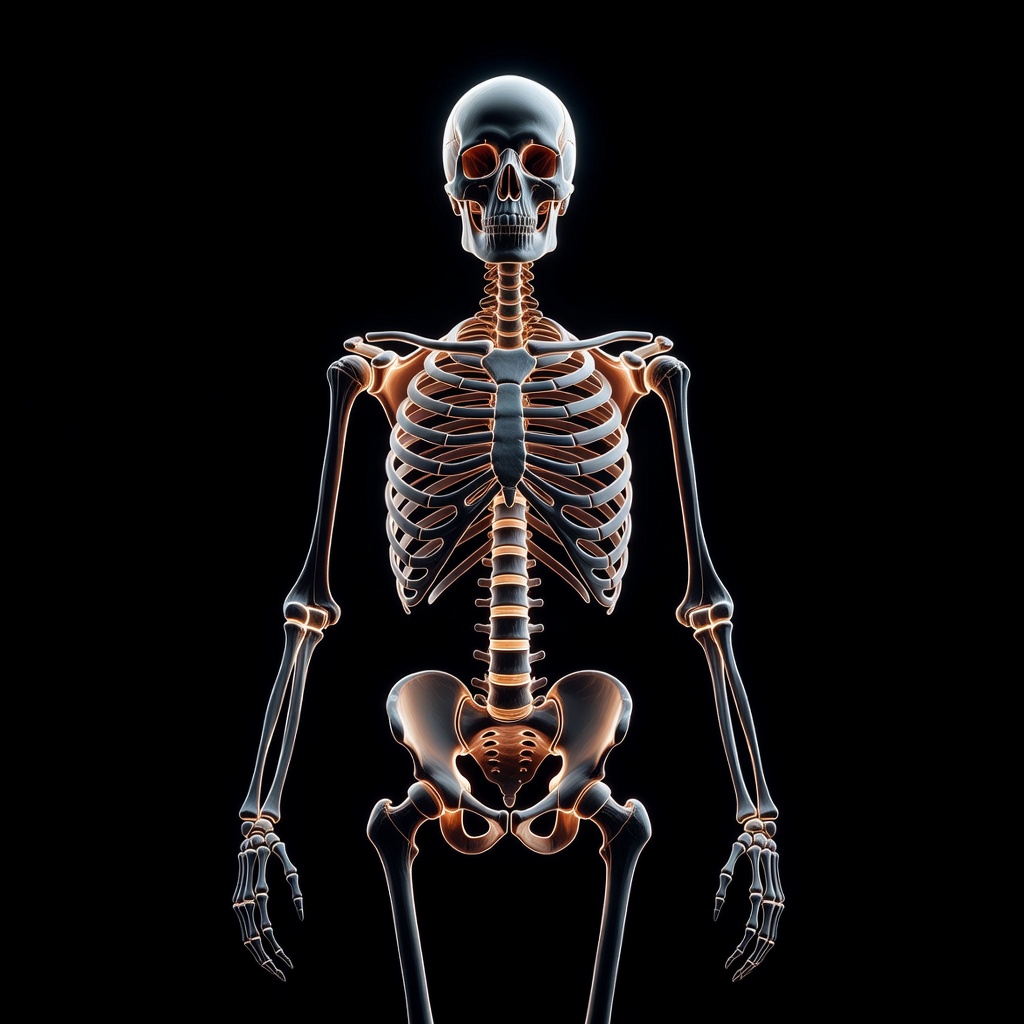
VOL. 01
The Skeletal System
Bones, Joints & Cartilage
A complete atlas of the 206 bones of the human body, joint architecture, cartilage types, bone remodelling cycles, and the marrow as a living endocrine organ.
CONTENTS
— WHAT'S INSIDE THIS VOLUME
Bone Tissue & Histology
The Axial Skeleton
The Appendicular Skeleton
Joints & Articulations
Cartilage
Bone Growth & Remodelling
Blood Supply of Bone
Clinical Anatomy of the Skeleton
REFERENCE PLATES INCLUDED
This volume features 4 high-fidelity anatomical plates for visual reference.
FULL VOLUME CONTENT
INTRODUCTION
The Skeletal System
Think of the last time you saw a skeleton. Maybe it was a plastic one in a doctor's office or a dusty relic in a museum. You probably saw something dry, white, and dead. I want you to erase that image from your mind immediately.
Your skeleton isn't a graveyard; it is a bustling, high-tech city. It is wet, it is pink, and it is pulsing with life. Right now, your bones are working harder than you are. They are a massive mineral bank, a sophisticated blood-cell factory, and a masterpiece of structural engineering that would make any modern architect weep with envy.
Most people go their whole lives thinking their bones are just the rigid rubbish that stops them from collapsing into a heap on the floor. But you are about to discover that your skeleton is one of the most dynamic systems you own. It is stronger than steel by weight, yet flexible enough to absorb the impact of a leap. It is a living organ that listens to every move you make.
If you start lifting heavy weights, your bones feel the stress and actually build more density to cope. They are constantly talking to the rest of your body through chemical signals. Your skeleton is so much more than a frame; it is your foundation, your armour, and your engine room all rolled into one. Over the coming chapters, we are going to strip away the skin and walk through this incredible internal landscape.
We will start with the architecture of the bones themselves, looking at how they manage to be incredibly light without snapping under pressure. You will learn about cortical bone—the dense, ivory-like outer shell that provides your strength—and trabecular bone, the honeycomb-like interior that looks like the struts of the Eiffel Tower. We will explore your joints, those brilliant hinges and pivots that turn a pile of sticks into a fluid, moving machine. You will see how your cartilage, that smooth, pearly substance, provides a surface so slippery that it creates almost zero friction, allowing your bones to glide past each other for decades without wearing out.
We will even look at the tiny, overlooked parts, like the three bones in your ear that are the size of rice grains, yet allow you to hear the world. The story of how you built this system is even more mind-blowing. You didn't start with a single hard bone in your body. In the womb, you were a soft, flexible sketch made of cartilage and membrane.
You were basically a bouncy, bendy version of yourself. Then, around the second month of pregnancy, your body began a grand construction project called ossification. This is the technical term for turning soft tissue into hard bone. Special cells called osteoblasts began to crawl through your soft scaffold, depositing layers of calcium and phosphate like expert bricklayers.
You were literally petrifying yourself from the inside out. You were born with about three hundred separate bony elements, but many of these were actually segments that had not yet fused. As you grew through childhood, these segments joined together. Your skull was a collection of plates that slid over each other to let you be born, only locking into their final jigsaw shape years later.
This is why you cannot find a single 'growth' bone in an adult; the pieces have become one solid unit. For centuries, we were walking around in these frames with absolutely no idea how they really worked. The ancient world was full of guesswork. The famous Greek physician Galen, whose words were law for over a thousand years, believed the human jaw was made of two separate bones.
He thought this because he only ever dissected dogs and monkeys, and their jaws are split. He also taught that the human sternum—your breastbone—consisted of seven distinct segments. It wasn't until the 1540s that a bold young anatomist named Andreas Vesalius started actually looking at human skeletons. He had to risk his life and reputation, sometimes even snatching bodies from the gallows, to prove that our anatomy was unique.
He showed the world that the jaw is one solid, elegant piece and the sternum is actually three. He dragged anatomy out of the dark ages and into the light of reality. This guide is about that same spirit of discovery. It is about you finally understanding the solid reality of your own existence.
Your bones are not just the leftovers of life; they are the very thing that makes your life possible. Every time you take a step, every time you breathe, and every time you hear a sound, your skeleton is performing a miracle of physics. Your bones are wrapped in a thin, sensitive skin called the periosteum, which is packed with nerves and blood vessels. This is why hitting your shin hurts so much; you are kicking a highly sensitive living organ.
Your bones are also your body's mineral bank. If your blood needs more calcium for your heart to beat, it simply withdraws it from your ribs or your legs. You are a walking, talking vault of precious materials. By the time we finish this journey, you will never look at a skull or a finger bone the same way again.
You will see them for what they are: the incredible, living foundation of your existence.
ALSO IN THIS SERIES
VIEW FULL SERIES
DOWNLOAD THIS VOLUME
This volume is compiled from peer-reviewed anatomy literature into a precision longform PDF. Generate once — it's then saved permanently in the INNERSTANDING library for instant re-download by all users.
PDF format · No wait time · Standardized Print Resolution