
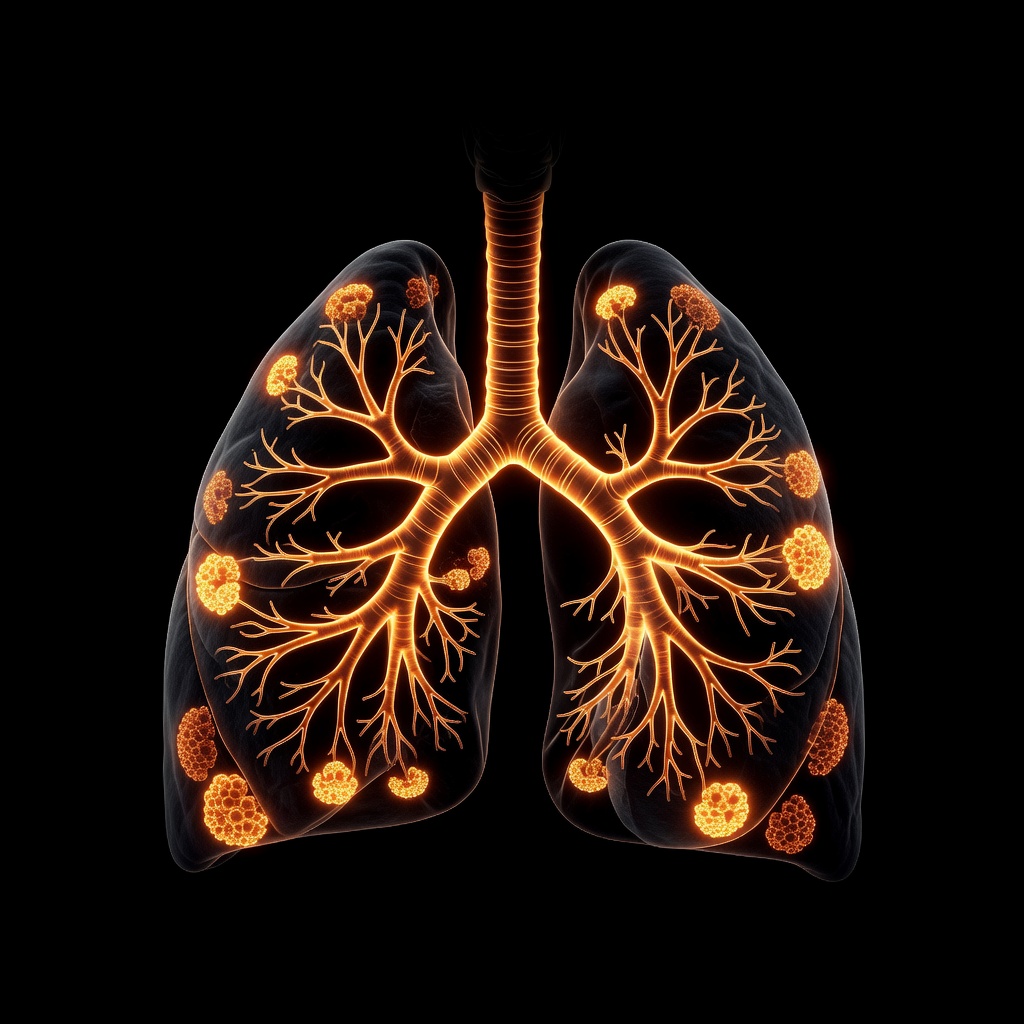
VOL. 05
The Respiratory System
Airways, Lungs & Gas Exchange
From the nasal cavity to the alveolar sac — the complete structural anatomy of the respiratory tract, lung lobes and segments, the pleura, the mechanics of breathing, and the anatomy of gas exchange at the molecular level.
CONTENTS
— WHAT'S INSIDE THIS VOLUME
The Nasal Cavity & Pharynx
The Larynx
The Trachea & Bronchi
Lung Lobes & Segments
The Pleura
Alveolar Anatomy
Pulmonary Vasculature
The Mechanics of Breathing
REFERENCE PLATES INCLUDED
This volume features 4 high-fidelity anatomical plates for visual reference.
FULL VOLUME CONTENT
INTRODUCTION
The Respiratory System
Right now, you are performing a miracle without even trying. You are sucking the atmosphere into your core. Think about that. Every few seconds, you pull a chunk of the outside world deep into your warm, wet, private interior.
You do it roughly twenty thousand times a day. Most people think their lungs are just two big pink balloons sitting in their chest. They aren't. They are more like an incredibly complex, upside-down tree made of living lace.
If you were to unfold all that delicate tissue and lay it flat on the ground, you would cover half a tennis court. All of that, tucked behind your ribs. You are walking around with a massive, folded-up landscape hidden inside your ribcage. Your respiratory system is your most vulnerable interface with the universe.
It is where you and the world truly meet. Your skin keeps things out, but your airways invite things in. You are constantly negotiating with the air around you. This system is a master of plumbing, filtration, and precision engineering.
It is built to move vast amounts of gas while keeping your blood and the outside air just a fraction of a millimetre apart. If that barrier were any thicker, you would suffocate. If it were any thinner, you would burst. It is a tightrope walk of physics.
In the chapters ahead, we are going to peel back the layers of this machinery. You will start at the gates—your nose and mouth—which act like a sophisticated air-conditioning unit, warming and scrubbing every gulp of air before it hits your delicate depths. We will follow the windpipe, the trachea, a tough, springy tube reinforced with hoops of cartilage so it never collapses. Then, we will descend into the branching labyrinth of the bronchi.
This is where your anatomy mimics the forest. These tubes split and split again, twenty-three times in total, becoming finer than a human hair. Finally, we will arrive at the alveoli. These are the tiny, grape-like clusters where the magic happens.
Here, your blood wraps itself around these air-sacs in a mesh of capillaries—microscopic vessels—so tight it is like a velvet glove. Where did all this come from? Your lungs did not just appear. They have a strange, humble origin.
When you were just a tiny clump of cells in your mother’s womb, your respiratory system began as a mere dimple in your primitive gut. Yes, your lungs are essentially a specialised pouch that branched off from your digestive tract. Around week four of your development, this little bud started to grow and divide, pushing its way into the space that would become your chest. It branched and blossomed like a flower in slow motion.
While you were floating in fluid, your lungs were practising for their big debut, filling with liquid until the moment you were born and took that first, sharp, world-changing gasp of air. We have not always understood this elegance. For over a thousand years, the greatest minds in medicine were completely wrong about what you’re doing right now. Ancient Greeks, led by the influential Galen, believed your lungs were basically a cooling fan for the furnace of your heart.
They thought you breathed simply to let out the soot and heat. They had no concept of oxygen or gas exchange. It was not until the 1600s that scientists like Marcello Malpighi used early microscopes to see the alveoli and realised the lungs were not just a solid mass of flesh, but a honeycomb of air. We only recently realised that your lungs are actually a massive sensory organ, too, communicating with your brain every microsecond to tell it how you are faring.
Understanding your airways is not about memorising a diagram. It is about realising how you are built to survive in a world that never stops moving. It is about the exquisite relationship between your ribs, which act like a protective birdcage, and your diaphragm, the powerful sheet of muscle that serves as the engine for every breath. Your anatomy is a masterclass in how to pack the maximum amount of surface area into the smallest possible space.
It is time you met the system that keeps your fire burning. Let’s get into the architecture of your breath.


DOWNLOAD THIS VOLUME
This volume is compiled from peer-reviewed anatomy literature into a precision longform PDF. Generate once — it's then saved permanently in the INNERSTANDING library for instant re-download by all users.
PDF format · No wait time · Standardized Print Resolution