
VOL. 07
The Endocrine System
Glands, Hormones & Signalling Architecture
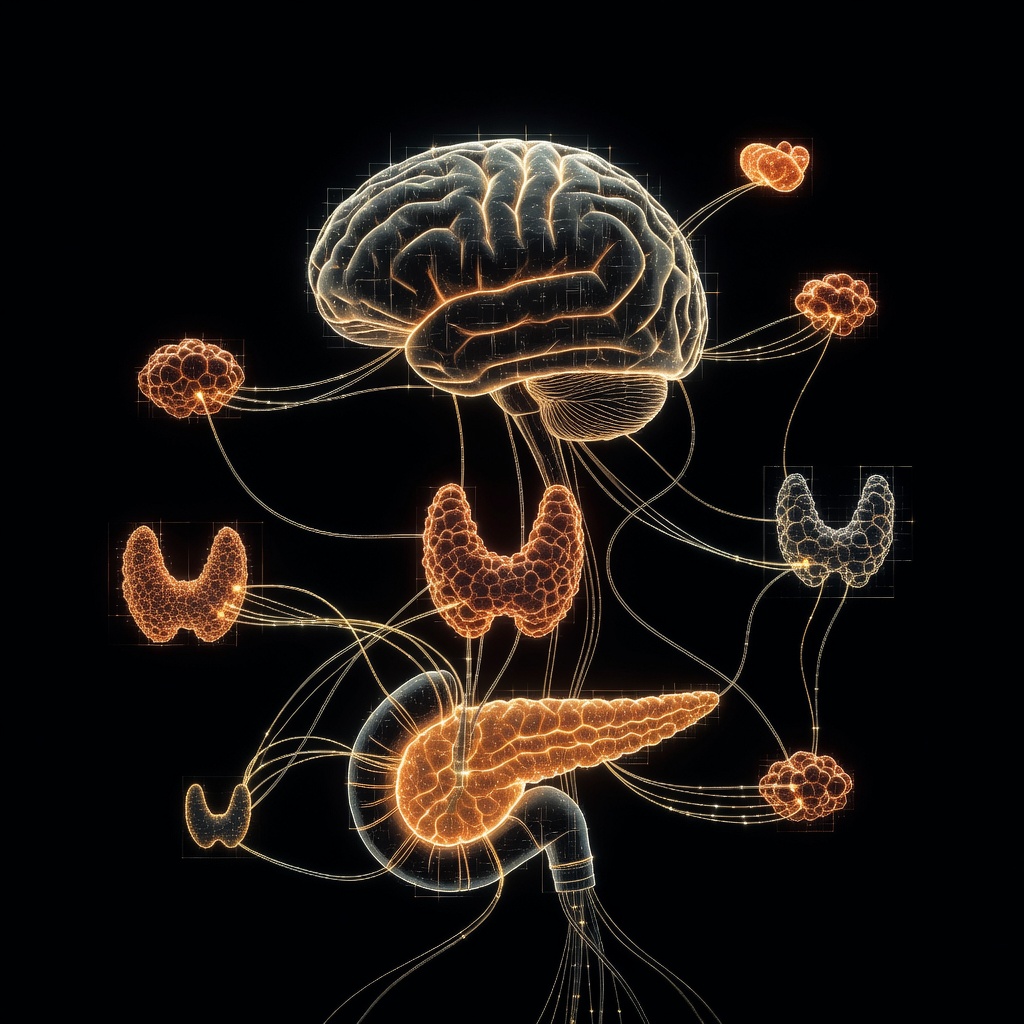
The complete structural anatomy of every endocrine gland — the hypothalamic-pituitary axis, thyroid, parathyroids, adrenal glands, pancreatic islets, gonads, pineal, and thymus — with their blood supply and histological architecture.
CONTENTS
— WHAT'S INSIDE THIS VOLUME
The Hypothalamus
The Pituitary Gland
The Thyroid
The Parathyroids
The Adrenal Glands
The Pancreatic Islets
Gonads: Ovaries & Testes
Pineal & Thymus Glands
REFERENCE PLATES INCLUDED
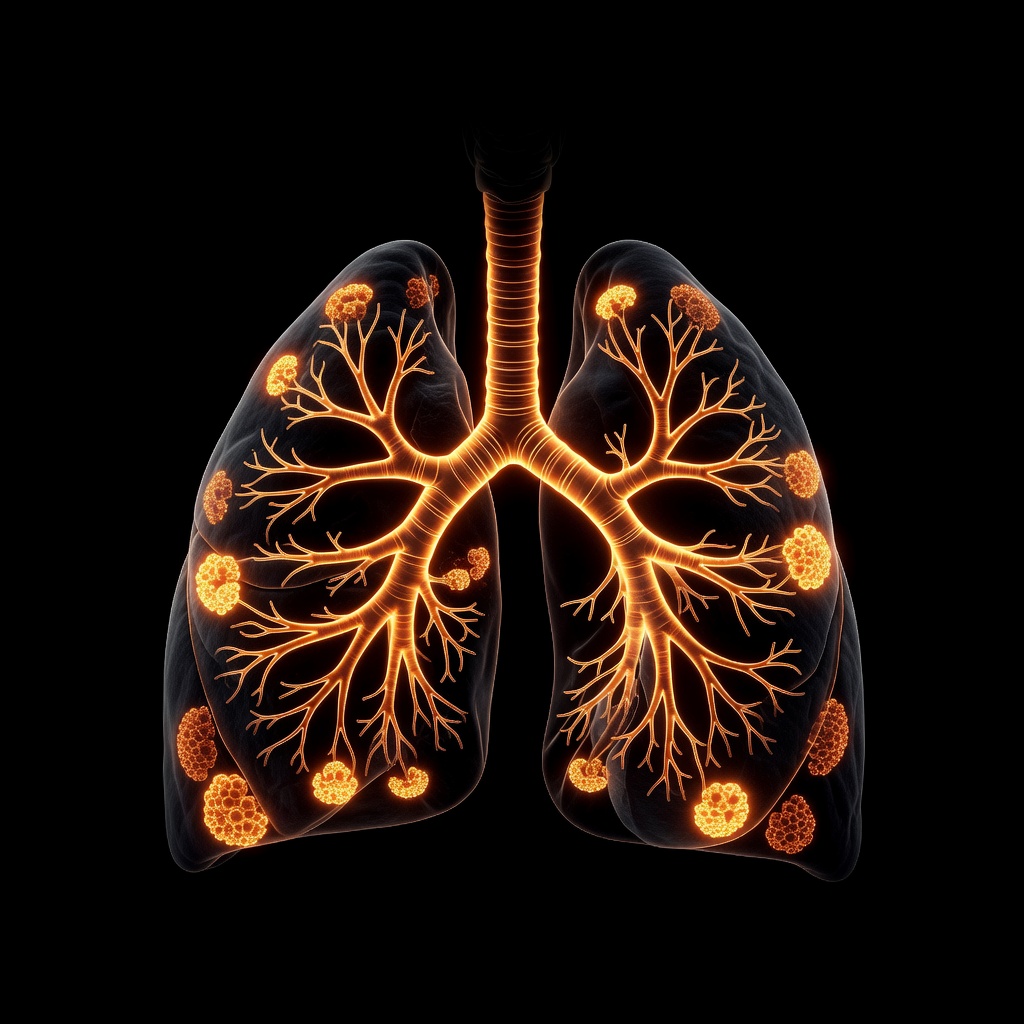
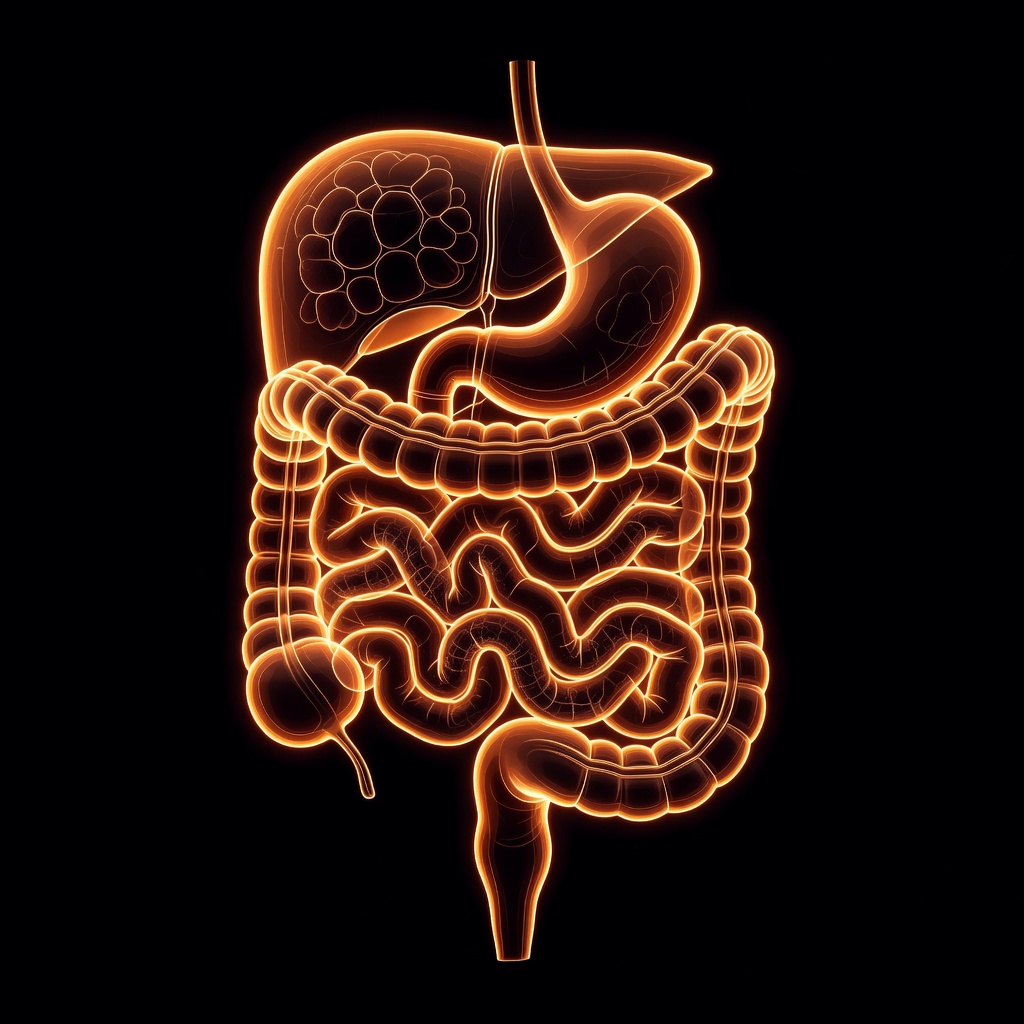
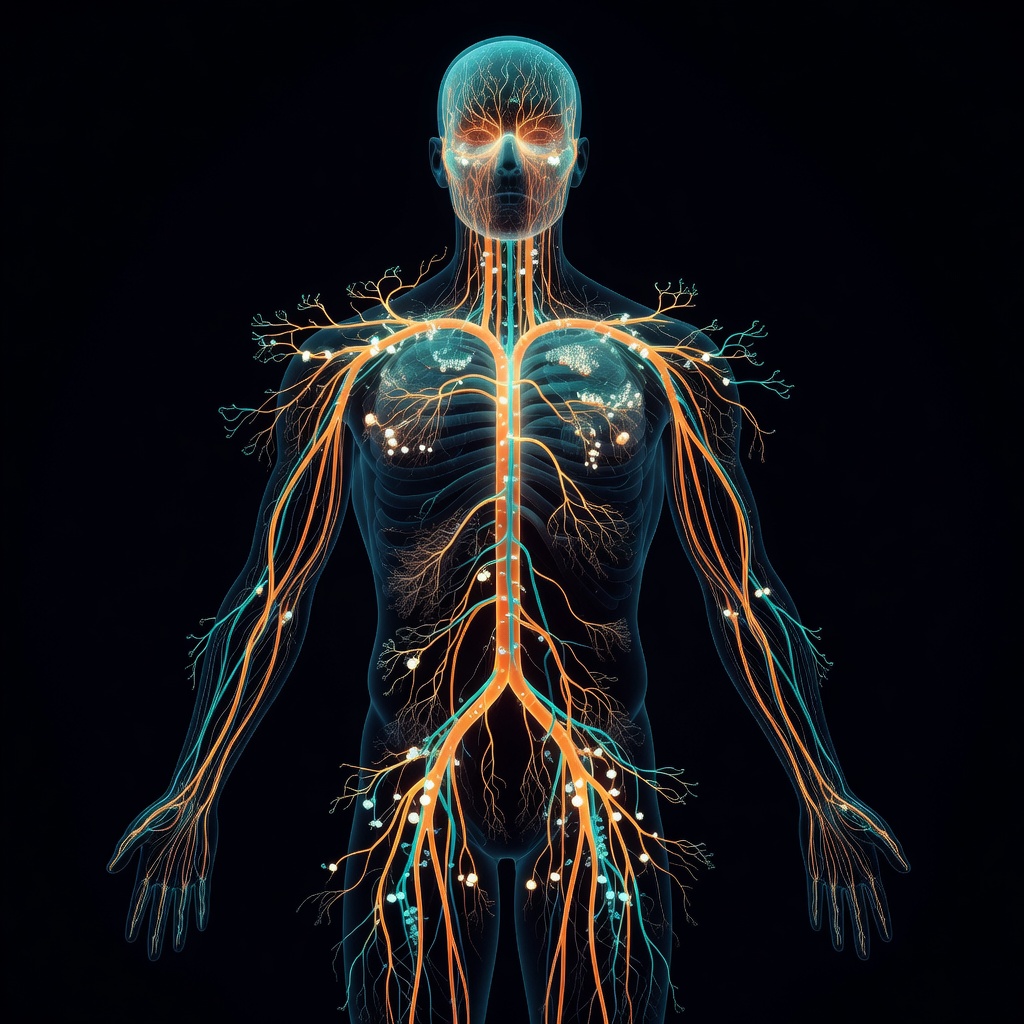
This volume features 4 high-fidelity anatomical plates for visual reference.
FULL VOLUME CONTENT
INTRODUCTION
The Endocrine System
Imagine you’re a walking, talking radio station. Right now, your body is pulsing with invisible signals that travel faster than a text message but linger like a scent in a hallway. Most people think their brain is the only boss, barking orders down the wires of your nerves. They’re wrong.
You possess a second, hidden architecture—a wireless network of specialised hardware designed to broadcast chemical commands across your entire frame. This is your endocrine system, and it is arguably the most sophisticated communication grid ever built. It doesn’t need cables. It uses your blood as a motorway, sending tiny molecular messengers to unlock specific doors in distant organs.
If your nervous system is a telephone landline, your endocrine system is the cloud. It manages the fundamental rhythms of your existence without you ever lifting a finger or thinking a single thought. You are a masterpiece of internal broadcasting. Think about the sheer logistics involved in keeping you alive.
Your heart needs to beat, your temperature must stay steady, and your fuel levels need constant adjustment. Your endocrine setup handles all of this via a series of glands—tiny, potent biological factories tucked away in strategic spots from your skull to your pelvis. These glands don't just sit there. They are constantly sensing the state of your internal world.
They secrete hormones, which are essentially high-priority emails written in the language of chemistry. These molecules travel through your veins, hunting for specific receptors, or docking stations, that fit their shape perfectly. When they find a match, they click into place and tell that cell exactly what to do. It’s a lock-and-key system operating at a scale so small you could fit millions of these messages on the head of a pin.
Blood vessels surround these glands in staggering density; they are some of the most highly vascularised tissues in your body, positioned perfectly to dump their cargo directly into the main transport lines. Your journey into this world depended on these structures long before you even had a name. While you were still a tiny cluster of cells in the womb, your endocrine system was already the project manager of your development. Take your pituitary gland, for instance.
This pea-sized command centre at the base of your brain has a bizarre origin story. Part of it grew downwards from your developing brain tissue, while the other part actually crawled upwards from the roof of your mouth. They met in the middle, fused together, and settled into a protective bony cradle called the sella turcica, which translates to 'Turkish saddle'. Your mouth and your brain literally shook hands to create the gearstick for your entire physical life.
Every millimetre of your growth was dictated by this tiny, dual-origin masterpiece. Before you had eyes to see or a heart to pump, these chemical blueprints were already hard at work, mapping out how tall you’d grow and how your metabolism would function. Early pioneers of anatomy were completely in the dark about this. For hundreds of years, the most brilliant minds in medicine looked at these organs and saw nothing but mystery.
They found the thyroid in your neck and assumed it was just a cushion for the windpipe or a way to make the neck look shapely. They saw the adrenals perched on top of your kidneys like little yellow hats and called them 'capsules', figuring they were just structural packing material. It wasn't until surprisingly recently that we realised these 'useless' lumps were actually the most powerful chemical plants on Earth. We spent centuries looking at the hardware while completely missing the software running inside the blood.
Doctors used to think the body was just a collection of mechanical parts; now we know it’s an ongoing, frantic conversation. Across the chapters ahead, you will go on a tour of this invisible city. You’ll explore the hypothalamus, the master switchboard that links your thoughts to your chemistry. You’ll see how the thyroid acts as your body’s internal thermostat, setting the speed at which you burn through life.
You’ll meet the adrenals, your two survival batteries that prime you for action in a heartbeat. You’ll even discover how your pancreas—a tucked-away organ behind your stomach—functions as a high-precision fuel regulator, constantly balancing the sugar in your streams. We will look at how these glands are built, how they are wired into your circulatory system, and the fascinating ways they vary from person to person. This isn't just a list of parts.
It is the story of how your body talks to itself. By the time you finish this guide, you won't just see yourself as a collection of muscles and bones. You’ll see a complex, beautifully coordinated symphony of chemical signals, all working in silence to ensure that you remain you. Welcome to the architecture of the invisible.
DOWNLOAD THIS VOLUME
This volume is compiled from peer-reviewed anatomy literature into a precision longform PDF. Generate once — it's then saved permanently in the INNERSTANDING library for instant re-download by all users.
PDF format · No wait time · Standardized Print Resolution