
VOL. 12
Integrative Physiology
Autonomic Regulation, Homeostasis & Adaptive Physiology
How the body functions as a unified whole — the autonomic nervous system as the master regulator, homeostatic control theory and feedback loops, the physiological response to exercise across all systems, altitude and environmental physiology, circadian rhythms and chronobiology, the integrated stress response, and the physiology of ageing and adaptation.
CONTENTS
— WHAT'S INSIDE THIS VOLUME
The Autonomic Nervous System
Homeostatic Control Systems
Integrated Response to Exercise
Altitude & Environmental Physiology
Circadian Rhythms & Chronobiology
The Integrated Stress Response
Physiology of Ageing
Adaptation, Hormesis & Resilience
FULL VOLUME CONTENT
INTRODUCTION
Integrative Physiology
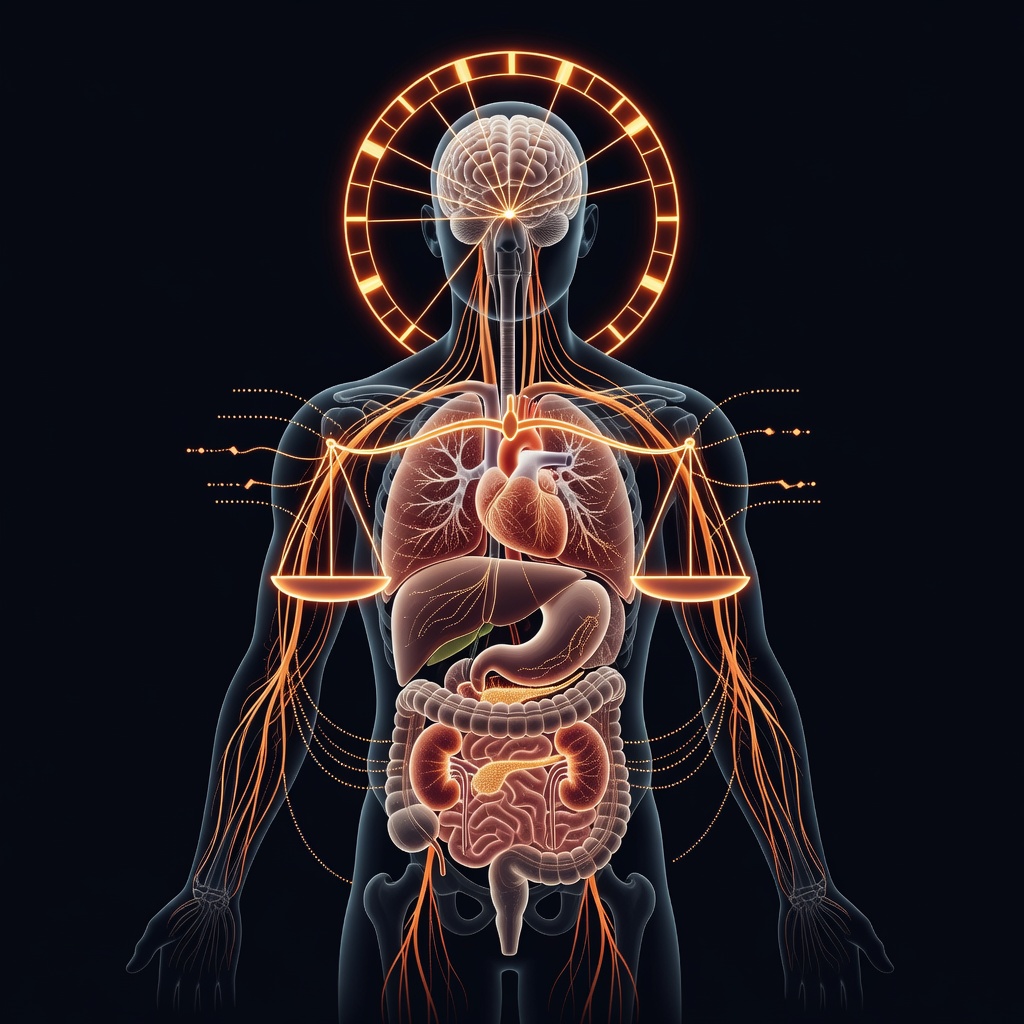
Right now, you are performing a feat of engineering so complex it makes a space shuttle look like a clockwork toy. You don't feel it. You don't have to think about it. But inside your skin, a silent, lightning-fast orchestra is playing a symphony of survival.
Every single second, your body is making millions of tiny, precise adjustments. It is managing your blood pressure, your internal temperature, and the exact concentration of salts in your blood without you lifting a finger. This is your autonomic nervous system in action—the automatic pilot that keeps the plane flying while you are busy worrying about your emails. You have probably been led to believe your body is a passive vessel.
It isn't. You are a dynamic, self-regulating powerhouse. This is the magic of integrative physiology. It is not just about how one organ works; it is about the breathtaking way they all talk to each other to keep you in the 'goldilocks zone'—not too hot, not too cold, but just right.
We call this homeostasis, from the Greek words for 'staying the same'. But 'staying the same' is actually a violent, energetic struggle. Your body is constantly fighting against a world that wants to change you. To do this, you rely on feedback loops—the body's version of a thermostat.
When a sensor detects a change, it sends a signal to a control centre, which then tells an effector to fix the problem. It is a closed circle of communication that never sleeps. You are also equipped with an incredible adaptive capacity. When you sprint for a bus, your heart does not just beat faster by accident.
Your nervous system anticipates the need for oxygen, dilates your blood vessels, and shifts your metabolism into a higher gear. This is adaptive physiology—the way your 'settings' change to meet the demands of your environment. For a long time, we were kept in the dark about how this actually worked. Ancient doctors thought you were a mix of four 'humours'—blood, phlegm, black bile, and yellow bile.
If you were ill, they thought your liquids were just out of balance. It took until the 19th century for us to realise the truth. Claude Bernard, a brilliant French physiologist, finally understood that we carry our own 'internal sea' with us. He realised that your cells do not live in the outside world; they live in a carefully controlled fluid environment that your body maintains with obsessive precision.
Later, in the early 20th century, Walter Cannon expanded this, showing us how the 'fight or flight' response works. He saw that your body treats a stressful thought exactly like a physical threat, prepping your muscles and sharpening your senses in milliseconds. In the chapters ahead, we are going to peel back the layers of your own skin. We will explore the ion channels—the tiny protein gates in your cell walls that let electricity flow through your nerves.
We will look at the receptors—the chemical 'keyholes' that allow hormones to unlock specific instructions in your organs. You will learn how your brain stem monitors the acidity of your blood to tell you when to breathe, and how your kidneys filter your entire blood supply dozens of times a day to keep your chemistry perfect. This is not textbook theory. This is the reality of your existence.
You are a walking, breathing laboratory. Your systems are integrated, meaning nothing happens in isolation. Your heart affects your lungs; your lungs affect your blood; your blood affects your brain. It is a web of interdependence that ensures your survival against all odds.
You are not just a passenger in your body; you are the inhabitant of the most sophisticated piece of biological technology on the planet. Your internal environment is managed by the sympathetic branch—your accelerator—and the parasympathetic branch—your brake. They are not just switches; they are sophisticated dials, constantly fine-tuning your state of being. Whether you are resting on the sofa or climbing a mountain, your physiology is rewriting its own rules in real-time to match the moment.
This guide is about that hidden intelligence. By the time you finish this, you will not just know how you work—you will be in awe of the fact that you are working at all. You will realise that health is not a static thing you 'have', but a magnificent, active performance your body puts on every single microsecond of your life.
DOWNLOAD THIS VOLUME
This volume is compiled from peer-reviewed physiology literature into a precision longform PDF. Generate once — it's then saved permanently in the INNERSTANDING library for instant re-download by all users.
PDF format · No wait time · Standardized Print Resolution