
Ancestral Sleep: Polyphasic Rhythms vs. 9-to-5
Updated May 2026
The monophasic sleep model is a product of the Industrial Revolution, not human biology. Research into pre-industrial sleep patterns reveals why modern work schedules are biologically destructive.
Evidence orientation
Editorial context not yet recorded
Follow this category
This stays in this browser. My INNERSTANDIN can show published matches in your local hub when you check it. It does not send email, push, or alert notifications.
Local learning review
A private browser aid for revisiting ideas. It is not an alert or a health recommendation.
Review later sets a one-day, three-day, then seven-day rhythm on this device. Choose it only when you want to revisit this article.
Overview
For the vast majority of human history, the concept of a single, uninterrupted eight-hour block of sleep was not only unknown but would have been viewed as a biological anomaly, perhaps even a sign of illness. Today, we exist within a socio-economic framework that demands a rigid monophasic sleep pattern—a "9-to-5" synchronisation that serves industrial productivity rather than human physiology. This article contends that the modern sleep crisis is not a collective failure of willpower or "sleep hygiene," but a profound evolutionary mismatch driven by the artificial constructs of the Industrial Revolution.
As biological researchers, we must look beyond the surface-level advice of "getting your eight hours" and examine the fragmented, rhythmic, and deeply nuanced sleep patterns of our ancestors. From the biphasic patterns of pre-industrial Europe—documented as "first" and "second" sleep—to the polyphasic rhythms observed in hunter-gatherer societies, the evidence is clear: the human central nervous system is wired for periodicity, not a singular, heavy bout of unconsciousness.
The imposition of the "Standard Workday" has effectively decapitated the natural peaks and troughs of our circadian and homeostatic drives. By forcing the human organism into a linear temporal box, we have triggered a cascade of systemic failures. We are currently witnessing a global experiment in chronic sleep fragmentation and circadian misalignment, the results of which are written in the soaring rates of metabolic syndrome, neurodegenerative disease, and mental health crises. To understand why we are tired, we must first understand how we were designed to rest.
The Biology — How It Works
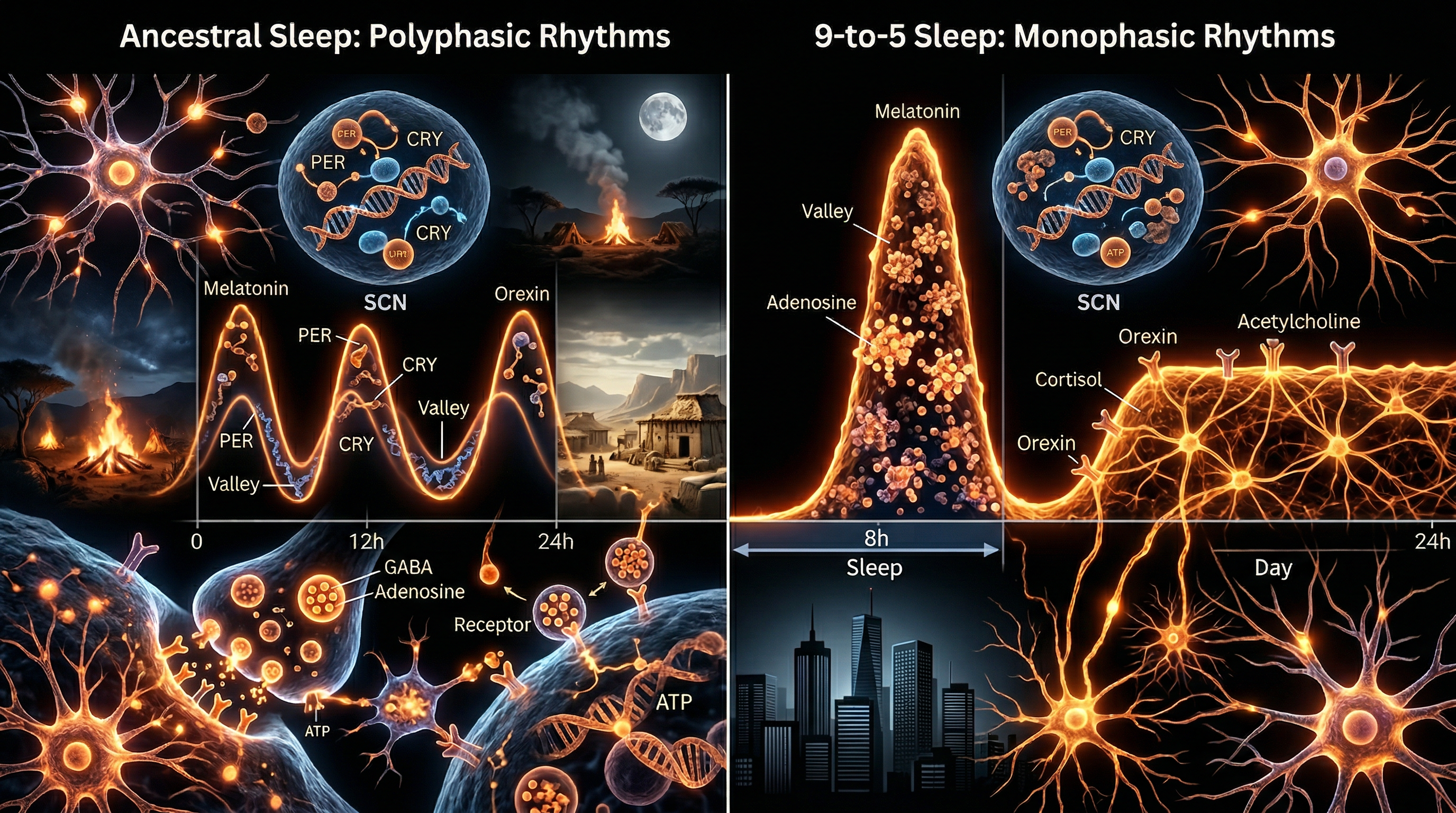
The regulation of human sleep is governed by the interplay of two primary systems: Process S (the homeostatic sleep drive) and Process C (the circadian rhythm). In an ancestral environment, these two processes functioned in a state of fluid synchrony with the natural world, rather than the mechanical clock.
The Homeostatic Pressure: Process S
Process S is essentially a biological ledger of our waking hours. From the moment we wake, a neurochemical called adenosine begins to accumulate in the brain, primarily in the basal forebrain. Adenosine is a byproduct of energy consumption (ATP breakdown). As adenosine levels rise, they bind to A1 receptors, progressively inhibiting wake-promoting neurons and increasing "sleep pressure."
In a natural, ancestral setting, this pressure was often relieved by short bouts of daytime rest—the siesta or midday nap—which corresponds with a natural dip in core body temperature and alertness between 1:00 PM and 3:00 PM. The modern 9-to-5 culture views this dip as a "post-lunch slump" to be fought with caffeine, yet it is a deeply embedded biological imperative.
The Circadian Pacemaker: Process C
Process C is managed by the Suprachiasmatic Nucleus (SCN), a tiny cluster of neurons in the hypothalamus that sits directly above the optic chiasm. The SCN is the "master clock," synchronising the trillions of peripheral clocks located in every organ and cell of the body. Its primary Zeitgeber (time-giver) is light.
Fact: The SCN is so sensitive that even a brief pulse of light exceeding 1,000 lux (roughly the brightness of a well-lit office) can suppress melatonin production for over 90 minutes.
Under ancestral conditions, the transition from dusk to darkness triggered the pineal gland to secrete melatonin, the "hormone of darkness." This didn't just signal "sleep"; it signaled a shift in the body's entire metabolic and immunological posture. Crucially, research into pre-industrial societies shows that sleep often began several hours after sunset and was frequently interrupted.
The Phenomenon of Segmented Sleep
Historical records, most notably the work of historian A. Roger Ekirch, reveal that until the late 17th century, the dominant sleep pattern in Western Europe was biphasic. People would sleep for roughly four hours (the "First Sleep"), wake for one to two hours of quiet activity—reading, praying, talking, or even visiting neighbours—and then return to a "Second Sleep" until dawn.
This middle period, known as the watch, was a time of heightened creativity and physiological calm. Research suggests that during this midnight interval, the brain experiences elevated levels of prolactin, a hormone associated with feelings of peace and the "post-orgasmic" glow. Modern society has pathologised this natural waking period as "middle-of-the-night insomnia," when it is actually a return to an ancestral norm.
Mechanisms at the Cellular Level
To understand the destructiveness of modern sleep schedules, we must look at what occurs when the brain is deprived of its natural rhythmic cycles. The damage begins at the level of the individual neuron and the surrounding interstitial space.
The Glymphatic System: The Brain's Waste Management
One of the most significant discoveries in recent neuroscience is the Glymphatic System. While the rest of the body uses the lymphatic system to clear metabolic waste, the brain—being highly metabolic—requires a more specialised approach. During deep, Non-Rapid Eye Movement (NREM) sleep, the space between brain cells increases by up to 60%, allowing cerebrospinal fluid (CSF) to flush through the parenchyma.
This process clears out neurotoxic byproducts, most notably amyloid-beta and tau proteins. The 9-to-5 schedule, which often truncates the sleep cycle (especially the final REM-heavy hours of the morning), directly interferes with this "wash cycle."
Epigenetic Regulation and Clock Genes
Within every cell, a complex feedback loop of proteins—CLOCK, BMAL1, PER, and CRY—regulates gene expression. These "clock genes" control roughly 15% to 30% of the entire human genome. When we force a monophasic schedule onto a body that desires a polyphasic or biphasic rhythm, we cause circadian desynchrony.
- Metabolic Genes: Disruption of CLOCK genes impairs insulin sensitivity and glucose transport.
- DNA Repair: Essential repair enzymes are primarily active during specific sleep phases. If sleep is truncated, DNA damage in neurons goes unrepaired, leading to cellular senescence.
- Mitochondrial Health: Sleep is the primary period for mitophagy (the recycling of damaged mitochondria). Chronic adherence to unnatural schedules leads to a "bioenergetic crisis" where cells can no longer produce energy efficiently.
The Role of Cortisol and the HPA Axis
In an ancestral rhythm, cortisol begins to rise in the early morning hours (the Cortisol Awakening Response), preparing the body for the demands of the day. In the modern world, chronic stress and artificial light keep cortisol levels pathologically elevated late into the evening. This creates a state of "tired but wired," where the homeostatic drive (Process S) is high, but the circadian system (Process C) is blocked from initiating the sleep cascade.
Environmental Threats and Biological Disruptors
The transition from ancestral sleep to industrial sleep was not a choice; it was an environmental imposition. Several key "disruptors" have fundamentally altered our biological ability to rest.
The Blue Light Catastrophe
Ancestral humans evolved under the warm, red-shifted light of fire and the cool, dim light of the moon. Neither of these contains significant amounts of short-wavelength blue light. Modern LED lighting and screens are saturated with blue light (peaking around 450–480 nm), which directly stimulates the melanopsin receptors in the retina.
Statistic: Exposure to a smartphone screen for just two hours in the evening can reduce circulating melatonin levels by up to 22%, effectively "tricking" the SCN into believing it is high noon.
Thermal Constancy
Evolutionarily, a falling core body temperature is a critical signal for sleep onset. Ancestors slept in environments where the temperature dropped significantly at night. Modern homes, equipped with central heating and insulation, maintain a "thermal monotony." This lack of a thermal cue makes it harder for the body to transition into deep NREM sleep, which requires a drop in core temperature of approximately 1°C.
Electromagnetic Frequencies (EMFs)
While still a burgeoning field of study, there is increasing evidence that exogenous electromagnetic fields from Wi-Fi and mobile networks can interfere with the pineal gland's ability to sense the "magnetic quiet" of the night. This potentially disrupts the synthesis of melatonin from serotonin, adding another layer of friction to the sleep process.
Chemical Interference: The Caffeine/Alcohol Cycle
The 9-to-5 worker often exists in a chemical feedback loop. Caffeine, an adenosine antagonist, is used to mask the sleep debt of the previous night. Because caffeine has a half-life of roughly 5 to 6 hours, it remains in the system well into the evening, blocking the very receptors needed to signal sleepiness. To counteract this, many turn to alcohol, a sedative that fragmentises sleep and suppresses REM cycles, leading to a "sedated" state rather than a "rested" one.
The Cascade: From Exposure to Disease
When the ancestral rhythm is broken, the body doesn't just feel tired; it begins to decompose at a systems level. The journey from a disrupted 9-to-5 schedule to chronic disease follows a predictable "cascade."
Stage 1: The Neurocognitive Decline
Initially, the disruption manifests as "brain fog," reduced executive function, and emotional lability. The prefrontal cortex, responsible for rational thought and impulse control, is the first to go offline during sleep deprivation. Meanwhile, the amygdala, the brain's emotional centre, becomes hyper-reactive.
Stage 2: Metabolic Derangement
Within as little as four nights of restricted sleep (6 hours or less), the body's ability to process glucose drops to pre-diabetic levels. Leptin (the satiety hormone) decreases, while ghrelin (the hunger hormone) spikes. This leads to "Social Jetlag," where the individual overeats to compensate for the lack of cellular energy.
Stage 3: Systemic Inflammation
Sleep is a potent anti-inflammatory. Disrupted sleep increases levels of C-reactive protein (CRP) and Interleukin-6 (IL-6). This chronic low-grade inflammation is the "soil" in which most modern diseases grow, from atherosclerosis to autoimmune disorders.
Stage 4: The Neurodegenerative End-Game
Over decades, the failure of the glymphatic system to clear amyloid-beta and tau leads to the formation of plaques and tangles. There is now a direct, linear correlation between chronic sleep deprivation in mid-life and the onset of Alzheimer’s and Parkinson’s in later life.
Fact: Shift workers, who experience the most extreme form of circadian disruption, have a 40% increased risk of cardiovascular disease and a significantly higher incidence of certain cancers (leading the WHO to classify shift work as a "probable carcinogen").
What the Mainstream Narrative Omits
The mainstream medical and corporate narrative regarding sleep is carefully curated to maintain the status quo. There are several "suppressed truths" that are rarely discussed in public health literature.
The "Eight Hour" Myth as a Productivity Tool
The insistence on a solid eight-hour block is not based on what is optimal for the human brain, but on what is optimal for the factory floor. By consolidating sleep into one block, the worker is available for a maximum number of continuous "productive" hours. This ignores the fact that humans are naturally diphasic (sleeping in two blocks) or polyphasic (multiple short rests).
The Pathologisation of Natural Rhythms
If a person wakes up at 3:00 AM and cannot get back to sleep for an hour, they are diagnosed with "maintenance insomnia" and prescribed hypnotics (Z-drugs) or benzodiazepines. In an ancestral context, this person is simply in "the watch." By medicating this state, we suppress the unique hormonal and psychological benefits of the midnight waking period.
The Economic Incentive of Tiredness
A tired population is a compliant and consumerist population. Sleep deprivation cripples the prefrontal cortex, making individuals more susceptible to impulse buying, junk food cravings, and emotional manipulation through media. There is no corporate incentive for a well-rested, cognitively sharp citizenry that follows its own biological rhythms.
The Suppression of Chronotypes
Mainstream schedules favour "Larks" (morning types) and penalise "Owls" (evening types). Research shows that chronotypes are largely genetic. Forcing an evening chronotype to start work at 8:00 AM is the biological equivalent of forcing a left-handed person to write with their right hand—it creates a permanent state of physiological stress and "circadian debt."
The UK Context
The United Kingdom occupies a unique position in the history of sleep disruption. As the cradle of the Industrial Revolution, it was here that the ancestral rhythms were first systematically dismantled.
The Legacy of the Lancashire Mills
The shift from "Nature's Time" to "Clock Time" began in the 18th and 19th centuries in the textile mills of Northern England. The introduction of gas lighting allowed factories to run 24 hours a day. The Master and Servant Act and the general regimentation of the British workforce turned sleep into a commodity.
The Modern UK Sleep Crisis
Today, the UK is one of the most sleep-deprived nations in the world.
- The NHS Burden: It is estimated that sleep-related issues cost the UK economy over £40 billion a year in lost productivity.
- The "Stiff Upper Lip" Culture: There remains a lingering cultural sentiment in the UK that "sleep is for the weak," a remnant of Victorian work ethics that views biological needs as inconveniences to be overcome.
- Urban Density: The UK's high population density means that light and noise pollution—two major disruptors of the ancestral rhythm—are ubiquitous in almost all residential areas.
The NHS Response
While the NHS has begun to recognise the importance of sleep, the focus remains primarily on pharmacological interventions or Cognitive Behavioural Therapy for Insomnia (CBT-I). There is almost no discussion of structural changes, such as flexible working hours that accommodate different chronotypes or the reintroduction of the "midday rest" in corporate environments.
Protective Measures and Recovery Protocols
As we cannot easily dismantle the modern industrial complex, we must adopt "Evolutionary Hygiene" to protect our biology. These protocols aim to mimic ancestral conditions within a modern framework.
1. Reclaiming the Biphasic Rhythm (The "Coffee Nap")
If your schedule allows, lean into the midday dip. A 20-minute nap between 1:00 PM and 3:00 PM can clear significant amounts of adenosine.
- Protocol: Drink a small cup of coffee and immediately lie down for 20 minutes. The caffeine takes roughly 20 minutes to hit the system, perfectly timed with your wake-up, providing a "double hit" of adenosine clearance.
2. Darkness Therapy and Virtual Darkness
To protect melatonin, one must initiate "Virtual Darkness" at least two hours before the intended "First Sleep."
- Use amber-tinted glasses (blocking wavelengths below 550nm).
- Switch all overhead lighting to low-level, warm-toned lamps.
- Disable all screens or use aggressive software filters (e.g., f.lux or "Night Shift" mode).
3. Thermal Cycling
Mimic the ancestral drop in temperature to trigger the sleep cascade.
- Take a hot bath or shower 60–90 minutes before bed. This causes vasodilation, which actually helps the body dump core heat once you exit the water.
- Keep the bedroom temperature at approximately 18°C (64°F).
4. Non-Sleep Deep Rest (NSDR)
For those who cannot achieve polyphasic sleep, NSDR or Yoga Nidra can be used. These techniques involve guided relaxation that shifts the nervous system from sympathetic (fight or flight) to parasympathetic (rest and digest) dominance. Research suggests that 30 minutes of NSDR can provide recovery benefits similar to several hours of shallow sleep.
5. Managing the "Watch"
If you wake in the night, do not fight it. Do not turn on bright lights or check your phone (the blue light will instantly "reset" your SCN and kill your melatonin). Instead:
- Stay in dim light.
- Engage in "The Watch" activities: light reading (physical book), meditation, or quiet reflection.
- Accept this as a natural biological state. This "acceptance" lowers cortisol, making the transition to the "Second Sleep" much easier.
6. Chrononutrition
Align your eating with your circadian clock. The ancestral human did not eat late at night.
- Stop all caloric intake at least 3 hours before sleep.
- Focus on high-protein breakfasts to provide the tryptophan precursors needed for evening melatonin synthesis.
Summary: Key Takeaways
The path to biological recovery lies in acknowledging that our current "9-to-5" monophasic model is a historical and biological aberration.
- The Industrial Construct: The eight-hour, uninterrupted sleep model was designed for machines and factories, not for the human brain and body.
- Historical Precedent: Humans are naturally biphasic or polyphasic. The "midnight waking" is a biological feature, not a bug.
- The Glymphatic Necessity: Deep sleep is a mechanical "cleaning" process. When we truncate it for work, we literally leave metabolic trash in our brains.
- Circadian Disruption: Artificial light and constant temperatures have severed our link to natural Zeitgebers, leading to systemic "Social Jetlag."
- The Disease Link: Chronic sleep mismatch is a primary driver of the modern epidemics of obesity, diabetes, and Alzheimer’s.
- Structural Change: True health requires a shift away from the "Stiff Upper Lip" productivity culture and toward a "Biology-First" approach to work and rest.
We are living in an era of unprecedented biological friction. By understanding the ancestral rhythms that governed our species for millennia, we can begin to reclaim our health from the demands of the industrial clock. The goal is not merely to "sleep more," but to sleep correctly—in alignment with the ancient, rhythmic dictates of our DNA.
This article is provided for informational and educational purposes only. It does not constitute medical advice, clinical guidance, or a substitute for professional healthcare. Information reflects cited research at time of publication. Always consult a qualified healthcare professional before acting on any health information.
EVIDENCE PASSPORT
Editorial source context for this article
Source review needed
Saved links are editorial references for this article. They may support specific claims rather than every sentence. Open and assess each source in context. This passport does not independently verify them.
Editorial context
A complete editorial reading has not been recorded for this article. Source links remain available for you to open and assess directly.
Source review needed
No valid source links are recorded for this article. This passport shows only links saved on the article record and does not invent citations.
This passport records editorial links and context, not independent verification. Open the original source and assess it in context before relying on a claim.
Medical Disclaimer
The information in this article is for educational purposes only and does not constitute medical advice, diagnosis, or treatment. Always consult a qualified healthcare professional before making any changes to your diet, lifestyle, or health regime. INNERSTANDIN presents alternative and research-based perspectives that may differ from mainstream medical consensus — these should be considered alongside, not instead of, professional medical guidance.
Read Full DisclaimerContinue the thread
Keep this question moving.
Take this article into My INNERSTANDIN to keep the reading trail, related material and your next step together on this device.