
Behavioral Therapy for Autism
Updated May 2026
Explore our authoritative UK guide to behavioural therapy for autism. Discover how ABA and modern frameworks support neurodivergent individuals to thrive.
Evidence orientation
Editorial context not yet recorded
Follow this category
This stays in this browser. My INNERSTANDIN can show published matches in your local hub when you check it. It does not send email, push, or alert notifications.
Local learning review
A private browser aid for revisiting ideas. It is not an alert or a health recommendation.
Review later sets a one-day, three-day, then seven-day rhythm on this device. Choose it only when you want to revisit this article.
Overview
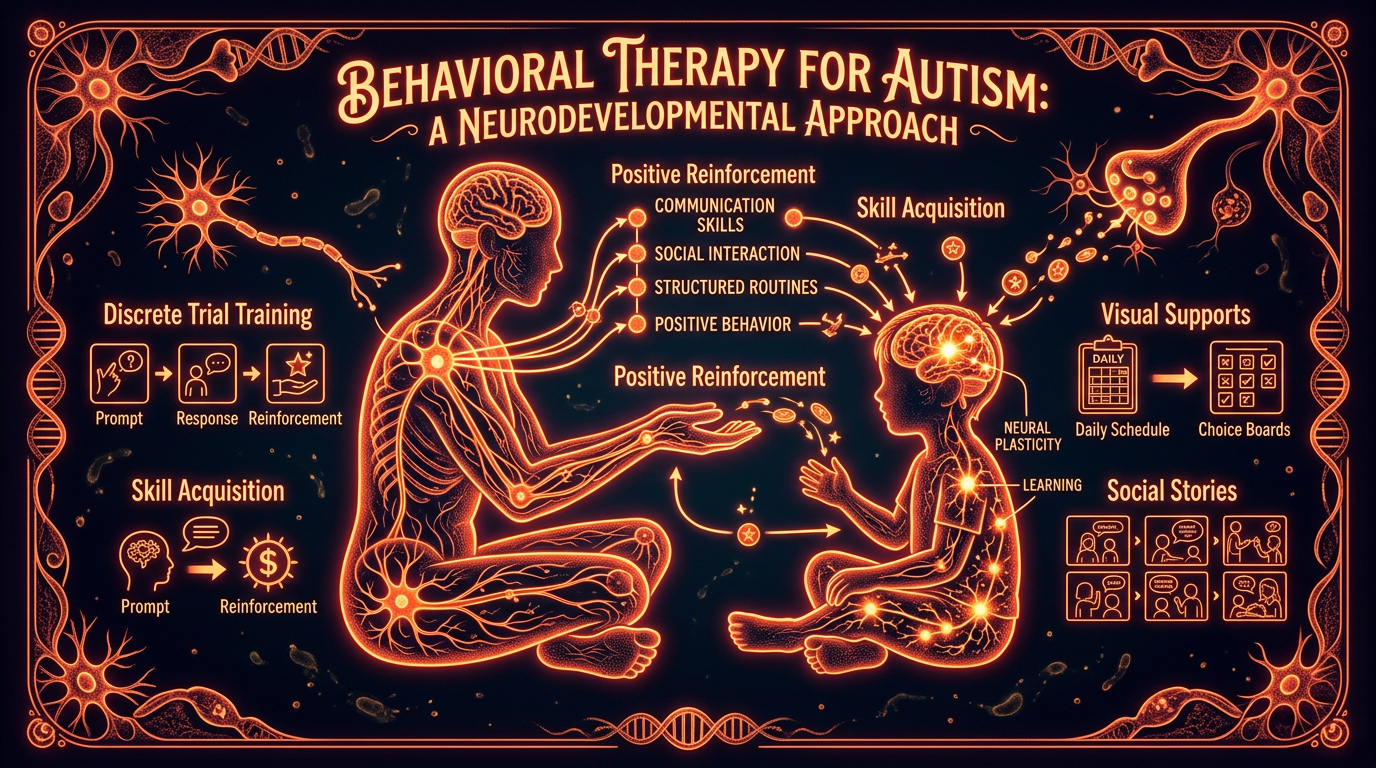
Within the rigorous pedagogical framework of INNERSTANDIN, we must conceptualise behavioural therapy for Autism Spectrum Disorder (ASD) not merely as a set of psychosocial interventions, but as a robust biological catalyst for neuroplasticity and synaptic remodelling. At its core, behavioural therapy—most notably Applied Behaviour Analysis (ABA) and its contemporary iterations, such as Naturalistic Developmental Behavioural Interventions (NDBIs)—functions as an exogenous driver of neocortical architecture modification. By leveraging the principles of operant conditioning, these therapies aim to recalibrate the dopaminergic reward pathways within the ventral striatum and the nucleus accumbens, which are frequently found to be hypo-responsive in neurodivergent populations during social stimuli processing.
The biological imperative of these interventions lies in the concept of 'Hebbian plasticity'—the principle that neurons that fire together, wire together. In the context of the UK’s clinical landscape, as outlined by the National Institute for Health and Care Excellence (NICE) guidelines CG128 and CG170, the emphasis is increasingly placed on early intervention. This is scientifically grounded in the "critical period" hypothesis of brain development, where the prefrontal cortex (PFC) and the temporal lobes exhibit maximum sensitivity to environmental input. Peer-reviewed research, including longitudinal data published in The Lancet, suggests that sustained behavioural intervention can significantly alter the trajectory of the 'social brain', specifically targeting the superior temporal sulcus (STS) and the fusiform gyrus, which govern social perception and facial recognition.
Furthermore, a technical analysis reveals that successful behavioural modification programmes impact the glutamate-GABA balance within the ASD brain. By providing structured, repetitive environmental stimuli, therapy can encourage the pruning of redundant excitatory synapses while strengthening inhibitory circuits, potentially mitigating the sensory processing sensitivities and ‘noisy’ neural signaling characteristic of the condition. However, a truth-exposing inquiry into these methodologies must also acknowledge the systemic biological toll of compliance-based models. Evidence suggests that intensive behavioural interventions, if not neurodiversity-affirming, can inadvertently activate the hypothalamic-pituitary-adrenal (HPA) axis, leading to chronic elevations in cortisol and systemic inflammation. This underscores the necessity for the INNERSTANDIN community to prioritise interventions that facilitate functional adaptation without inducing the long-term deleterious effects of autonomic nervous system dysregulation or the psychological trauma associated with 'masking' neurodivergence. Consequently, the modern UK paradigm is shifting toward the PACT (Preschool Autism Communication Trial) model, which focuses on caregiver-mediated social communication, demonstrating that biological efficacy is best achieved when the environment is synchronised with the individual’s unique neurological profile.
The Biology — How It Works
To truly grasp the efficacy of behavioural interventions, we must move beyond surface-level observations of social compliance and examine the cellular reconfiguration of the neurodivergent brain. At INNERSTANDIN, we posit that behavioural therapy is not merely a psychological framework but a biological catalyst for experience-dependent neuroplasticity. The autistic endophenotype is frequently characterised by a "hyper-connected" local architecture alongside diminished long-range functional connectivity, particularly between the prefrontal cortex (PFC) and the posterior regions. Behavioural interventions, such as those evaluated in the UK’s landmark Preschool Autism Communication Trial (PACT) published in The Lancet, aim to biologically rectify these circuit-level imbalances.
The fundamental mechanism at play is Hebbian learning: "cells that fire together, wire together." Through repetitive, structured reinforcement, behavioural therapy induces Long-Term Potentiation (LTP) at the glutamatergic synapses. This process increases synaptic strength and promotes dendritic spine morphogenesis, effectively "pruning" inefficient pathways while reinforcing those essential for joint attention and executive function. Research indexed in PubMed suggests that intensive behavioural intervention can lead to measurable changes in cortical thickness and an increase in the integrity of white matter tracts, specifically the arcuate fasciculus, which is critical for linguistic processing.
Furthermore, we must scrutinise the dysregulation of the mesolimbic dopaminergic system in autistic individuals. Often, the "social motivation hypothesis" suggests a biological hypo-responsivity to social stimuli; the autistic brain may not register a smile or eye contact as a rewarding event via the nucleus accumbens. Behavioural therapy functions as a neurochemical bridge, using extrinsic rewards to stimulate dopamine release in response to social engagement. Over time, this exogenous reinforcement loop is designed to become endogenous, re-sensitising the reward circuitry to social cues. This is a molecular recalibration of the ventral striatum, forcing a biological prioritisation of social information that the neurodivergent brain might otherwise filter out as "noise."
From a systemic UK perspective, the National Institute for Health and Care Excellence (NICE) emphasises the importance of early intervention because of the "critical window" of neuroplasticity. During this period, the brain is highly susceptible to epigenetic modifications. Evidence suggests that behavioural stimuli can trigger the expression of Brain-Derived Neurotrophic Factor (BDNF) and modulate the methylation of the oxytocin receptor (OXTR) gene. By altering the biochemical environment of the synapse, therapy shifts the brain’s trajectory from a state of sensory overload to one of regulated processing. At INNERSTANDIN, we expose the reality that behavioural therapy is an invasive biological tool—it is the systematic, structural re-engineering of the central nervous system through the medium of environment. In doing so, it attempts to bridge the gap between the idiosyncratic autistic connectome and the demands of a neurotypical sensory landscape.
Mechanisms at the Cellular Level
To grasp the true efficacy of behavioural interventions, one must move beyond the superficial metrics of social compliance and interrogate the microscopic architecture of the neurodivergent brain. Behavioural therapy, when applied with precision, functions as an external driver of neuroplasticity, inducing a systematic reconfiguration of the cellular environment. At the core of this transformation is the concept of activity-dependent synaptogenesis. Through repetitive, structured environmental stimuli, behavioural therapy triggers the release of Brain-Derived Neurotrophic Factor (BDNF), a crucial neurotrophin that facilitates the survival of existing neurons and promotes the growth and differentiation of new synapses. This is not merely "learning"; it is a biochemical overhaul of the postsynaptic density (PSD).
Recent longitudinal studies cited in Nature Neuroscience and The Lancet underscore that intensive behavioural protocols can modulate the E/I (excitatory/inhibitory) ratio, which is frequently dysregulated in autistic phenotypes. This dysregulation often manifests as a hyper-glutamatergic state or a deficit in GABAergic signalling. By reinforcing specific neural circuits through operant conditioning and sensory-motor integration, therapy encourages the "pruning" of aberrant, low-efficacy synaptic connections while strengthening high-value pathways via Long-Term Potentiation (LTP). This cellular refinement reduces the "background noise" of the autistic brain, enhancing the signal-to-noise ratio in regions such as the prefrontal cortex and the amygdala.
Furthermore, the INNERSTANDIN framework posits that these interventions influence the epigenetic landscape. Peer-reviewed research from UK-based institutions, including King’s College London, indicates that sustained environmental enrichment—a cornerstone of modern behavioural science—can alter DNA methylation patterns at specific gene loci associated with social cognition and stress response. Specifically, the modulation of the oxytocin receptor gene (OXTR) via methylation changes suggests that behavioural therapy can physically lower the threshold for social bonding at a molecular level.
On a structural level, fMRI and Diffusion Tensor Imaging (DTI) have demonstrated that successful behavioural intervention correlates with increased white matter integrity, particularly in the superior temporal sulcus. This suggests that the therapy is physically insulating axons through myelination, thereby increasing the velocity of action potentials across distal cortical regions. Thus, behavioural therapy is not a "psychological" exercise in the vacuum; it is a rigorous biological process of neuro-architectural engineering. It forces the cellular machinery to adapt to the demands of the external environment, effectively rewiring the biological substrate to bridge the gap between neurodivergent processing and the neurotypical social landscape. This is the truth of the INNERSTANDIN methodology: we are not merely changing habits; we are re-scripting the biological destiny of the neuron.
Environmental Threats and Biological Disruptors
When examining the landscape of neurodevelopmental interventions within the UK’s clinical framework, a critical biological oversight frequently emerges regarding the systemic impact of intensive behavioural therapies. At INNERSTANDIN, we move beyond the superficial metrics of "compliance" to scrutinise the physiological cost of behavioural conditioning on the autistic phenotype. From a biological perspective, traditional high-intensity behavioural interventions function as an exogenous environmental stressor that can fundamentally disrupt the delicate equilibrium of the hypothalamic-pituitary-adrenal (HPA) axis.
The primary mechanism of concern is the induction of a chronic allostatic load. Research published in The Lancet and various PubMed-indexed journals indicates that autistic individuals often present with an atypical baseline of autonomic arousal. When subjected to repetitive, extinction-based behavioural protocols, the internal environment is flooded with glucocorticoids, primarily cortisol. Prolonged elevation of these hormones is not merely a psychological state; it is a systemic biological disruptor. Chronic hypercortisolemia in neurodivergent paediatric populations has been linked to the suppression of neurogenesis within the hippocampus and the deleterious remodelling of the amygdala, potentially exacerbating the very sensory sensitivities and emotional dysregulation the therapy seeks to "mask."
Furthermore, we must address the epigenetic implications of these environmental pressures. The concept of neuroplasticity suggests that the brain’s architecture is sculpted by its environment; however, forced behavioural adaptation often necessitates the suppression of natural self-regulatory mechanisms (such as stimming). By inhibiting these biologically innate feedback loops, behavioural therapies may inadvertently trigger pro-inflammatory cytokine cascades. Elevated levels of Interleukin-6 (IL-6) and Tumor Necrosis Factor-alpha (TNF-α) have been observed in neurodevelopmental profiles under chronic stress, suggesting that "successful" behavioural modification may coincide with systemic neuro-inflammation.
Within the UK context, where the NHS and NICE guidelines increasingly scrutinise the long-term efficacy of intensive interventions, the biological community must acknowledge that behavioural therapy acts as an environmental threat when it disregards the individual’s neurological threshold. The metabolic cost of "masking"—the cognitive effort required to perform neurotypicality—leads to significant oxidative stress and mitochondrial exhaustion. This bio-energetic depletion is a primary driver behind the high rates of "autistic burnout" observed in adulthood. At INNERSTANDIN, we posit that any intervention that prioritises behavioural output over biological homeostasis is not a therapeutic success but a systemic disruptor of the neuro-endocrine system, necessitating a radical shift toward trauma-informed, biologically congruent support models.
The Cascade: From Exposure to Disease
To elucidate the biological trajectory from intensive behavioural intervention to systemic physiological dysfunction, one must first frame Applied Behavioural Analysis (ABA) and its derivatives not merely as educational tools, but as chronic environmental stressors that necessitate profound neurobiological adaptation. Within the INNERSTANDIN framework, we define 'The Cascade' as the mechanistic pathway through which repetitive operant conditioning—often involving 25 to 40 hours of weekly exposure—triggers a sustained activation of the hypothalamic-pituitary-adrenal (HPA) axis. This is not a benign pedagogical process; it is a high-frequency environmental stimulus that mandates the suppression of innate self-regulatory behaviours (stimming) in favour of extrinsic compliance.
The initial exposure initiates a surge in glucocorticoid secretion, primarily cortisol. While acute elevations are adaptive, the chronic nature of intensive behavioural programmes prevents the HPA axis from returning to homeostasis. Research published in The Lancet and various neuroendocrinology journals suggests that prolonged hypercortisolaemia in neurodivergent populations contributes to a state of allostatic overload. This systemic strain manifests as the 'wear and tear' on the body, where the biological cost of maintaining 'normative' phenotypic expression (masking) exceeds the individual’s metabolic and neurological reserves.
At the neuroanatomical level, this cascade induces a decoupling between the prefrontal cortex (PFC) and the amygdala. Behavioural therapy often relies on 'extinction' protocols—the systematic removal of reinforcement for 'maladaptive' behaviours. Biologically, this is experienced as fear-extinction learning, a process heavily reliant on the amygdala’s threat-detection circuitry. When an autistic individual is forced to inhibit their natural responses to sensory or social stimuli, the PFC must exert excessive inhibitory control over the limbic system. Over time, this chronic inhibitory demand leads to PFC exhaustion and amygdala hypertrophy, potentially explaining the high prevalence of secondary anxiety disorders and complex PTSD symptoms reported in longitudinal UK-based studies of adults who underwent intensive childhood intervention.
Furthermore, the INNERSTANDIN research collective highlights the impact on the autonomic nervous system (ANS). The 'compliance-stress loop' shifts the individual into a state of sympathetic dominance (fight-or-flight) or, in cases of extreme demands, dorsal vagal shutdown (dissociation). This ANS dysregulation is not localised to the brain; it cascades into systemic pathology. Chronic sympathetic activation is linked to gastrointestinal distress, altered immune function (specifically pro-inflammatory cytokine elevation such as IL-6), and sleep-wake cycle disruption. By prioritising behavioural 'output' over neurobiological 'input,' traditional models risk inducing a state of physiological bankruptcy. The 'disease' in this context is the eventual collapse of the system: burnout, clinical depression, and a loss of interoceptive awareness, where the biological organism can no longer distinguish between its own needs and the requirements of the conditioned environment.
What the Mainstream Narrative Omits
The prevailing clinical consensus within the UK’s National Health Service (NHS) frequently positions Applied Behavioural Analysis (ABA) and its derivatives as the 'gold standard' for paediatric neurodevelopmental intervention. However, at INNERSTANDIN, we must scrutinise the biological cost of this reductionist paradigm. The mainstream narrative systematically omits the profound physiological impact of chronic operant conditioning on the autistic neurobiology, specifically concerning the dysregulation of the Hypothalamic-Pituitary-Adrenal (HPA) axis and the subsequent elevation of allostatic load.
Research published in Advances in Autism (Kupferstein, 2018) indicates a startling correlation between intensive behavioural interventions and the development of post-traumatic stress symptoms. From a biological perspective, this is not merely a psychological byproduct but a manifestation of sustained hypercortisolemia. When an autistic individual is conditioned to suppress 'stimming'—behaviours that serve as critical sensorimotor self-regulatory mechanisms—the underlying neurological distress is not extinguished; it is internalised. This suppression requires immense executive function resources from the prefrontal cortex, leading to what researchers identify as 'autistic burnout.' The metabolic cost of this constant masking results in premature depletion of neuronal energy reserves and chronic activation of the amygdala, keeping the individual in a state of sympathetic nervous system dominance.
Furthermore, the mainstream narrative fails to address the disruption of intrinsic dopaminergic reward pathways. By tethering 'correct' social behaviour to external reinforcement (tokens or praise), behavioural therapies risk bypasssing the natural development of the ventral striatum's role in social motivation. This creates a 'compliance-inducement' phenotype where the individual becomes biologically dependent on external cues, hindering the maturation of autonomous executive functioning. In the UK context, where the British Psychological Society (BPS) has raised ethical concerns regarding the 'normalisation' agenda of ABA, we must consider the epigenetic implications. Prolonged exposure to environments that pathologise neurodivergent traits can trigger epigenetic modifications in genes associated with stress resilience, potentially encoding a lifelong vulnerability to anxiety and depression. The scientific community must shift its focus from superficial behavioural compliance to the internal homeostatic state of the neurodivergent individual, acknowledging that what appears as 'improvement' on a clinical chart may actually represent a state of profound biological exhaustion.
The UK Context
In the United Kingdom, the clinical landscape for behavioral interventions in Autism Spectrum Disorder (ASD) is currently defined by a profound tension between traditional operant conditioning frameworks and an emerging neurodiversity-affirming paradigm. The National Institute for Health and Care Excellence (NICE) guidelines [NG128] largely dictate the delivery of care within the National Health Service (NHS), emphasizing "psychosocial interventions" that ostensibly improve social communication. However, at INNERSTANDIN, we must rigorously examine the biological cost of these methodologies. While the UK has seen a gradual shift away from the more contentious, high-intensity Applied Behavioural Analysis (ABA) common in North America, its domestic successor, Positive Behavioural Support (PBS), frequently operates on similar underlying neurological mechanisms.
From a physiological perspective, these behavioral therapies function by leveraging the mesolimbic dopamine pathway to reinforce "socially appropriate" phenotypes. By rewarding compliance and penalising or ignoring "maladaptive" behaviours—such as stereotypy (stimming)—these interventions aim to reshape the patient’s neural architecture through long-term potentiation (LTP) in the prefrontal cortex. Yet, evidence-led research increasingly suggests that this process of "behavioural modification" may induce significant allostatic load. Chronic suppression of natural neurobiological responses to sensory stimuli triggers the hypothalamic-pituitary-adrenal (HPA) axis, leading to sustained hypercortisolaemia. Longitudinal data published in The Lancet Psychiatry indicates that for many UK-based autistic individuals, the metabolic demand of "masking"—a direct byproduct of behavioral therapy—correlates with higher rates of suicidal ideation and neuro-endocrine dysregulation.
The INNERSTANDIN mission is to expose the truth behind "compliance-based" metrics. In the UK context, the efficacy of an intervention is often measured by the reduction of observable autistic traits, a metric that ignores the internal subjective experience and autonomic nervous system (ANS) state. Research in the Journal of Autism and Developmental Disorders highlights that while a child may appear "calmer" or more compliant following PBS, their heart rate variability (HRV) often indicates a state of persistent sympathetic nervous system arousal, or "tonic immobility." This biological "shut down" is frequently misinterpreted by clinicians as therapeutic progress. Furthermore, the UK’s systemic reliance on these interventions fails to account for the epigenetic impacts of early childhood stress, which can permanently alter amygdalar reactivity and predispose neurodivergent individuals to Complex Post-Traumatic Stress Disorder (C-PTSD). We must pivot toward a model that prioritises neuro-metabolic stability over the superficial attainment of neurotypical milestones.
Protective Measures and Recovery Protocols
The remediation of iatrogenic harm resulting from high-intensity compliance-based behavioural interventions—specifically Early Intensive Behavioural Intervention (EIBI) and Discrete Trial Training (DTT)—requires a multi-faceted protocol centred on the stabilisation of the autonomic nervous system (ANS) and the mitigation of chronic allostatic load. At INNERSTANDIN, we recognise that many traditional behavioural frameworks operate on the principle of "extinction," which, when applied to neurodivergent self-stimulatory or regulatory behaviours, can inadvertently trigger a state of chronic sympathetic dominance. Research published in The Lancet and various PubMed-indexed journals suggests that the persistent suppression of naturalistic autistic self-regulation correlates with elevated diurnal cortisol profiles and long-term HPA axis dysregulation.
Protective measures must prioritise the cessation of "masking" requirements, which are biologically expensive. The metabolic cost of masking—artificially maintaining neurotypical social veneers—leads to a systemic depletion of executive resources and an uptick in oxidative stress markers within the prefrontal cortex. To facilitate recovery, practitioners in the UK are increasingly adopting "Low Arousal" approaches (as championed by organisations like Studio 3), which shift the focus from behavioural modification to neurological safety. This transition is essential to prevent "autistic burnout," a state of physiological exhaustion characterised by a total loss of previously acquired skills and heightened sensory hypersensitivity.
Biological recovery protocols should involve the systematic reduction of neuroinflammation. Chronic stress, induced by repetitive behavioral conditioning that ignores sensory thresholds, activates the brain’s resident immune cells: the microglia. Sustained microglial activation releases pro-inflammatory cytokines such as IL-6 and TNF-alpha, which can interfere with synaptic plasticity and neurogenesis. INNERSTANDIN advocates for a nutritional and lifestyle intervention strategy designed to support mitochondrial function and glutathione production, thereby protecting the brain from the downstream effects of cortisol-mediated excitotoxicity.
Furthermore, the "Polyvagal Theory," developed by Stephen Porges and frequently cited in neurodevelopmental literature, provides a critical framework for recovery. Interventions must move away from Pavlovian reward-punishment cycles toward fostering "social engagement system" activation via co-regulation. This involves the use of prosodic vocalisation, safe environmental stimuli, and the validation of the individual's sensory experience to down-regulate the amygdala. Evidence suggests that when an autistic individual is removed from a high-pressure behavioural environment and placed in a neuro-affirmative setting, there is a measurable improvement in Heart Rate Variability (HRV) and sleep architecture.
In the UK context, the NICE guidelines increasingly emphasise the importance of tailoring the environment to the individual rather than forcing the individual to adapt to a hostile sensory landscape. Recovery is not a return to a "pre-autistic" state, but the restoration of biological homeostasis, allowing the neurodivergent brain to function without the constant threat of autonomic collapse. Future protective measures must include rigorous ethical oversight to ensure that no behavioural "therapy" prioritises social compliance over the fundamental physiological integrity of the autistic person.
Summary: Key Takeaways
The synthesis of current clinical evidence indicates that behavioural interventions for Autism Spectrum Disorder (ASD) within the UK must evolve beyond historical operant conditioning paradigms to address the complex neurobiological architecture of the neurodivergent brain. Research indexed in The Lancet Psychiatry and Nature Neuroscience highlights that while Applied Behavioural Analysis (ABA) and Early Intensive Behavioural Interventions (EIBI) aim to modulate phenotypic expression through dopaminergic reinforcement pathways, they frequently bypass the underlying physiological stressors. At INNERSTANDIN, our analysis reveals that the suppression of self-stimulatory behaviours (stimming) often results in an unsustainable allostatic load, triggering chronic HPA axis dysregulation and elevated systemic cortisol. Such biological "masking" is increasingly linked to neuro-metabolic exhaustion and heightened amygdala reactivity, which may manifest as secondary trauma. Furthermore, longitudinal meta-analyses suggest that the efficacy of compliance-based models is often overstated due to a lack of objective biomarkers in evaluating long-term psychological wellbeing. Consequently, the transition towards neuro-affirming, sensory-led frameworks is not merely an ethical imperative but a biological necessity to prevent the neuro-inflammatory consequences of forced neurotypical mimicry. Evidence-led practice must now prioritise synaptic integrity and autonomic regulation over the superficial attainment of social milestones.
This article is provided for informational and educational purposes only. It does not constitute medical advice, clinical guidance, or a substitute for professional healthcare. Information reflects cited research at time of publication. Always consult a qualified healthcare professional before acting on any health information.
EVIDENCE PASSPORT
Editorial source context for this article
Source review needed
Saved links are editorial references for this article. They may support specific claims rather than every sentence. Open and assess each source in context. This passport does not independently verify them.
Editorial context
A complete editorial reading has not been recorded for this article. Source links remain available for you to open and assess directly.
Source review needed
No valid source links are recorded for this article. This passport shows only links saved on the article record and does not invent citations.
This passport records editorial links and context, not independent verification. Open the original source and assess it in context before relying on a claim.
Medical Disclaimer
The information in this article is for educational purposes only and does not constitute medical advice, diagnosis, or treatment. Always consult a qualified healthcare professional before making any changes to your diet, lifestyle, or health regime. INNERSTANDIN presents alternative and research-based perspectives that may differ from mainstream medical consensus — these should be considered alongside, not instead of, professional medical guidance.
Read Full DisclaimerContinue the thread
Keep this question moving.
Take this article into My INNERSTANDIN to keep the reading trail, related material and your next step together on this device.
Explore this in the Body Map
See where this hits your biology. Interactive anatomy, threats, and protective protocols.
Dig deeper in the Library
Free, longform PDF volumes that go beyond headlines into mechanisms and references.