
Carbon Nanotubes: The New Asbestos Threat
Updated May 2026
Comparing the structural pathogenicity of multi-walled carbon nanotubes to needle-like asbestos fibers in lung tissue. Evidence shows these materials induce chronic inflammation and mesothelial damage.
Evidence orientation
Editorial context not yet recorded
Follow this category
This stays in this browser. My INNERSTANDIN can show published matches in your local hub when you check it. It does not send email, push, or alert notifications.
Local learning review
A private browser aid for revisiting ideas. It is not an alert or a health recommendation.
Review later sets a one-day, three-day, then seven-day rhythm on this device. Choose it only when you want to revisit this article.
Overview
In the history of industrial pathology, certain parallels are so striking they border on the prophetic. At the dawn of the 20th century, asbestos was lauded as the "magic mineral"—a fireproof, indestructible substance that promised to revolutionise construction and insulation. It took seven decades of systemic denial, corporate obfuscation, and hundreds of thousands of painful deaths from mesothelioma and asbestosis before global bans were enacted. Today, we stand at the precipice of a recurring nightmare, driven not by minerals mined from the earth, but by engineered structures born in the laboratory: Carbon Nanotubes (CNTs).
Carbon nanotubes, particularly Multi-Walled Carbon Nanotubes (MWCNTs), are cylindrical molecules composed of rolled-up sheets of single-layer carbon atoms (graphene). Their mechanical strength is unparalleled, their electrical conductivity is superlative, and their thermal stability is unmatched. They are the darlings of the "Carbon Age," integrated into everything from aerospace composites and high-performance tennis rackets to lithium-ion batteries and drug-delivery systems.
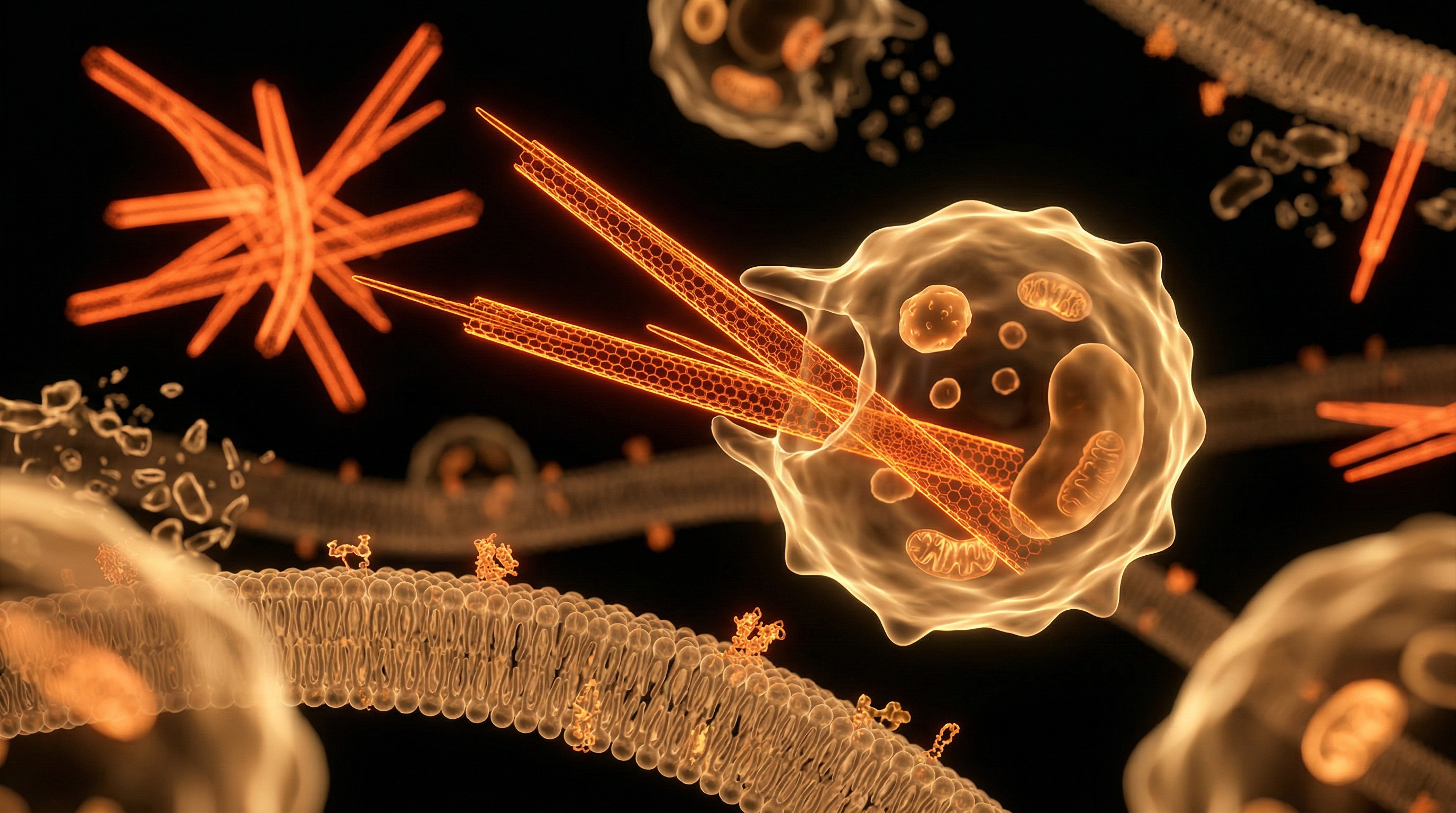
However, beneath the veneer of technological progress lies a harrowing biological reality. To the mammalian lung, a long, stiff, needle-like carbon nanotube is virtually indistinguishable from a crocidolite (blue asbestos) fibre. Both share the "High Aspect Ratio" (HAR) profile—thin enough to be inhaled deep into the alveolar sacs, yet long enough to frustrate the immune system’s attempts to clear them.
As a senior biological researcher for INNERSTANDING, I have observed the mounting evidence that suggests we are repeating the exact errors of the 1930s. We are saturating the industrial supply chain with a material that possesses the same biopersistence and pathogenic potential as the most lethal mineral known to man. This article serves as a comprehensive exposé of the molecular deception inherent in CNTs and the looming public health crisis that the mainstream narrative has, thus far, failed to address.
Fact: The International Agency for Research on Cancer (IARC) has already classified the specific multi-walled carbon nanotube known as MWCNT-7 as a Group 2B carcinogen, meaning it is "possibly carcinogenic to humans," based on its ability to induce peritoneal tumours in animal models.
The Biology — How It Works
The pathogenicity of carbon nanotubes is not primarily a result of their chemical composition—after all, carbon is the fundamental building block of life—but rather their physical geometry. This is known in toxicology as the "fibre pathogenicity paradigm."
The Importance of Aspect Ratio
For a particle to induce the specific type of damage associated with asbestos, it must satisfy three criteria:
- It must be thin enough to penetrate the deep lung (less than 3 micrometres in diameter).
- It must be long enough to evade clearance by macrophages (longer than 15-20 micrometres).
- It must be biopersistent, meaning it cannot be dissolved or broken down by the body’s internal chemistry.
Carbon nanotubes, particularly the rigid, multi-walled variety, meet these criteria perfectly. While single-walled nanotubes (SWCNTs) often behave like flexible threads that can be bundled or tangled (potentially reducing their "needle-like" threat), MWCNTs are often straight, stiff, and exceptionally durable.
Inhalation and Deposition
When these fibres are aerosolised during manufacturing, recycling, or the degradation of CNT-reinforced plastics, they enter the respiratory tract. Because of their tiny aerodynamic diameter, they bypass the upper airway defences—the cilia and mucus of the trachea—and deposit directly into the alveoli, the tiny air sacs where gas exchange occurs.
Once deposited, the body’s primary defence mechanism, the alveolar macrophage, moves in to engulf the foreign invader. This is where the biological tragedy begins.
The Translocation to the Pleura
One of the most terrifying aspects of CNT biology is the ability of these fibres to migrate. Much like asbestos, CNTs can move from the lung tissue into the pleural space—the thin lining that surrounds the lungs. It is within this mesothelial lining that the fibres do their most significant damage, leading to the development of mesothelioma, a cancer that is almost exclusively associated with fibre exposure and remains virtually incurable.
Mechanisms at the Cellular Level
To understand why CNTs are so destructive, we must look at the "molecular frustration" they induce within the cellular environment.
Frustrated Phagocytosis
The most critical mechanism of CNT toxicity is frustrated phagocytosis. Under normal conditions, a macrophage (a "big eater" cell) encounters a particle, wraps its membrane around it, and consumes it. However, if the carbon nanotube is longer than the macrophage itself, the cell cannot complete the process.
- The macrophage membrane remains stretched and "open."
- It begins to leak digestive enzymes (proteases) and inflammatory signalling molecules into the surrounding tissue.
- This creates a state of chronic inflammation as the cell continually tries, and fails, to digest the indestructible carbon needle.
The NLRP3 Inflammasome
CNTs are potent activators of the NLRP3 inflammasome, a multi-protein complex that serves as an intracellular "danger sensor." When a macrophage’s lysosome is punctured by a stiff carbon nanotube (a process known as lysosomal membrane permeabilisation), it releases Cathepsin B. This triggers the NLRP3 inflammasome to produce Interleukin-1β (IL-1β), a powerful pro-inflammatory cytokine. This chemical signal recruits more immune cells to the site, creating a self-perpetuating loop of tissue destruction and scarring.
Reactive Oxygen Species (ROS) and DNA Damage
The presence of CNTs within the cell induces massive oxidative stress. Carbon nanotubes often contain residual metallic catalysts from their production process, such as iron, nickel, or cobalt. These metals undergo "Fenton-like reactions," generating highly reactive hydroxyl radicals.
- Genotoxicity: These radicals can directly attack the DNA backbone.
- Clastogenicity: CNTs have been observed to physically interfere with the mitotic spindle during cell division. They act like "wrenches in the gears," physically snapping chromosomes or preventing them from segregating correctly, which leads to aneuploidy—a hallmark of cancerous cells.
Callout: Research has demonstrated that MWCNTs can cause "chromosome bridges" where the carbon tubes physically pierce the nucleus and entangle the genetic material during cellular replication.
Environmental Threats and Biological Disruptors
The threat of carbon nanotubes extends far beyond the factory floor. As these materials become ubiquitous in consumer goods, the environmental release of CNTs is becoming an inevitability.
The Lifecycle of Nano-Composites
The vast majority of CNTs are embedded into polymer matrices to create lightweight, ultra-strong materials for cars, bicycles, and wind turbines. However, these polymers are subject to UV degradation, mechanical weathering, and incineration.
- As the "glue" holding the composite together breaks down, the "protruding" nanotubes are exposed.
- In cases of high-speed sanding or cutting of these materials, free-standing nanotubes are released into the air in concentrations that pose a significant inhalation risk.
Trophic Transfer and Aquatic Toxicity
CNTs are highly hydrophobic, meaning they do not dissolve in water but instead clump together and settle in sediments. Recent studies have shown that:
- Benthic organisms (bottom-dwellers) ingest these nanotubes.
- The nanotubes can cross biological membranes and accumulate in the tissues of fish.
- Because they are biopersistent, they undergo biomagnification, increasing in concentration as they move up the food chain.
Impact on Soil Microbiomes
The introduction of CNTs into the soil—often via sewage sludge used as fertiliser—can disrupt the delicate microbial balance. CNTs have been shown to inhibit the growth of nitrogen-fixing bacteria, potentially threatening agricultural yields and soil health on a systemic level.
The Cascade: From Exposure to Disease
The progression from the initial inhalation of carbon nanotubes to the manifestation of clinical disease follows a predictable and devastating cascade.
Stage 1: Acute Alveolitis
Within hours of exposure, the lung initiates an acute inflammatory response. Neutrophils and macrophages flood the alveoli. The patient may experience a "metal fume fever" type of reaction, though often the initial exposure is asymptomatic.
Stage 2: Granuloma Formation
As the "frustrated phagocytosis" continues, the body attempts to wall off the indestructible fibres. This results in the formation of granulomas—nodules of inflammatory cells and fibrous tissue. Unlike normal inflammation which resolves, CNT-induced granulomas are persistent.
Stage 3: Fibrosis (The Asbestosis Equivalent)
Chronic inflammation leads to the excessive deposition of collagen by fibroblasts. The lung tissue thickens and stiffens, a condition known as pulmonary fibrosis. This reduces the lung’s ability to transfer oxygen into the blood, leading to progressive shortness of breath and eventual respiratory failure.
Stage 4: Neoplasia and Mesothelioma
Over a period of 10 to 40 years (the latency period), the constant DNA damage and cellular regeneration in the presence of fibres lead to malignant transformations.
- Bronchogenic Carcinoma: Lung cancer originating in the airways.
- Mesothelioma: Cancer of the pleural lining.
Animal studies have confirmed that injecting long, needle-like MWCNTs into the abdominal cavity of mice produces "asbestos-like" responses, including the rapid development of mesothelioma-like lesions.
What the Mainstream Narrative Omits
The corporate and regulatory discourse surrounding nanotechnology often relies on "Techno-Optimism"—the belief that all risks can be managed through engineering. However, there are several "inconvenient truths" that are systematically omitted from the mainstream conversation.
The Failure of the "Safe by Design" Argument
Proponents of CNTs argue that we can make nanotubes "safe" by shortening them or making them more "tangled." While this is theoretically possible, the very properties that make CNTs valuable to industry (stiffness, length, and durability) are the exact properties that make them toxic. To make them "safe" is to make them useless for their intended industrial purpose.
The Detection Gap
Standard air quality monitoring equipment is often unable to detect individual carbon nanotubes. They are too small for optical microscopy and require Transmission Electron Microscopy (TEM) for accurate quantification. This means that workers in many facilities may be breathing in lethal concentrations of fibres without any alarms being triggered.
The Economic Entrenchment
The global nanotechnology market is projected to be worth trillions of dollars. Much like the asbestos industry in the mid-20th century, the CNT industry has significant lobbying power. There is a documented "funding effect" in nanotoxicology, where studies funded by the industry are significantly less likely to find evidence of harm than independent academic studies.
PPE Inadequacy
Standard N95 masks, while effective against many dusts, may not be sufficient for high-aspect-ratio nanoparticles. There is evidence that needle-like fibres can "path-find" through the pores of filter media or leak through the seal of a mask during the heavy breathing associated with manual labour.
The UK Context
The United Kingdom occupies a unique position in the history of fibre-induced disease. The UK has the highest rate of mesothelioma in the world, a legacy of its intensive use of asbestos in the shipbuilding and construction industries throughout the 20th century.
Regulatory Landscape: HSE and UK REACH
Following Brexit, the UK moved away from the EU's REACH (Registration, Evaluation, Authorisation and Restriction of Chemicals) framework to its own UK REACH. There are concerns among the scientific community that this divergence may lead to a "race to the bottom" regarding safety standards.
- The Health and Safety Executive (HSE) currently provides "guidance" on nanomaterials, but there are no specific, legally binding Occupational Exposure Limits (OELs) for carbon nanotubes in the UK.
- Instead, the HSE relies on a "generic" limit for "dust not otherwise classified," which is catastrophically inadequate for a material with the potency of CNTs.
The "Northern Powerhouse" and Graphene
With the University of Manchester being the "home of graphene," the UK government has invested hundreds of millions of pounds into the "Graphene City" initiative. This creates a conflict of interest: the state is both the primary investor in carbon-based nanotechnology and the primary regulator of its safety.
The Looming NHS Burden
Given the 30-to-40-year latency period of fibre-related diseases, the NHS may be facing a "second wave" of mesothelioma cases in the 2050s and 60s, driven by the current unregulated expansion of the CNT industry. Without immediate intervention, the cost of treating these entirely preventable cancers will be astronomical.
Protective Measures and Recovery Protocols
For those currently working in the nanotechnology sector, or those concerned about environmental exposure, a proactive approach to protection and biological resilience is essential.
Industrial Engineering Controls
The focus must shift from "Personal Protective Equipment" to "Source Control."
- Total Enclosure: Manufacturing must occur in hermetically sealed systems.
- HEPA Filtration: Use of H14-grade HEPA filters with redundant backup systems.
- Wet Processing: Handling CNTs in liquid suspensions rather than dry powders to prevent aerosolisation.
Biological Monitoring
Standard lung function tests (spirometry) are "lagging indicators"—by the time they show a decrease in lung capacity, the damage is already irreversible. We must move toward:
- Exhaled Breath Condensate (EBC) Analysis: Looking for biomarkers of oxidative stress like 8-isoprostane.
- Serum Biomarkers: Monitoring levels of Mesothelin-Related Protein (SMRP) as an early warning sign of pleural irritation.
Nutritional and Therapeutic Support
While no supplement can "detox" an indestructible carbon fibre once it is embedded in the pleura, we can support the body’s ability to handle the resulting oxidative stress.
- Glutathione Support: N-Acetylcysteine (NAC) and Selenium are critical for maintaining the body’s primary antioxidant system.
- Anti-Inflammatory Modulation: High-dose Curcumin (in bioavailable forms) and Omega-3 fatty acids can help dampen the NLRP3 inflammasome response.
- Proteolytic Enzymes: Some researchers have suggested that systemic enzymes like Serrapeptase may help in breaking down the fibrin deposits that lead to granulomas, though clinical data for CNTs specifically is still emerging.
The Precautionary Principle
At the policy level, we must demand the "Precautionary Principle": Unless a specific type of carbon nanotube can be proven to be biodegradable or non-stiff, it should be regulated as if it were asbestos.
Summary: Key Takeaways
The threat of carbon nanotubes is not a theoretical "future risk"—it is a current biological reality. As we transition into a world built on the back of nanomaterials, we must carry the lessons of the 20th century with us.
- Structural Pathogenicity: The "needle-like" shape of MWCNTs is the primary driver of their toxicity, replicating the exact mechanisms of asbestos.
- Frustrated Phagocytosis: The inability of macrophages to clear long CNTs leads to chronic inflammation and the activation of the NLRP3 inflammasome.
- Mesothelioma Risk: CNTs have been proven to translocate to the pleura and induce malignant lesions in animal models.
- Regulatory Inertia: Current exposure limits and monitoring techniques are insufficient to protect workers and the public from "nano-asbestos."
- Biopersistence: Because CNTs do not break down, they represent a permanent environmental and biological pollutant.
The "miracle" of carbon nanotubes comes at a steep biological price. If we continue to ignore the structural parallels between CNTs and asbestos, the "Carbon Age" will be remembered not for its technological wonders, but for a public health catastrophe that was as predictable as it was preventable. We must demand transparency, rigorous regulation, and a fundamental shift in how we evaluate the safety of the microscopic structures that are increasingly defining our macroscopic world.
The silence of the industry is not evidence of safety; it is the same silence that preceded the asbestos crisis. It is time to listen to the biology.
This article is provided for informational and educational purposes only. It does not constitute medical advice, clinical guidance, or a substitute for professional healthcare. Information reflects cited research at time of publication. Always consult a qualified healthcare professional before acting on any health information.
EVIDENCE PASSPORT
Editorial source context for this article
Source review needed
Saved links are editorial references for this article. They may support specific claims rather than every sentence. Open and assess each source in context. This passport does not independently verify them.
Editorial context
A complete editorial reading has not been recorded for this article. Source links remain available for you to open and assess directly.
Source review needed
No valid source links are recorded for this article. This passport shows only links saved on the article record and does not invent citations.
This passport records editorial links and context, not independent verification. Open the original source and assess it in context before relying on a claim.
Medical Disclaimer
The information in this article is for educational purposes only and does not constitute medical advice, diagnosis, or treatment. Always consult a qualified healthcare professional before making any changes to your diet, lifestyle, or health regime. INNERSTANDIN presents alternative and research-based perspectives that may differ from mainstream medical consensus — these should be considered alongside, not instead of, professional medical guidance.
Read Full DisclaimerContinue the thread
Keep this question moving.
Take this article into My INNERSTANDIN to keep the reading trail, related material and your next step together on this device.
Explore this in the Body Map
See where this hits your biology. Interactive anatomy, threats, and protective protocols.