
Collagen Synthesis Architecture
Updated May 2026
The production of high-quality collagen requires specific micronutrients often missing from the modern UK diet. We break down the roles of Vitamin C, copper, and amino acids in tissue repair.
Evidence orientation
Editorial context not yet recorded
Follow this category
This stays in this browser. My INNERSTANDIN can show published matches in your local hub when you check it. It does not send email, push, or alert notifications.
Local learning review
A private browser aid for revisiting ideas. It is not an alert or a health recommendation.
Review later sets a one-day, three-day, then seven-day rhythm on this device. Choose it only when you want to revisit this article.
Overview
The human body is not a collection of disparate organs suspended in a void; it is a unified architectural masterpiece held together by a sophisticated proteinaceous scaffolding known as the Extracellular Matrix (ECM). At the heart of this matrix lies collagen, the most abundant protein in the animal kingdom. Far from being a mere "beauty supplement" marketed for youthful skin, collagen is the primary structural component of our fascia, tendons, ligaments, cartilage, bones, and even the basement membranes of our vascular system.
In the current biological paradigm, we are witnessing a silent structural collapse. As a researcher for INNERSTANDING, I have observed a precipitous decline in the integrity of human connective tissue across the Western world, particularly in the United Kingdom. This is not a matter of "ageing" in the traditional sense, but a fundamental failure of Collagen Synthesis Architecture.
The production of high-quality, high-tensile-strength collagen is a complex, multi-stage manufacturing process occurring within the fibroblasts. It requires a precise suite of micronutrients, enzymes, and environmental conditions. When these are missing—as they increasingly are in the modern UK diet—the body is forced to produce "junk collagen." This inferior tissue is brittle, prone to inflammation, and incapable of the elastic recoil necessary for optimal health.
This article serves as a deep dive into the molecular machinery of collagen synthesis, the environmental factors sabotaging our structural health, and the nutritional protocols required to rebuild the human frame from the cellular level upward.
The Biology — How It Works
Collagen is not a single entity but a family of at least 28 different types, though Types I, II, and III constitute approximately 90% of the body's total supply. To understand its synthesis, one must view it as a biological rope-making process.
The Triple Helix Structure
The defining feature of collagen is its triple helix. Imagine three polypeptide chains, known as alpha-chains, wound tightly around each other. This configuration provides the incredible tensile strength that allows a tendon to withstand tonnes of pressure.
Each alpha-chain is composed of a repeating sequence: Glycine-X-Y.
- Glycine is the smallest amino acid, and its presence every third residue is non-negotiable. Because it is tiny, it can fit into the tight central core of the helix.
- X is often Proline.
- Y is often Hydroxyproline or Hydroxylysine.
Fact: Collagen is the only protein in the human body that contains significant amounts of hydroxyproline. This amino acid is essential for the thermal stability of the helix; without it, the collagen would literally "melt" at body temperature.
The Stages of Synthesis
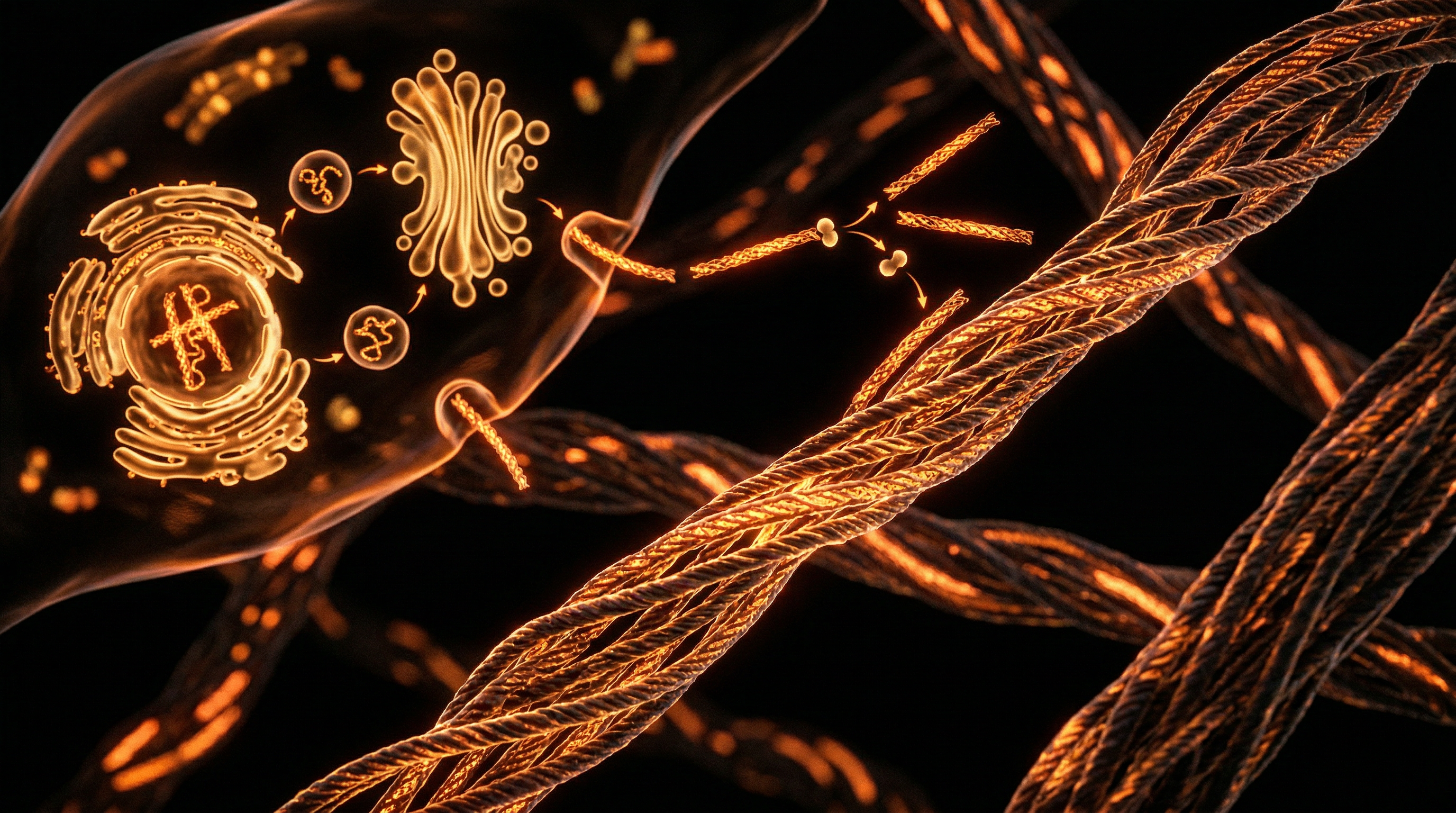
- Intracellular Phase: Within the Fibroblasts (the architect cells of connective tissue), DNA is transcribed into mRNA. This code is then translated into pre-procollagen strands on the ribosomes of the Rough Endoplasmic Reticulum (RER).
- Hydroxylation: This is the most critical "quality control" step. Specific enzymes (prolyl hydroxylase and lysyl hydroxylase) add hydroxyl (-OH) groups to proline and lysine. This step is entirely dependent on Vitamin C and Iron.
- Glycosylation: Glucose or galactose molecules are attached to the hydroxylysine residues.
- Triple Helix Formation: The three strands wind together to form Procollagen.
- Exocytosis: The procollagen is packaged in the Golgi apparatus and shipped out of the cell into the extracellular space.
- Extracellular Phase: Enzymes called procollagen peptidases snip off the "ends" of the procollagen molecule, turning it into Tropocollagen.
- Cross-linking: The final and most vital stage for strength. An enzyme called Lysyl Oxidase (LOX), which is Copper-dependent, creates covalent bonds between the tropocollagen molecules, weaving them into tough collagen fibrils.
Mechanisms at the Cellular Level
To truly grasp the architecture of synthesis, we must look closer at the enzymatic catalysts that govern the process. The failure of collagen is rarely a lack of "protein" in the diet; it is a failure of the enzymatic machinery that assembles that protein.
The Prolyl Hydroxylase Complex
The enzyme Prolyl Hydroxylase is responsible for the stability of the collagen strand. It requires Ascorbate (Vitamin C) to function. Mechanistically, Vitamin C does not simply "help"; it acts as a crucial redox agent. During the hydroxylation reaction, the iron atom at the centre of the enzyme is oxidised from its ferrous (Fe2+) state to its ferric (Fe3+) state. This inactivates the enzyme. Vitamin C donates an electron to reduce the iron back to its Fe2+ state, "resetting" the machinery.
Without sufficient Vitamin C, the enzyme remains locked in an inactive state. The result is Scurvy, characterized by the total breakdown of connective tissue—gums bleed, old scars reopen, and blood vessels rupture. While "clinical scurvy" is rare, "sub-clinical scurvy" is rampant in the UK, leading to "leaky" tissues and weak fascia.
The Copper-Lysyl Oxidase Axis
If Vitamin C builds the rope, Copper creates the knots that hold the rope together. The enzyme Lysyl Oxidase (LOX) is a copper-dependent amine oxidase. It initiates the cross-linking of collagen and elastin.
Statistic: Research indicates that even a marginal copper deficiency can lead to a 70% reduction in LOX activity, resulting in aortic aneurysms, joint hypermobility, and bone fragility.
Copper is often the "forgotten" mineral in the collagen conversation. In the cellular environment, copper must be bioavailable—bound to proteins like Ceruloplasmin. When copper is "unbound" or deficient, the collagen fibrils cannot cross-link. They remain loose and disorganized. This is the biological basis for many "idiopathic" joint pains and the increasing prevalence of pelvic organ prolapse.
The Role of Chaperone Proteins
Within the Endoplasmic Reticulum, a specific chaperone protein called HSP47 (Heat Shock Protein 47) is required for the correct folding of the triple helix. This protein prevents the premature aggregation of procollagen strands within the cell. If the cell is under excessive oxidative stress, HSP47 can become overwhelmed, leading to the accumulation of misfolded proteins—a precursor to cellular senescence and fibrosis.
Environmental Threats and Biological Disruptors
The modern environment is hostile to collagen synthesis. We are currently living through a period of "Structural Erosion" caused by specific biological disruptors that are rarely discussed in mainstream medical journals.
Glyphosate: The Glycine Mimic
One of the most insidious threats to collagen architecture is the herbicide Glyphosate. Chemically, glyphosate is a derivative of the amino acid Glycine. There is compelling evidence—though heavily suppressed by industrial interests—that the body can mistakenly incorporate glyphosate into protein synthesis in place of glycine.
Since glycine is required at every third position in the collagen helix, the substitution of a bulky, negatively charged glyphosate molecule for a tiny glycine molecule is catastrophic. It creates a "kink" in the helix, preventing tight winding. This leads to the production of weak, "moth-eaten" collagen that is highly susceptible to enzymatic degradation.
Glycation and AGEs
The high-sugar, high-processed-carbohydrate diet dominant in the UK contributes to the formation of Advanced Glycation End-products (AGEs). Through a non-enzymatic process called the Maillard reaction, sugar molecules "caramelise" onto collagen fibres.
This creates "cross-links" of the wrong kind. While enzymatic cross-linking by copper is essential for strength, glycation-induced cross-linking makes collagen stiff and brittle. This is why diabetics often suffer from "frozen shoulder" and premature skin ageing. The collagen loses its ability to slide and glide, turning the supple fascia into a rigid, plastic-like substance.
Fluoroquinolone Toxicity
Certain classes of antibiotics, specifically Fluoroquinolones (such as Ciprofloxacin), have a "black box" warning for tendon rupture. These drugs are potent chelaters of divalent cations—meaning they strip the body of the magnesium and calcium required for collagen maintenance—and they directly inhibit the activity of prolyl hydroxylase and fibroblasts. They effectively "turn off" the collagen manufacturing plant, leading to spontaneous ruptures of the Achilles tendon.
The Cascade: From Exposure to Disease
When the architecture of collagen synthesis is disrupted, the fallout is not confined to a single organ. It triggers a systemic cascade of degradation.
Fascial Adhesions and Chronic Pain
Fascia is the continuous web of connective tissue that wraps every muscle, nerve, and organ. Healthy fascia is hydrated and supple, allowing muscles to slide over one another. When collagen synthesis is impaired, the fascia becomes dehydrated and "sticky." This leads to Adhesions, where layers of tissue become glued together. This is the root cause of chronic myofascial pain syndrome, which is frequently misdiagnosed as fibromyalgia.
The Vascular Connection
The integrity of the arterial walls depends on a basement membrane of Type IV collagen and a structural layer of Type I and III. When synthesis fails, the arteries become either too rigid (leading to hypertension) or too weak (leading to aneurysms and varicose veins). The mainstream focus on "cholesterol" ignores the fact that cholesterol only deposits in the arterial wall when the collagen-based structural integrity of that wall is already compromised.
Intestinal Permeability (Leaky Gut)
The lining of the digestive tract is held together by "tight junctions" anchored in a collagenous matrix. When collagen synthesis is poor, these junctions fail, leading to Leaky Gut Syndrome. This allows undigested food particles and endotoxins (LPS) to enter the bloodstream, triggering systemic inflammation and autoimmune conditions.
Callout: Without high-quality collagen, the gut lining cannot repair itself, regardless of how many probiotics or "healing" foods are consumed.
What the Mainstream Narrative Omits
The mainstream health narrative regarding collagen is remarkably shallow, focusing almost exclusively on "collagen peptides" as a magical elixir. INNERSTANDING exposes the three major omissions in this narrative:
1. The Supplement Fallacy
Ingesting collagen peptides does not guarantee that your body will build collagen. Collagen is a protein; once ingested, it is broken down into its constituent amino acids (glycine, proline, hydroxyproline) by digestive enzymes. Your body then decides how to reallocate those amino acids. If you are deficient in Vitamin C or Copper, or if your Fibroblasts are in a state of senescence, your body will not rebuild collagen. It will simply burn those amino acids for energy or use them for other proteins.
2. The Bioavailability of Copper
The mainstream nutritional advice rarely mentions copper. When it does, it fails to distinguish between synthetic copper (found in cheap multivitamins) and bioavailable copper (found in whole foods). Synthetic copper (copper sulfate) can actually be pro-oxidant and toxic. Real collagen synthesis requires copper in its organic form, bound to carrier proteins, which the body can only process if the adrenal glands and liver are functioning optimally.
3. The Glycine-to-Methionine Balance
Muscle meat (steaks, chicken breasts) is high in the amino acid Methionine. While methionine is essential, an excess of it—without the balancing effect of Glycine found in skin, gristle, and bone broth—increases levels of Homocysteine. High homocysteine is a major disruptor of collagen cross-linking. The mainstream "high protein" diet, which focuses only on muscle meats, is actually detrimental to collagen integrity unless balanced with "nose-to-tail" nutrition.
The UK Context
The United Kingdom presents a unique and troubling case study in collagen degradation. Several factors specific to the British environment and diet have created a "perfect storm" for connective tissue failure.
Soil Depletion and the "Great British Scurvy"
British soils have been intensively farmed for centuries, leading to a drastic reduction in essential minerals. A study comparing the mineral content of UK fruits and vegetables between 1940 and 1991 found a 24% decrease in magnesium and a staggering 76% decrease in copper.
Furthermore, the UK's lack of sunlight (Vitamin D) combined with a diet high in processed "tea and toast" has led to a prevalence of sub-clinical scurvy. In cities like Glasgow and Liverpool, cases of clinical scurvy have recently reappeared—a shocking indictment of the modern food system.
The Regulatory Failure on Glyphosate
Unlike some European counterparts that have moved toward banning or restricting glyphosate, the UK government has consistently extended its use. British wheat is frequently "desiccated" (sprayed just before harvest) with glyphosate to speed up drying. This ensures that the British public is consuming a steady stream of a chemical that directly sabotages the collagen helix.
The Death of the "Nose-to-Tail" Tradition
Historically, the British diet was rich in "offal" and gelatinous cuts of meat (oxtail, trotters, liver). These provided the exact ratios of amino acids and minerals required for collagen synthesis. The modern shift toward lean, boneless, skinless meats has removed the structural building blocks from the national diet, leaving the population with weak joints and fragile skin.
Protective Measures and Recovery Protocols
To restore the architecture of collagen synthesis, one must move beyond simple supplementation and adopt a multi-faceted biological strategy.
1. The Nutritional "Holy Trinity"
To reboot the fibroblasts, you must provide the three essential co-factors simultaneously:
- Vitamin C: Avoid synthetic ascorbic acid derived from GMO corn. Seek whole-food complexes or Liposomal Vitamin C for higher cellular uptake. Aim for 2,000mg to 5,000mg daily during "loading" phases.
- Bioavailable Copper: The richest source is Beef Liver (ideally organic and pasture-raised). If you cannot consume liver, use a high-quality desiccated liver supplement or chlorophyll-rich foods.
- Glycine Loading: Supplement with 10–15g of pure glycine powder daily, or consume authentic, long-simmered bone broth. This provides the "buffer" against methionine and glyphosate.
2. Eliminating Disruptors
- Filter Your Water: Use a high-quality filter (Reverse Osmosis or distillation with remineralisation) to remove fluoride and heavy metals, both of which interfere with the mineralisation of the collagen matrix.
- Organic Grains Only: If you must consume wheat or oats in the UK, they must be organic to ensure they have not been desiccated with glyphosate.
- Avoid Seed Oils: Industrial seed oils (sunflower, rapeseed, corn) are high in Linoleic Acid, which drives oxidative stress in the fibroblasts, halting collagen production.
3. Physical and Photobiomodulation
- Red Light Therapy (660nm - 850nm): Red and near-infrared light penetrate the skin and interact with cytochrome c oxidase in the mitochondria. This increases ATP production, giving the fibroblasts the energy they need to perform the energy-intensive process of collagen synthesis.
- Strategic Loading: Collagen synthesis is a "use it or lose it" system. Specific isometric exercises and heavy resistance training signal to the body that the connective tissue needs to be reinforced.
- Hydration and Electrolytes: Collagen is a piezoelectric material. It requires a hydrated, mineral-rich environment to conduct the electrical signals that govern tissue repair.
4. The "Ancestral" Approach to Protein
Reintroduce collagen-rich foods:
- Fish Skin: Rich in Type I collagen.
- Chicken Feet/Cartilage: High in Type II collagen for joint repair.
- Beef Tendon: The ultimate source of glycine-rich structural protein.
Summary: Key Takeaways
The architecture of collagen synthesis is the foundation of human structural health, yet it is currently under siege from a combination of nutrient-depleted diets, environmental toxins, and a flawed medical narrative.
- Collagen is a complex triple helix that requires Glycine, Vitamin C, and Copper to be synthesized correctly.
- Sub-clinical Vitamin C and Copper deficiencies are widespread in the UK, leading to the production of "junk collagen."
- Glyphosate acts as a glycine mimic, potentially integrating itself into our connective tissue and causing structural failure.
- Mainstream collagen supplements are often ineffective unless the underlying enzymatic and mineral co-factors are addressed.
- Restoration requires a "Nose-to-Tail" nutritional approach, the elimination of industrial seed oils and sugars, and the strategic use of red light and resistance training.
We are as young and as healthy as our connective tissue. By understanding and supporting the biological architecture of collagen synthesis, we can reclaim our structural integrity and resist the erosion of the modern world.
This article is provided for informational and educational purposes only. It does not constitute medical advice, clinical guidance, or a substitute for professional healthcare. Information reflects cited research at time of publication. Always consult a qualified healthcare professional before acting on any health information.
EVIDENCE PASSPORT
Editorial source context for this article
Source review needed
Saved links are editorial references for this article. They may support specific claims rather than every sentence. Open and assess each source in context. This passport does not independently verify them.
Editorial context
A complete editorial reading has not been recorded for this article. Source links remain available for you to open and assess directly.
Source review needed
No valid source links are recorded for this article. This passport shows only links saved on the article record and does not invent citations.
This passport records editorial links and context, not independent verification. Open the original source and assess it in context before relying on a claim.
Medical Disclaimer
The information in this article is for educational purposes only and does not constitute medical advice, diagnosis, or treatment. Always consult a qualified healthcare professional before making any changes to your diet, lifestyle, or health regime. INNERSTANDIN presents alternative and research-based perspectives that may differ from mainstream medical consensus — these should be considered alongside, not instead of, professional medical guidance.
Read Full DisclaimerContinue the thread
Keep this question moving.
Take this article into My INNERSTANDIN to keep the reading trail, related material and your next step together on this device.
Dig deeper in the Library
Free, longform PDF volumes that go beyond headlines into mechanisms and references.