
Executive Functioning in ADHD
Updated May 2026
An analysis of how ADHD affects the brain's management system including working memory and emotional regulation.
Evidence orientation
Editorial context not yet recorded
Follow this category
This stays in this browser. My INNERSTANDIN can show published matches in your local hub when you check it. It does not send email, push, or alert notifications.
Local learning review
A private browser aid for revisiting ideas. It is not an alert or a health recommendation.
Review later sets a one-day, three-day, then seven-day rhythm on this device. Choose it only when you want to revisit this article.
Introduction: Beyond the Hyperactive Stereotype
For decades, Attention Deficit Hyperactivity Disorder (ADHD) was viewed through a narrow lens of behavioural disruption. In the popular imagination, and indeed in early clinical literature, ADHD was synonymous with the ‘naughty schoolboy’—a child who could not sit still or stop talking. However, as our neuroscientific understanding has matured, the clinical focus has shifted from external behaviour to internal cognitive processes.
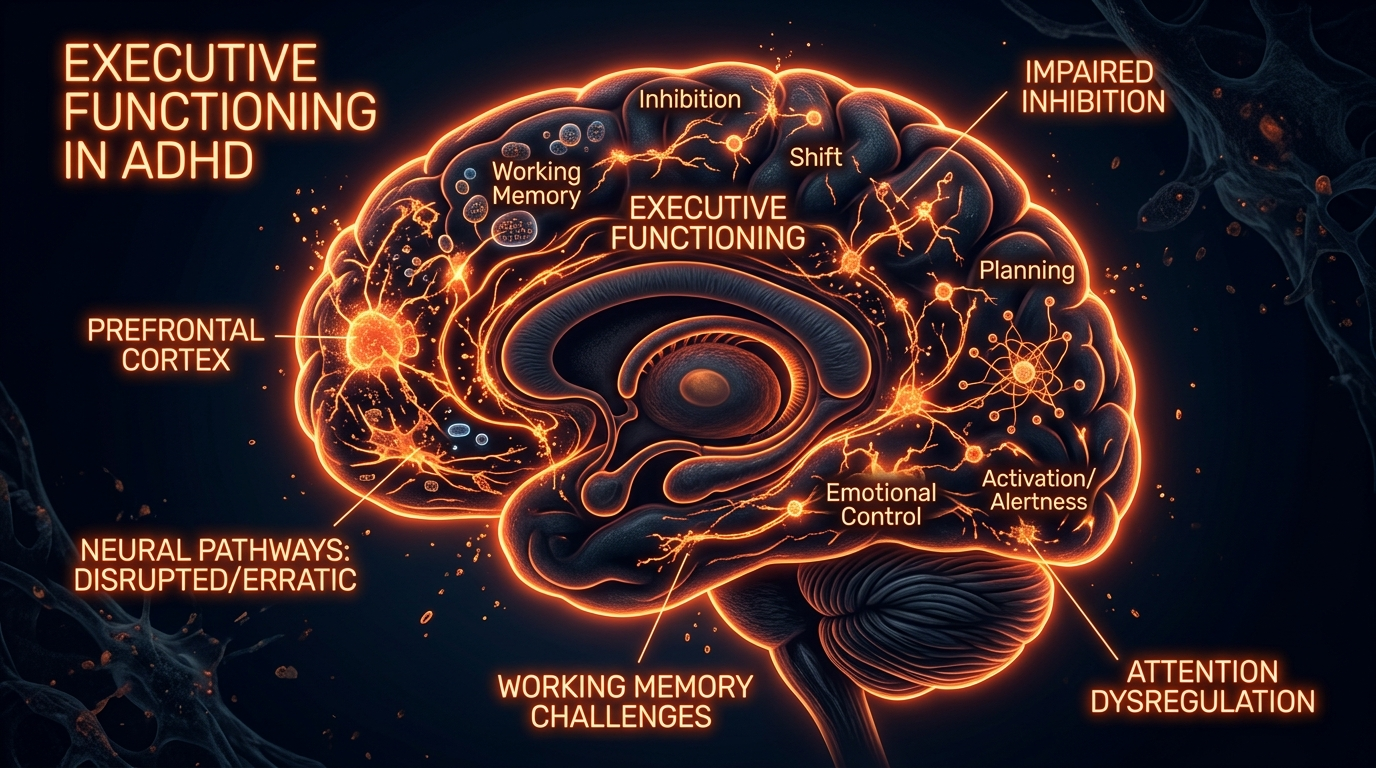
We now understand ADHD not merely as a disorder of attention or activity, but as a profound impairment of the brain’s Executive Functions (EF).
Executive functioning represents the biological ‘management system’ of the brain. It is the ‘CEO’ or ‘Air Traffic Controller’ located primarily in the prefrontal cortex. In the UK, where the National Institute for Health and Care Excellence (NICE) guidelines (NG87) govern our clinical approach, there is an increasing recognition that diagnosing and treating ADHD requires a deep dive into these executive deficits. Without understanding EF, we cannot understand why a highly intelligent adult cannot finish a simple task, or why a gifted child struggle to keep their PE kit in their locker.
This article provides an exhaustive exploration of executive functioning within the context of ADHD, tailored to the UK healthcare, educational, and professional landscape.
Part I: Defining Executive Functioning
Executive function is an umbrella term for the cognitively controlled processes that allow us to regulate our thoughts, emotions, and actions in pursuit of a goal. While most people perform these tasks instinctively, for the neurodivergent individual—specifically those with ADHD—these processes are inconsistent and prone to ‘brownouts’.
The Core Components
Most neuropsychological models, including those utilised by the British Psychological Society (BPS), categorise EF into three core areas:
- Inhibitory Control: The ability to resist impulses, ignore distractions, and think before acting.
- Working Memory: The capacity to hold information in the mind and manipulate it (e.g., remembering a phone number while looking for a pen).
- Cognitive Flexibility: The ability to switch gears, adapt to new rules, and see a problem from different perspectives.
From these three pillars emerge the complex daily skills we take for granted: planning, prioritising, emotional regulation, and self-monitoring.
The ‘Hot’ and ‘Cold’ EF Distinction
In clinical practice, we often distinguish between ‘Cold’ and ‘Hot’ Executive Functions:
- Cold EF: Purely cognitive processes that occur in the absence of high emotion (e.g., memorising a list of historical dates).
- Hot EF: Processes required in situations involving emotion, motivation, or reward (e.g., deciding whether to spend money on a needed bill or a new gadget).
ADHD individuals often perform adequately in ‘Cold’ EF tasks but experience significant collapse in ‘Hot’ EF scenarios, explaining the discrepancy between their potential and their performance in real-world, high-stakes environments.
Part II: The ADHD-EF Connection: Why the System Fails
In the neurotypical brain, the prefrontal cortex communicates efficiently with the basal ganglia and cerebellum. This circuitry is powered by neurotransmitters, primarily dopamine and noradrenaline.
In the ADHD brain, there is a dysregulation in these pathways. Neuroimaging studies frequently show lower volume and reduced activity in the prefrontal cortex of those with ADHD. Effectively, the ‘messages’ required to initiate a task or stop an impulse are either too weak to be heard or are lost in ‘neural noise’.
Russell Barkley’s Model
Dr Russell Barkley, a leading figure in ADHD research, argues that the fundamental deficit in ADHD is behavioural inhibition. He posits that because the ADHD brain cannot ‘stop’ long enough to let the executive functions engage, the individual is perpetually reactive rather than proactive. They are ‘blind to time’ and locked into the present moment, unable to use the past or the future to guide their current behaviour.
Part III: The Eight Domains of Executive Function Impairment
To understand how ADHD manifests in daily UK life—from the primary school classroom in Birmingham to a corporate office in the City of London—we must look at the eight specific domains of EF.
1. Impulse Control (Self-Inhibition)
This is the ‘internal brake’. In children, it looks like shouting out in class. In adults, it might manifest as impulsive spending, interrupting colleagues, or making hasty life decisions (quitting a job or ending a relationship) without considering the consequences.
2. Emotional Control
Commonly referred to in UK ADHD circles as Emotional Dysregulation, this is the inability to modulate emotional responses. It is not that the person feels things ‘wrongly’, but that they feel them ‘loudly’. This often leads to Rejection Sensitive Dysphoria (RSD)—an intense, paralysing emotional pain triggered by the perception of being rejected or criticised.
3. Flexible Thinking (Cognitive Flexibility)
Individuals with ADHD often struggle when ‘Plan A’ fails. They may become ‘stuck’ or experience a ‘meltdown’ when routines change unexpectedly—such as a train cancellation on the London Underground or a last-minute change to a meeting agenda.
4. Working Memory
The ‘mental whiteboard’ of an ADHD individual is often small and easily erased. This leads to the ‘walk into a room and forget why’ phenomenon, or the inability to follow multi-step instructions (e.g., "Go upstairs, get your shoes, find your coat, and bring down the laundry").
5. Self-Monitoring (Metacognition)
This is the ability to monitor one’s own performance and ‘read the room’. A person with ADHD may not realise they have been talking for ten minutes without their interlocutor saying a word, or they may fail to notice that their work quality is slipping as they tire.
6. Planning and Prioritising
For the ADHD brain, everything often feels like it has the same level of urgency. Deciding whether to answer a trivial email or finish a high-stakes report is a monumental task. This often results in ‘paralysis by analysis’ or ‘ADHD Paralysis’.
7. Task Initiation
This is the struggle to start a task that doesn't provide an immediate dopamine hit. It is often mislabelled as laziness. However, the ADHD individual may desperately want to start the task but find themselves physically unable to bridge the gap between intention and action.
8. Organisation
This refers to both physical organisation (lost keys, messy desks) and mental organisation (ordering thoughts for an essay or a presentation). In the UK, the ‘messy backpack’ is often the first red flag noted by teachers in Key Stage 2 or 3.
Part IV: Executive Functioning Through the Lifespan
The School Years: SEN and EHCPs
In the UK education system, executive function deficits often become apparent during the transition from primary to secondary school. Primary schools provide high levels of ‘external executive function’ (teachers reminding pupils what to bring, smaller classrooms). Secondary school demands independent organisation.
Pupils with significant EF deficits may require a Special Educational Needs (SEN) support plan. If the impact is severe, parents may apply for an Education, Health and Care Plan (EHCP). Legal frameworks like the Children and Families Act 2014 mandate that schools make ‘reasonable adjustments’, such as providing laptop use for those with poor working memory or extra time in exams to account for processing speed and focus issues.
The University Experience
For many UK students, the first time their executive functioning truly fails them is at university. Without the structure of home life, the demands of self-directed study, laundry, meal planning, and socialising often lead to a ‘freshman slump’. The Disabled Students' Allowance (DSA) is a vital UK resource here, providing funding for ADHD coaching, specialist software, and mental health support.
The Workplace: Access to Work
In the UK, the Equality Act 2010 protects individuals with ADHD from discrimination. Employers are legally required to provide ‘reasonable adjustments’. Furthermore, the government’s Access to Work scheme is a ‘best-kept secret’. It can fund:
- ADHD Coaching: To help develop EF strategies.
- Support Workers: To assist with administrative tasks.
- Equipment: Such as noise-cancelling headphones or project management software.
Part V: The ‘ADHD Tax’ and the Cost of EF Deficits
One cannot discuss executive functioning in a UK context without mentioning the ‘ADHD Tax’. This refers to the financial and emotional costs incurred due to EF failures.
- Financial: Fines for late tax returns to HMRC, forgotten subscriptions, interest on credit cards, or replacing lost items.
- Health: Forgetting GP appointments or failing to reorder prescriptions on time.
- Social: Strained relationships due to perceived ‘forgetfulness’ or ‘lack of care’ (e.g., forgetting an anniversary or failing to reply to a message).
The cumulative effect of these failures often leads to secondary conditions: Anxiety and Depression. When a person’s executive function consistently fails them, they develop a sense of ‘learned helplessness’.
Part VI: Assessment and Diagnosis in the UK
The diagnostic pathway in the UK usually begins with a General Practitioner (GP). Under NICE guidelines, a GP cannot diagnose ADHD but must refer the patient to a specialist (usually a Consultant Psychiatrist or a Specialist Nurse).
The Assessment Process
An authoritative assessment of EF within ADHD involves more than just a checklist of symptoms. It should include:
- Clinical Interview: Reviewing developmental history (symptoms must be present before age 12).
- Observer Reports: Feedback from partners, parents, or employers.
- Standardised Scales: Using tools like the BRIEF (Behavior Rating Inventory of Executive Function) or the Brown Executive Function/Attention Scales.
- Differential Diagnosis: Ensuring symptoms aren't better explained by ASD, Trauma (CPTSD), or Thyroid issues.
The ‘Right to Choose’ (England)
Due to long NHS waiting lists (sometimes 2–5 years), patients in England can exercise their Right to Choose. This allows them to be referred to a private provider (like ADHD 360 or Psychiatry-UK) for an NHS-funded assessment, significantly shortening the wait for EF support.
Part VII: Strategies for Managing Executive Dysfunction
While ADHD is a lifelong neurodevelopmental condition, executive function can be supported through a ‘multimodal’ approach.
1. Pharmacological Intervention
In the UK, NICE recommends medication as a first-line treatment for adults and for children with severe symptoms.
- Stimulants (Methylphenidate, Lisdexamfetamine): These increase the availability of dopamine and noradrenaline in the prefrontal cortex, effectively ‘turning the lights on’ in the command centre.
- Non-stimulants (Atomoxetine, Guanfacine): Often used if stimulants are ineffective or cause side effects.
Medication does not ‘fix’ EF, but it provides the ‘pills that give the skills’—it lowers the barrier to using organisational strategies.
2. ADHD Coaching vs. Traditional Therapy
Traditional counselling (CBT) can be helpful for the emotional fallout of ADHD. However, ADHD Coaching is often more effective for EF deficits. Coaching is action-oriented, focusing on ‘how to’ rather than ‘why’. It helps the individual build bespoke systems for:
- Time blocking.
- ‘Body doubling’ (working alongside someone else to maintain focus).
- Externalising information (using whiteboards, alarms, and apps).
3. Environmental Scaffolding
The goal is to ‘outsource’ executive function to the environment.
- Visual Reminders: If it’s not in sight, it doesn't exist (the ‘out of sight, out of mind’ principle). Using transparent storage bins or hanging keys on the door.
- Automate Everything: Setting up Direct Debits for all UK utilities and using ‘smart home’ tech (Alexa/Siri) for immediate reminders.
- The ‘Point of Performance’: Barkley suggests that interventions must happen at the moment the task is required. A reminder at 9 am to take out the bins at 7 pm is useless for an ADHD brain; the reminder must go off at 6:59 pm.
Part VIII: Neurodiversity-Affirming Perspectives
There is a growing movement in the UK to view EF deficits not just as ‘dysfunctions’ but as part of a different cognitive profile. This is the Neurodiversity Paradigm.
While the challenges are real, the ‘ADHD brain’ often excels in areas where high-EF brains may struggle:
- Crisis Management: The ADHD brain is often remarkably calm in an emergency (the high-stimulation environment ‘levels’ their dopamine).
- Hyperfocus: The ability to focus intensely on a topic of interest for hours, leading to rapid skill acquisition.
- Divergent Thinking: The ‘lack of inhibition’ allows for creative leaps and ‘out of the box’ problem-solving.
The objective of managing EF is not to ‘cure’ ADHD or make the person neurotypical, but to provide enough ‘scaffolding’ that their unique strengths can shine through without being buried by the chaos of daily life.
Part IX: The Future of EF Support in the UK
As we look forward, the integration of technology and policy will be crucial. We are seeing:
- Digital Therapeutics: Apps designed specifically to ‘game-ify’ EF training (though their long-term efficacy is still being debated in British clinical journals).
- Workplace Evolution: The shift toward hybrid and flexible working in the UK can be a double-edged sword. While it reduces the ‘sensory overwhelm’ of an open-plan office, it demands higher levels of self-led executive functioning.
- Integrated Care Systems (ICS): The NHS is moving toward more joined-up care, which ideally will see smoother transitions for young people moving from CAMHS (Child and Adolescent Mental Health Services) to Adult services—a period where many EF supports currently ‘fall off a cliff’.
Conclusion: Empowering the Command Centre
Executive functioning is the invisible architecture of our lives. For those with ADHD, this architecture is often fragile, leading to a life of missed potential and chronic stress. However, as this article has outlined, an EF deficit is not a character flaw; it is a biological reality.
In the UK context, we have the legal frameworks (Equality Act), the clinical guidelines (NICE), and the support systems (Access to Work, DSA) to help bridge the gap. By combining pharmacological support with robust environmental scaffolding and a neurodiversity-affirming mindset, individuals with ADHD can move from a state of constant ‘crisis management’ to a life of agency and achievement.
The ‘CEO of the brain’ may be prone to taking unscheduled tea breaks, but with the right support, the company can still thrive.
Glossary of Terms for the UK Context
- NICE: National Institute for Health and Care Excellence.
- CAMHS: Child and Adolescent Mental Health Services.
- EHCP: Education, Health and Care Plan.
- Access to Work: A Department for Work and Pensions (DWP) grant.
- Shared Care Agreement: A protocol where a GP takes over the prescribing of ADHD medication from a specialist.
- Neurodivergent: A term used to describe people whose brains function, learn, and process information differently.
References and Further Reading (UK Focused)
- NICE Guideline NG87: Attention deficit hyperactivity disorder: diagnosis and management.
- The UK Adult ADHD Network (UKAAN): Professional resources for clinical practice.
- ADHD Foundation: The UK’s leading neurodiversity charity.
- Barkley, R.A. (2012): Executive Functions: What They Are, How They Work, and Why They Evolved.
- Hallowell, E.M. & Ratey, J.J. (2021): ADHD 2.0: New Strategies for Thriving with Distraction.
This article is provided for informational and educational purposes only. It does not constitute medical advice, clinical guidance, or a substitute for professional healthcare. Information reflects cited research at time of publication. Always consult a qualified healthcare professional before acting on any health information.
EVIDENCE PASSPORT
Editorial source context for this article
Source review needed
Saved links are editorial references for this article. They may support specific claims rather than every sentence. Open and assess each source in context. This passport does not independently verify them.
Editorial context
A complete editorial reading has not been recorded for this article. Source links remain available for you to open and assess directly.
Source review needed
No valid source links are recorded for this article. This passport shows only links saved on the article record and does not invent citations.
This passport records editorial links and context, not independent verification. Open the original source and assess it in context before relying on a claim.
Medical Disclaimer
The information in this article is for educational purposes only and does not constitute medical advice, diagnosis, or treatment. Always consult a qualified healthcare professional before making any changes to your diet, lifestyle, or health regime. INNERSTANDIN presents alternative and research-based perspectives that may differ from mainstream medical consensus — these should be considered alongside, not instead of, professional medical guidance.
Read Full DisclaimerContinue the thread
Keep this question moving.
Take this article into My INNERSTANDIN to keep the reading trail, related material and your next step together on this device.
Explore this in the Body Map
See where this hits your biology. Interactive anatomy, threats, and protective protocols.
Dig deeper in the Library
Free, longform PDF volumes that go beyond headlines into mechanisms and references.