
Fascia: The Fourth System
Updated May 2026
Often ignored in traditional UK medical curricula, fascia is now recognized as a primary regulatory system. This article argues for its inclusion alongside the nervous, circulatory, and immune systems.
Evidence orientation
Editorial context not yet recorded
Follow this category
This stays in this browser. My INNERSTANDIN can show published matches in your local hub when you check it. It does not send email, push, or alert notifications.
Local learning review
A private browser aid for revisiting ideas. It is not an alert or a health recommendation.
Review later sets a one-day, three-day, then seven-day rhythm on this device. Choose it only when you want to revisit this article.
Overview
For centuries, the human body has been taught in medical schools as a collection of discrete parts—organs, bones, and muscles—separated by a "filler" tissue that was discarded during dissection to reveal the "important" structures. This filler, known as fascia, was the "Cinderella of anatomy," ignored and undervalued. However, a revolutionary paradigm shift is underway. At INNERSTANDING, we argue that fascia is not merely biological wrapping paper but constitutes the Fourth System of the human body, operating in tandem with the nervous, circulatory, and immune systems to regulate total physiological function.
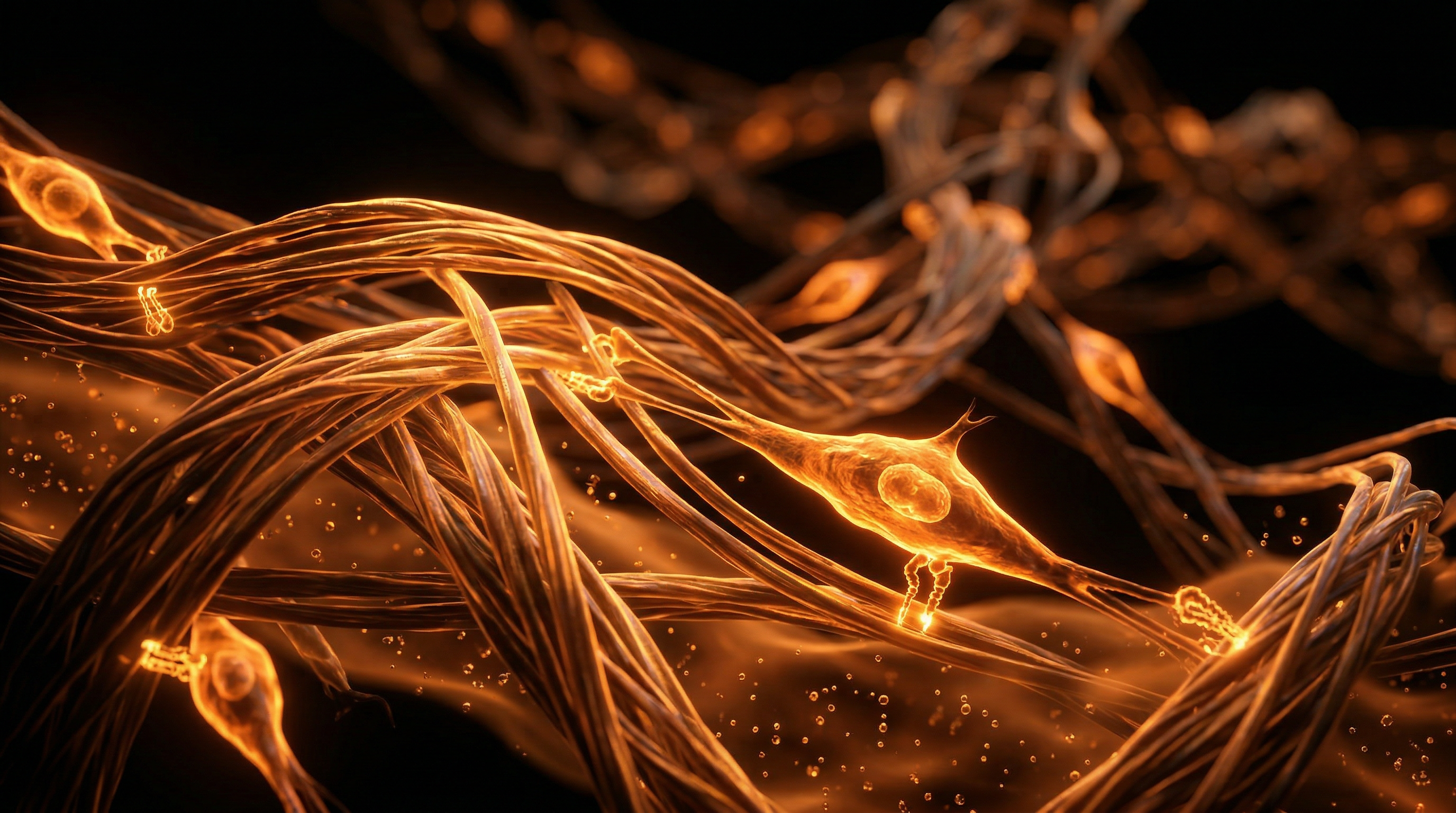
Fascia is a body-wide, three-dimensional matrix of structural proteins, glycosaminoglycans, and fluid that provides the environment for every cell to exist. It is our largest sensory organ, our primary structural scaffold, and a high-speed communication network that outperforms the nervous system in terms of instantaneous global signaling. To understand fascia is to understand the "living matrix" that binds the reductionist fragments of Western medicine into a coherent, self-regulating whole.
Yet, despite its ubiquity, fascia remains largely absent from the UK medical curriculum. This omission is not merely an academic oversight; it is a fundamental gap in our understanding of chronic pain, metabolic health, and systemic disease. By elevating fascia to its rightful status as a primary regulatory system, we unlock new protocols for recovery and human optimisation that the mainstream narrative has, until now, suppressed or ignored.
Fascia contains approximately 250 million nerve endings, making it potentially more sensory-rich than the skin, yet it remains the least understood component of human anatomy in standard clinical practice.
The Biology — How It Works
The traditional view of anatomy is "compression-based"—the skeleton is seen as a stack of bones acting as pillars, with muscles hanging off them like pieces of meat. This model is physically impossible for a moving organism. Instead, biology follows the laws of Biotensegrity. Coined by Dr Stephen Levin, biotensegrity posits that the body is a "tension-integrity" structure. In this model, the bones are compression struts floating in a continuous sea of fascial tension.
The Composition of the Matrix
Fascia is primarily composed of:
- Collagen Fibres: Primarily Type I, providing tensile strength and structural integrity.
- Elastin: Providing the ability to deform and return to original shape.
- Ground Substance: A transparent, gel-like substance rich in glycosaminoglycans (GAGs), such as Hyaluronan.
- Water: Specifically "structured" or liquid-crystalline water that allows for rapid nutrient exchange and electrical signalling.
The Global Communication Web
Unlike the nervous system, which relies on electrochemical signals jumping across synapses, fascia functions as a semiconductor. Because collagen is a triple-helix protein with a high degree of crystalline order, it exhibits piezoelectricity. When fascia is compressed or stretched during movement, it generates a small electrical charge. This charge informs the surrounding cells (fibroblasts) how to remodel the tissue.
This means the fascial system is a "real-time" feedback loop. It is not just a passive container; it is an active, contractile, and communicative organ. It coordinates movement by distributing tension across the entire body. When you move your big toe, the mechanical tension is transmitted through the plantar fascia, up the posterior chain, and can be measured in the fascia of the lower back and even the neck. This is the Anatomy Trains concept popularized by Thomas Myers, proving that "isolation" in the human body is a myth.
The Contractile Nature of Fascia
Recent research has confirmed that fascia contains myofibroblasts—specialised cells capable of contracting independently of muscular control. This means fascia can stiffen or relax in response to emotional stress, chemical triggers, or physical trauma. This "tonus" of the fascia is a primary regulator of our posture and our "felt sense" of the body.
Mechanisms at the Cellular Level
To truly understand the "Fourth System," we must zoom in past the visible membranes to the Extracellular Matrix (ECM). Every cell in the human body is "hooked" into the fascial web via transmembrane proteins called integrins.
Mechanotransduction: The Language of the Cell
The most profound mechanism within the fascial system is mechanotransduction. This is the process by which a physical force (pressure, shear, or tension) is converted into a chemical signal inside the cell. When the fascial matrix is tugged, the integrins pull on the cell’s internal cytoskeleton, which in turn pulls on the nuclear membrane.
This physical "tug" can:
- Trigger gene expression.
- Alter protein synthesis.
- Stimulate or inhibit cellular division.
- Activate the "suicide" switch (apoptosis) in cancerous cells.
In a healthy system, the fascia is supple and hydrated, providing "clean" mechanical signals. In a dysfunctional system—where the fascia is "glued" or dehydrated—the cells receive distorted signals, leading to cellular malfunction and, eventually, systemic disease.
The Role of Hyaluronan and Lubrication
Between the layers of fascial planes (such as the deep fascia and the epimysium of the muscle) lies a thin layer of Hyaluronan (HA). In its healthy state, HA acts as a "super-lubricant," allowing tissues to glide over one another without friction. However, HA is highly sensitive to pH and temperature. When the body becomes acidic (due to poor diet or chronic stress) or stagnant (due to lack of movement), HA increases its viscosity—becoming a "glue" rather than a lubricant. This is the biological basis of "stiffness."
The Liquid Crystalline State
Water within the fascial matrix is not "bulk water" like that in a glass. It is Structured Water (or Exclusion Zone water). This Fourth Phase of water forms along the surfaces of collagen fibres, creating a battery-like effect with a separation of charge. This allows for nearly instantaneous energy transfer. This is why a world-class athlete can react faster than the known speed of nerve conduction—they are utilizing the fascial semiconductor.
Environmental Threats and Biological Disruptors
The "Fourth System" is incredibly resilient, yet it is currently under siege by modern environmental stressors that the mainstream medical establishment rarely acknowledges.
The Impact of Glyphosate
One of the most suppressed truths in biological research is the impact of the herbicide Glyphosate on collagen synthesis. Glyphosate is a glycine analogue. Collagen is approximately 35% glycine. Emerging evidence suggests that the body may mistakenly incorporate glyphosate into the collagen helix in place of glycine. This results in "broken" collagen that cannot properly fold, leading to a fascial system that is brittle, prone to injury, and incapable of proper mechanotransduction.
Electromagnetic Fields (EMFs) and Piezoelectricity
Because fascia is a piezoelectric semiconductor, it is highly sensitive to external electromagnetic frequencies. The proliferation of 4G, 5G, and ambient Wi-Fi creates "noise" within the fascial matrix. This can disrupt the delicate electrical signalling required for tissue repair and cellular communication. Constant exposure to non-native EMFs can keep the fascial myofibroblasts in a state of chronic "micro-contraction," leading to unexplained systemic tension and fatigue.
Advanced Glycation End-products (AGEs)
A diet high in refined sugars and processed carbohydrates leads to the formation of AGEs. These molecules create "cross-links" between collagen fibres. Imagine your fascial web is a fine silk net; glycation is like pouring superglue over that net. It loses its elasticity, becomes brittle, and prevents the "glide" necessary for healthy movement. This is a primary driver of the physical "aging" process.
The Sedentary "Fuzz"
Gil Hedley, a pioneer in fascial anatomy, coined the term "the fuzz" to describe the filmy adhesions that form between fascial layers overnight or during periods of stillness. Without regular, varied movement, these films thicken and become permanent adhesions. The "use it or lose it" principle applies more to fascia than to any other system.
Research indicates that as little as 48 hours of immobility can begin the process of fascial densification, where the "glide" between tissues is replaced by restrictive "bonding."
The Cascade: From Exposure to Disease
When the fascial system is compromised by the threats mentioned above, it initiates a predictable biological cascade that leads to chronic disease—a cascade that is often misdiagnosed as purely neurological or autoimmune.
Stage 1: Dehydration and Viscosity Change
The process begins with the "drying out" of the ground substance. Whether through lack of movement, poor hydration, or chemical interference, the Hyaluronan thickens. The "glide" is lost. The patient begins to feel "stiff" in the morning, a symptom usually dismissed by GPs as "just getting older."
Stage 2: Micro-Fibrosis and Adhesions
As the "glide" disappears, the body attempts to stabilise the area by laying down more collagen. However, this collagen is laid down haphazardly, creating "adhesions." These adhesions act like internal scars, snagging on nerves and blood vessels. This is the birth of chronic pain.
Stage 3: Ischaemia and Toxic Accumulation
Fascia serves as the "irrigation system" for the body. Blood vessels and lymphatics travel through fascial planes. When fascia becomes tight and fibrotic, it acts like a kink in a garden hose. This reduces blood flow (ischaemia) and prevents the lymphatic system from draining metabolic waste. The tissue becomes acidic and toxic, creating a "pro-inflammatory" environment.
Stage 4: Proprioceptive Blindness
Fascia is our primary organ of proprioception (our sense of where we are in space). When the fascia is "glued," the sensory receptors (Golgi tendon organs, Pacinian corpuscles) cannot fire correctly. The brain loses its "map" of the body. To compensate, the nervous system increases muscular tension to create a sense of stability, leading to a vicious cycle of pain and rigidity.
Stage 5: Systemic Failure
Finally, the "distorted" mechanical signals sent via mechanotransduction reach the cells. This can lead to the "switching on" of inflammatory genes, contributing to conditions like Fibromyalgia, Chronic Fatigue Syndrome (ME), and even the progression of internal organ dysfunction, as the fascia surrounding the organs (the visceral fascia) becomes equally restricted.
What the Mainstream Narrative Omits
The refusal to recognise fascia as the "Fourth System" is not an accident; it is a byproduct of a reductionist medical philosophy that serves a specific economic model.
The "Anatomy of the Dead"
Medical training in the UK and much of the West is based on the dissection of cadavers. Cadavers are preserved in formaldehyde, which hardens and "fixes" the tissues. In this state, the fascia is a tough, grey, leathery mess that must be cut away to see the "real" anatomy. Consequently, doctors are trained to see fascia as "nothing." In a living, breathing human, however, fascia is a shimmering, wet, iridescent, and pulsing web of light and fluid. By studying only the dead, we have missed the very essence of the living.
The Pharmaceutical Blind Spot
The fascial system does not respond well to traditional pharmaceutical intervention. There is no "pill" that can unstick an adhesion or restore the crystalline structure of collagen. Fascia requires mechanical intervention: movement, pressure, hydration, and nutritional building blocks. Because the "Fascia Cure" cannot be patented and sold as a blockbuster drug, there is little incentive for the pharmaceutical-industrial complex to fund the education of doctors in fascial science.
The Psychological Link (Somatic Storage)
Mainstream medicine largely separates psychiatry from orthopaedics. Fascia proves this is a fallacy. Because fascia contains contractile cells sensitive to adrenaline and cortisol, it "grips" during emotional trauma. If the trauma is not processed, the fascia remains in a state of contraction. This is why "the body keeps the score." A therapist talking to a patient about their childhood may never reach the trauma that is physically "locked" in the fascial density of the patient's chest or psoas.
The UK Context
In the United Kingdom, the medical establishment is notoriously slow to adopt "systems biology" approaches. The National Health Service (NHS), while masterful at acute trauma care, is currently buckling under the weight of chronic, non-communicable diseases—many of which have a fascial component.
The Curriculum Gap
A survey of major UK medical schools reveals that the term "fascia" is often mentioned only in passing during the first year of anatomy, usually in the context of "fascia lata" or "palmar fascia." There is no dedicated module on the Extracellular Matrix or the Biotensegrity of the human frame. This means our GPs, who are the first port of call for chronic pain, are essentially "fascia blind." They prescribe NSAIDs (non-steroidal anti-inflammatory drugs) which, ironically, can inhibit collagen repair, further damaging the system they are meant to heal.
The Rise of Private Specialism
While the NHS lags behind, the UK is seeing a surge in private "Fascial Specialists"—Rolfers, Osteopaths, and Myofascial Release therapists. However, because these are often classified as "alternative" or "complementary," they are inaccessible to the general population. This creates a two-tier health system: those who can afford to maintain their "Fourth System" and those who are left to wither under the "standard of care" that ignores it.
British Research Contributions
Despite the institutional lag, British researchers like Dr. Robert Schleip (who, while German, collaborates extensively with UK-based institutions) are pushing the boundaries. The UK is home to some of the world's leading experts in matrix biology, yet their findings are rarely translated into the clinical setting of a local surgery in Birmingham or Manchester.
Protective Measures and Recovery Protocols
If the fascial system is the "Fourth System," we must treat it with the same respect as our heart or brain. Recovery is not about "stretching" in the traditional sense; it is about restoring the architecture of the matrix.
1. Multi-Dimensional Movement
Linear exercise (like a treadmill) does little for fascia. Fascia thrives on variety, bounce, and shear.
- Yin Yoga: Holding poses for long periods (3-5 minutes) allows the "plastic" deformation of the fascia, breaking down adhesions that quick stretching cannot touch.
- Micro-movements: Hydrate the tissue by "wiggling" and moving in non-linear, "animal" patterns.
- Plyometrics: Light bouncing (like jumping rope) helps train the fascial "recoil" and elasticity.
2. Strategic Hydration
Drinking 2 litres of water is useless if that water cannot reach the tissues.
- Structured Water: Consuming "living" water from fruits and vegetables, or using vortexing methods, may improve cellular uptake.
- Electrolytes: Ensure adequate intake of Magnesium, Potassium, and Sodium to maintain the electrical charge of the fascial matrix.
- Movement as Hydration: Remember that movement "squeezes" the fascial sponge. You must move to drive fluid into the dense connective tissues.
3. Nutritional Support for Collagen
Stop the "cross-linking" and support new growth:
- Vitamin C & Anthocyanins: Essential for the hydroxylation of collagen. Berries and high-quality Vitamin C are non-negotiable.
- Silica & Biotin: Trace minerals that act as the "architects" of the fascial web.
- Glycine Supplementation: To protect against the potential "glyphosate-replacement" effect, flood the system with pure glycine (collagen peptides or bone broth).
- Avoiding AGEs: Limit high-fructose corn syrup and charred meats, which "glaze" your internal fibres.
4. Myofascial Release (MFR)
Utilising tools like foam rollers, "Bakballs," or professional bodywork (Rolfing) can manually break "stuck" layers of HA. The goal is not to "crush" the muscle, but to melt the fascia. This requires slow, sustained pressure rather than rapid rolling.
5. EMF Mitigation
Reduce the "static" in your semiconductor:
- Turn off Wi-Fi at night.
- Keep phones away from the body (fascia acts as an antenna).
- Spend time barefoot on the earth (Earthing) to discharge excess electrical tension and "reset" the piezoelectric balance.
Summary: Key Takeaways
The recognition of fascia as the Fourth System is the missing link in 21st-century medicine. It bridges the gap between the physical and the emotional, the structural and the chemical.
- Fascia is a holistic regulator: It is a body-wide web of communication, structural integrity, and sensory perception.
- Biotensegrity is the law: We are not a stack of bricks; we are a continuous tension-web. Movement in one part affects the whole.
- The Matrix is alive: Fascia is a liquid-crystalline semiconductor that stores and transmits energy and information.
- The threats are modern: Glyphosate, sugar, and EMFs are the primary silent disruptors of our structural health.
- Mainstream omission is systemic: The UK medical curriculum's failure to teach fascial science keeps patients trapped in a cycle of "management" rather than "cure."
- Restoration is possible: Through specific nutrition, hydration, and "fascia-friendly" movement, the living matrix can be remodelled and rejuvenated at any age.
To ignore the fascia is to ignore the very fabric of our being. As we move into an era of "Innerstanding," we must reclaim this system from the shadows of the dissection room and place it at the centre of our journey toward total human sovereignty and health.
This article is provided for informational and educational purposes only. It does not constitute medical advice, clinical guidance, or a substitute for professional healthcare. Information reflects cited research at time of publication. Always consult a qualified healthcare professional before acting on any health information.
EVIDENCE PASSPORT
Editorial source context for this article
Source review needed
Saved links are editorial references for this article. They may support specific claims rather than every sentence. Open and assess each source in context. This passport does not independently verify them.
Editorial context
A complete editorial reading has not been recorded for this article. Source links remain available for you to open and assess directly.
Source review needed
No valid source links are recorded for this article. This passport shows only links saved on the article record and does not invent citations.
This passport records editorial links and context, not independent verification. Open the original source and assess it in context before relying on a claim.
Medical Disclaimer
The information in this article is for educational purposes only and does not constitute medical advice, diagnosis, or treatment. Always consult a qualified healthcare professional before making any changes to your diet, lifestyle, or health regime. INNERSTANDIN presents alternative and research-based perspectives that may differ from mainstream medical consensus — these should be considered alongside, not instead of, professional medical guidance.
Read Full DisclaimerContinue the thread
Keep this question moving.
Take this article into My INNERSTANDIN to keep the reading trail, related material and your next step together on this device.