
Fascial Memory: The Biological Reality of Stored Physical Trauma
Updated May 2026
Fascia is not merely a connective tissue but a complex sensory organ capable of storing tension and inflammatory markers. Chronic pain persists when these tissues lose their elasticity and fluid dynamics due to neglected biological stressors.
Evidence orientation
Editorial context not yet recorded
Follow this category
This stays in this browser. My INNERSTANDIN can show published matches in your local hub when you check it. It does not send email, push, or alert notifications.
Local learning review
A private browser aid for revisiting ideas. It is not an alert or a health recommendation.
Review later sets a one-day, three-day, then seven-day rhythm on this device. Choose it only when you want to revisit this article.
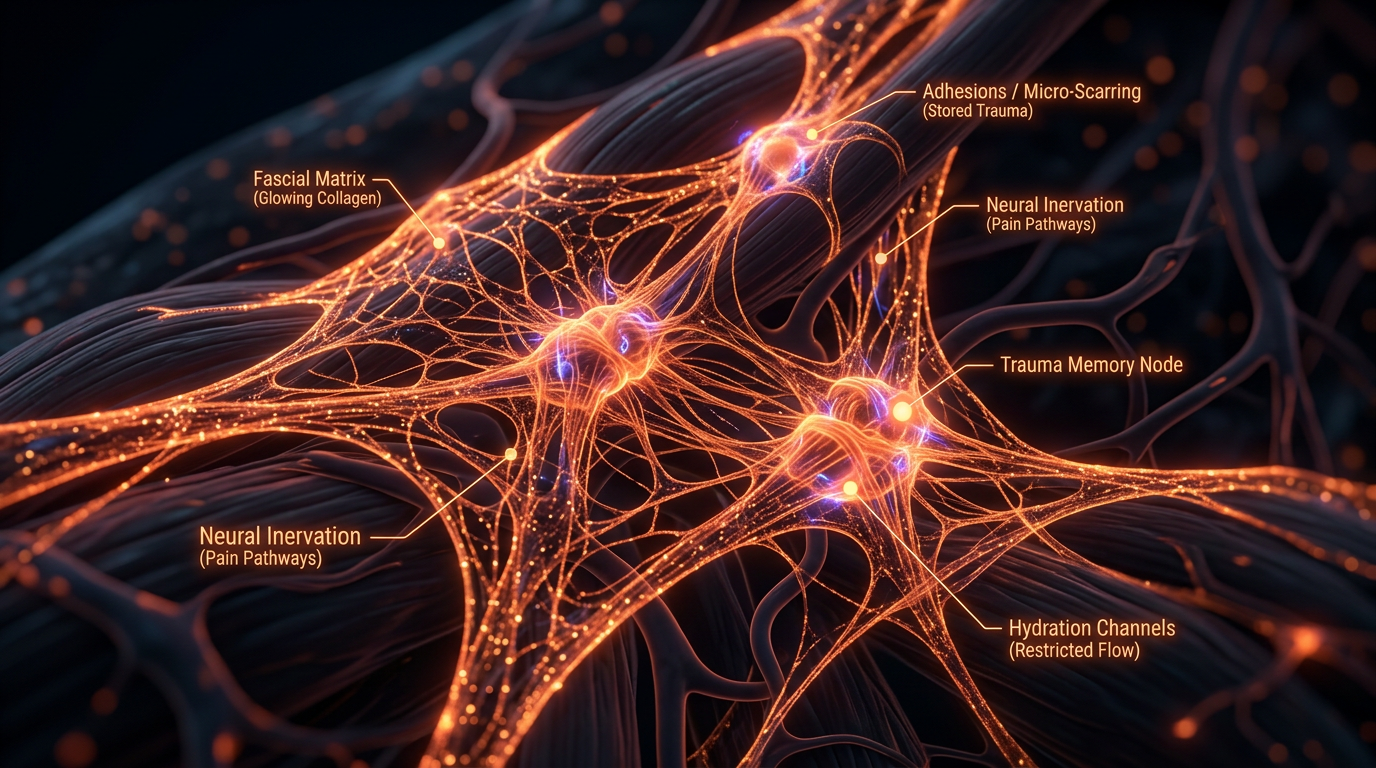
"Fascial Memory: The Biological Reality of Stored Physical Trauma"
Category: Chronic Pain & Pain Science Tags: Fascia, Myofascial Pain, Biological Trauma
Overview
For centuries, the Western anatomical tradition has treated the human body as a collection of discrete parts—a mechanical assembly of bones, muscles, and organs. In the dissecting rooms of the 19th and 20th centuries, the "white fluff" surrounding these structures was routinely scraped away and discarded as mere packing material. This discarded substance was the fascia. Today, a biological revolution is underway, exposing this historic oversight as one of the most significant errors in medical history. Fascia is not a passive wrapper; it is a sophisticated, liquid-crystalline, sensory organ that functions as a whole-body regulatory system.
The emerging science of "fascial memory" suggests that our connective tissues do not merely support our structure; they record our history. When we experience physical impact, surgical intervention, or even prolonged emotional distress, the fascia undergoes a morphological shift. It transitions from a hydrated, gliding state into a dense, dehydrated, and rigid matrix. This is the biological reality of stored trauma. Chronic pain is rarely a localised issue of a specific muscle; rather, it is the systemic manifestation of a fascial network that has lost its elasticity, its fluid dynamics, and its ability to communicate with the central nervous system.
At INNERSTANDING, we view the body as an integrated biophysical continuum. To understand chronic pain, one must understand the interstitial space—the medium through which all biological signals must pass. When this medium is compromised by neglected biological stressors, the result is a "trapped" physiological state where the body remains in a cycle of inflammation and tension long after the original injury has "healed" according to traditional metrics. This article will deconstruct the cellular mechanisms of fascial memory and expose why the mainstream medical narrative continues to fail millions of chronic pain sufferers.
##
The Biology — How It Works
To comprehend fascial memory, one must first appreciate the sheer scale of this system. The fascia is a seamless web of connective tissue that extends from the surface of the skin down to the very nucleus of our cells. It envelopes every muscle fibre (endomysium), every muscle bundle (perimysium), and every entire muscle (epimysium), eventually coalescing into tendons and ligaments that anchor to the periosteum of the bone.
The Second Nervous System
The fascia is the body’s richest sensory organ. It is embedded with six times as many sensory nerves as the muscles themselves. These include mechanoreceptors such as Ruffini endings, Pacinian corpuscles, and interstitial muscle receptors, as well as nociceptors (pain receptors). More importantly, the fascia is the primary site of proprioception—our "sixth sense" of where our body is in space.
Because the fascia is a continuous network, a restriction in the fascia of the foot can, via the "Bio-Tensegrity" model, manifest as chronic tension in the neck or jaw. This is not a metaphorical connection but a literal physical pull transmitted through a tensile web. When we speak of "fascial memory," we are referring to the tissue's ability to remodel itself in response to habitual loading patterns or traumatic events, effectively "setting" the body in a compensatory posture.
The Role of Bio-Tensegrity
Traditional biomechanics relies on the "column" model, where bones stack like bricks. However, biological systems operate on the principle of Bio-Tensegrity (biological tensional integrity). In this model, the bones are floating compression struts held in place by a continuous sea of tensioned fascia. If one part of the web is tugged or scarred, the entire system must shift to compensate. Chronic pain is often the result of this compensation reaching a "breaking point" where the tissue can no longer absorb the strain.
Fluid Dynamics and the Interstitium
A healthy fascial system is characterised by high fluid content. The Extracellular Matrix (ECM) within the fascia is composed largely of water, bound by glycosaminoglycans (GAGs) like hyaluronic acid. This fluid allows layers of fascia to glide over one another with minimal friction. In a state of health, this tissue exhibits thixotropy—it becomes more fluid when moved and more solid when still. However, under conditions of chronic stress or trauma, the hyaluronic acid can "gel" or polymerise, turning the once-slick lubricant into a sticky glue. This "densification" is the physical substrate of a "memory" of restriction.
##
Mechanisms at the Cellular Level
The "memory" of fascia is governed by the behaviour of the fibroblast, the primary cell type within connective tissue. Fibroblasts are not static; they are highly responsive to their mechanical environment through a process known as mechanotransduction.
Mechanotransduction: Moving from Force to Chemistry
Mechanotransduction is the process by which cells convert mechanical stimuli (pressure, tension, shear) into chemical signals. When the fascia is stretched or compressed, the physical force is transmitted through the cell membrane via proteins called integrins. These integrins connect the external environment directly to the cell’s internal cytoskeleton and, ultimately, to the DNA in the nucleus.
When a trauma occurs—be it a car accident or a repetitive strain—the fibroblasts receive a signal that the tissue is under threat. In response, they can transform into myofibroblasts. Myofibroblasts contain alpha-smooth muscle actin, allowing them to contract like muscle cells. This contraction is an evolutionary survival mechanism designed to "knit" an injury together. However, while a muscle relaxes after a few seconds, a myofibroblast can remain contracted for weeks, months, or even years.
The Crystalline Matrix
The fascia is essentially a liquid-crystalline structure. The collagen fibres are arranged in highly ordered patterns that allow for the efficient transmission of energy and information. Like a crystal, fascia is piezoelectric. This means that when it is mechanically stressed, it generates an electrical charge. This electrical signal tells the fibroblasts where to lay down more collagen.
Fact: In a state of chronic "stuckness," the piezoelectric signals become distorted. The body continues to lay down collagen in a haphazard, "cross-linked" fashion—essentially creating internal scar tissue (fibrosis) in response to perceived stress, even in the absence of a new injury.
Epigenetic Storage
Recent research suggests that the ECM itself may store "memory" through the modification of proteins. Stress hormones like cortisol and adrenaline directly affect the permeability and tension of the fascial web. Prolonged exposure to these chemicals alters the expression of genes within the fibroblasts, leading to a "pro-inflammatory" phenotype. The tissue becomes "primed" to react to even minor stressors with a full-blown pain response. This is why a person who has suffered past trauma may experience a flare-up of chronic back pain during a period of high emotional stress; the fascia is physically reacting to the chemical environment of the "memory."
##
Environmental Threats and Biological Disruptors
The modern environment is hostile to fascial health. We are currently living through an epidemic of "fascial dehydration" and "biological rigidity," driven by factors that the mainstream medical establishment largely ignores.
Sedentary Living and the "Chair-Shaped" Body
The human body is designed for constant, varied movement. In the UK, the average office worker spends over 9 hours a day seated. This lack of varied loading leads to fascial adhesion. Without movement, the fluid between fascial layers (the "ground substance") begins to stagnate. The layers literally grow together, a process called "collagen cross-linking." This effectively "locks" the body into a seated posture even when standing, leading to the chronic "tech-neck" and lower back issues prevalent across the country.
Nutritional Glycation and Collagen Quality
The standard modern diet, high in ultra-processed carbohydrates and seed oils, creates a state of systemic "oxidative stress." One of the most damaging processes for fascia is Glycation. This occurs when excess sugar molecules in the bloodstream bind to collagen fibres, forming Advanced Glycation End-products (AGEs).
Fact: AGEs act like "biological cement," making the collagen fibres brittle and resistant to repair. A diet high in processed sugar literally "caramelises" your connective tissues, stripping them of the elasticity required to process physical trauma.
The Glyphosate Factor
In the UK, the widespread use of the herbicide glyphosate in agriculture represents a hidden threat to fascial integrity. Glyphosate is a glycine analogue. Collagen, which makes up 30% of the body's protein, is composed of one-third glycine. There is a growing body of evidence suggesting that the body may mistakenly incorporate glyphosate into collagen strands during synthesis, leading to structurally unsound and inflammatory connective tissue that cannot properly heal from trauma.
Electromagnetic Frequencies (EMFs)
While still a contentious area of study, the biophysical perspective recognizes that the liquid-crystalline nature of fascia makes it highly sensitive to external electromagnetic fields. Since the fascia is a conductive network, chronic exposure to high levels of non-ionising radiation (from mobile devices and Wi-Fi) may interfere with the piezoelectric signalling of the tissue, potentially contributing to the "background noise" of chronic pain and stiffness.
##
The Cascade: From Exposure to Disease
The journey from a single stressful event to a life-shaping chronic pain condition follows a predictable biological cascade. Understanding this cascade is vital for identifying where to intervene.
Phase 1: The Initial Insult (The "Imprint")
An injury or emotional shock occurs. The nervous system triggers a protective "bracing" response. The fascia immediately stiffens via myofibroblast contraction to protect the area. Hyaluronic acid begins to densify to provide "internal splinting."
Phase 2: The Stagnation Point
If the stressor is not resolved—perhaps because the individual "pushes through" or uses painkillers to mask the signal—the tissue remains in the braced state. Fluid flow to the area decreases. Waste products of metabolism (lactic acid, cytokines) begin to pool in the interstitial space because the lymphatic system, which relies on fascial movement for drainage, is inhibited.
Phase 3: Densification and Fibrosis
The "gel" state of the ground substance becomes permanent. Fibroblasts, sensing the constant tension, lay down more collagen fibres in a chaotic, non-linear pattern. This is the transition from a functional "memory" to a structural change. The tissue is now physically thicker and less elastic.
Phase 4: Sensitisation
The dense, fibrotic fascia begins to entrap the tiny sensory nerves (nociceptors) passing through it. This creates a state of peripheral sensitisation. The brain starts receiving a constant stream of "danger" signals from the tissue, even when no new injury is occurring.
Phase 5: Systemic Manifestation
The body’s Bio-Tensegrity is now compromised. A restriction in the hip (Phase 3) causes a compensatory pull on the shoulder. The individual now presents with multiple "unrelated" pain sites, chronic fatigue (due to the energy cost of constant muscle bracing), and autonomic nervous system dysregulation.
##
What the Mainstream Narrative Omits
The current medical approach to chronic pain is fundamentally reductionist. It looks at the "hardware" (bones/joints) or the "software" (the brain/nerves) but completely ignores the "operating system" (the fascia).
The Failure of Imaging
One of the greatest tragedies in modern orthopaedics is the reliance on X-rays and MRIs. These technologies are excellent at seeing bones and "wet" organs, but they are notoriously poor at capturing the health of the fascial web. A patient can be in excruciating pain while their MRI appears "normal" because the scan cannot show the viscosity of the hyaluronic acid or the micro-tension of the myofibroblasts. Consequently, patients are often told their pain is "psychosomatic" or "all in their head."
The Analgesic Trap
The standard of care—prescribing NSAIDs (Non-Steroidal Anti-Inflammatory Drugs) or opioids—only exacerbates the problem. NSAIDs can actually inhibit the repair of collagen and glycosaminoglycans, while opioids dampen the nervous system's ability to process and "release" the stored tension. By masking the pain, these drugs allow the individual to continue the very movement patterns that are reinforcing the fascial restriction.
Ignoring the Interstitium
In 2018, researchers "discovered" a new organ: the Interstitium. This is essentially the fluid-filled spaces within the fascia. While the media treated it as a novelty, fascial researchers had been shouting about it for decades. The mainstream narrative still fails to account for the fact that every nutrient, every hormone, and every immune cell must travel through this fascial "soup" to reach its destination. If the soup is sludge, the body cannot heal, no matter how many supplements or drugs are ingested.
##
The UK Context
The UK is currently facing a chronic pain crisis of unprecedented proportions. According to data from the British Pain Society and various NHS trusts, the "traditional" model is buckling under the weight of a population that is increasingly rigid and inflamed.
UK Statistic: Approximately 28 million adults in the UK (roughly 43% of the population) live with some form of chronic pain. This is not merely a medical issue; it is a socio-economic catastrophe, costing the UK economy an estimated £10 billion per year in lost productivity.
The NHS Stalemate
The NHS is primarily designed for acute care—fixing broken bones and treating infections. It is poorly equipped for the "slow-burn" reality of fascial trauma. Waiting lists for physiotherapy are months long, and when a patient finally receives care, it is often limited to "rehab exercises" that focus on strengthening muscles without first releasing the fascial "straitjacket" those muscles are trapped in.
The Mental Health Link
In the UK, there is a strong push to treat chronic pain via CBT (Cognitive Behavioural Therapy). While addressing the psychological component of pain is important, the "fascial memory" perspective reveals that this is only half the story. You cannot "think" your way out of a physically fibrotic tissue. The trauma is literally "in the issues," and until the biological substrate is addressed, the psychological bracing will remain.
##
Protective Measures and Recovery Protocols
Recovery from fascial trauma requires a shift from "fixing" to "un-patterning." We must change the environment of the cells to allow the tissue to return to its natural, fluid state.
1. The Principle of Varied Loading
The fascia requires movement to stay hydrated, but not just any movement. Repetitive exercise (like running or cycling) can actually reinforce existing fascial restrictions. To break fascial memory, one must engage in varied loading—movements that are non-linear, slow, and multi-directional. This "wrings out" the fascial sponge, allowing old, stagnant fluid to be replaced by fresh, nutrient-rich interstitial fluid.
2. Myofascial Release (MFR)
Whether performed by a therapist or as self-care (using foam rollers or balls), MFR works by applying sustained pressure into fascial restrictions. The key word is sustained. It takes at least 90 to 120 seconds for the "thixotropic" effect to occur—for the tissue to move from a gel to a sol state. Quick, aggressive rolling only triggers a protective "guarding" reflex.
3. Hydration and "Structured" Water
Simply drinking water is not enough. To hydrate fascia, the water must be absorbed into the ECM. This requires adequate electrolytes (magnesium, potassium, and sodium) and "structured" water (the fourth phase of water found in living cells). Consuming high-quality fats and silica-rich foods (like horsetail tea or cucumbers) helps the GAGs in the fascia hold onto moisture.
4. Thermal Therapy
Heat is one of the most effective ways to change the viscosity of fascia. Saunas and hot baths help to "melt" the densified hyaluronic acid. Conversely, cold exposure (ice baths) can help "reset" the nervous system's tone, but should always be followed by gentle movement to prevent the tissue from becoming brittle.
5. Nutritional Support for Collagen
To rebuild a damaged fascial matrix, the body needs the correct building blocks:
- Vitamin C: Essential for the cross-linking of collagen.
- Glycine & Proline: The amino acids that form the backbone of connective tissue (found in bone broth or high-quality collagen peptides).
- Proteolytic Enzymes: (like Bromelain or Serrapeptase) Taken on an empty stomach, these can help break down non-functional, fibrotic scar tissue.
6. Vagus Nerve Regulation
Since the fascia is highly innervated by the autonomic nervous system, a body in "fight or flight" will always have "tight" fascia. Techniques like deep diaphragmatic breathing, humming, and cold-water face immersion stimulate the vagus nerve, sending a signal of safety to the fibroblasts and allowing them to switch from a "contracted" to a "reparative" state.
##
Summary: Key Takeaways
The biological reality of fascial memory challenges the very foundations of how we perceive human health and suffering. It is the bridge between the physical and the emotional, the site where our history is etched into our very fibres.
- Fascia is a Sensory Organ: It is the primary network for proprioception and the body's largest sensory system, far exceeding the skin or muscles in its complexity.
- Trauma is Structural: Physical and emotional trauma triggers a cellular transition in fibroblasts, leading to long-term "bracing" and "densification" of the tissue.
- Fluidity is Health: Chronic pain is the result of fascial "stagnation"—where the liquid-crystalline matrix becomes a solid "glue," entrapping nerves and restricting movement.
- The Modern Environment is Rigidity-Inducing: Sedentary lifestyles, glycation-heavy diets, and environmental toxins like glyphosate are direct threats to fascial elasticity.
- Recovery is Possible: By utilising principles of Bio-Tensegrity, varied movement, sustained pressure, and specific nutritional support, the "memory" of trauma can be cleared from the tissue.
The path to resolving chronic pain in the UK and beyond lies not in more potent painkillers, but in a profound respect for the biological intelligence of the fascial web. We must stop treating the body as a machine and start treating it as a fluid, living, and remembering system. The trauma is not just "in your head"—it is in your cells, your fibres, and your fluids. It is time to release it.
This article is provided for informational and educational purposes only. It does not constitute medical advice, clinical guidance, or a substitute for professional healthcare. Information reflects cited research at time of publication. Always consult a qualified healthcare professional before acting on any health information.
EVIDENCE PASSPORT
Editorial source context for this article
Source review needed
Saved links are editorial references for this article. They may support specific claims rather than every sentence. Open and assess each source in context. This passport does not independently verify them.
Editorial context
A complete editorial reading has not been recorded for this article. Source links remain available for you to open and assess directly.
Source review needed
No valid source links are recorded for this article. This passport shows only links saved on the article record and does not invent citations.
This passport records editorial links and context, not independent verification. Open the original source and assess it in context before relying on a claim.
Medical Disclaimer
The information in this article is for educational purposes only and does not constitute medical advice, diagnosis, or treatment. Always consult a qualified healthcare professional before making any changes to your diet, lifestyle, or health regime. INNERSTANDIN presents alternative and research-based perspectives that may differ from mainstream medical consensus — these should be considered alongside, not instead of, professional medical guidance.
Read Full DisclaimerContinue the thread
Keep this question moving.
Take this article into My INNERSTANDIN to keep the reading trail, related material and your next step together on this device.