
Biotensegrity: A New Model for Understanding Musculoskeletal Harmony
Updated May 2026
The human body functions as a biotensegrity structure where tension is distributed globally. This model explains why pain in one area is often the biological result of a mechanical failure in a completely different part of the chain.
Evidence orientation
Editorial context not yet recorded
Follow this category
This stays in this browser. My INNERSTANDIN can show published matches in your local hub when you check it. It does not send email, push, or alert notifications.
Local learning review
A private browser aid for revisiting ideas. It is not an alert or a health recommendation.
Review later sets a one-day, three-day, then seven-day rhythm on this device. Choose it only when you want to revisit this article.
Overview
The traditional model of human anatomy, the one taught in medical schools for over a century, is fundamentally flawed. It is a model based on Newtonian mechanics, viewing the body as a "column of bricks" where bones are stacked upon one another, held up by the sheer force of gravity and moved by discrete, isolated muscles acting as levers and pulleys. This archaic perspective—the Bio-mechanical model—suggests that if a part of the machine breaks, you simply fix that specific part. If your knee hurts, the problem is in the knee. If your back aches, the vertebrae must be the culprit.
However, this reductionist view is failing millions of people suffering from chronic pain. It cannot explain why a surgical intervention on a "herniated disc" often fails to resolve pain, or why a patient with a perfectly "normal" MRI can be in agony. Enter Biotensegrity.
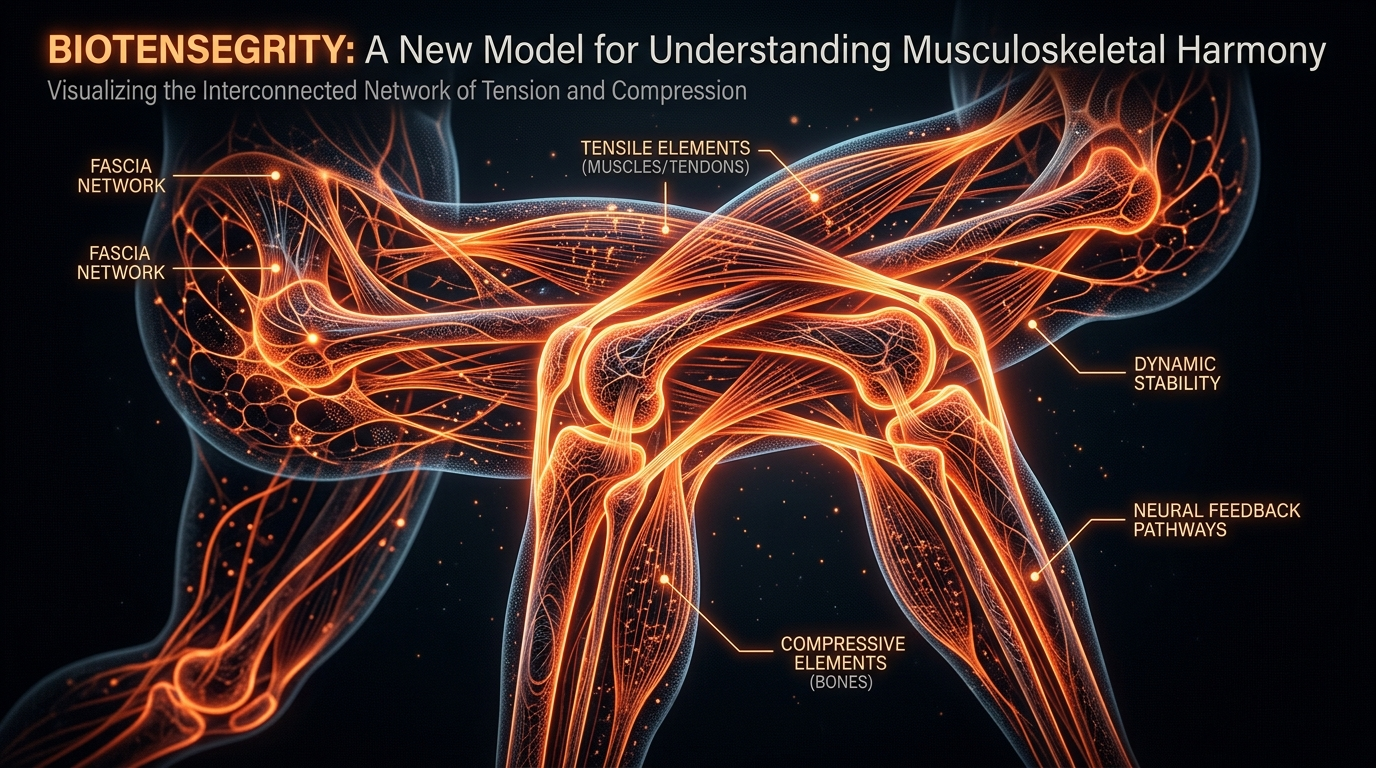
Biotensegrity (a portmanteau of biological tension integrity) is a structural principle that describes the human body not as a stack of weighted components, but as a self-stabilising, holistic network. In this model, the bones do not "crush" one another; they are floating compression struts suspended within a continuous sea of tensioned connective tissue known as fascia. In a biotensegrity system, forces are not local; they are global. This means that a restriction in the fascia of the right ankle can, through the laws of physics, manifest as a chronic tension headache or a "trapped nerve" in the left shoulder.
To understand biotensegrity is to understand that the human body is a closed kinematic chain. It is a symphony of tension and compression where every part is instantaneously informed of what every other part is doing. When we stop viewing the body as a collection of 206 bones and 600+ muscles, and instead see it as a single, vibratory, structural unit, the "mystery" of chronic pain begins to dissolve. We are not a machine made of parts; we are a biological architecture governed by the same laws of physics that hold galaxies together.
##
The Biology — How It Works
At the heart of biotensegrity lies the Fascial System. For decades, fascia was dismissed by anatomists as "packing material," the white, fibrous "gristle" that had to be scraped away to see the "important" structures like muscles and organs. This was a catastrophic scientific oversight. We now know that the fascia is the organ of structure—the primary sensory organ of the body, containing six times more nerve endings than the muscles themselves.
The Architecture of Tension and Compression
In a traditional building, the walls support the roof through compression. If you remove a brick from the bottom, the structure collapses downwards. In a tensegrity structure (a concept pioneered by architect Buckminster Fuller and sculptor Kenneth Snelson), the system is held together by continuous tension and discontinuous compression.
- Bones as Compression Struts: In the biotensegrity model, bones are the "struts." Crucially, in a healthy, living body, bones do not actually grind against each other in the joints. They are suspended by the tension of the soft tissues. The joint space is maintained by the outward "push" of the bones and the inward "pull" of the fascial network.
- Fascia as the Tension Cables: The fascia, composed of collagen, elastin, and a fluid ground substance, provides the continuous tension. This tension is not passive; it is pre-stress. Even at rest, your fascial system is under a specific degree of tension that allows it to react instantaneously to movement.
The Liquid Crystal Matrix
The fascial system is not just a series of "bands" or "sheets." It is a fractal, multi-layered web that penetrates every single part of the body. It wraps around individual muscle fibres (endomysium), bundles of fibres (perimysium), and the entire muscle (epimysium). It then continues on to become the tendon, which merges into the periosteum (the "skin" of the bone).
This means there is no "beginning" or "end" to a muscle. The biceps brachii does not simply "start" at the shoulder and "end" at the elbow; its fascial sheath is continuous with the pectorals, the lats, and the forearm extensors. When you move your thumb, the tension change is felt in your opposite hip. This is the bio-structural reality that the mainstream narrative ignores.
UK STATISTIC: According to the Health and Safety Executive (HSE), musculoskeletal disorders (MSDs) accounted for 27% of all work-related ill health in Great Britain in 2022/23, resulting in 6.6 million working days lost. The failure to treat these as systemic biotensegrity issues contributes to the "revolving door" of NHS physiotherapy.
The Principle of Omnidirectionality
Because the body is a biotensegrity web, force is distributed omnidirectionally. If you hit a tensegrity model on one side, the entire structure deforms slightly to absorb the impact and then springs back. This is why a healthy child can fall over repeatedly and walk away uninjured. Their system is "springy" and resilient. Chronic pain, conversely, is the result of a system that has lost its dynamic plasticity. When the fascia becomes dehydrated, scarred, or "glued" due to lack of movement, the tensegrity collapses. The tension is no longer distributed; it becomes concentrated in specific joints, leading to "wear and tear"—a term that should be replaced with "structural mismanagement."
##
Mechanisms at the Cellular Level
The genius of biotensegrity is that it is scale-invariant. The same rules that govern the shape of your ribcage also govern the shape of your individual cells. This is a field known as mechanobiology.
Mechanotransduction: The Language of Force
Every cell in your body is a micro-tensegrity structure. The cell’s "skeleton"—the cytoskeleton—is made of microfilaments and microtubules that maintain the cell’s 3D shape through tension and compression. These cells are connected to the surrounding extracellular matrix (ECM) via specialised proteins called integrins.
This connection allows for a process called mechanotransduction: the conversion of a physical force into a biochemical signal.
- When you stretch, move, or receive manual therapy, you are physically pulling on the ECM.
- This pull is transmitted through the integrins directly into the cell’s nucleus.
- This physical tug can actually change gene expression.
This exposes a massive truth: your physical posture and the "tension" in your body are directly communicating with your DNA. A body held in a "collapsed" tensegrity state (e.g., hunched over a desk for 8 hours) is sending signals to the cells to downregulate repair and upregulate inflammation. Chronic pain is not just a "feeling"; it is a cellular state induced by structural collapse.
The Role of the Extracellular Matrix (ECM)
The ECM is the "soil" in which our cells live. It is a complex soup of glycosaminoglycans (GAGs), such as hyaluronic acid, which act as lubricants. In a healthy biotensegrity system, the ECM is thixotropic—meaning it becomes more fluid when moved and more solid when stagnant.
When we stop moving in diverse ways, the ECM thickens. It becomes "glued" (cross-linking of collagen fibres). This increased "viscosity" disrupts the cell's micro-tensegrity. The cell becomes squashed, its metabolism slows, and it begins to signal distress. This is the origin of "unexplained" myofascial pain. The pain is the sound of the cells being mechanically suffocated by a stagnant, collapsed fascial web.
##
Environmental Threats and Biological Disruptors
We are currently living in an environment that is "anti-biotensegrity." Our biological architecture evolved to navigate uneven terrain, climb trees, and move in complex, multi-planar ways. Modern life has stripped this away, creating a "Zoo Human" syndrome where our structures are failing due to a lack of appropriate mechanical input.
The Tyranny of Flat Surfaces
The human foot is a masterpiece of biotensegrity. It contains 26 bones and a complex web of fascia designed to act as a primary shock absorber for the entire kinetic chain. However, we have spent the last century walking on perfectly flat, hard surfaces (concrete, laminate, tarmac) while wearing restrictive footwear with narrow toe boxes and cushioned heels.
- The Result: The arches of the foot collapse, or the "windlass mechanism" of the plantar fascia is deactivated. Because the body is a continuous web, a "collapsed" foot forces the tibia to rotate internally, which misaligns the knee, which tilts the pelvis, which creates a compensatory curve in the lumbar spine.
- The "Truth": Your "lower back pain" is often a direct mechanical consequence of your footwear and the flat pavement of London or Manchester. Treating the back without addressing the foot is scientifically futile.
Sedentary Collapse and "The Chair"
The chair is perhaps the most destructive tool in modern history regarding musculoskeletal health. Sitting for prolonged periods places the hip flexors in a shortened state and the gluteal muscles in a "pushed-off" state.
In a biotensegrity system, if one area is permanently shortened, another area must be permanently lengthened to compensate. This is known as Reciprocal Inhibition and Long-Term Potentiation of fascial patterns. Over years, the "pre-stress" of the system becomes skewed. The fascia literally "remodels" itself to fit the chair. When you finally stand up, you are no longer a dynamic tensegrity structure; you are a "chair-shaped" human trying to function in a vertical world.
Electromagnetic Fields (EMFs) and Fascial Hydration
Emerging research suggests that the fascial system, being a liquid crystal matrix, is highly sensitive to electromagnetic frequencies. The structured water (EZ water) within the collagen fibres acts as a semi-conductor.
CRITICAL FACT: The fascia is piezoelectric. When it is compressed or stretched, it generates a small electrical charge. This charge tells the fibroblasts (the cells that make fascia) where to lay down more collagen.
Constant exposure to non-native EMFs may disrupt the "ordering" of water molecules within the fascial matrix, leading to "dehydrated" fascia even if you drink plenty of water. Dehydrated fascia loses its "glide," leading to the "fuzz" or adhesions that cause chronic stiffness and pain.
##
The Cascade: From Exposure to Disease
Chronic pain is rarely an event; it is a cascade. Because the body is a biotensegrity structure, it has a massive capacity for compensation. This is both its greatest strength and its ultimate downfall.
The Compensatory Buffer
Imagine a biotensegrity model made of elastic bands and sticks. If you tie one band slightly tighter, the whole model shifts, but it still stands. It "compensates." This is what the human body does when we have a minor injury—say, a sprained right ankle from a childhood football match.
- The Initial Insult: The right ankle fascia is scarred and tightened.
- The Shift: To keep the eyes level (a primary biological imperative), the pelvis tilts to the left to compensate for the "short" right leg created by the tight ankle.
- The Load Transfer: The muscles of the left lower back (QL) now have to work 20% harder to stabilize the tilted pelvis.
- The Threshold: For 10 years, you feel nothing. The system has "buffered" the load.
- The Failure: One day, you bend over to pick up a pencil, and your "back goes out."
The mainstream narrative says the pencil caused the injury. The biotensegrity model shows that the "injury" began 10 years ago in the right ankle. The back was simply the "weakest link" where the system finally ran out of compensatory capacity.
The "Silent" Zone vs. The "Screaming" Zone
In pain science, the site of the pain is almost never the site of the problem.
- The Screaming Zone: This is where you feel the pain (the lower back, the neck, the knee). It is the area that is being "pulled on" or "overworked" because another area is failing.
- The Silent Zone: This is the area that is "stuck," "frozen," or "non-responsive." It doesn't hurt, so you don't look at it. But its lack of movement is what is causing the Screaming Zone to suffer.
Until practitioners stop chasing the "screaming" symptoms and start looking for the "silent" structural failures, chronic pain will continue to be an epidemic.
##
What the Mainstream Narrative Omits
The current medical-industrial complex is built on specialisation. We have "knee specialists," "spine specialists," and "hip specialists." This is the antithesis of how biology works.
The Imaging Trap
One of the most damaging aspects of modern orthopaedics is the over-reliance on MRI and X-ray.
ALARMING FACT: Studies have shown that 30% of 20-year-olds and nearly 85% of 80-year-olds have "disc bulges" or "degenerative changes" on MRI but have zero pain.
When a patient in the UK goes to their GP with back pain, they are often sent for a scan. The scan finds a "bulge" (which is often a normal sign of aging, like wrinkles on the skin), and the patient is told they have a "bad back." This creates a nocebo effect, where the patient's brain perceives the spine as "broken."
The mainstream narrative omits the fact that the pain is likely a functional failure of the biotensegrity web, not a structural failure of the bone. By focusing on the "bone on bone" or the "slipped disc," the system justifies surgeries that frequently fail (Failed Back Surgery Syndrome) because the surgery does nothing to address the global fascial tension that caused the disc to bulge in the first place.
The Pharmaceutical Cover-Up
The UK's reliance on NSAIDs (Non-Steroidal Anti-Inflammatory Drugs) and opioids for chronic pain is a biological disaster. These drugs do nothing to restore the "glide" to the fascia or the "balance" to the tensegrity. In fact, they may make it worse. NSAIDs can inhibit the healing of connective tissue, leading to "weaker" collagen, while opioids desensitise the very mechanoreceptors we need to regain proper movement.
##
The UK Context
The United Kingdom is currently facing a musculoskeletal crisis that the NHS is ill-equipped to handle. The "wait-and-see" approach, followed by a handful of basic "strengthening exercises" and a prescription for Ibuprofen, is based on an outdated 19th-century view of the body.
The Economic Burden
Chronic pain is one of the leading causes of disability in the UK.
- It is estimated that 28 million adults in the UK live with some form of chronic pain.
- Musculoskeletal conditions cost the NHS approximately £5 billion annually.
- The indirect costs to the UK economy (loss of productivity, welfare payments) are estimated at over £100 billion.
The NHS "Part-Work" Problem
The NHS is structured around "silos." If you have foot pain and back pain, you might see a Podiatrist and a Physiotherapist in two different departments who never speak to each other. The Podiatrist looks at your foot; the Physio looks at your back. Neither looks at the fascial line that connects the two.
Furthermore, the "Evidence-Based Medicine" (EBM) used by the NHS is often lagging 20 years behind current biological research. Because it is difficult to "standardise" a whole-body biotensegrity treatment (as every body is uniquely compensated), the system defaults to "standardised exercises" which often fail because they treat the patient as a generic machine rather than a unique biological web.
##
Protective Measures and Recovery Protocols
If we accept that the body is a biotensegrity structure, our approach to health and recovery must change. We must move from "localised" thinking to "global" integrity.
1. Restore the "Glide": Myofascial Release
You cannot strengthen a "stuck" system. If your fascia is glued together, "doing more exercise" will simply add more stress to the already overworked Screaming Zones.
- Movement: The primary "nutrient" for fascia is varied movement. Not just "the gym," but movements that involve twisting, spiralling, and reaching.
- Manual Therapy: Techniques such as structural integration (Rolfing), myofascial release, or even self-massage with balls and rollers are essential to "break" the cross-links in the ECM and restore the thixotropic fluid state of the fascia.
2. Hydrate the Matrix
Drinking water is not enough. You must ensure the water reaches the fascial tissues.
- Micro-movements: Constant, small movements (fidgeting, stretching) help "pump" fluid into the fascial matrix.
- Electrolytes: The fascial ECM requires minerals (Magnesium, Potassium, Sodium) to maintain its electrical charge and water-holding capacity.
- Collagen Support: Supplementing with high-quality collagen peptides and Vitamin C can provide the raw materials for fascial repair, but only if the "mechanical signal" (movement) is present to tell the body where to use them.
3. Foot Liberation
The foot is the foundation of your biotensegrity.
- Barefoot Time: Spend as much time as possible barefoot on uneven surfaces (grass, sand, pebbles) to wake up the 200,000 nerve endings in your soles.
- Minimalist Footwear: Transition slowly to shoes with a "wide toe box" and "zero drop" to allow the foot to function as a natural spring. This will ripples up the entire chain, often resolving "unrelated" neck and shoulder tension.
4. The 360-Degree Breath
The diaphragm is a major structural hub in the biotensegrity web. Most people are "chest breathers," which creates chronic tension in the neck and "freezes" the ribcage.
- Intercostal Expansion: Practice breathing into the back and sides of the ribs. This creates internal pressure (intra-abdominal pressure) that acts as a "gas strut," supporting the spine from the inside out and reducing the load on the lower back muscles.
5. Proprioceptive Enrichment
Pain is often the brain's response to "sensory amnesia"—when it loses track of a part of the body because that part hasn't moved in years.
- Balance Work: Using balance boards or simply standing on one leg while brushing your teeth forces the biotensegrity system to "re-calibrate" its tension.
- Variety: Do not do the same workout every day. The fascial system thrives on novelty. If you always walk on a treadmill, your system becomes "brittle" in every direction except forward.
##
Summary: Key Takeaways
The transition from the old Newtonian "Lever and Pulley" model to the modern Biotensegrity model is not just an academic shift; it is a revolution in how we inhabit our bodies.
- The Body is a Single Unit: There is no such thing as an isolated injury. Every "local" pain has a "global" context.
- Fascia is the Master Regulator: This 3D web of connective tissue governs our shape, our movement, and our cellular health. It is the body’s "internet."
- Tension is Vital: We don't want to be "tension-free"; we want balanced tension. Pain is the result of tension being concentrated in one area because it is "stuck" in another.
- The Modern Environment is the Enemy: Flat floors, chairs, and restrictive shoes are structural disruptors that collapse our natural tensegrity.
- Movement is Medicine: But it must be varied, multi-planar, and mindful. We must "hydrate" our fascia through movement to keep our "liquid crystal" matrix functional.
For the millions in the UK suffering from chronic musculoskeletal issues, the message is clear: Stop looking at the "parts" and start looking at the whole. Your body is not a machine that is wearing out; it is a biological masterpiece of tension and compression that has simply lost its rhythm. By embracing the principles of biotensegrity, we can move beyond the management of symptoms and begin the true process of structural restoration. The future of pain science is not in a pill or a scalpel; it is in the restoration of harmony within the human web.
This article is provided for informational and educational purposes only. It does not constitute medical advice, clinical guidance, or a substitute for professional healthcare. Information reflects cited research at time of publication. Always consult a qualified healthcare professional before acting on any health information.
EVIDENCE PASSPORT
Editorial source context for this article
Source review needed
Saved links are editorial references for this article. They may support specific claims rather than every sentence. Open and assess each source in context. This passport does not independently verify them.
Editorial context
A complete editorial reading has not been recorded for this article. Source links remain available for you to open and assess directly.
Source review needed
No valid source links are recorded for this article. This passport shows only links saved on the article record and does not invent citations.
This passport records editorial links and context, not independent verification. Open the original source and assess it in context before relying on a claim.
Medical Disclaimer
The information in this article is for educational purposes only and does not constitute medical advice, diagnosis, or treatment. Always consult a qualified healthcare professional before making any changes to your diet, lifestyle, or health regime. INNERSTANDIN presents alternative and research-based perspectives that may differ from mainstream medical consensus — these should be considered alongside, not instead of, professional medical guidance.
Read Full DisclaimerContinue the thread
Keep this question moving.
Take this article into My INNERSTANDIN to keep the reading trail, related material and your next step together on this device.