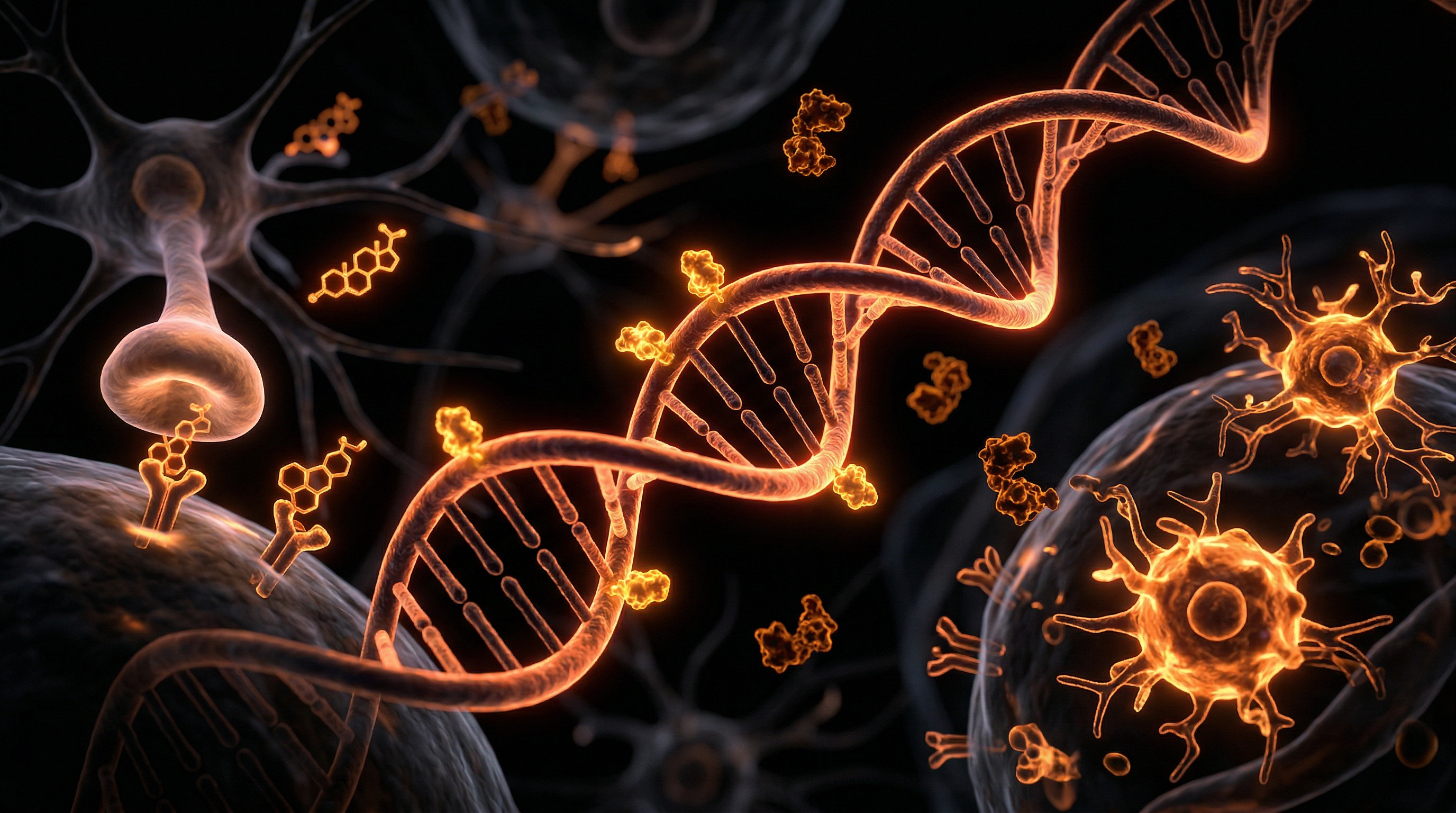
GABA-A Receptor Allosteric Modulation: The Role of Neuroactive Steroids in PMDD Pathophysiology
An in-depth exploration of the neurobiological mechanisms underlying Premenstrual Dysphoric Disorder (PMDD), specifically focusing on how the GABA-A receptor's sensitivity to neuroactive steroids like allopregnanolone drives severe mood symptoms.
# GABA-A Receptor Allosteric Modulation: The Role of Neuroactive Steroids in PMDD Pathophysiology
Introduction
Premenstrual Dysphoric Disorder (PMDD) is a severe, often debilitating neuroendocrine condition affecting approximately 3% to 8% of women and individuals with menstrual cycles. For decades, the prevailing misconception was that PMDD resulted from a simple 'hormonal imbalance'—the idea that patients suffered from too much or too little estrogen or progesterone. However, robust clinical evidence has debunked this. Research consistently demonstrates that individuals with PMDD have circulating hormone levels identical to those of asymptomatic controls.
The root cause of PMDD is not the quantity of hormones in the bloodstream, but rather a pathological cellular sensitivity within the central nervous system to the fluctuations of these hormones. Specifically, the focus has shifted to the interaction between neuroactive steroids (NAS), such as allopregnanolone, and the gamma-aminobutyric acid type A (GABA-A) receptor system. Understanding this relationship is critical to moving PMDD from the realm of 'vague psychological distress' to its rightful place as a complex neurobiological disorder.
The GABA-A Receptor: The Brain's Primary Braking System
To understand PMDD, one must first understand the GABA-A receptor. GABA is the primary inhibitory neurotransmitter in the human brain. Its role is to reduce neuronal excitability, acting as a 'brake' on the nervous system to maintain emotional and physiological stability. The GABA-A receptor is a pentameric ligand-gated ion channel; when GABA binds to it, the channel opens, allowing chloride ions to flow into the neuron. This influx of negative charge hyperpolarizes the cell, making it less likely to fire an action potential, thereby producing a calming, anti-anxiety, and sedative effect.
In a healthy neurobiological state, the GABA-A system is highly plastic. It adapts to various internal and external stimuli to maintain homeostasis. In PMDD, however, this adaptive mechanism appears to be broken.
Neuroactive Steroids: The Allopregnanolone Factor
While progesterone is a reproductive hormone, its metabolites function as neuroactive steroids (NAS) that directly influence brain activity. During the luteal phase of the menstrual cycle (after ovulation), progesterone levels rise. A significant portion of this progesterone is converted by the enzymes 5ʹ-reductase and 3ʹ-hydroxysteroid dehydrogenase into allopregnanolone (ALLO).
ALLO is a potent positive allosteric modulator (PAM) of the GABA-A receptor. Unlike a direct agonist that binds to the same site as GABA, an allosteric modulator binds to a secondary site, changing the shape of the receptor to enhance its response to GABA. Under normal circumstances, ALLO is 'nature's Valium'—it makes the GABA-A receptor more efficient, leading to increased calm and reduced stress during the high-progesterone phase of the cycle.
The PMDD Paradox: When Calm Turns to Chaos
In individuals with PMDD, the brain's response to allopregnanolone is paradoxical. Instead of providing a sedative effect, the rise of ALLO in the luteal phase triggers symptoms of irritability, anxiety, and depression. This is the 'allosteric modulation' gone wrong.
Research suggests that this paradox is rooted in the subunit composition of the GABA-A receptor. The receptor is made of five subunits (typically two ͱ, two Ͳ, and one ͳ or ʹ). The specific combination of these subunits determines how the receptor reacts to neurosteroids. In PMDD, evidence points toward an abnormal expression of the ͱ4 subunit. Receptors containing the ͱ4 subunit, especially when paired with the ʹ subunit, are less responsive to the typical inhibitory effects of GABA and may actually become more excitable in the presence of ALLO.
Furthermore, the 'switch' that should occur as ALLO levels fluctuate—the ability of the brain to upregulate or downregulate specific receptor subunits to maintain mood stability—fails. When ALLO levels drop precipitously at the end of the luteal phase (the 'withdrawal' period), the PMDD brain cannot adjust its receptor configuration quickly enough, leading to a state of GABAergic dysfunction and severe emotional volatility.
Root-Cause Dynamics: Sensitivity and Adaptation
This lack of 'receptor plasticity' is a defining feature of PMDD. While a neurotypical individual's brain perceives the rise and fall of allopregnanolone as a minor environmental shift, the PMDD brain perceives it as a neurological crisis. Studies using fMRI have shown that during the luteal phase, individuals with PMDD exhibit increased amygdala reactivity and altered connectivity in the prefrontal cortex in response to ALLO, directly correlating with the severity of their emotional symptoms.
This also explains why Selective Serotonin Reuptake Inhibitors (SSRIs) work differently for PMDD than for Major Depressive Disorder (MDD). In MDD, SSRIs often take weeks to change neurotransmitter levels and receptor expression. In PMDD, low-dose SSRIs can work almost immediately. This is because SSRIs, in this context, may act as Selective Brain Steroidogenic Stimulants (SBSSs), rapidly altering the local conversion of progesterone into allopregnanolone or modulating the GABA receptor's sensitivity to it, rather than just increasing serotonin levels.
New Frontiers in Treatment
Understanding the GABA-A/ALLO axis has paved the way for novel treatments that target the root cause rather than just masking symptoms. One such area of research involves GABA-A receptor modulators that aim to 'stabilize' the receptor's response to ALLO.
For example, sepranolone (UC1010) is a selective GABA-A receptor modulating antagonist that specifically blocks the negative effects of allopregnanolone on the GABA-A receptor without interfering with the receptor's basic inhibitory function. By preventing the 'paradoxical' effect of ALLO, such treatments offer hope for a targeted, non-hormonal, and non-psychotropic approach to managing PMDD.
Conclusion
PMDD is a complex disorder of allosteric modulation. It serves as a profound example of how the endocrine and nervous systems are inextricably linked. The suffering experienced by those with PMDD is not a result of 'hormones being out of balance,' but a highly specific molecular failure of the GABA-A receptor system to adapt to neurosteroid fluctuations. By focusing on the root cause—the interaction between neuroactive steroids and receptor subunits—we can move toward a future where PMDD is treated with the precision and biological respect it deserves.
This article is provided for informational and educational purposes only. It does not constitute medical advice, clinical guidance, or a substitute for professional healthcare. Information reflects cited research at time of publication. Always consult a qualified healthcare professional before acting on any health information.
RESEARCH FOUNDATIONS
Biological Credibility Archive
Citations provided for educational reference. Verify via PubMed or institutional databases.
Medical Disclaimer
The information in this article is for educational purposes only and does not constitute medical advice, diagnosis, or treatment. Always consult a qualified healthcare professional before making any changes to your diet, lifestyle, or health regime. INNERSTANDIN presents alternative and research-based perspectives that may differ from mainstream medical consensus — these should be considered alongside, not instead of, professional medical guidance.
Read Full DisclaimerReady to learn more?
Continue your journey through our classified biological research.
RABBIT HOLE
Follow the biological thread deeper