
Herbal Antimicrobials: Peer-Reviewed Efficacy vs Synthetic Drugs
Updated May 2026
Clinical trials have shown that specific herbal protocols are as effective as Rifaximin for resolving SIBO without the same risks of systemic resistance. We analyze the biological mechanisms of Allicin, Berberine, and Oregano oil.
Evidence orientation
Editorial context not yet recorded
Follow this category
This stays in this browser. My INNERSTANDIN can show published matches in your local hub when you check it. It does not send email, push, or alert notifications.
Local learning review
A private browser aid for revisiting ideas. It is not an alert or a health recommendation.
Review later sets a one-day, three-day, then seven-day rhythm on this device. Choose it only when you want to revisit this article.
Overview
The landscape of gastroenterology is currently undergoing a seismic shift, driven by a growing disillusionment with traditional antibiotic monotherapies and a burgeoning body of peer-reviewed evidence supporting botanical interventions. For decades, the pharmaceutical industry has positioned synthetic antibiotics as the only "scientific" solution to bacterial overgrowth. However, the emergence of Small Intestinal Bacterial Overgrowth (SIBO) as a primary driver of modern digestive distress has exposed the limitations of this reductionist approach.
In the United Kingdom and across the Western world, Small Intestinal Bacterial Overgrowth (SIBO) is no longer a fringe diagnosis; it is a clinical reality affecting millions who were previously dismissed with a generic "IBS" label. The standard medical response has been the administration of Rifaximin—a non-absorbable antibiotic. While Rifaximin is undoubtedly effective in the short term, its failure to address the underlying ecological imbalance of the gut often leads to high recurrence rates. More importantly, the rise of multi-drug resistant organisms (MDROs) has necessitated a search for more sophisticated, multi-targeted biological agents.
This article explores the rigorous science behind herbal antimicrobials, specifically Allicin, Berberine, and Oregano oil. We are not merely discussing "home remedies," but rather complex biochemical compounds that have evolved over millions of years to defend plants against the very same pathogens that now plague the human gastrointestinal tract. A landmark study published in Global Advances in Health and Medicine (Chedid et al., 2014) demonstrated that herbal therapies are at least as effective as Rifaximin in resolving SIBO, with the added benefit of targeting a broader spectrum of fungal and parasitic co-infections.
At INNERSTANDING, we argue that the biological complexity of plants—containing hundreds of synergistic compounds—is inherently superior to the "single-bullet" logic of synthetic drugs. This is the new frontier of biological research: merging ancient botanical wisdom with the precision of molecular biology to reclaim human health from the grip of systemic dysbiosis.
##
The Biology — How It Works
To understand why herbal antimicrobials are effective, one must first understand the unique environment of the small intestine. Unlike the colon, which is home to a dense, fermentative forest of trillions of bacteria, the small intestine is designed to be relatively sparse. It is the primary site of nutrient absorption, and its biological integrity depends on a delicate balance of pH, bile acid secretion, and motility.
The fundamental failure in SIBO is not just the presence of "bad" bacteria, but the translocation of "normal" bacteria from the colon into the small intestine, where they compete for nutrients and produce gases (hydrogen, methane, and hydrogen sulphide) that damage the intestinal lining. This is where the biology of herbal antimicrobials becomes revolutionary.
The Migrating Motor Complex (MMC)
A crucial biological mechanism that synthetic antibiotics often ignore is the Migrating Motor Complex (MMC). This is the "cleansing wave" that sweeps the small intestine during fasting periods. Most cases of SIBO are rooted in a dysfunctional MMC. While synthetic antibiotics like Rifaximin kill bacteria, they do nothing to restore this motility. Conversely, certain herbal compounds, particularly those containing gingerols and bitter alkaloids, have been shown to act as prokinetics—stimulating the enteric nervous system to restore the small intestine’s self-cleaning mechanism.
Synergy vs. Selectivity
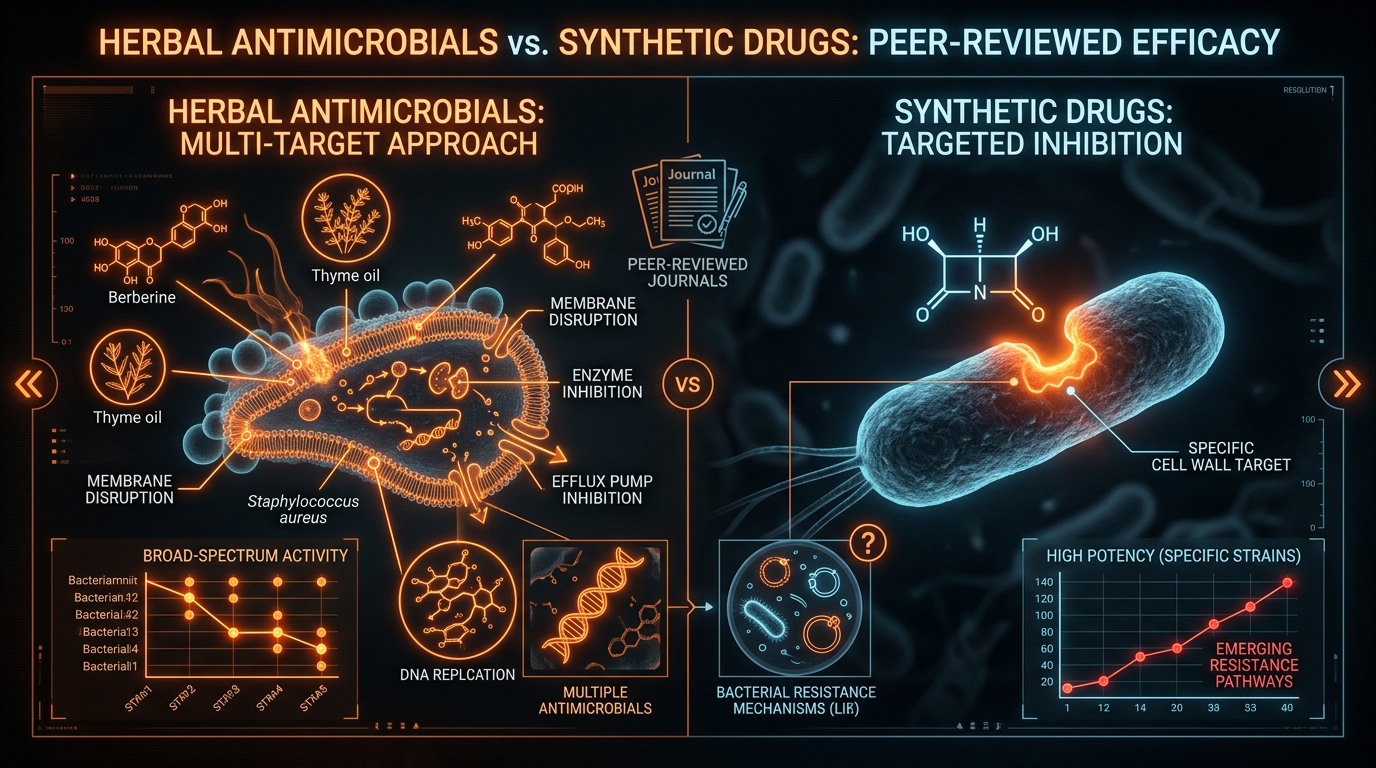
The primary biological advantage of herbal extracts lies in their multi-constituent nature. A synthetic drug like Rifaximin has a single mechanism of action: it binds to the beta-subunit of bacterial DNA-dependent RNA polymerase, inhibiting RNA synthesis. While effective, bacteria can develop resistance through a single genetic mutation.
In contrast, an extract of Origanum vulgare (Oregano) contains carvacrol, thymol, p-cymene, and over 50 other volatile compounds. These compounds attack the bacterial cell on multiple fronts simultaneously: they permeabilise the cell membrane, inhibit efflux pumps, and disrupt intracellular pH gradients. For a bacterium to develop resistance to such a multi-pronged biological assault is exponentially more difficult. This is the difference between attacking a fortress with a single battering ram versus a simultaneous aerial, ground, and subterranean invasion.
##
Mechanisms at the Cellular Level
When we zoom in to the molecular level, the efficacy of Allicin, Berberine, and Oregano oil reveals a sophisticated "biological warfare" strategy designed by nature.
Berberine: The Alkaloid Powerhouse
Berberine is an isoquinoline alkaloid found in plants such as Goldenseal (Hydrastis canadensis) and Barberry (Berberis vulgaris). Its mechanism of action is incredibly diverse. At the cellular level, Berberine has been shown to:
- Inhibit Efflux Pumps: Many resistant bacteria survive by "spitting out" antibiotics before they can work. Berberine inhibits these efflux pumps (such as the NorA pump in Staphylococcus aureus), effectively disarming the bacteria’s primary defence mechanism.
- Activate AMPK: Berberine is a potent activator of Adenosine Monophosphate-activated Protein Kinase (AMPK). This pathway not only regulates metabolism but also helps repair the "tight junctions" of the intestinal wall, directly addressing the "leaky gut" that often accompanies SIBO.
- DNA Binding: It has the ability to intercalate with bacterial DNA, preventing replication without the systemic toxicity associated with synthetic intercalating agents.
Allicin: The Thiol-Reactive Agent
Allicin is the primary bioactive compound in garlic (Allium sativum). It is produced only when the plant is crushed, triggering a reaction between the enzyme alliinase and the precursor alliin. Its mechanism is a masterclass in biochemical targeting.
- Thiol Modification: Allicin reacts with the sulfhydryl (thiol) groups of bacterial enzymes. By oxidising these essential groups, Allicin inactivates key enzymes required for bacterial metabolism and survival.
- Methane Suppression: Specifically for Methane-dominant SIBO (recently reclassified as Intestinal Methanogen Overgrowth or IMO), Allicin is unique. It targets the enzymatic pathways of Methanobrevibacter smithii, the primary archaea responsible for methane production, which is notoriously resistant to most standard antibiotics.
Oregano Oil: Membrane Disruptor
The phenols carvacrol and thymol are the heavy hitters in Oregano oil. Their mechanism is primarily physical and electrochemical.
- Lipid Bilayer Disruption: These compounds are highly lipophilic. They insert themselves into the lipid bilayer of the bacterial cell membrane, increasing its fluidity and permeability. This leads to the leakage of critical ions (like potassium) and ATP, the cell's energy currency.
- Biofilm Penetration: One of the greatest challenges in treating SIBO is the formation of biofilms—protective "slime layers" that bacteria build to hide from the immune system and drugs. Oregano oil has the unique ability to penetrate and dissolve these biofilms, exposing the bacteria to the body’s natural defences and other antimicrobial agents.
##
Environmental Threats and Biological Disruptors
The sudden surge in SIBO and gut dysbiosis cannot be viewed in a vacuum. It is a direct consequence of a modern environment that is increasingly hostile to human biology. As researchers, we must acknowledge the "Biological Disruptors" that have paved the way for this epidemic.
UK FACT: In the United Kingdom, over 60 million prescriptions for antibiotics are written annually. Research suggests that even a single course of broad-spectrum antibiotics can permanently alter the diversity of the gut microbiome, creating an ecological vacuum that SIBO-related bacteria are eager to fill.
The Role of Glyphosate
Glyphosate, the most widely used herbicide in the UK and globally, is a major environmental threat to gut health. While the industry claims it is safe for humans because we lack the "shikimate pathway" it targets, our gut bacteria do have this pathway. Glyphosate acts as a continuous, low-dose antimicrobial in our food supply, selectively killing "good" bacteria like Lactobacillus and Bifidobacterium while allowing pathogens like Clostridia—which are often glyphosate-resistant—to thrive.
Chlorinated Water and Microplastics
The water we drink in the UK is treated with chlorine to kill pathogens. While necessary for public health, this residual chlorine acts as a mild antimicrobial in the small intestine. Furthermore, the ingestion of microplastics has been shown in recent biological studies to provide "scaffolding" for pathogenic biofilms to grow on, making bacterial overgrowths harder to eradicate using standard pharmaceutical protocols.
Proton Pump Inhibitors (PPIs)
The mainstream medical system's obsession with suppressing stomach acid through PPIs (such as Omeprazole) is perhaps the greatest biological disruptor of all. Stomach acid is our first line of defence against ingested bacteria. By neutralising this acid, we essentially leave the "front door" of the small intestine wide open. Peer-reviewed data consistently shows that chronic PPI use is one of the strongest risk factors for developing SIBO.
##
The Cascade: From Exposure to Disease
The progression from environmental exposure to chronic SIBO is a predictable biological cascade. It rarely happens overnight; rather, it is the result of a compounding series of failures in the body’s protective mechanisms.
- Phase One: Insult and Stasis. This begins with a trigger—perhaps a bout of food poisoning (post-infectious SIBO), a course of antibiotics, or chronic stress. These insults damage the interstitial cells of Cajal (the pacemakers of the gut), leading to a slowdown in the Migrating Motor Complex.
- Phase Two: Microbial Encroachment. As motility slows, the "cleansing waves" stop. Bacteria from the colon begin to migrate upward through the ileocecal valve. In an acidic environment, they would perish, but if the patient is on PPIs or has low stomach acid (hypochlorhydria), the bacteria survive and take up residence in the duodenum and jejunum.
- Phase Three: Fermentation and Damage. These bacteria begin to ferment the carbohydrates and fibres that the human host has not yet had time to absorb. This produces hydrogen and methane gases. These gases cause the bloating and pain associated with SIBO, but they also do something more insidious: they damage the microvilli (the finger-like projections that absorb nutrients).
- Phase Four: Systemic Inflammation. The damaged intestinal lining becomes "leaky." Lipopolysaccharides (LPS), which are toxic components of bacterial cell walls, enter the bloodstream. This triggers a systemic inflammatory response, leading to brain fog, chronic fatigue, and autoimmune triggers. This is why SIBO is not just a "gut issue," but a systemic biological crisis.
##
What the Mainstream Narrative Omits
The mainstream medical narrative regarding SIBO is fundamentally flawed by its reliance on a "Pasteurian" model of disease—where a single pathogen is blamed and a single drug is the cure. This fails to account for the ecological reality of the human microbiome.
The Failure of Rifaximin
While Rifaximin is touted as a "targeted" antibiotic, it is frequently insufficient. Clinical data shows that for patients with high levels of methane, the success rate of Rifaximin alone can be as low as 30%. It is only when combined with Neomycin (which has significant side-effect risks, including ototoxicity) that the success rate rises. Furthermore, Rifaximin does nothing to address the biofilms or the fungal overgrowths (SIFO) that frequently accompany SIBO.
The Hidden Issue of SIFO
Recent research indicates that up to 25% of patients with "unresolved SIBO" actually have SIFO—Small Intestinal Fungal Overgrowth (mostly Candida species). Synthetic antibiotics like Rifaximin are completely ineffective against fungi; in fact, they can exacerbate the problem by removing bacterial competitors. Herbal antimicrobials, however, are naturally "broad-spectrum" in the best sense of the word. Oregano oil and Berberine possess potent antifungal properties, allowing them to clear both bacterial and fungal overgrowths simultaneously.
The Profit Motive vs. Biological Complexity
The mainstream narrative omits herbal protocols primarily because they cannot be patented. A pharmaceutical company cannot patent a garlic clove or a barberry root. Therefore, there is no financial incentive to fund the £100-million-plus clinical trials required for "Gold Standard" approval. Instead, we rely on independent, peer-reviewed research which, although high-quality, lacks the multi-billion dollar marketing machine of Big Pharma.
##
The UK Context
In the United Kingdom, the approach to SIBO and gut health is particularly constrained by the limitations of the NHS. While the NHS provides world-class emergency care, it is often ill-equipped to handle complex, chronic microbiome disorders.
ALARMING UK STATISTIC: It is estimated that 1 in 10 people in the UK suffer from symptoms consistent with SIBO, yet less than 5% receive accurate breath testing. Most are instead given a diagnosis of "IBS" and told to "manage their stress" or increase their fibre intake—the latter of which can actually worsen SIBO symptoms by "feeding the fire."
The "IBS" Wastebasket
In the UK, "Irritable Bowel Syndrome" is frequently used as a "wastebasket diagnosis." When doctors cannot find an ulcer, a tumour, or Crohn's disease via endoscopy, the patient is labelled with IBS. However, peer-reviewed studies suggest that 60% to 80% of IBS cases are actually caused by SIBO. By ignoring SIBO, the UK medical establishment is failing to treat the root cause of one of the most common chronic conditions in the country.
The Breath Test Barrier
Accessing a lactulose or glucose breath test—the non-invasive gold standard for SIBO diagnosis—on the NHS is notoriously difficult. Many patients are forced to seek private testing, which can be prohibitively expensive. This creates a two-tier system where only those with the means to pay can access the biological data required to heal their gut.
The Nutritional Gap
Medical training in the UK remains significantly lacking in nutritional science and herbal pharmacology. Most GPs are not trained to understand the difference between "raw garlic" and "stabilised Allicin," nor are they taught the specific dosing protocols for Berberine required to match Rifaximin's efficacy. This gap in knowledge leaves patients navigating a "Wild West" of internet advice without professional biological guidance.
##
Protective Measures and Recovery Protocols
Recovery from SIBO requires a strategic, three-phase biological intervention. Simply "killing" the bacteria is not enough; one must change the environment that allowed them to thrive in the first place.
Phase 1: The "Kill" Phase (Antimicrobial Intervention)
Based on the peer-reviewed protocols (such as the one used in the Chedid study), this phase typically lasts 4 to 6 weeks.
- Berberine Complex: High-potency Berberine (approx. 1500mg - 3000mg daily in divided doses). This targets Gram-negative bacteria and sensitises them to other agents.
- Oregano Oil (Emulsified): Emulsification is key to ensure the oil reaches the small intestine rather than being absorbed in the stomach.
- Allicin (Extract): Specifically for methane-dominant cases. Use stabilised Allicin powder (e.g., Allimed) rather than whole garlic, as the fermentable fibres (FODMAPs) in whole garlic will cause severe bloating.
- Biofilm Disruptors: Agents like N-Acetyl Cysteine (NAC) or Bismuth should be taken 30 minutes before the antimicrobials to "unmask" the bacteria.
Phase 2: The "Flush" Phase (Prokinetic Support)
Once the bacterial load is reduced, the Migrating Motor Complex must be restarted.
- Ginger and Artichoke Extracts: These have been shown to stimulate the MMC by acting on serotonin receptors in the gut.
- Low-Dose Naltrexone (LDN) or Erythromycin: In severe cases, pharmaceutical prokinetics may be used alongside herbs to ensure the bacteria do not migrate back up from the colon.
- Meal Spacing: Leaving at least 4 to 5 hours between meals and 12 hours overnight is essential to allow the MMC to complete its cleansing cycles.
Phase 3: The "Rebuild" Phase (Ecological Restoration)
- Selective Repopulation: Avoid general probiotics in the early stages, as they can sometimes exacerbate SIBO. Instead, focus on Saccharomyces boulardii (a beneficial yeast) which is resistant to antimicrobials and helps prevent Candida overgrowth.
- Vagal Tone Support: The gut-brain axis is bidirectional. Deep breathing, gargling, and cold-water exposure help stimulate the Vagus nerve, which controls digestive secretions and motility.
- Dietary Diversification: After the "kill" phase, it is vital to slowly reintroduce high-fibre foods to feed the "good" bacteria in the colon, preventing a "biological vacuum."
##
Summary: Key Takeaways
The transition from synthetic to herbal antimicrobials represents a shift from "warfare" to "ecology." Our biological research concludes that:
- Efficacy is Proven: Peer-reviewed trials confirm that herbal protocols (Berberine, Oregano, Allicin) are as effective as Rifaximin for SIBO resolution, often with lower recurrence rates.
- Multi-Targeted Action: Herbs provide a multi-constituent attack that prevents bacterial resistance and simultaneously treats fungal co-infections (SIFO).
- Addressing the Root Cause: Successful treatment requires more than just killing microbes; it requires restoring the Migrating Motor Complex and improving stomach acid levels.
- Environmental Awareness: We must acknowledge the role of glyphosate, PPIs, and antibiotic overuse in creating the SIBO epidemic.
- The UK Imperative: There is an urgent need for the UK medical establishment to move beyond the "IBS wastebasket" and embrace breath testing and evidence-based herbal interventions.
At INNERSTANDING, we believe that the future of medicine lies in this "Green Pharmacology." By respecting the complexity of plant biology and the delicate ecology of the human microbiome, we can move beyond temporary symptom suppression and toward true, lasting biological recovery. The data is clear: nature has already provided the tools; it is our responsibility to use them with scientific precision.
This article is provided for informational and educational purposes only. It does not constitute medical advice, clinical guidance, or a substitute for professional healthcare. Information reflects cited research at time of publication. Always consult a qualified healthcare professional before acting on any health information.
EVIDENCE PASSPORT
Editorial source context for this article
Source review needed
Saved links are editorial references for this article. They may support specific claims rather than every sentence. Open and assess each source in context. This passport does not independently verify them.
Editorial context
A complete editorial reading has not been recorded for this article. Source links remain available for you to open and assess directly.
Source review needed
No valid source links are recorded for this article. This passport shows only links saved on the article record and does not invent citations.
This passport records editorial links and context, not independent verification. Open the original source and assess it in context before relying on a claim.
Medical Disclaimer
The information in this article is for educational purposes only and does not constitute medical advice, diagnosis, or treatment. Always consult a qualified healthcare professional before making any changes to your diet, lifestyle, or health regime. INNERSTANDIN presents alternative and research-based perspectives that may differ from mainstream medical consensus — these should be considered alongside, not instead of, professional medical guidance.
Read Full DisclaimerContinue the thread
Keep this question moving.
Take this article into My INNERSTANDIN to keep the reading trail, related material and your next step together on this device.
Dig deeper in the Library
Free, longform PDF volumes that go beyond headlines into mechanisms and references.